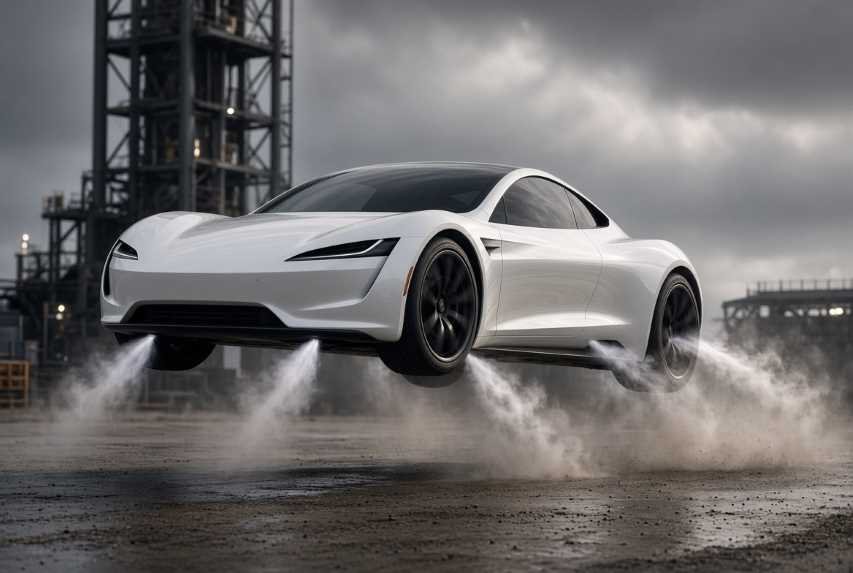
On October 15, 2026, at a SpaceX rocket test facility in McGregor, Texas, Tesla CEO Elon Musk stood before an audience and declared that flying cars are real. Moments earlier, a remotely operated second-generation Tesla Roadster had driven up a curved ramp, clung to the underside using underbody suction fans, launched into the air, executed a barrel roll, and landed on its wheels. Later it hopped over a line of parked Tesla vehicles. The maneuvers were powered by cold-gas thrusters fed by high-pressure compressed air or nitrogen stored in carbon-overwrapped pressure vessels (COPVs)—technology developed with SpaceX. Musk described the result as the collaboration of “the world’s best car company and the world’s best rocket company.” Production is targeted for 2028.
The demonstration was theatrical and technically impressive as a stunt. It was not sustained flight, not an electric vertical takeoff and landing (eVTOL) aircraft, and not a commercially available flying car. The version capable of leaving the ground is an invite-only, single-seat “Rocket” configuration that Tesla’s own materials note is not approved for public road use. Musk himself stated that the vehicle is “not necessarily a safety-optimized car” and that he was “not sure it’s necessarily legal in all jurisdictions.” Success, he added, was “not guaranteed.”
This event crystallizes the tension surrounding the idea of a Tesla flying car. For years, enthusiasts, investors, and futurists have speculated about whether Tesla’s battery, motor, software, and manufacturing strengths could extend into the air. The October 2026 demonstration answered one narrow question—can a Tesla sports car briefly leave the ground using rocket-style thrusters?—while leaving the larger questions of practical, safe, affordable, and legal personal flight largely unanswered. Those questions sit at the intersection of automotive engineering, aerospace certification, battery physics, urban airspace management, and economics.
What Is a Tesla Flying Car?
The phrase “Tesla flying car” currently refers to at least three distinct concepts, only one of which has any documented connection to Tesla:
A road-and-air vehicle capable of driving legally on public roads and also flying when needed. This is the classic “flying car” idea pursued by various independent developers for decades.
An electric flying vehicle designed primarily for short-distance passenger transport, typically using vertical takeoff and landing. These are the eVTOL air taxis under development by specialized companies.
A Tesla-branded aircraft or hybrid vehicle that incorporates Tesla-style electric motors, batteries, software, autonomy features, connectivity, and design language.
The demonstrated Roadster most closely matches a limited version of the first category for brief hops, but it is not optimized for either efficient road travel or practical flight. Engineering a vehicle that must meet automotive crash standards, road regulations, weight limits, and everyday durability while also satisfying aircraft weight, center-of-gravity, redundancy, and flight-control requirements is exceptionally difficult. A car optimized for roads is usually too heavy, has the wrong shape, and lacks the structural margins and systems redundancy expected of passenger aircraft. Conversely, an efficient aircraft is rarely practical or legal as a daily road vehicle.
These remain conceptual categories. Tesla has not published specifications, a development program, or a product roadmap for a dedicated flying vehicle beyond the thruster package on the Roadster.
Is Tesla Really Developing a Flying Car?
As of mid-October 2026, Tesla has not announced a formal flying-car or eVTOL development program. There is no official product page, technical paper, investor presentation, or regulatory filing describing a dedicated Tesla aircraft. No verified Tesla flying-car prototype intended for sustained flight has been demonstrated. There is no reservation program, price, or production timeline for a personal electric aircraft from Tesla.
What exists is the long-delayed second-generation Roadster, first shown as a concept in 2017 and now demonstrated with SpaceX-derived cold-gas thrusters. The thrusters use stored compressed gas expanded through nozzles; they are not electric motors turning propellers or rotors. The system can generate substantial short-duration thrust (reports indicate figures exceeding 80 kN in certain configurations) for acceleration, attitude control, and brief airborne maneuvers. Refilling the large onboard tanks reportedly takes hours in current form, though Tesla has indicated interest in faster systems. The Rocket variant is invite-only; the more widely offered Performance and Thrust variants focus on road performance, with the Thrust version adding rear thrusters for sub-one-second 0-60 mph acceleration claims.
Claims and images circulating online should be treated cautiously. The October 15 demonstration was real and livestreamed. Many earlier “Tesla flying car” concepts, renders, and videos were independent designs, AI-generated imagery, or speculative fan content. The distinction matters: a thruster-assisted sports car capable of short stunts is not the same as a practical personal aircraft.
Elon Musk has previously expressed skepticism about flying cars. In 2014 and again in 2017 he argued they would be noisy, generate strong downdrafts, alter skylines, and create anxiety because of the risk of falling debris (his memorable “hubcap guillotine” comment). He favored tunnels and underground transit as more scalable solutions for urban congestion. The Roadster thruster package represents a shift for a specialized high-performance vehicle rather than a reversal of that broader view.
Elon Musk’s Vision and Tesla’s Technological Philosophy
Musk’s public transportation priorities have centered on electric vehicles, autonomy, battery cost and performance, and high-volume manufacturing. Tesla has developed high-power-density electric motors, sophisticated battery management and thermal systems, vehicle software, over-the-air updates, sensor suites for driver assistance, and manufacturing automation. These strengths are real and relevant to electric aircraft in principle.
High-performance electric motors and power electronics can transfer. Battery management expertise is valuable. Software and AI capabilities could support flight-control assistance or future autonomy. However, passenger aircraft demand fundamentally different engineering: extreme reliability and redundancy, lightweight structures optimized for flight loads rather than crashworthiness, certification under aviation authorities, pilot (or remote-operator) training standards, and maintenance regimes governed by airworthiness rules. Automotive crash standards and aviation airworthiness standards are not interchangeable.
SpaceX’s involvement is limited, in documented form, to the cold-gas thruster technology for the Roadster. SpaceX is a launch and satellite company, not an aircraft manufacturer. Activities of Tesla, SpaceX, and any other Musk-associated company should be evaluated separately.
How Could a Hypothetical Tesla Electric Flying Vehicle Work?
Any practical electric flying vehicle—Tesla-branded or otherwise—would face well-understood physics and engineering constraints.
Electric propulsion for aircraft typically uses electric motors driving propellers or rotors. Distributed electric propulsion (multiple smaller rotors or propellers) can improve redundancy, reduce noise, and allow novel configurations. Road-vehicle motors prioritize continuous power for acceleration and cruising under tire friction; aircraft motors must deliver high power for vertical lift or takeoff and efficient power for cruise. Hovering or vertical takeoff consumes far more energy per unit time than efficient forward flight.
Batteries remain the central limitation. Current lithium-ion packs achieve roughly 220–280 Wh/kg at pack level in high-performance applications, with higher figures at the cell level. Practical urban eVTOL missions with regulatory reserves typically require higher effective energy density—often discussed in the 300+ Wh/kg pack range for useful range and payload. Takeoff and hover demand high power (high C-rates); cruise requires energy capacity; landing and reserves add further demands. Battery weight directly reduces payload or range. Thermal management is critical because high-power operation generates heat. Charging infrastructure for high-utilization aircraft must support rapid turnaround, which stresses cells and cooling systems. Simply installing a large automotive battery pack does not create a practical aircraft; weight, power delivery, and certification requirements differ.
Design features commonly explored for electric aircraft include multiple rotors or propellers for redundancy, lightweight composite structures, aerodynamic efficiency in cruise, and systems for controlled emergency landing or glide. Folding wings or rotors appear in some dual-mode concepts. These are industry approaches, not confirmed Tesla designs.
Autonomy is another domain. Automotive driver-assistance systems operate in a two-dimensional road environment with visual cues, maps, and relatively constrained failure modes. Certified autonomous aircraft operation in complex urban airspace requires orders-of-magnitude higher reliability, redundant sensors and computers, robust communication, precise navigation independent of GPS in some failure cases, and fail-safe modes that protect both occupants and people on the ground. Regulatory approval for such systems is a multi-year process.
Charging and maintenance for a future network would require dedicated landing sites (vertiports or similar), high-power charging, trained technicians following aviation standards, and software for fleet management. Roadside charging and automotive service centers are not equivalent.
Tesla Flying Car vs. Tesla Electric Cars
Dimension | Current Tesla Road Vehicles (e.g., Model 3/Y, Cybertruck, etc.) | Hypothetical Practical Flying Vehicle / Demonstrated Roadster Thruster Package |
Primary function | Road transportation | Brief aerial maneuvers (demonstrated); sustained flight (hypothetical) |
Practical operating distance | Hundreds of km on a charge | Minutes of thrust / short hops (demonstrated); limited range with reserves (hypothetical eVTOL-style) |
Energy consumption | Optimized for rolling resistance and drag | Very high during hover/takeoff; lower in efficient cruise |
Battery requirements | High energy for range; moderate power | Extreme power for lift + high energy + reserves; weight critical |
Passenger capacity | 4–6+ typical | 1–5 depending on design (Roadster Rocket: 1) |
Travel environment | Roads, highways | Airspace; designated sites |
Purchase price | Tens to low hundreds of thousands USD (varies by model) | Likely hundreds of thousands to millions USD (illustrative; no official Tesla price) |
Operating/maintenance costs | Relatively low for EVs | High (aviation-grade parts, inspections, insurance) |
Parking/storage | Standard or home charging | Specialized landing and storage facilities |
Charging infrastructure | Widespread public and home | Limited high-power sites at landing areas |
Safety requirements | Automotive crash standards | Aviation airworthiness, redundancy, emergency procedures |
Licensing | Driver’s license | Pilot certificate or equivalent (likely for flight) |
Environmental impact | Low local emissions; depends on electricity mix | Zero local emissions; energy-intensive; manufacturing impacts |
Commercial availability | Available | Not available (Roadster thruster version invite-only, not road-approved for flight) |
All flying-vehicle entries are estimates or illustrative. No official Tesla flying-car specifications exist beyond the demonstrated thruster system.
Tesla Flying Car vs. Existing Flying Vehicle Companies
Specialized companies are further along in developing purpose-built electric aircraft:
Joby Aviation (S4): Piloted eVTOL in advanced FAA certification (Stage 5 / Type Inspection Authorization as of late 2026). Demonstration flights conducted; no FAA type certificate and no paying passenger service yet. Partnerships include Dubai plans.
Company / Vehicle | Propulsion | Intended Use | Passengers | Range (reported/expected) | Status (as of Oct 2026) | Challenges |
Joby S4 | Distributed electric | Urban air taxi | 4 + pilot | ~100+ miles class | Advanced FAA testing; no type cert yet | Certification, infrastructure |
Archer Midnight | Electric | Urban air taxi | 4 + pilot | ~100 miles class | FAA Phase 4; testing ongoing | Certification, competition |
EHang EH216-S | Electric multicopter | Sightseeing / short hops | 2 (pilotless) | ~20–30+ km class | CAAC certified; commercial rollout delayed | Regulatory caution, scale |
Tesla Roadster (Rocket) | Cold-gas thrusters + electric | Performance stunts / road | 1 | Minutes of thrust | Demonstrated; production target 2028; not aircraft-certified | Regulation, limited practicality, safety |
Archer Aviation (Midnight): Progressing through FAA phases (Phase 4 reported). Piloted flights demonstrated; certification ongoing. UAE partnerships.
EHang (EH216-S): Pilotless eVTOL with Chinese CAAC certification. Trial operations and some operator certificates exist, but public ticketed commercial service has faced delays and regulatory caution.
Vertical Aerospace and others: Various stages of development and testing.
Tesla’s potential advantages would lie in battery scale, manufacturing cost reduction, software, brand, and capital. Dedicated aerospace firms hold deeper expertise in flight controls, structures, certification processes, and operational safety. No evidence shows Tesla currently competing in the eVTOL certification race.
Potential Price of a Tesla Flying Car
No official Tesla price exists for a flying vehicle. Illustrative scenarios based on comparable aircraft and engineering complexity (all figures in USD, 2026 context, approximate and subject to change):
Entry-level personal electric aircraft (limited capability, light-sport or experimental pathway): $150,000–$400,000 manufacturing-influenced retail range possible in volume, but certification and low volume raise prices.
Premium personal flying vehicle or early air-taxi equivalent: $500,000–$1.5 million or higher.
Complex dual-mode road-and-air vehicle: Potentially $1 million+, driven by dual certification, materials, and systems.
Factors include battery cost and capacity, propulsion redundancy, aerospace materials, flight controls, certification expenses, low initial production volumes, insurance, and infrastructure. Manufacturing cost is lower than retail price once volume and margins are considered. Ownership costs (insurance, maintenance, training, landing fees, battery replacement) substantially exceed those of a conventional electric car and can approach or exceed those of small helicopters or private aircraft. Commercial air-taxi services, if they materialize, aim for per-trip pricing competitive with premium ground transport on short routes, but this depends on utilization and regulation.
Could Ordinary People Afford One?
Mass-market affordability is unlikely in the near or medium term. Aerospace certification, liability, insurance, pilot or operator training, specialized maintenance, and infrastructure create high fixed costs. Financing and leasing can lower barriers for businesses and high-net-worth individuals. Shared air-mobility services (air taxis) are a more plausible early pathway than private ownership for middle-income households. In the United States and Europe, early users would likely be affluent individuals, corporations, or emergency services. In developing economies, cost, regulation, and infrastructure gaps would be larger. Volume production can reduce unit costs, but safety and certification requirements limit how far and how fast prices can fall relative to cars.
Safety: Can a Flying Car Be as Safe as a Tesla on the Road?
Aviation safety philosophy emphasizes redundancy, fail-safe design, rigorous certification, and trained operators because failures in the air have limited recovery options. Automotive systems focus on crash protection and driver assistance. These approaches are not directly transferable.
Key challenges include motor or thruster failure, battery thermal runaway or power loss, rotor or propeller damage, weather (wind, turbulence, icing), navigation or software faults, midair collision risk, bird strikes, cybersecurity, maintenance errors, and ground risk to people and buildings. Emergency landing capability, multiple independent systems, predictive maintenance, and independent certification are essential. The Roadster demonstration itself was performed without a human occupant “to make sure we don’t kill anyone,” underscoring the current developmental stage. Musk has previously highlighted the anxiety created by objects flying overhead.
A future Tesla-branded aircraft could leverage software monitoring and over-the-air updates, but these would need to meet aviation standards, not merely automotive ones. Road safety records do not imply equivalent flight safety.
Regulations and Legal Challenges
Road-legal and airworthy are separate statuses. In the United States, the FAA regulates aircraft and airspace. As of October 16, 2026, the FAA stated that the Tesla Roadster does not meet its definition of an aircraft. Any vehicle that operates as an aircraft would fall under FAA rules for certification, operations, and pilot qualifications (powered-lift category for many eVTOLs). The FAA has issued rules for powered-lift pilot certification and operations. Europe’s EASA has its own framework. Noise, privacy, landing-site approvals, liability, and insurance are additional hurdles. Approvals in one country do not automatically transfer.
In Egypt and the broader Middle East, operations would require approval from national aviation authorities (Egyptian Civil Aviation Authority or equivalents). Airspace management, urban planning, noise, and infrastructure would need to be addressed before routine services. The UAE has been actively engaging with eVTOL developers and targeting commercial air-taxi activity, illustrating one regional pathway. Cairo’s density, existing airspace, and infrastructure would present significant integration challenges. No assumption of automatic legality should be made.
Environmental Impact
Electric propulsion eliminates direct tailpipe emissions. Total impact depends on electricity generation mix, battery manufacturing and recycling (critical minerals), vehicle utilization and occupancy, flight distance, and infrastructure. Short urban flights can be energy-intensive per passenger-kilometer compared with efficient electric cars, buses, or trains on the same route. Noise is generally lower than helicopters but not zero. Lifecycle analysis is required; electric does not automatically equal greener in every scenario.
How Could Flying Cars Transform Cities?
In a labeled hypothetical scenario, designated landing sites could enable faster airport transfers, emergency medical transport, and selected business trips in congested cities (Cairo, New York, London, Dubai, Mumbai, Tokyo). Commute times on specific corridors could fall. Urban planning might incorporate rooftop or dedicated vertiports and smart-city airspace management.
Challenges include safety buffers, residual noise, airspace congestion, high infrastructure cost, accessibility, and risk to people on the ground. Flying vehicles would not eliminate road traffic; they would complement other modes on limited routes. Over-promising congestion relief is not supported by current evidence.
Economic and Industrial Impact
A successful program would affect automotive and aerospace manufacturing, battery and motor suppliers, semiconductors, AI and software firms, charging and vertiport operators, maintenance providers, insurers, and training organizations. Business models could include direct sales, leasing, air-taxi fleets, software subscriptions, and fleet management. Opportunities exist for suppliers and partners. Risks include regulatory delays, technical shortfalls, high costs, limited demand, and overinvestment. No specific financial forecasts are offered.
Social Consequences and Ethical Questions
Access could remain concentrated among wealthier users or commercial operators, raising equity questions. New jobs in piloting, maintenance, and operations would appear alongside training needs. Noise, privacy from aerial sensors, cybersecurity, and public acceptance are ongoing concerns. Emergency access might improve in some cases. Whether the technology becomes broadly accessible or stays premium depends on cost, regulation, and demonstrated safety.
Real-World Applications Beyond Private Transportation
Controlled uses—emergency medical transport, organ or supply delivery, search and rescue, disaster response, airport shuttles, and industrial inspection—may advance sooner than private ownership. These benefit from trained operators, defined routes, centralized maintenance, and clearer operating environments. Existing helicopter and emerging eVTOL demonstration programs illustrate partial precedents; full commercial scale remains limited.
When Could a Tesla Flying Car Become Reality?
Near term (already underway): Continued eVTOL certification and limited demonstration or early commercial operations by specialized companies; further Roadster thruster development and 2028 production target for the sports car.
Medium term: Expansion of certified electric air-taxi services on selected routes; specialized applications grow. Personal dual-mode vehicles remain constrained by physics, certification, and cost.
Long term: Advances in energy density (solid-state or other next-generation batteries), autonomy, and materials could expand practical personal electric flight. Integrated road-and-air vehicles stay among the hardest technical and regulatory problems.
Milestones required for any scaled flying vehicle include successful type certification, operational approvals, infrastructure build-out, pilot or operator training capacity, demonstrated safety records, and economic viability. No official Tesla launch date or reservation program for a dedicated flying car exists.
What Would Tesla Need to Succeed?
Aircraft engineering talent, aviation-grade batteries and propulsion, lightweight certified structures, flight-control software meeting aviation standards, extensive testing, type and production certification, manufacturing quality systems, supplier networks, landing and charging infrastructure, maintenance support, regulatory cooperation, competitive pricing, and proven demand. Tesla’s automotive strengths could accelerate certain elements (batteries, software, manufacturing scale). An aerospace division, partnership, or acquisition would likely be necessary for full aircraft development and certification. No verified evidence shows Tesla has committed to such a strategy beyond the Roadster thruster collaboration with SpaceX.
Frequently Asked Questions
- Is Tesla really making a flying car?
Tesla demonstrated a Roadster with SpaceX cold-gas thrusters capable of brief aerial maneuvers. It has not announced a dedicated flying-car or eVTOL program. - Has Elon Musk officially announced a Tesla flying car?
He has described the thruster-equipped Roadster in terms of flight capability and said “flying cars are real” in connection with the October 2026 demonstration. This refers to the demonstrated system, not a general personal aircraft product. - Does a Tesla flying car prototype exist?
A prototype Roadster performed short hops and flips in a controlled demonstration. It is not a certified or production flying car. - What would a Tesla flying car look like?
The demonstrated vehicle is a two-seat (or single-seat Rocket) sports car with thrusters. A practical aircraft would look different—more like existing eVTOL designs. - How much might a Tesla flying car cost?
No official price. Comparable early electric aircraft and the complexity of dual-mode vehicles suggest high six- or seven-figure USD prices in early production. Estimates only. - When could a Tesla flying car be available?
Roadster production is targeted for 2028. No timeline exists for a practical flying vehicle from Tesla. - Would it use Tesla batteries?
The demonstrated thrusters use stored compressed gas, not battery power for thrust. A future electric aircraft could use advanced batteries; no such product is confirmed. - Would it be fully autonomous?
The demonstration was remotely operated. Certified autonomous passenger flight requires extensive additional development and regulatory approval. - Could it drive on roads and fly through the air?
The Roadster is designed as a road vehicle with limited thruster capability. The flying version is not approved for public roads. True dual-mode operation faces major engineering and regulatory barriers. - How far could it travel on one charge?
For the thruster system: limited by stored gas volume (minutes of operation). For a hypothetical electric aircraft: dependent on battery density, payload, and mission—typically short urban ranges with reserves under current technology. - Would people need a pilot’s license?
For aircraft operations, yes under current frameworks (or an equivalent for powered-lift). Automotive driver’s licenses do not cover flight. - Would it be legal to fly over cities?
Only with specific regulatory approvals, designated routes or sites, and compliance with noise, safety, and airspace rules. Not automatically legal. - Could it operate in Egypt?
Only after approval by Egyptian aviation authorities, suitable infrastructure, and airspace management. No current pathway exists for the demonstrated vehicle. - Would a flying Tesla be safer than a helicopter?
Unknown. Any new aircraft must demonstrate safety through certification and operational experience. Helicopters have established (if imperfect) safety records under specific conditions. - Could flying cars reduce traffic congestion?
On limited corridors and with high utilization, they could offer alternatives. They will not eliminate road traffic. - Would an electric flying vehicle be environmentally friendly?
Zero local emissions, but total impact depends on electricity sources, manufacturing, utilization, and comparison with ground alternatives. - Which companies are already developing electric flying aircraft?
Joby Aviation, Archer Aviation, EHang, Vertical Aerospace, and others have documented programs at various stages of testing and certification. - Could an ordinary family afford a flying car?
Unlikely in the near term due to vehicle cost, training, insurance, maintenance, and infrastructure. Shared services are a more realistic early model.
Final Assessment
The idea of a Tesla flying car is technologically intriguing because Tesla has demonstrated mastery of high-performance electric propulsion, batteries, software, and manufacturing. The October 15, 2026 Roadster demonstration proved that cold-gas thrusters can enable brief, controlled airborne maneuvers on a sports-car platform. That is a real engineering achievement in a narrow domain.
It is not, however, evidence of an imminent practical flying car. Sustained, safe, affordable, and legal personal flight faces battery energy-density limits, the fundamental difficulty of dual-mode design, rigorous aviation certification, infrastructure requirements, high costs, and public-acceptance challenges that go well beyond developing another electric road car. Musk’s earlier skepticism about noise, falling debris, and scalability remains relevant to any vision of large numbers of vehicles in urban airspace.
What is known is limited: a thruster-equipped Roadster prototype exists and performed stunts; production of the road-focused versions is targeted for 2028; the flying configuration is restricted and uncertified as an aircraft. Everything beyond that—true eVTOL capability, dual-mode practicality, mass-market pricing, or widespread urban use—remains speculative.
Electric aviation is advancing through specialized companies pursuing certification for air-taxi and other applications. Those efforts, together with continued battery and autonomy progress, will determine whether flying vehicles eventually complement cars, trains, buses, and conventional aircraft on selected routes. The combination of physics, regulation, and economics suggests they will be a specialized tool rather than a universal replacement.
Would you trust an autonomous electric flying car for your daily commute, and how much would you be willing to pay for the ability to fly above traffic?
 |  |  |
 |  |  |