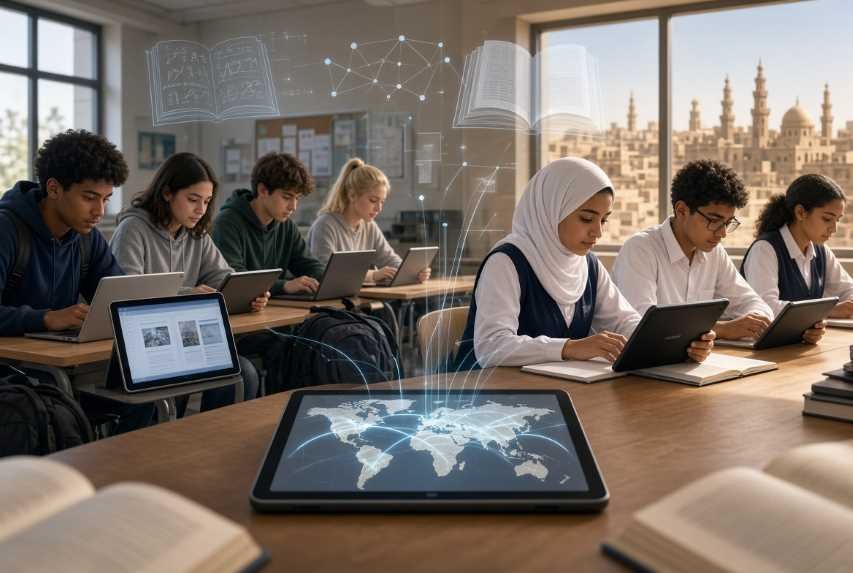
For most of the last century, a classroom had a recognizable shape. A teacher stood at a chalkboard. Students worked from printed textbooks. Assignments were written by hand, collected on paper, and marked in red ink. Knowledge moved slowly, from ministry printers to warehouses, then to schools, then to desks. A new edition could take years. A lost book was a real problem. A student who missed school often missed the lesson entirely.
That model has not disappeared. In much of the world it remains the daily reality. But it is no longer the only model. Over the past two decades, and especially since the COVID-19 school closures, governments, school systems, universities, teachers, parents, and students have treated digital devices as a normal part of learning. Laptops, tablets, learning platforms, digital textbooks, and online examinations have moved from pilot projects into national policy.
Tablets occupy a particular place in that shift. They are lighter than most laptops, larger than phones, and capable of holding textbooks, videos, quizzes, and communication tools in one device. A government can buy them in bulk and issue them to a grade. A district can load them with approved apps. A student can carry a term’s reading in a bag. For ministries trying to modernize examinations, reduce printing, or reach students outside the school building, the tablet looks like a practical instrument.
Interest is therefore widespread. Education ministries see a route to digital transformation. Schools see a way to update materials quickly. Teachers see multimedia they could not draw on a board. Parents hope for better preparation for a digital economy, and sometimes for less spending on printed books. Students often prefer a screen to a heavy stack of paper. Technology companies, meanwhile, have built entire education lines around school procurement.
The central question is less flattering to the hardware. Do tablets actually improve education, or does their effect depend on teachers, content, internet access, electricity, training, assessment design, and the way the device is used? A tablet can deliver a well-designed simulation. It can also deliver games, social media, a dead battery, or an exam that will not load.
This article compares that question across developed and developing systems, with the United States and Egypt as the main cases. The United States shows what large-scale device programs look like in a wealthy, decentralized system that leaned hard on laptops and Chromebooks after 2020. Egypt shows what a nationally directed tablet program looks like in a large middle-income country trying to reform secondary education, examinations, and digital content at the same time. The comparison is then set against evidence from UNESCO, the OECD, and other countries. The conclusion is deliberately unspectacular: a tablet is a tool inside an education system, not a substitute for one.
What Are Educational Tablets?
An educational tablet is not a special species of computer. It is an ordinary tablet used for teaching and learning, sometimes locked down by the school, sometimes not. In practice the term covers several arrangements.
Some students have a personal device assigned for the year, taken home each night. Others share a classroom set that stays in a cart and is booked by the teacher. Some schools issue the hardware. Others allow bring-your-own-device policies, in which students use family-owned tablets or phones. The operating system matters. Android tablets dominate many government procurements because the unit price is lower. Apple’s iPad remains common in wealthier districts, early grades, and special education, where its app ecosystem and accessibility tools are valued. Windows tablets and 2-in-1 devices sit closer to laptops and are often used where schools want a full desktop environment.
What sits on the device matters more than the brand. Digital textbooks may be simple PDF files or interactive editions with video and quizzes. Educational applications cover literacy, mathematics, languages, coding, and revision. A learning management system, or LMS, is the organizational layer: assignments, grades, announcements, and sometimes the exam itself. Online classrooms extend that layer into live or recorded teaching. Digital examinations move questions from paper to a screen, with automated or remote marking. Video lessons and interactive simulations try to replace or supplement the lecture.
Tablets differ from desktop computers and from smartphones in ways that shape classroom use. Compared with a desktop, a tablet is portable and can move between home and school, which is useful for homework and closures, and risky for loss and damage. Compared with a phone, the larger screen is better for reading and split-screen work, and schools can more easily restrict the app store. Compared with a laptop, a tablet is often cheaper and simpler, but weaker for long-form writing, coding, spreadsheets, and multi-window research. Many American secondary schools concluded that a keyboard device was the better default. Many Egyptian secondary students received a tablet because the national reform was built around content delivery and on-screen assessment, not around essay writing in a word processor.
Why Are Schools Adopting Tablets?
The reasons are practical, political, and pedagogical, and they are not always the same reason.
Printed textbooks are expensive to revise, slow to distribute, and easy to lose. A digital file can be updated and pushed to a platform in days. Interactive lessons can show a chemical reaction, a geometric proof, or a historical map in motion. Students can search, annotate, and submit work without a photocopier. Multimedia and educational apps promise engagement that a static page struggles to match. Online examinations can, in theory, randomize questions, reduce leakage, and cut manual marking errors. Personalized paths and, more recently, artificial intelligence tools promise exercises matched to a student’s level. Accessibility tools can enlarge text, read aloud, or caption video for learners with disabilities. Remote and hybrid learning, proved necessary in 2020, is difficult without a device in the student’s hands. Collaboration tools let teachers collect work and message families. Distribution of a new chapter no longer waits on a truck.
Potential long-term savings are part of the pitch. If digital files replace annual print runs, and if devices last several years, the arithmetic can look favorable. It often does not, once charging cabinets, repairs, connectivity, content licenses, and replacements are included.
None of these motives guarantees better learning. UNESCO’s 2023 Global Education Monitoring Report, Technology in education: A tool on whose terms?, is blunt on this point. Good, impartial evidence on education technology is scarce. Products change about every 36 months, faster than rigorous evaluation. Most evidence comes from rich countries. In the United Kingdom, the report noted, 7% of education technology companies had conducted randomized controlled trials, and 12% had used third-party certification. A survey of teachers and administrators in 17 U.S. states found that only 11% requested peer-reviewed evidence before adoption. Buying tablets can be an education policy. It can also be a procurement policy.
The United States: Tablets and Digital Education
American schools did not adopt a single national tablet. Authority sits with states and roughly thirteen thousand school districts, funded by local property taxes, state formulas, and smaller federal programs. The result is variety: one district issues Chromebooks to every student from kindergarten; a neighboring district still shares carts; a third allows family devices and spends its money on broadband.
The dominant American story of the last decade is one-to-one computing, accelerated by the pandemic, and it is more often a laptop story than a tablet story. Before 2020, many districts were moving toward assigning a device to each student, especially in middle and high school. Closures made that shift urgent. Federal emergency relief helped pay for it. The Consortium for School Networking’s 2026 State of EdTech findings, reported by K-12 Dive, put the scale in perspective. About 78% of districts provided devices or allowed bring-your-own-device in kindergarten through grade 2. The share was about 84% in grades 3 to 5, 90% in middle school, and 88% in high school. In 2020 those figures had been far lower: about 43% in elementary, 69% in middle school, and 66% in high school. An informal New York Times survey of 350 teachers in October 2025 found a similar pattern. Ninety-nine% said their school provided devices for class. Eight in ten said students had an assigned device, compared with about a third before the pandemic. Roughly 80% said the district device was a Chromebook.
Industry trackers, which should be read as market analyses rather than federal statistics, consistently place Chromebooks ahead of iPads in U.S. K-12 fleets. iPads retain a strong share of school-issued tablets and remain common in early grades and special education, where touch, cameras, and assistive apps fit the work. Windows laptops persist in career and technical programs. The day-to-day software layer is often Google Workspace and Google Classroom, alongside district learning management systems, digital textbooks from major publishers, video lessons, and a growing set of adaptive and AI-assisted applications.
Homework, formative quizzes, and some standardized testing now run on these devices. Remote and hybrid options never fully disappeared after schools reopened. At the same time, concern about distraction has produced a second wave of rules. CoSN’s 2026 survey found that 99% of districts reported policies or initiatives on healthy technology choices. About 77% banned social media on school-issued devices. About 58% banned personal devices entirely during the school day or during instruction. Screen time is no longer an unqualified good in American education politics.
Federal policy sets conditions more than it sets curriculum. The E-Rate program has long subsidized school and library connectivity. Pandemic relief paid for devices and hotspots, then tapered. In 2026, 38% of ed-tech leaders in the CoSN survey expected reduced device funding, which points toward longer refresh cycles and possible erosion of one-to-one ratios. States set standards, privacy rules, and sometimes device guidance. Districts buy, deploy, and train. Teachers decide, within those constraints, whether the device is a research tool or a digital worksheet. Parents supply home broadband, or do not. Technology companies supply hardware, operating systems, and platforms, and their pricing and product cycles shape what districts can sustain.
Wealth still divides the experience. National Center for Education Statistics figures drawn from the 2021 American Community Survey found that 97% of children aged 3 to 18 had home internet access, 93% through a computer and 4% by smartphone only, leaving 3% with none. That average hides gaps. Access was 99% for Asian children and 89% for American Indian and Alaska Native children. Access through a computer was 97% and 83% for those groups. It rose with parental education, from 91% where parents had not finished high school to 99% where a parent held a bachelor’s degree or higher. Census-based estimates for 2024 still put about 7.9 million U.S. households, roughly 6%, offline. A student in a well-funded suburban high school with a personal Chromebook and fiber at home is not in the same digital classroom as a student who shares a phone hotspot.
Egypt: Tablets and Digital Education
Egypt’s tablet story is national, secondary-focused, and tied to examination reform. It is also a story in which official objectives, early technical failures, later adjustments, and everyday student experience need to be kept separate.
The Egyptian Knowledge Bank, launched in 2016, became the content backbone. A UNESCO case study describes it as both a digital learning platform and a national knowledge ecosystem: scholarly subscriptions, curriculum resources, and capacity-building, aligned with Egypt’s Vision 2030, for a country of more than 110 million people. The Bank was meant to widen access to materials that universities and schools had previously bought, or failed to buy, on their own.
In 2018, under then Minister of Education Tarek Shawky, the ministry launched a broader secondary reform often called Education 2.0. Tablets for students entering grade 10 were part of it. Shawky told Egypt Today in December 2018 that the aim was to value understanding over memorization, to introduce open-book style assessment, and to run exams on the device with anonymous online marking. He described technology as serving two purposes: access to extra digital content on the Knowledge Bank, and a reduction in fraud and manual correction errors. The first cohort was on the order of 600,000 grade 10 students. In a December 2020 statement reported by Youm7, he put the cost of extending tablets across secondary at 9 billion Egyptian pounds, and argued that digital copies on the ministry site, the learning platform, and the Knowledge Bank made mass printing unnecessary.
Implementation was rougher than the objective. Tablets reached many public schools months after the 2018 term began. In March 2019, experimental electronic exams for about 600,000 first-year secondary students failed to load for a second day, and the sittings were canceled. Egyptian Streets and Ahram Online reported Shawky’s acknowledgment that early challenges were expected, and his decision that end-of-year exams would not use tablets until the system was reliable. Students and teachers later described leaked papers, cheating on devices, and a gap between the reform’s anti-memorization rhetoric and a system still organized around the high-stakes Thanaweya Amma certificate. Those accounts, including oral histories published in the open-access volume Education 2.0, are experiences and interpretations, not a national evaluation.
The program continued, with changes in rules. A November 2024 ministerial circular, reported by Egyptian outlets, redefined the tablet as a personal custody to be returned at the end of secondary school, not a gift, and set liability for loss or damage outside warranty. Private-school students and homeschooled candidates were outside the free distribution. In October 2026, as the 2026/27 year opened, the ministry again began handing tablets to first-year general and technical secondary students in government and official language schools, against a deposit and identity documents. One report put the targeted group near 1.5 million; that figure is a media account of ministry planning data, not an audited total. In September 2026, Minister Mohamed Abdel Latif said the state provides free tablets to about 700,000 secondary students a year, with technical education now included, and that total government-provided devices would exceed 1.2 million. He also said about 700,000 first-year secondary students had studied JavaScript on a digital platform the previous year, with an expansion toward 800,000 studying JavaScript and Python, and that a UNICEF collaboration had folded digital-safety ideas into subjects reaching about 12 million students. These are ministerial statements of intent and activity, not independent impact results.
Infrastructure has improved on the ministry’s own statistical releases and still does not settle the home-access problem. The Central Agency for Public Mobilization and Statistics, in its bulletin for 2024/25, reported 28.9 million pre-university pupils, and said 39,900 general-education schools, 92.9%, were connected to the internet. Secondary enrollment was about 2.9 million pupils in roughly 7,400 schools, with about 145,000 teachers. The transition rate into general secondary was 46.5%, a reminder that the tablet cohort is a selected slice of the age group, not the whole system. Connectivity at school is not connectivity at home. In May 2026, Al-Masry Al-Youm reported students who could not open education platforms after mobile data bundles ran out, despite a regulator announcement that government and education sites should remain reachable. Households facing higher data prices were left with a device and an empty connection.
Final certificate examinations have not become a simple national tablet exam. Recent Thanaweya Amma sittings have continued as large, centrally run tests, with the ministry publishing traditional pass rates. For 2025/26, the ministry reported a 75.1% pass rate on the new system in the first round, among roughly 826,000 students who sat, and described a paper that was about 85% multiple choices. Digital assessment has been used more heavily in lower secondary grades and in pilots. A vendor case study claimed more than 11 million exam sessions for grades 10 and 11 with the ministry; that is a company account and should be read as such.
The objectives were coherent: modernize content, cut leakage and marking error, reduce dependence on print, and give every secondary student a device and a platform. Documented successes include a real national content library, repeated device distribution at large scale, school connectivity above 90% in the latest official school survey, and a policy correction that treats hardware as a reusable public asset. Documented and widely reported problems include early system failures, uneven infrastructure, home connectivity costs, device loss and maintenance, continued reliance on private tutoring centers, and the absence of a clear public evaluation showing that tablets raised learning rather than merely digitized access. Egyptian education researchers quoted in local media in 2026 still describe the tablet as a technological step that has not, by itself, replaced the demand for face-to-face explanation.
USA vs. Egypt: Detailed Comparison
Category | United States | Egypt |
Tablet ownership | Tablets are common but secondary. Chromebooks and laptops dominate one-to-one programs; iPads are stronger in early grades and special education. | Android tablets are the flagship state device for general and technical secondary students in public and official schools, issued as custody and returned later. |
Government involvement | Federal funding and rules, state standards, local purchasing. No single national student tablet. | Ministry-led procurement, distribution rules, platforms, and content. A national secondary policy rather than district choice. |
School-issued devices | Widespread one-to-one by 2026 in CoSN data, especially after 2020, with funding pressure on replacements. | Large annual secondary distributions; private schools and some enrollment categories excluded from free issue. |
Internet access | High household access on average, with persistent gaps by income, race, and geography. School connectivity is generally strong. | Official data: 92.9% of general schools online in 2024/25. Home data cost and bundle limits remain a reported barrier. |
Digital textbooks | Publisher platforms plus open resources; print still widely used, especially in early grades. | Ministry PDFs, interactive files, and Knowledge Bank content. Ministers have argued print runs can shrink; practice is mixed. |
Online examinations | Digital formative tests and some standardized testing on school devices. High-stakes exams vary by state. | Electronic assessment used in secondary reform and pilots. The final certificate has remained a centrally administered high-stakes exam. |
Educational platforms | Google Classroom and district LMS tools are widespread; many commercial apps. | Egyptian Knowledge Bank, ministry LMS, and national lesson platforms such as the school television and revision portals. |
Teacher training | Uneven by district. Many teachers use devices daily; fewer systems required evidence before purchase, per UNESCO’s U.S. survey note. | Training exists and has been expanded around platforms and, recently, coding. Independent evidence on classroom practice is limited. |
Infrastructure | Generally reliable power and school networks, with rural and high-poverty exceptions. | School connectivity has expanded. Power, bandwidth, and home access still vary sharply by region and income. |
AI in education | Rapid classroom experimentation, district caution, and emerging acceptable-use rules. | Ministry statements on coding and digital safety at scale. Classroom AI use is not yet documented as a national system. |
Digital divide | Less about owning any screen, more about device quality, home broadband, and quiet study space. | Device in school or in hand, then a second divide at home data, tutoring access, and school quality. |
Costs | District capital cycles, licenses, and refresh. Pandemic funds masked costs that are now returning. | A 2020 ministerial figure of 9 billion pounds for secondary tablets; ongoing deposits, repairs, and connectivity costs for families. |
Student experience | Research, writing, testing, and distraction on a personal school device. | Content access and some digital testing, alongside private tutoring and exam pressure. |
Main challenges | Screen time, evidence gaps, funding cliffs, privacy, and unequal home support. | Connectivity at home, maintenance, assessment integrity, tutoring dependence, and thin public impact data. |
Future potential | Strong if devices stay in a balanced pedagogy and refresh is funded. | Strong if content, training, and home access catch up with distribution. |
Both countries contain wide internal gaps. A well-resourced U.S. district and an underfunded rural one do not share one digital model. Cairo, a Nile Delta town, and a remote village do not share one Egyptian experience. National averages describe policy more than they describe a child’s afternoon.
Developed Countries vs. Developing Countries
The same hardware lands in very different systems.
In much of the OECD, school devices are no longer the scarce item. PISA 2022 found, on average, about 0.8 computers and 0.4 tablets per 15-year-old for educational use. Several systems, including the United States, the United Kingdom, Australia, and Canada, report at least one computer per student in school. The policy argument has shifted from access to use. Sweden’s government has funded more reading time and fewer screens, removed digital-tool requirements for the youngest preschool children, and moved toward mobile-free school days. Finland’s National Agency for Education implemented, from August 2025, rules that phones, tablets, and laptops stay off during lessons unless the teacher allows them for learning or health needs. Korea has been rolling out one-to-one devices with provincial choice about whether machines go home. Singapore, in OECD policy reporting, treats primary devices as a shared mobile resource used when needed, not as a universal take-home tablet. Japan and France show lower reported teacher use of AI than Singapore in OECD snapshots, a reminder that rich systems do not move in lockstep.
Developing systems often face an earlier constraint. UNESCO’s 2023 report found that only about 40% of primary schools, 50% of lower-secondary schools, and 65% of upper-secondary schools worldwide were connected to the internet. Electricity, device price, spare parts, and teacher support decide whether a shipment becomes a program. India’s DIKSHA platform, launched in 2017 under NCERT, took a different route from mass tablet issue: a national content platform, QR codes in printed textbooks, offline downloads, and materials in many scheduled languages. The government describes it as a one-nation digital platform adopted across states. Kenya offers a smaller, sharper example. In Murang’a and other counties, the organization EIDU has used locked, often offline tablets in early-childhood centers with curriculum-approved literacy and numeracy content. A 2026 report in The Star cited the group’s figure of about 790,000 learners in 10,500 schools across 32 counties. Schools without power were using power banks. That is an organizational claim, not a government census, but it illustrates a design choice: offline, curriculum-locked, early grades, rather than a connected secondary exam tablet.
Brazil, South Africa, and Indonesia have all run digital-content and connectivity programs with uneven school coverage. Reliable national tablet counts are harder to pin down than policy statements, and this article does not invent them. The pattern is consistent enough without false precision. Richer systems argue about distraction, evidence, and refresh budgets. Poorer systems argue about power, data prices, spare parts, local-language content, and whether the teacher was trained before the carton arrived.
The Digital Divide
The digital divide in education is not a single gap between people who own a screen and people who do not. It is a stack of gaps.
Internet availability and broadband speed decide whether a video lesson plays or buffers. Household income decides who can replace a broken charger. Electricity reliability decides whether the device is charged on exam morning. Technical support decides whether a cracked screen ends the term’s access. Digital literacy decides whether a student can file an assignment or only open a game. Content quality decides whether the platform is a textbook or a pile of untagged files. A teacher who can use the dashboard is a different resource from a teacher handed a login. A quiet room is an educational technology too.
A student with a maintained tablet and fast home internet can review a missed lesson, submit work, and ask for feedback. A student with a tablet and a finished data bundle has a slab of glass. Providing the device does not equalize those afternoons. OECD analysis of PISA found disadvantaged students more likely to report that school ICT did not work, was hard to reach in class, or sat on a slow connection. During COVID-19, UNESCO estimated that distance learning failed to reach at least half a billion students, 31% worldwide and 72% of the poorest. The right to education, the report argued, is increasingly tied to meaningful connectivity, and connectivity is unequal.
Major Educational Benefits of Tablets
Where the surrounding system works, the benefits are real.
Accessibility of resources is the clearest gain. A platform can put the chapter, the worked example, and the revision set in front of any student who can connect, including during a closure or an illness. Portability follows: thousands of pages weigh the same as one device, which matters in systems that still expect students to carry several subjects a day. Interactive learning can make abstract ideas visible. A simulation is not automatically better teaching, but it can show what a static diagram only describes. Personalized practice, including adaptive quizzes, can give a faster student harder items and a struggling student another explanation, if the software is any good and the teacher looks at the results. Collaboration tools shorten the path from assignment to comment. For learners with disabilities, screen readers, text-to-speech, magnification, captions, and switch access are not minor features. UNESCO noted that accessible devices were already replacing older assistive tools for a large share of visually impaired adults. Faster feedback is a genuine instructional advantage when a quiz marks itself and the teacher uses the error pattern the next morning. Remote learning is the emergency case: a device does not replace school, but it can keep a line open when the building cannot.
These benefits are conditional. They appear when content is aligned to the curriculum, when teachers know the tools, and when the connection holds. They do not appear automatically from the unboxing.
Problems and Disadvantages
Technology introduces problems that chalk did not have.
Excessive screen time is associated, in large-scale data, with weaker performance when use is heavy and unfocused. OECD material linked to PISA reports that distraction by digital resources in most or every science lesson goes with an 11-point score drop on average. A McKinsey analysis of PISA 2018, which is correlational and not a verdict on any country’s program, found tablet use in class associated with roughly half a grade level lower performance after socioeconomic controls. Proximity to a personal phone distracts even when the phone is not in use. Social media, games, and notifications compete with the lesson on the same glass. Eye strain, fractured attention, and a habit of outsourcing effort are classroom complaints, not only parental ones.
Beyond attention, schools inherit cyberbullying, data collection by app vendors, weak privacy enforcement, and cybersecurity risks around student records. UNESCO’s policy review found only 16% of countries enforcing education data privacy in law. Devices break, get stolen, and need batteries, chargers, and spare parts. Internet outages cancel the lesson plan. Teachers who were not trained, or who were trained once on a different platform, resist or quietly route around the system. Poor applications digitize bad worksheets. Inequality widens if only some homes can support the device after school.
None of this means tablets should be rejected. It means an unplanned rollout can subtract as well as add. Sweden and Finland’s recent limits are a policy response to that risk, not a rejection of digital learning altogether.
Tablets vs. Traditional Textbooks
Tablets win on portability, multimedia, search, interactive items, updates, and accessibility. A revised diagram does not wait for the next print cycle. A student with low vision can enlarge the page. A teacher can find the passage instead of flipping.
Books win on simplicity. They need no battery, no account, and no network. They do not notify. Many readers concentrate better on paper, and a book still works in the year the platform contract ends. A printed textbook is also a known object for a teacher who has taught from it for a decade.
The practical answer in both the United States and Egypt has been hybrid, even when policy language sounds replacement-minded. American elementary classrooms still use print readers beside Chromebooks. Egyptian ministers have pointed families to free PDFs and the Knowledge Bank, while families and teachers continue to buy and print explanations. A hybrid model keeps the book for sustained reading and the device for video, practice, and updates. Full replacement makes the lesson hostage to power and procurement.
Tablets + Artificial Intelligence
Artificial intelligence is the next layer on the same devices. An AI tutor can explain a step, generate a similar problem, and translate a term. Adaptive exercises can change difficulty. Speech recognition can support pronunciation and students who struggle to type. Progress dashboards can show a teacher who is stuck on fractions rather than who merely scored 60. Teachers can draft quizzes, simplify a text, or produce a first version of a worksheet. For learners with disabilities, captioning and read-aloud features are already useful.
The risks are the mirror image. Models invent citations and misstate methods. Students can submit AI prose as their own. Overuse can hollow out the practice the assignment was meant to build. Training data can embed biased examples and narrow language coverage, a serious issue for Arabic educational content and for African and South Asian languages. Privacy rules written for textbooks do not cover a vendor that stores a child’s questions. A tutor that never loses patience is not a substitute for a teacher who knows the child.
The durable design is assistance. AI drafts, translates, and diagnoses patterns. The teacher decides what is accurate, what is fair, and what the class needs next. Systems that skip that step will scale errors as efficiently as they scale worksheets.
The Economic Question
Sticker price is the wrong number. A tablet program’s total cost includes the device, a case, a license or content budget, school wireless, charging and storage, electricity, repairs, replacements, insurance or deposits, help-desk staff, teacher training, and the people who keep the platform online. A cheap unit becomes expensive if it fails in year two and there is no spare-parts contract. Egypt’s 2020 ministerial figure of 9 billion pounds for secondary tablets was only the hardware chapter of a larger system that also included platforms described as costing hundreds of millions. U.S. districts discovered the same structure when pandemic grants receded and refresh bills arrived.
Printed textbooks have their own total cost: writing, printing, warehousing, distribution, and replacement of lost copies. They avoid batteries and help desks. Digital programs can undercut print on revisions and reach, and lose the advantage on maintenance and connectivity. UNESCO’s financing work on digital transformation puts the operating bill for serious connectivity and content, across low- and lower-middle-income countries, in the hundreds of billions of dollars. That is an order of magnitude, not a school invoice, and it is the right scale to keep in mind when a pilot quotes only the carton price.
What Happens When Tablets Are Given Without Proper Planning?
Egypt’s March 2019 pilot is the clean illustration. Hundreds of thousands of students arrived for an experimental electronic exam. The system did not deliver the paper. The ministry canceled the sittings and postponed high-stakes use until reliability improved. The hardware was present. The examination system was not. Early delays in delivery, leaked papers, and later reports of students locked out by data limits repeat the same structure at lower drama: device first, conditions later.
The contrasting design is visible in smaller programs that start from the constraint. Kenya’s early-grade tablets that work offline, load only curriculum-approved material, and sit with a teacher are not glamorous. India’s choice to energize printed books with QR codes assumes the book is still there when the network is not. Neither is a complete model for secondary examinations. Both respect the equation that should govern procurement. A tablet plus no internet, no training, weak content, and fragile infrastructure has limited educational impact. A tablet plus reliable connectivity, trained teachers, aligned content, technical support, and a curriculum that uses the device has a much larger chance of mattering. The device is the smallest part of that sentence.
Teachers: The Most Important Factor?
Hardware does not teach. Teachers do, and they can use tablets well: to prepare a lesson, present a clip, collect work, comment faster, track who missed the last three quizzes, message a parent, and, carefully, use an AI tool to vary practice. They can also be reduced to invigilators of a platform they do not trust.
Training is the binding constraint more often than purchase. OECD’s TALIS-related figures show a minority of lower-secondary teachers reporting a high need for ICT professional development, and a larger share who had some ICT training recently, which is not the same as training on the specific platform in front of them. UNESCO’s 2023 report listed teacher preparation as one of three system conditions, with access and governance, for technology to reach its potential. A district that spends its grant on carts and a single afternoon workshop has bought equipment. A ministry that certifies teachers on the LMS, gives them time to build materials, and keeps a working help desk has started an education reform.
Parents and Students
Parents set the home rules the school cannot see. Screen time, homework versus games, and basic security, including who has the passcode and which sites stay open, decide how a take-home device behaves after dark. Cybersecurity at home is mostly ordinary hygiene: updates, no shared exam logins, caution with links. Protecting children from inappropriate content is harder on a general-purpose tablet than on a locked school image, which is an argument for management tools, not for abandoning the device. Parents also absorb costs the tender omitted, from data top-ups to a replacement charger.
Students can become more independent. A platform lets a motivated learner replay a lesson and practice without waiting for the evening tutoring center. It also lets an unmotivated learner look busy. Independence is a skill taught by the assignment design, not a feature of the operating system. Egyptian families’ continued spending on private centers, described by parents and by education academics in 2026 coverage, is evidence that a device has not yet met the demand for explanation and exam practice. American parents’ support for phone bans beside continued school Chromebooks is a related judgment: the tool stays, the distraction is fenced.
Real-World Examples
United States, district one-to-one after 2020. School districts, not a single federal program, expanded device assignment during closures, heavily toward Chromebooks, with federal relief as a major funding source. CoSN’s before-and-after figures show elementary one-to-one rising from about 43% in 2020 to the high 70s and 80s by 2026, depending on grade band. Use includes research, digital assignments, classroom testing, and platforms such as Google Classroom. Measurable learning gains attributable to the devices alone are not established. Challenges include distraction, unequal home broadband, and a 2026 funding squeeze on replacements. Sources: CoSN via K-12 Dive, May 2026; New York Times teacher survey, November 2025; NCES home-access figures.
Egypt, secondary tablet distribution from 2018. The Ministry of Education issued tablets to grade 10 cohorts as part of Education 2.0, linked to the Knowledge Bank and to electronic assessment. The stated reasons were understanding over memorization, content access, and less fraud and marking error. Early experimental exams in March 2019 failed at national scale and were canceled. Later rules made the device a returnable custody. By 2024/25, official statistics put school internet coverage at 92.9%. Challenges include home data costs, maintenance, tutoring dependence, and limited independent impact evidence. Sources: Egypt Today interview with Minister Shawky, 2018; Ahram Online and Egyptian Streets, 2019; UNESCO Knowledge Bank case study; CAPMAS 2024/25 bulletin; ministerial statements reported in 2024 and 2026.
India, DIKSHA. NCERT’s platform, from 2017, supplies curriculum-linked video, simulations, and offline downloads, with QR codes connecting printed textbooks to digital extras and materials in multiple languages. The aim was national content infrastructure rather than a universal device. The government reports broad state adoption. Independent learning effects are not settled in the sources used here. Sources: Government of India statements reported by Times of India and OpenGov Asia, 2026.
Kenya, offline early-grade tablets. EIDU devices in county early-childhood centers, content approved by the Kenya Institute of Curriculum Development, often used without a live connection. Reported scale in 2026 was about 790,000 learners in 10,500 schools. Power remains a constraint, solved in places with power banks. Learning results should be treated as program claims until independently published. Source: The Star, October 2026, quoting program staff.
Sweden, fewer screens for the youngest. In 2024 the government dropped preschool requirements to use digital tools, steered children under two toward analogue materials, and funded more reading, with mobile-free school rules expected before the 2026 autumn term. The technology was already present. The policy response was restriction. Source: Swedish Ministry of Education and Research, 2024.
What Can Developing Countries Learn?
Start with infrastructure that the lesson actually needs: power, a minimum school network, and a plan for home access if work leaves the building. Train teachers before the shipment, on the curriculum they already teach, not on generic digital literacy. Build local-language content instead of importing interfaces students cannot read. Price connectivity as part of the program, or design for offline use. Fund repairs and replacements on a cycle, not as a surprise. Write privacy rules before vendors hold children’s data. Evaluate a cohort before buying the next million units. Do not buy a device because a conference made it fashionable. Publish total cost, not unit cost. Put teachers and students in the pilot so the failure mode appears early, as Egypt’s 2019 exams did at larger scale than anyone wanted.
Copying a rich country’s dashboard is a poor shortcut. A system with unreliable power and a high-stakes paper exam needs a different first investment from a system with universal broadband and strong school autonomy.
What Can Developed Countries Learn From Developing Countries?
Constraint produces designs that wealthier systems overlook. Offline-first tablets, QR codes on ordinary books, mobile-first revision platforms, and content in the language of the home are responses to limited bandwidth, not relics. Public platforms such as the Knowledge Bank and DIKSHA try to pool subscriptions and curriculum resources that individual schools cannot afford. Partnerships with curriculum bodies, rather than open app stores, keep the device on the syllabus. Rich systems spending heavily on screens, then legislating screen limits, can learn from programs that never put a general-purpose internet in a six-year-old’s hands. Innovation is not a monopoly of the highest spenders.
The Future of Tablet-Based Education
Over the next five to ten years the likely additions are AI tutors tied to the curriculum, richer adaptive practice, automatic feedback, and wider real-time translation and speech tools. Augmented reality can overlay a diagram on a desk; virtual reality can place a student inside a lab they do not have. Both remain expensive and narrow. Cloud classrooms and digital exams will expand where identity, integrity, and connectivity can be guaranteed. Offline AI, running on the device, matters precisely for places where the cloud does not. Voice interfaces help the youngest students and some learners with disabilities. Digital credentials will spread faster in higher education and training than in primary school.
Tablets are unlikely to be the single dominant device. In the United States they already lost that role to Chromebooks. Phones will remain the access device for many families in Africa and Asia, which is why mobile-first content still matters. Laptops win wherever writing and technical subjects dominate. AR glasses are a prospect, not a school standard. The more stable future is a managed mix: print for deep reading, a school device for practice and feedback, a phone for reach, and a teacher deciding which one is on.
Key Question: Do Tablets Actually Improve Education?
Not by themselves. The evidence does not support a yes, and it does not support a simple no.
UNESCO’s 2023 report found little robust proof of added value, evidence skewed to rich countries, and signs that excessive or poorly governed use can hurt. PISA-linked analyses associate heavy, distracting device use with lower scores, and associate some classroom technologies, notably teacher-directed projection and connected computers, with better results than student tablet use. Those are correlations. They do not prove that giving a tablet causes harm, and they do not prove that a well-used tablet causes gain. McKinsey’s reading of PISA 2018 pointed the same way: technology in teachers’ hands looked more promising than technology as a student distraction.
Tablets look most useful when they remove a real barrier. A student without books gains from a digital library. A learner with a disability gains from assistive tools. A closure is less damaging if lessons can travel. A teacher who checks a dashboard and reteaches the missed idea is using the device as an instrument. Tablets look weakest when they are a procurement target, when exams outrun the network, when apps are unaligned, and when home access splits the class at 4 p.m.
The working formula is technology plus teachers, curriculum, content, infrastructure, training, assessment, and student engagement. Remove pieces and the sum changes.
FAQ
Do tablets in education improve results? Only as part of a system. UNESCO and OECD evidence does not show that devices alone raise learning, and heavy distracting use is linked to lower scores.
Are tablets or Chromebooks more common in U.S. schools? Chromebooks dominate one-to-one programs. iPads remain important in early grades and special education.
Does Egypt give every student a tablet? The state program focuses on secondary students in targeted public and official schools. Private-school students and some other categories are excluded, and devices are custody, not gifts.
Why did Egypt’s early tablet exams fail? In March 2019 the experimental system did not load papers for about 600,000 grade 10 students, and the ministry canceled those sittings until reliability improved.
What is the digital divide if a student already has a tablet? Home internet, data cost, electricity, repairs, content quality, teacher support, and a place to study still separate students.
Should tablets replace textbooks? A hybrid is the stronger model. Print needs no battery. Digital files update faster and support accessibility tools.
Is AI on school tablets a good idea? As a teacher-directed aid for practice, translation, and feedback, yes. As an unchecked answer engine, it creates integrity, accuracy, and privacy risks.
What should developing countries buy first? Power, connectivity or offline design, teacher training, and curriculum content. Devices after those, not before.
Why are some rich countries limiting screens? Sweden and Finland have restricted phones and non-learning device use, and Sweden has pulled back digital requirements for the youngest children, citing distraction and reading time.
What is the total cost of a tablet program? Device plus content, network, charging, repairs, replacements, support, and training. Unit price understates the bill.
A tablet is not an education system. It is a tool inside one. The United States shows how quickly wealthy, decentralized districts can put a device in front of almost every student, and how quickly the debate then moves to distraction, evidence, privacy, and the bill for the next refresh. Egypt shows how a ministry can tie hardware to a national content bank and an examination reform, reach hundreds of thousands of secondary students a year, and still meet system failures, home data costs, and a tutoring market the device did not replace. Each can learn from the other. American districts can learn from the discipline of a shared national content platform and from offline fallbacks. Egyptian planners can learn from the American lesson that pedagogy, teacher skill, and sustainable refresh matter as much as the first distribution, and from the newer OECD trend of limiting devices where they distract.
Successful digital education is a bundle: technology, teachers, infrastructure, content, internet access, training, policy, funding, cybersecurity, student engagement, and evaluation. Hardware is the visible piece and the least sufficient one.
Will the future classroom be defined by the devices students use, or by how intelligently those devices are used?
 |  |  |
 |  |  |