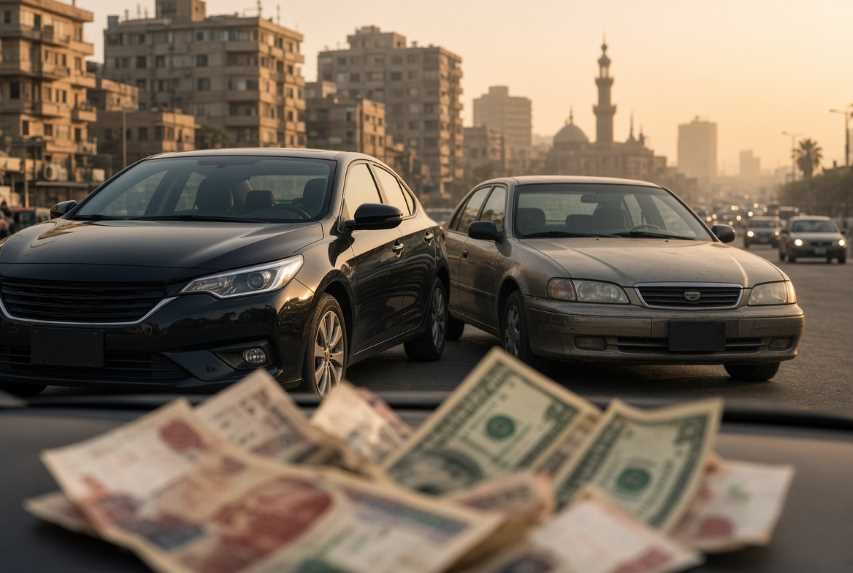
Egypt’s car market presents a paradox that is easy to see and harder to explain in a single sentence. The country has more than 100 million people, dense cities, long commutes, a wide range of incomes, and a real need for private and commercial vehicles. Yet a basic new sedan can cost several years of an ordinary wage, and a late-model used car often sells for a sum that would look like a new-car price in parts of Europe. The puzzle is not that every Egyptian car is the most expensive car on Earth in dollar terms. It is that vehicles which are ordinary purchases in richer countries, and often manageable ones in other middle-income countries, absorb an unusually large share of Egyptian household income.
Nominal price and affordability are different ideas, and mixing them up produces bad comparisons. A compact car listed near $30,000 can be a stretch, but still a realistic purchase, for a median household in the United States. A similar sum in Egypt can equal many years of gross pay for a formal private-sector worker. The gap is produced by a stack of forces that move together: customs duties and cascading taxes, the exchange rate, access to foreign currency, a market still built more on assembly than on deep manufacturing, general and imported inflation, expensive credit, limited model competition in some segments, and a used-car market that inherits the high price of new cars.
This article separates those forces. It compares Egypt with richer and poorer markets using published figures, explains each price driver on its own, and then looks at the economic, social, and environmental consequences. Where official statistics exist, they are identified as such. Dealer lists, classified-site averages, and industry guides are labeled as market reports, not government indexes. Published customs tables do not always agree with one another, and that uncertainty is stated rather than smoothed over.
How to Read a Car Price
A sticker price is the end of a chain, not the start.
For an imported car, the chain usually runs from the factory or export price, to freight and insurance, to a customs value, to duty, to development and schedule charges, to value-added tax, to port and clearance fees, to distributor and dealer margins, and finally to registration. For a locally assembled car, the kit of imported parts follows a similar path, while local labor, local parts, and assembly overhead replace some of the freight and duty. For a used car, the chain is shorter in paperwork and longer in economics: the price is whatever buyers will pay to avoid the new-car market.
Affordability is that final price divided by income, then adjusted for credit, fuel, insurance, and repairs. A country can have lower wages and higher car prices at the same time, because car prices are set by global factory costs, shipping, local tax, and local scarcity. They are not set by local pay scales. A manufacturer in Korea, Japan, Europe, or China does not discount a vehicle to match Egyptian wages. Customs then applies a%age to a dollar or euro price, so the tax bill itself becomes large in pounds.
Two further distinctions matter throughout. First, a list price is not a transaction price. Incentives, over-price premiums in shortage periods, and optional packages move the amount actually paid. Second, a car that is cheap to buy can be expensive to own if parts are scarce, and a car that is expensive to buy can be rational if it holds value and can be financed. Egyptian buyers often face both problems at once.
Egypt Beside Other Countries
Cross-country comparisons are imperfect. Trim levels, safety equipment, engine size, and taxes differ. Even so, the pattern is consistent. Egypt’s sticker prices are often close to those in much richer countries, while incomes are not.
World Bank figures put Egypt’s GDP per capita at about $3,086 in current dollars in 2025, compared with about $4,672 in Morocco in the same dataset. Egypt remains a lower-middle-income economy on the World Bank’s income classification. By contrast, U.S. median household income was $83,730 in 2024, the latest Census figure widely used in 2026 affordability studies. CAPMAS’s last full wage bulletin put the average monthly wage in Egypt at EGP 5,005 in 2023, with private-sector employees at EGP 4,675 and public-sector employees at EGP 12,401. Statutory floors have since risen: the private-sector minimum wage is EGP 7,000 a month from March 2025, and the public-sector minimum is EGP 8,000 from July 2026. Informal work, a large share of employment, is often paid less than either floor. No single income figure describes Egypt. The range does.
A 2026 city comparison by Deutsche Bank and Numbeo, reported by the Turkish outlet Ekonomim, priced a Volkswagen Golf 1.5 or equivalent new car at about $34,600 in Cairo. That was close to Munich, Frankfurt, and Berlin at about $33,600, close to Riyadh, and well below Istanbul at about $49,100. Cairo was not an outlier in dollars. It was an outlier in what those dollars mean locally.
Richer countries
In the United States, Cox Automotive’s affordability index put the average new vehicle at 34.9 weeks of median income in May 2026, with an average transaction price of $49,220. Anderson Economic Group later estimated about 38 weeks of average earnings for a typical new vehicle in August 2026, when the average new-vehicle price was about $50,089. Americans buy larger vehicles than Egyptians do, so the average is pulled up by pickups and large SUVs. A like-for-like compact is cheaper. A 2026 Toyota Corolla Hybrid has been listed from about $25,970 in the United States. The point is not that American cars are cheap in absolute terms. It is that a typical new car costs well under a year of median household income, and credit is available at rates far below Egypt’s.
Germany taxes cars more heavily than most U.S. states. The same Corolla Hybrid has been listed near €33,340 in Germany, with VAT included, roughly half as much again as the American price. Golf-class cars in major German cities sat near $33,600 in the 2026 city survey. German wages absorb that tax. Britain sits a little higher in the same survey, around $38,700–$40,300 for a Golf-class car in London and Birmingham. Japan and South Korea, as producer countries, generally offer mainstream cars at or below European list prices before foreign taxes are added, with deep used markets and shorter ownership cycles. Canada’s transaction prices have tracked close to U.S. levels in recent industry reporting, in local-currency terms that still leave a car inside one year of a typical household income.
Middle-income and developing countries
Turkey is the clearest warning that Egypt is not unique. The same Golf-class benchmark put Istanbul near $49,100, and separate affordability rankings have placed Turkey’s new-car cost above six times average annual pay. Special consumption taxes and currency stress, not wealth, produce that result. Brazil and South Africa also combine domestic assembly with high consumer taxes, so entry cars are cheaper than European luxury imports but still heavy relative to median wages. Johannesburg appeared near $36,300 in the same city survey, close to Cairo in dollars and far above Egypt in average income.
India shows the other side. Industry commentary in 2025 put the average new vehicle above ₹11.5 lakh, roughly $13,000, after a sharp rise from a very low base. Incomes are not high, but a large domestic industry produces small cars at prices Egypt does not match. Indonesia and Mexico sit between the Indian and Brazilian patterns: significant local production, large used markets, and entry prices that are high relative to wages but usually below Egypt’s tax-inflated imports. Morocco, with higher GDP per capita than Egypt and an established Renault–Dacia export base, generally offers a cheaper path into basic motoring, though model-by-model gaps depend on specification.
What the price-to-income gap looks like
An Egyptian worker on the private-sector minimum of EGP 7,000 a month earns EGP 84,000 a year. A locally assembled economy sedan listed around EGP 650,000 to EGP 700,000 — a range reported for models such as the Nissan Sunny and Chery Arrizo 5 in 2026 dealer coverage — equals roughly eight years of that gross wage, before interest, insurance, or fuel. A Golf-class benchmark near $34,600 is roughly EGP 1.8 million at bank rates around EGP 52.3 per dollar in early October 2026. That is more than twenty years of minimum-wage income, and about ten years of gross pay even at EGP 15,000 a month.
Market | Approximate new-car benchmark | Income context | What the comparison shows |
United States | Average transaction price about $49,220 in May 2026 | Median household income $83,730 in 2024 | Roughly 35–38 weeks of earnings for a typical new vehicle |
Germany | Golf-class car about $33,600; Corolla Hybrid near €33,340 | High-income economy, VAT in the list price | Higher tax than the U.S., wages still absorb it |
United Kingdom | Golf-class equivalents about $38,700–$40,300 | High household incomes by Egyptian standards | Nominal prices similar to or above Cairo |
Egypt | Golf-class equivalent about $34,600; economy sedans often EGP 650,000–1,000,000 | GDP per capita about $3,086; private minimum EGP 7,000 a month | Similar dollar price, far higher price-to-income ratio |
Turkey | Golf-class car about $49,100 in Istanbul | High special taxes, currency stress | Among the least affordable new-car markets |
India | Average new vehicle estimated above ₹11.5 lakh, roughly $13,000 | Lower incomes, deep local industry | Much cheaper entry cars than Egypt |
Morocco | Higher GDP per capita than Egypt; regional assembly hub | Export-oriented production | Generally cheaper entry cars, with gaps by model |
Used cars widen the contrast. In the United States and much of Europe, a three-year-old mainstream car often sells well below its original price. In Egypt, classified-site averages in 2026 still put a 2025 Hyundai Elantra near EGP 950,000–1,040,000 and a 2025 Nissan Sunny near EGP 678,000. Those are marketplace averages, not official indices, but they show how little the first years of use remove from the price.
Import Duties, Taxes, and Fees
Egypt taxes passenger cars heavily, and the bill is layered rather than flat. Industry and customs guides current through 2025 and 2026 consistently describe four charges that matter more than registration.
Customs duty on petrol cars is widely listed at 40% up to 1,600 cc, and at 135% above that threshold. Some Arabic guides insert an intermediate band near 80% for 1,601–2,000 cc. Because published tables differ, the binding figure is the Customs Authority tariff for the exact tariff code, not a blog summary. The cliff itself is the policy fact. A few cubic centimeters can move a car from the lower band into a much higher one, which is why the Egyptian market crowds into small engines.
A development fee, commonly listed between 1% and 8.5% by engine size, sits on top. A schedule, or table, tax runs from about 1% on small engines to 15–30% on larger ones. Value-added tax is 14%, charged on a base that already includes duty and fees. VAT is not 14% of the factory price. It is 14% of the price after the other charges have been added. Port handling, clearance, and a small stamp duty add a further slice.
The arithmetic is easiest on a small car and startling on a large one. A trade-cost guide walked through a Japan-sourced 1,598 cc car with an $18,000 export price. After freight, insurance, 40% duty, small fees, and VAT, the landed cost was about $31,700. The same method applied to a larger-engine BMW-class vehicle produced a landed cost more than triple the export price, because duty jumped to 135% and the schedule tax rose sharply. On a non-EU car over 1,600 cc, published schedules imply a tax bill that can exceed the vehicle’s customs value.
Origin changes the bill. Under the Egypt–EU Association Agreement, customs duty on qualifying EU vehicles is generally exempt, while development fees, schedule tax, and VAT can still apply. A European car is not tax-free. It is duty-relieved if it meets the rules of origin. That is why origin matters as much as engine size, and why a badge alone does not predict the tax.
Electric and hybrid cars are treated differently from each other. Fully electric cars have been eligible for zero customs duty under Presidential Decree 419/2018, but still face 14% VAT. Hybrids are not treated as electrics. Published 2026 guides put hybrid duty around 30% up to 1,600 cc and about 100% above that, plus development fees and schedule tax. A plug-in hybrid can therefore land closer to a conventional car than to a battery EV.
Registration is a separate and smaller cost. Traffic-license renewal for a common 1,330–1,630 cc private car was reported in October 2026 at roughly EGP 4,000 a year after a modest fee cut. For engines above about 2,030 cc, the annual tax has been described as 2.5% of vehicle value. Registration does not explain the purchase price. Import taxation does.
Charge | Typical published range | What it does to the price |
Customs duty | 40% up to 1,600 cc; often 135% above | The largest single levy on non-EU petrol cars |
Development fee | About 1% to 8.5% by engine size | Smaller, but inside the VAT base |
Schedule / table tax | About 1% to 30% by engine size | Rises sharply with displacement |
VAT | 14% on the stacked base | Taxes the tax as well as the car |
EU-origin duty | Often exempt if rules of origin are met | Other charges still apply |
Battery EV duty | 0% under Decree 419/2018 | VAT remains |
Exchange Rates and the Pound
Almost every car sold in Egypt contains a large imported share: the whole vehicle, or the kit, the engine, the electronics, and much of the steel. Those inputs are priced in dollars, euros, yen, or yuan. When the pound falls, the local price rises even if the factory price does not.
On 2 October 2026, major banks quoted the dollar near EGP 52.2–52.4 for selling, after a rise of roughly 0.4–0.5 pounds over the previous week, according to Al-Masry Al-Youm and Youm7. A car whose import content costs $12,000 therefore carries about EGP 626,000 of foreign-currency cost before tax, freight, and margin. In 2022, before the large devaluations of 2022–2024, the same $12,000 cost far fewer pounds. World Bank series show the effect on measured income as well: Egypt’s GDP per capita in current dollars fell from about $4,233 in 2022 to about $3,086 in 2025, partly because the pound’s dollar value dropped.
Dealers who expect further pound weakness also price in a buffer. Exchange-rate uncertainty itself becomes part of the sticker. A distributor that orders kits today and sells cars in three months cannot know the pound’s exact level at delivery. The rational commercial response is to protect the dollar margin, which means a higher pound price than a stable-currency market would require. Buyers learn the same lesson from the other side. If the pound is expected to fall, delaying a purchase can mean paying more later, which feeds the panic buying that appears in every sharp devaluation.
Parts follow the same path. A service item priced in euros does not care that the car was assembled in Sixth of October or Ain Sokhna. Currency depreciation therefore raises not only the purchase price but the cost of keeping the car, which feeds back into used prices: owners ask more because replacing the car, or repairing it, costs more.
Foreign Currency and Import Limits
Egypt’s car market contracted sharply in the early 2020s when foreign-exchange shortages delayed letters of credit and left vehicles stuck at ports. Sales later recovered. The Automotive Marketing Information Council reported 173,763 vehicles sold in 2025, up about 70% from 102,249 in 2024. Passenger cars accounted for 133,973 of those units. Completely knocked-down vehicles, assembled from imported kits, reached 99,598. Recovery is not the same as an open market.
Personal imports were limited in December 2024 to one car per importer every five years, with payment through Egyptian banks and proof of financial capacity. Diplomats and some other categories are exempt, and cars already shipped or covered by earlier letters of credit were carved out. Commercial imports remain possible, but they still need foreign currency. A three-year age rule, widely cited by customs guides, means that in 2026 only 2024–2026 vehicles are generally admitted as personal imports. Cheap older cars from abroad cannot refill the used market. Scarcity at the border supports prices inside the country.
The policy has a logic. Unrestricted personal imports during a currency crunch pull dollars out of the banking system and undercut local assembly. The side effect is a thinner pipeline of newer used cars, which is exactly the stock middle-income buyers want. When official supply is tight, two prices can exist at once: the distributor’s circular, and a higher street price for immediate delivery. Those premiums are market behavior, not a published tax, and they fade when stock improves. They are a symptom of thin supply.
Supply, Brands, and Competition
Egypt is not a closed market. Chinese brands accounted for about 37% of sales in the first half of 2025, according to industry figures cited in local business reporting, and names such as Chery, MG, BYD, Changan, and Jetour have widened the catalogue. AMIC data show both fully imported cars and locally assembled kits growing in 2025. Focus2Move reported year-to-date July 2026 sales of 116,696 units, up about 40%, with large gains for several Chinese marques. EVs, still small, reached about 2.2% of industry sales in that tracking.
Competition is still narrower than in the United States, India, or the European Union. A few distributor groups handle multiple brands. GB Auto has reported passenger-car share near 20% and kit throughput around 80,000 units a year, assembling for several marques rather than one. Engine-size tax cliffs push the market toward 1,600 cc and below, so models that are mid-range elsewhere become luxury purchases here. Waiting lists have appeared in past shortage years when official lists and street prices diverged.
More brands do not automatically mean lower prices. A new entrant still pays duty or kit tariffs, still buys dollars, and still faces the same credit market. Chinese competition has slowed some increases and filled gaps left by restricted Japanese and European supply. It has not repealed the tariff schedule. Buyers gained choice. They did not gain rich-country affordability.
Local Assembly and What It Does Not Do
Egypt assembles a large share of the cars it sells. In 2025, AMIC recorded 99,598 CKD vehicles out of 173,763 total sales. El Nasr resumed production after a long stop, with bus models reported at 63.5% and more than 70% local content. Officials at the Ministry of Industry’s automotive unit said local content in produced vehicles had reached about 40–50% by late 2025, up from roughly 20–30% two years earlier. Plant-level figures cited in industry coverage put several Chinese assembly projects near 45% in early phases.
That is real progress, and it is not full manufacturing. Engines, transmissions, electronics, and many body panels are still imported. Seats, glass, wiring harnesses, and some plastic and metal parts are the usual first local wins. The Automotive Industry Development Program aims to raise local value-added toward 60% over about seven years, with a longer-run production target of 400,000–500,000 vehicles a year by 2030, part of it for export. The program covers conventional and electric vehicles and is being used to court additional investment, including from German suppliers.
Until high-value parts are made locally at scale, a “made in Egypt” label still moves with the exchange rate. Assembly saves some duty and freight relative to a fully built import. It does not remove the dollar cost of the powertrain. This is why local assembly does not automatically mean a cheap car. A kit with 45% local content still has 55% exposed to the pound, and the finished car still passes through distributor margins and, where applicable, domestic taxes. Buses with 60–70% local content are a different product from a passenger car whose engine arrives in a crate. Treating them as the same industry stage overstates how far passenger-car prices can fall on localization alone.
The strategic bet is sequential. First, assemble enough volume to justify paint, welding, and trim. Then pull in harnesses, seats, and glass. Then stamp more metal. Engines and batteries come last because they need scale Egypt does not yet have. Each step reduces import dependence. None of them, by itself, resets the price of a family car to an Indian or Moroccan entry level.
Inflation, Energy, and the Cost of Holding Stock
Headline inflation eased to 14.5% in August 2026, with core inflation at 14.9%, according to the Central Bank of Egypt. Food inflation cooled, while electricity tariffs and rents pushed the other way. The Central Bank projects inflation toward its 7% target, plus or minus 2 points, only in the second half of 2027. That is far below the peaks of 2023–2024, but prices do not rewind when inflation slows. Imported parts, shipping, warehousing, and dealer finance were reset at higher levels and have stayed there.
Fuel is no longer a footnote. As of early October 2026, official station prices were EGP 20.75 per liter for 80-octane, EGP 22.25 for 92-octane, and EGP 24.00 for 95-octane, with the Ministry of Petroleum saying the pricing committee had not yet reset them. A household driving 15,000 km a year in a car using 8 liters per 100 km spends roughly EGP 2,700–2,900 a month on 92-octane before maintenance. Fuel does not set the purchase price. It raises the cost of keeping any car, new or old, and it narrows the advantage of a cheaper, thirstier vehicle.
Logistics add another quiet layer. Cars and kits spend time in ports, bonded yards, and dealer compounds. At high interest rates, that time has a price. A distributor financing inventory at more than 20% cannot treat a slow month as free. The cost is recovered in the margin or in a refusal to discount. Spare parts follow the same logic: a dealer who imports a gearbox in dollars and holds it for months prices the holding cost into the invoice.
Dealers, Distributors, and the Gap to the Street
The chain runs from factory price, to exclusive or semi-exclusive distributor, to dealer, to buyer. Public data on Egyptian distributor margins are scarce, so the size of the gap should not be guessed. What is observable is the structure. Limited official importers control allocation. Optional packages and dealer-fitted accessories move the out-the-door price. In tight periods, street prices rise above the circular for immediate delivery.
None of that requires assuming bad faith. Exclusive distribution plus a tax-inflated landed cost plus uncertain currency is enough to keep retail prices sticky. Over-price premiums are real when they appear, and they are also temporary when stock returns, as the 2025 sales rebound showed. Buyers should treat a premium above the official list as a shortage price, not as the permanent cost of the car, and they should ask whether the same model is available at list from another dealer in the group.
Why Used Cars Stay Expensive
Used prices follow new prices. If a new economy sedan costs EGP 700,000, a two-year-old example cannot fall to EGP 250,000 while demand is strong and newer imports are restricted. Buyers who cannot reach the new market bid up late-model used cars. Inflation and pound weakness reinforce the habit of treating a car as a store of value. Parts for older European and Japanese cars have also become expensive because they are imported.
The result is a high floor. Marketplace data in 2026 showed late-model Sunnys and Elantras retaining most of their recent list prices. A 2021 Hyundai Elantra still averaged about EGP 920,000 on one major classified site, against roughly EGP 950,000–1,040,000 for a 2025. Five years of use barely cleared a discount. Older cars have not collapsed either. Demand for anything reliable, and the cost of replacing it, keeps even high-mileage examples expensive relative to wages.
Depreciation in a normal market is the owner’s private loss and the next buyer’s gain. In Egypt, weak depreciation is the current owner’s protection and the next buyer’s barrier. It also encourages speculation: if a car is expected to hold or rise in pound terms, some purchases are delayed investments rather than transport decisions. That can support prices beyond what commuting demand alone would justify, until a currency calm or a wave of new stock breaks the expectation.
Financing and the Real Price
The Central Bank held its policy rates in September 2026 at 19% for overnight deposits and 20% for overnight lending. Retail car loans sit above that. Bank reporting in 2026 put National Bank of Egypt auto rates around 19.5–22.25% on a declining balance, Bank Misr around 20–25%, with terms up to seven or even ten years and administrative fees near 1.5–2%. Some programs advertise funding up to several million pounds. The binding constraint for most households is the installment, not the maximum loan size.
An illustration, not a bank quote: borrow EGP 560,000 after a 20% down payment on a EGP 700,000 car, at 22% declining over five years. The monthly installment is on the order of EGP 15,000, and total repayments approach EGP 900,000 before fees. The buyer pays far more than the sticker, at a monthly cost above the private-sector minimum wage. Stretch the same loan toward seven years and the monthly payment falls, while total interest rises. Cash buyers avoid the interest. Most households cannot be cash buyers at these prices.
This is why an unchanged sticker can still become less affordable. If the car stays at EGP 700,000 and the lending rate rises, the five-year cost rises with it. Conversely, a future rate cut would lower the real cost of the same car without any dealer discount. Until inflation is closer to the Central Bank’s target, that cut is a hope, not a plan.
Why Poorer Countries Can Have Rich-Country Car Prices
Car prices track global costs and local tax. Incomes track local productivity. Nothing forces the two into line. Singapore is the extreme case in the other direction: a Golf-class car near $156,000 in the 2026 city survey, in a high-income city that chooses to tax cars as a congestion tool. Turkey and Egypt are the more relevant cases: middle-income markets where tax, currency, and import structure push car prices up to or above rich-country levels.
The Cairo Golf-class figure of about $34,600 makes the contradiction concrete. It is close to the German city price in dollars. Against U.S. median household income, it is under half a year. Against an Egyptian minimum-wage income of EGP 84,000 it is more than twenty years. The car is not cheap because Egypt is poorer. The tax and currency system price it as an imported durable, while incomes remain those of a lower-middle-income economy.
Purchasing-power comparisons soften the income gap and do not close the car gap. Egypt’s PPP income is far above its dollar GDP per capita, because many local services are cheaper than in Europe. Cars are not local services. They are traded goods. PPP adjustments therefore make Egyptian wages look more adequate for food and housing than for vehicles. That is the right reading, not a statistical trick.
Case Studies
These are dealer and classified ranges reported in 2025–2026, not official indexes. Specs differ across markets, and a higher Egyptian trim can include equipment that a base foreign model lacks. The direction of the gap is still clear.
Economy sedan. Nissan Sunny listings started around EGP 645,000 in May 2026 coverage, with used 2025 examples averaging about EGP 678,000 in October 2026 classified data. A comparable new compact in the United States often transacts in the low-to-mid $20,000s. The Egyptian pound price is lower in dollars than a U.S. average new car, and still extreme relative to local pay. Local assembly avoids the full built-up duty, which is why this class exists at all. Resale holding near the recent list price means the second buyer captures little of the usual depreciation discount.
Compact hatchback. Suzuki’s small cars have been listed from roughly EGP 630,000. In India, equivalent small cars sell for a fraction of that in dollar terms because they are built in volume with high local content and modest taxes. The Egyptian price reflects kit imports plus residual taxes, not Indian-style scale. For a first-time buyer, this is often the relevant comparison: not against a German Golf, but against the small car a peer in India or Morocco can actually buy.
Small SUV. A Chery Tiggo 7 class SUV has been advertised from about EGP 1 million. In dollar terms that is a mainstream compact-SUV price. In wage terms it is another multiple of annual pay. Chinese competition has made this segment more available. It has not made it a mass purchase.
Family SUV. A family SUV with a larger engine crosses the 1,600 cc cliff and can move into the multi-million-pound range once duty, schedule tax, and VAT stack. October 2026 dealer tables showed a range of premium SUVs from about EGP 5 million upward, with top trims of large models above EGP 10 million. A U.S. compact SUV often transacts around $30,000–$40,000. The Egyptian family SUV is frequently more expensive in dollars and vastly less affordable. These are different products from the economy sedan, and they should not be used as the typical household example.
Pickup. Work pickups such as the Nissan Navara have been listed above EGP 5 million for higher trims in October 2026 dealer tables. Those prices hit logistics firms, contractors, and farms directly, because a pickup is a tool. A high tool price becomes a cost of doing business, then a price in the goods those businesses deliver.
Popular used car. The Elantra pattern is the cleanest illustration of the used-market floor. Late-model averages near the new price, and five-year-old averages not far below, mean the usual age discount is thin. Buyers who hoped to “buy used and save half” are shopping in a market that does not offer that saving on the cars people actually want.
Economic Consequences
High car prices push households to save longer, borrow more, or go without. That diverts money from other goods and raises debt-service ratios when loans are used. A household that commits EGP 15,000 a month to a car loan has less room for housing, school fees, or a buffer against illness. Multiply that constraint across the minority of households that do borrow, and the macro effect is a tilt of credit toward a depreciating, imported durable.
For the balance of payments, every fully built import and most assembly kits require dollars. The 2025 rebound to 173,763 units therefore also meant a rebound in foreign-currency demand. That is not an argument for permanent scarcity. It is a reason the authorities have preferred local assembly and personal-import limits. The industrial offset is employment. Assembly plants, component workshops, and dealer networks employ people, and the development program is explicitly meant to deepen that base. Local content of 40–50%, if sustained and raised, substitutes for some imports. It does not yet substitute for engines and electronics.
Transport businesses feel both sides. Ride-hailing and taxis can spread the cost of an expensive car across many paying trips, which is one reason those services grew when private ownership became harder. The driver still has to service the loan, so fares embed the car’s capital cost. Logistics companies face higher capital costs per vehicle, which feed into delivery prices. Small traders who need a van or pickup pay a tax-like premium on a working tool. Productivity effects are plausible rather than precisely measured: longer vehicle lives, more downtime for repairs, and slower replacement of inefficient trucks all raise the cost of moving goods.
There is a revenue side. Vehicle taxes collect money that would otherwise have to come from other taxes or from borrowing. A large duty cut would be felt in the budget as well as in the showroom. Honest analysis has to hold both facts: the tax makes cars less affordable, and the tax is not free money to abolish without a replacement.
Social Consequences
Documented income data explain the social pattern without anecdotes. An average wage measured in the low thousands of pounds in 2023, and a legal minimum of EGP 7,000–8,000 in 2025–2026, cannot absorb a EGP 700,000 car except through family pooling, years of saving, or debt. A new car is out of reach for most young workers. First-car ownership slides later in life, or never arrives. Household studies reported in 2026 put a basic monthly basket for a family of four well above the minimum wage, which leaves little surplus for a vehicle deposit.
That affects mobility more than status. Jobs outside metro corridors are harder to take without a car where buses are slow. Rural buyers face the same purchase price and weaker resale liquidity. Urban middle-income households who do buy often commit a large share of income for years. Ride-hailing fills part of the gap for people who need occasional trips, not a vehicle outside the door at dawn. Inequality widens inside the car market itself: a household that bought before the large devaluations holds an asset that rose in pound terms, while a household trying to enter now pays the new price. These are mechanical effects of prices and incomes, not claims about culture or family decisions. Marriage and household formation may be delayed when a car is treated as a prerequisite, but that link is social observation, not a measured national statistic.
Risks That Are Visible, and Risks That Are Conditional
Some risks are already visible. Households keep older cars longer because replacement is unaffordable, which raises maintenance costs and, over time, safety risk if brakes, tires, and structure are deferred. Imported spare parts are vulnerable to the same currency and tax pressures as cars. A large used market with limited history reporting makes odometer and accident transparency weak. Counterfeit or low-grade parts become more attractive when genuine parts are priced in dollars. That risk is widely discussed by workshops; systematic seizure data are thinner, so it should be treated as a known market pressure rather than a counted share of parts sold.
Other risks are conditional. Price spikes during foreign-currency crunches have looked like scarcity bubbles, and they have partially reversed when stock returned, as in the 2025 sales rebound. A sudden large duty cut would lower replacement cost and could also cut used-car values, hurting recent buyers. Neither outcome is guaranteed. Speculation is rational while the pound is expected to weaken and new supply is capped; it is not a permanent feature. The structural risk is simpler. Import dependence plus currency volatility means car prices can jump faster than wages, and an aging fleet can lag safety and emissions standards for years.
Environment, Congestion, and the Age of the Fleet
An older fleet is usually a dirtier and less safe fleet. High replacement cost slows the shift to newer engines, better crash structures, and lower fuel use. Congestion in Cairo is not caused only by car prices. Fuel has at times been cheap relative to the cost of the vehicle, public-transport capacity is uneven, and urban form concentrates trips. An aging private fleet still does not help emissions. The environmental irony is that expensive new cars can slow the retirement of old ones. A policy that makes the cleaner car unaffordable extends the life of the dirtier car.
Public transport is the other side of the same constraint. Where metro and trunk buses work, households can refuse the car premium. Where they do not, the premium becomes a condition of employment. Electric adoption, discussed below, will not clean the existing fleet quickly if only a few% of new sales are electric and new sales themselves are a small share of the vehicles on the road.
Electric and Hybrid Cars
A pure battery EV avoids the 40–135% customs duty. It does not avoid VAT, shipping, dealer margin, or the dollar price of the battery. Charging at home depends on the household electricity tariff and on whether the building can support a charger. Public charging is growing from a low base. Hybrids, which many buyers would prefer as a bridge, are taxed much more like conventional cars than like electrics.
Government strategy treats EVs as an industrial opportunity. El Nasr and private groups have signed assembly agreements, and the development program covers electric as well as conventional vehicles. Incentives that cut duty on kits will not make a mid-size EV cheap while batteries are imported and credit costs about 20%. Industry tracking put EVs at about 2.2% of sales in 2026, after very fast growth from a tiny base. That is a real start and a small share.
Resale is the open question. A conventional Sunny has a known parts network and a deep buyer pool. An EV’s second buyer has to trust the battery, the charger network, and the brand’s presence five years on. Until that trust exists, EVs are more likely to widen choice at the upper-middle end of the market than to cut the entry price. They can still be the right buy for a household with home charging and high annual mileage, because fuel savings are real at EGP 22 per liter. They are not, yet, a general answer to the affordability problem.
What Could Be Done
No single lever removes the gap. Each option below has a benefit, a cost, and a time scale.
Tax and customs reform. Narrowing the 1,600 cc cliff and lowering peak rates would cut landed cost directly. The fiscal cost is real, because vehicle taxes are revenue and an import-control tool. A phased cut, tied to local-content targets, is more plausible than an overnight abolition. Effects would show within a model year on new stock, and more slowly in used prices. The risk is a surge in imports if the cut is not matched by currency availability.
Deeper local content. Moving from about 45% toward the program’s 60% target, especially in engines, electronics, and stampings, would reduce dollar exposure. This is a multi-year industrial task. Assembly incentives alone will not do it if parts keep arriving in boxes. The disadvantage is the temptation to protect weak local suppliers behind high tariffs, which keeps car prices high in the name of industry policy.
Clearer foreign-currency access. Predictable letters of credit reduce shortage premiums. They also increase import demand. Transparency helps prices. It does not create dollars. The useful version is a published, rules-based queue, not an informal allocation.
Competition and consumer rules. More distributors, published price lists, and transferable warranties would narrow dealer premiums. Independent inspections and accident-history databases would make the used market less of a gamble. These are low-fiscal-cost steps with modest price effects and faster implementation than a new engine plant.
Financing rules. Lower policy rates would cut installments, but rates are set for inflation control. Caps that ignore the cost of funds would shrink the supply of loans rather than make cars cheaper. Clear disclosure of total interest, in pounds, would still help buyers compare offers.
Public transport. Better buses, metro, and rail do not cut car prices. They cut the penalty for not owning one, which is the relevant welfare effect for many households. This is a long project with a large capital cost and a direct daily benefit.
Trade agreements. EU duty relief already exists for qualifying vehicles. Similar rules with other production hubs could lower specific models. Rules of origin decide whether the benefit is real or a badge on an imported kit.
Price transparency. Digital listings with verified mileage, auction records, and standard inspection reports would not repeal taxes. They would reduce the tax that buyers pay in the form of bad used cars. That is a consumer-protection gain with little budget cost.
What Buyers Can Do Now
Compare the full cost, not the headline. A cheaper car with scarce parts can cost more over five years than a slightly dearer car with local stock. Ask several dealers for the out-the-door price, including mandatory fees and any “immediate delivery” premium. On a used car, pay for an independent inspection and check service and accident history before transfer.
Price the loan, not the monthly advertisement. A seven-year plan at more than 20% can add hundreds of thousands of pounds. A larger down payment, or a smaller car, often beats a longer tenor. Write down the total of installments plus fees and compare it with the cash price. Fuel use still matters: at EGP 22.25 per liter, a difference of 2 liters per 100 km is several thousand pounds a year.
Do not treat a sudden price jump as a last chance. Shortage spikes have reversed before. If the purchase can wait, waiting through a currency or stock shock has sometimes been cheaper than buying the panic. If it cannot wait, buy the car with the best parts network rather than the lowest sticker in an unknown badge.
Frequently Asked Questions
- Why are used cars so expensive in Egypt?
Because new cars are expensive, newer used imports are restricted by the three-year rule and the one-car-in-five-years personal limit, and buyers shut out of the new market compete for the same late-model stock. - Why can a used car keep so much of its price?
Replacement cost sets the ceiling and, in a scarce market, much of the floor. Currency depreciation also lifts the pound value of a car bought earlier. Weak depreciation is a rational price, not a mystery, as long as those conditions hold. - Why are cars sometimes costlier in Egypt than in richer countries?
Dollar prices are often similar, as the Cairo Golf-class comparison showed. Taxes, a weak pound, and thin local content push many models above rich-country stickers, while incomes are far lower. Price does not follow local wages. - How do taxes affect the price?
Duty, development fee, schedule tax, and 14% VAT cascade. On a non-EU car over 1,600 cc, published schedules imply a tax bill that can exceed the vehicle’s customs value. EU origin can remove the duty and still leave the other charges. - Does local assembly make cars cheaper?
It avoids full built-up duty and some freight, which is why kit-built economy cars are the attainable end of the market. It does not remove the cost of imported engines and electronics. Local content near 40–50% is progress, not a finished industry. - Will more competition reduce prices?
Chinese brands have already widened choice and slowed some increases. Competition cannot repeal the tariff schedule or the exchange rate. - Can electric cars become affordable in Egypt?
Duty-free entry helps. Battery cost, charging, VAT, and credit near 20% still point to a slow path. They are unlikely to reset mass-market prices quickly. A household with home charging may still save on fuel. - Could car prices fall significantly?
A stronger pound, lower duties, or a glut of stock could pull prices down. None of those is the base case while inflation is still near 14–15% and policy rates are near 20%. Used prices would fall only after new prices and expectations fall. - What should buyers watch over the next few years?
The pound, Central Bank rates, any revision of the tariff book, local-content milestones under the automotive program, and whether kit supply keeps up with the 2025–2026 sales rebound.
Egypt’s car prices are high for a stack of reasons that reinforce one another: steep and cascading vehicle taxes, a pound that has reset import costs, foreign-currency constraints, assembly that still depends on imported kits, inflation that does not reverse, credit near 20%, and a used market that cannot fall far while new cars stay scarce. Nominal dollar prices are often close to European city prices. Affordability is not. A Golf-class car near $34,600 is a normal multiple of German income and an extreme multiple of Egyptian wages.
Local assembly, Chinese entry, and the post-2024 sales recovery have made cars more available than in the worst shortage years. They have not made them cheap relative to pay. Closing that gap would take lower import taxation, deeper local parts, more predictable currency access, and cheaper credit — and cheaper credit waits on lower inflation. Until more of those move together, the typical Egyptian household will keep measuring a car in years of income, not in months. The useful distinction, for policy and for buyers, is the one this market keeps blurring: a car can be ordinarily priced in dollars and still be extraordinarily expensive in lives.
 |  |  |
 |  |  |