Subtitle: How Science, Instruments, and Artificial Intelligence Reveal the Invisible Layers of Everyday Reality
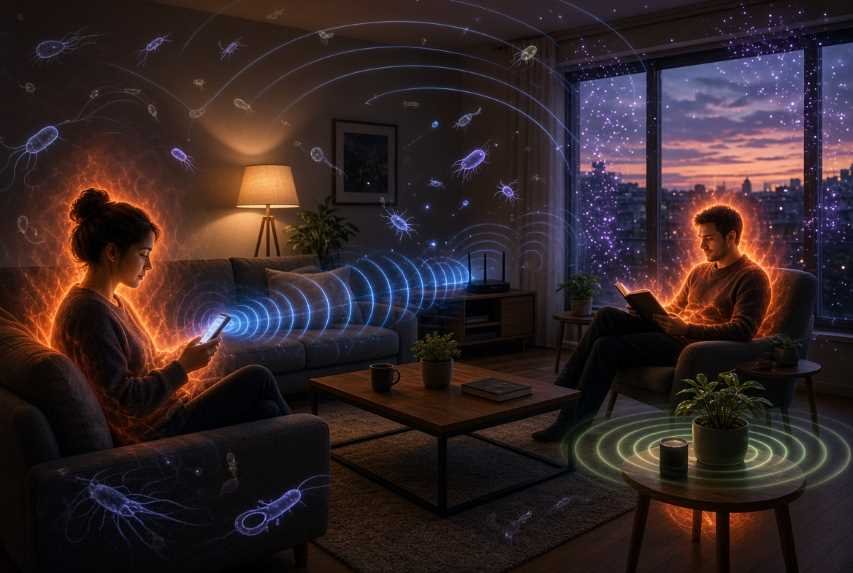
Imagine sitting quietly in an ordinary room. You notice the chair beneath you, the window letting in daylight, the lamp on the desk, and the faint outline of a doorway. You hear someone speaking nearby, the distant sound of traffic, and the steady low hum of a refrigerator or fan. The scene feels complete and ordinary. Yet the same space is filled with radio waves carrying wireless data, infrared radiation streaming continuously from every warm surface, ultraviolet light that has passed through the atmosphere and the window glass, microscopic organisms living on surfaces and in the air, low-frequency vibrations traveling through the floor and walls, magnetic fields generated by the Earth and by nearby electrical devices, and countless subatomic particles passing through the room with almost no interaction. Almost none of this activity is available to ordinary human vision or hearing.
The world we experience through our senses is only a limited slice of the physical world that science can investigate. Invisible does not mean mysterious, supernatural, dangerous by default, or impossible to measure. Many invisible phenomena are well understood, routinely measured, and put to practical use every day. Others remain active subjects of research, with evidence that is strong in some areas and incomplete in others. Scientific instruments convert signals that human senses miss into data that can be recorded, analyzed, and interpreted. Artificial intelligence now helps researchers examine enormous volumes of that data, but the instruments and the underlying measurements remain essential.
This article explores what can exist around us without being visible to our eyes, what sounds occur beyond the range of human hearing, how animals perceive aspects of reality that humans cannot, what technologies allow scientists to detect invisible phenomena, how much of the universe remains unknown, and whether future technology could extend human senses beyond their natural limits. The goal is to make these ideas clear, accurate, and useful for general readers, students, and anyone curious about the physical world.
The World We Cannot Perceive
The familiar room described above already contains multiple layers of physical reality that ordinary senses do not reveal. Radio waves from a wireless router and nearby mobile networks pass through walls. Infrared radiation is emitted by people, pets, electronics, and even the walls themselves because any object warmer than absolute zero radiates energy. Ultraviolet radiation arrives from the Sun. Microscopic bacteria, fungi, and other organisms occupy surfaces and the air. Mechanical vibrations at frequencies too low or too high for the ear continue through solid materials. Earth’s magnetic field threads through the entire space, and local electric and magnetic fields arise from wiring and devices. High-energy particles from space and from natural radioactivity occasionally interact with matter in the room.
These examples illustrate a central point: human perception evolved for survival in a particular environment, not for a complete inventory of physical phenomena. Science expands that inventory by building instruments that respond to signals outside biological ranges and by testing explanations against repeated observations. The questions that guide the rest of this article are practical as well as conceptual. What physical signals are present but undetected by eyes and ears? How do specialized animals detect some of those signals? Which instruments convert the signals into usable information? Where does current evidence end and open research begin? And how might technology continue to extend the range of what people can reliably measure and interpret?
Human Senses: Why We Cannot Experience Everything
Human senses are powerful within their operating ranges and limited outside them. Understanding those limits helps explain why so much of the physical world remains hidden without instruments.
The Limitations of Human Vision
The human eye responds to electromagnetic radiation in a band of wavelengths roughly 380–750 nanometers, commonly called visible light. Within this narrow window, shorter wavelengths are perceived as violet or blue and longer wavelengths as orange or red. The cornea and lens focus incoming light onto the retina. Rod cells are especially sensitive in dim light and do not support color vision; cone cells operate in brighter light and enable color discrimination through three main types sensitive to different parts of the visible spectrum. Electrical signals travel along the optic nerve to the brain, which constructs the coherent visual scene we experience.
The eye does not detect radio waves, microwaves, most infrared radiation, ultraviolet radiation, X-rays, or gamma rays because its photoreceptors and optical structures are not sensitive to those wavelengths. Visible light is simply the portion of the spectrum that proved useful for daytime vision on Earth’s surface under the Sun’s illumination and the atmosphere’s filtering. Optical instruments such as telescopes, microscopes, and spectrometers extend observation within and near this band, but they still operate with light or with signals that can be converted into light or electronic data.
The Limitations of Human Hearing
A healthy young person can typically detect sound frequencies from approximately 20 hertz to 20,000 hertz (20 kHz). Frequency is the number of pressure oscillations per second; higher frequency is generally perceived as higher pitch. Sounds below about 20 Hz are termed infrasound; sounds above about 20 kHz are termed ultrasound. Actual hearing thresholds vary with age, cumulative noise exposure, individual biology, and the intensity of the sound. Even within the conventional range, sensitivity is not uniform; the ear is most sensitive in the middle frequencies used for speech.
Sounds outside the conventional range can still propagate through air, water, or solid materials. Specialized microphones, geophones, and hydrophones detect them. Some animals hear portions of the infrasound or ultrasound bands that humans miss. The existence of a sound wave is therefore independent of whether a human ear registers it under ordinary conditions.
Other Human Sensory Limitations
Humans also have limited sensitivity to magnetic fields, electric fields, very low concentrations of many chemicals, objects smaller than roughly the wavelength of visible light, and most forms of radiation. A magnetic field can be strong enough to align a compass needle or affect sensitive instruments while producing no visual or auditory cue. An electric field can surround a charged object without creating a visible spark or glow. Chemical signals that dogs detect at extremely low concentrations may be imperceptible to people. These examples show that physical presence and human detectability are separate. Instruments close the gap by responding to the relevant physical quantity and converting the response into a readable signal.
The Invisible World of Electromagnetic Waves
Electromagnetic radiation consists of oscillating electric and magnetic fields that propagate through space at the speed of light in a vacuum. Wavelength and frequency are inversely related: shorter wavelengths correspond to higher frequencies and higher energy per photon. Different regions of the spectrum are produced by different physical processes and interact with matter in different ways. Category boundaries are conventional and can vary slightly by scientific tradition; the underlying continuous spectrum does not change.
Radio Waves
Radio waves occupy the long-wavelength, low-frequency end of the commonly used spectrum. They carry amplitude-modulated and frequency-modulated radio broadcasts, television signals, mobile-phone traffic, Wi-Fi, Bluetooth, and many satellite links. A transmitting antenna converts a changing electrical current into outgoing radio waves; a receiving antenna converts incoming waves back into electrical signals that electronic circuits can process. Because radio waves pass through many materials that block visible light, a phone can maintain a connection indoors and a radio can receive a station through walls.
Radio telescopes collect radio emissions from astronomical sources. Pulsars, radio galaxies, and certain molecular clouds produce radio signals that are faint or invisible in optical light. The ability to observe at radio wavelengths has revealed objects and processes that optical astronomy alone could not fully characterize. Everyday examples include the continuous exchange of data packets between a smartphone and a wireless router, and the longer-range links that connect mobile towers to the broader network.
Microwaves
Microwaves are used in microwave ovens, radar systems, certain satellite communications, and some wireless links. In a microwave oven the radiation is absorbed mainly by water and other polar molecules, which rotate and generate heat through molecular friction. The food is not made radioactive. Biological and material effects depend on frequency, intensity, exposure time, and the properties of the material. Microwaves are non-ionizing; individual photons do not carry enough energy to remove electrons from atoms in the manner of X-rays or gamma rays. Radar systems transmit microwave pulses and measure the time and character of the returning echoes to estimate distance, speed, and sometimes the nature of the reflecting object. Weather radar, aviation radar, and maritime radar are practical examples.
Infrared Radiation: Seeing Heat
Any object warmer than absolute zero emits infrared radiation; the spectrum and intensity depend primarily on temperature. Thermal cameras detect this radiation, typically in the long-wave infrared, and produce images that represent relative temperature differences rather than ordinary reflected visible light. Applications include locating heat loss from poorly insulated buildings, identifying overheating electrical connections or motors, helping firefighters navigate smoke-filled spaces, observing nocturnal wildlife, inspecting industrial equipment for faults, and supporting environmental and scientific measurements.
Thermal imaging is distinct from conventional night-vision systems. Night vision generally amplifies available visible or near-infrared light, sometimes with the aid of an infrared illuminator. Thermal cameras detect emitted long-wave infrared and function in complete darkness without requiring ambient light. Thermal cameras do not see through solid walls. They register infrared radiation that reaches the detector, ordinarily from the surface of the nearest opaque object. Heat conducted or radiated from something behind a wall may raise the wall’s surface temperature and appear as a pattern, but the camera is not producing a direct interior image.
Visible Light: The Small Window We Can See
Visible light occupies only a narrow interval within the full electromagnetic spectrum. The Sun emits across a broad range of wavelengths. Earth’s atmosphere absorbs or scatters many of those wavelengths before they reach the ground, so the light that arrives at the surface is already filtered. Optical telescopes collect and focus visible and near-visible light from distant objects. Microscopes use visible light and lenses to magnify small structures. Cameras record reflected or emitted visible light. Spectroscopy disperses light into its component wavelengths so that the presence and abundance of particular atoms or molecules can be inferred from characteristic absorption or emission lines.
Ultraviolet Radiation
Ultraviolet radiation is conventionally divided into UVA, UVB, and UVC bands of decreasing wavelength and increasing photon energy. The Sun is the dominant natural source at Earth’s surface. UVB contributes both to sunburn and skin damage and to the cutaneous production of vitamin D. The ozone layer and the rest of the atmosphere block most UVC before it reaches the ground. Controlled ultraviolet sources are used in fluorescence studies, certain forensic examinations, laboratory research, and disinfection systems. Excessive exposure can damage skin and eyes; looking directly at ultraviolet sources is unsafe. Fluorescence occurs when a material absorbs ultraviolet light and re-emits energy at longer, often visible, wavelengths; this principle is used in mineral identification, document examination, and biological staining.
X-Rays and Gamma Rays
X-rays are employed in medical radiography, computed tomography, security screening, industrial inspection of welds and castings, and X-ray astronomy. Materials absorb X-rays to different degrees according to density and atomic composition, allowing internal structures to be imaged. Gamma rays are still higher-energy electromagnetic radiation associated with nuclear transitions, radioactive decay, and energetic cosmic processes. Medical uses include radiotherapy, in which carefully planned beams target tumors. Both X-rays and gamma rays are ionizing radiation and require shielding, dose monitoring, and adherence to safety standards. Diagnostic imaging uses limited, controlled exposures; therapeutic applications use higher, precisely calculated doses under medical supervision.
Electromagnetic Spectrum Overview
Type | Relative Wavelength / Frequency | Visible to Human Eye? | Common Natural Sources | Key Applications | Safety Considerations |
Radio waves | Longest wavelengths, lowest frequencies | No | Lightning, astronomical sources | Broadcasting, mobile networks, Wi-Fi, radio astronomy | Ordinary levels generally low risk; high-power sources require controls |
Microwaves | Shorter than most radio | No | Cosmic microwave background, some astronomical objects | Ovens, radar, satellite links | Non-ionizing; intensity and exposure matter |
Infrared | Between microwaves and visible | No (most of band) | Warm objects, Sun | Thermal imaging, remote controls, spectroscopy | Ambient levels generally safe |
Visible light | Approx. 380–750 nm | Yes | Sun, stars, combustion | Vision, photography, optical astronomy | Intense sources can damage eyes |
Ultraviolet | Shorter than visible | No | Sun | Fluorescence, disinfection, research | Can cause skin and eye damage |
X-rays | Much shorter wavelengths | No | Certain astronomical sources, some decay processes | Medical imaging, security, materials inspection, astronomy | Ionizing; dose limits and shielding required |
Gamma rays | Shortest wavelengths, highest energies | No | Nuclear processes, cosmic events | Radiotherapy, high-energy astronomy | Ionizing; strict protection required |
The table summarizes conventional categories. Actual boundaries vary by context, and the spectrum itself is continuous.
The Secret World of Sounds We Cannot Hear
Sound is a mechanical disturbance that travels through a material medium such as air, water, or solid matter. Unlike electromagnetic waves, ordinary sound does not propagate through a vacuum. The frequency of the oscillation determines whether the sound falls into the infrasound, audible, or ultrasound range for human hearing.
Infrasound: Sounds Below Human Hearing
Infrasound comprises frequencies below approximately 20 Hz. Natural sources include earthquakes, volcanic eruptions and ongoing volcanic tremor, large storms, ocean waves, and avalanches. Human-made sources include some heavy machinery, large vehicles, and certain industrial processes. Specialized low-frequency microphones and seismic sensors allow scientists to monitor volcanic activity, track atmospheric waves, and study seismic events. Elephants produce and respond to low-frequency calls that can travel substantial distances under favorable conditions, supporting long-range communication. At sufficiently high intensities, infrasound can produce sensations of pressure or vibration; claims of specific psychological effects from ordinary environmental levels require careful, controlled evidence.
Ultrasound: Sounds Above Human Hearing
Ultrasound frequencies above roughly 20 kHz are used in medical imaging, echocardiography, industrial non-destructive testing, ultrasonic cleaning, level sensing, and scientific research. Medical ultrasound transmits short pulses of high-frequency sound and records the echoes that return from boundaries between tissues of different acoustic properties. The technique does not use ionizing radiation, which is one reason it is widely applied in prenatal imaging and other examinations. Proper equipment design, operator training, and adherence to safety guidelines remain necessary. Industrial applications include detecting cracks or voids inside metal parts without destroying the sample.
Bats and Echolocation
Many bat species emit brief ultrasonic calls and interpret the returning echoes. The time delay indicates distance; differences in intensity and frequency content provide information about size, shape, texture, and motion. This biological system shares fundamental principles with human-made sonar and with certain robotic sensing methods that use acoustic or electromagnetic echoes.
Dolphins and Underwater Sound
Dolphins and some other marine mammals use sound and echolocation in water, where sound travels faster and with less attenuation than in air under many conditions. Underwater acoustics is essential for studying marine life, mapping the seafloor, and monitoring oceanographic processes. Elevated levels of underwater noise from shipping, construction, and other human activities can mask animal signals or alter behavior; researchers continue to quantify these effects and evaluate mitigation approaches.
The Hidden Acoustic Environment Around Us
Ordinary environments can contain low-frequency mechanical vibrations from machinery or traffic and, in some cases, higher-frequency emissions from electronic devices or from animals. Not every electronic device produces significant ultrasound, and the presence of inaudible sound does not by itself indicate a health hazard. Measurement of frequency, intensity, duration, and context is required for any assessment.
The Microscopic Universe: Life Beyond Naked-Eye Vision
A vast biological world becomes visible only with magnification or with specialized molecular and imaging methods.
Bacteria
Bacteria are single-celled organisms found in soil, water, air, food, and on and inside the human body. Many species are beneficial or harmless. The human gut microbiome assists in digestion and interacts with the immune system. Certain bacteria are used in the production of yogurt, cheese, and other fermented foods, and in the cycling of nutrients in ecosystems. A minority of species can cause disease when they enter the body under particular conditions or when host defenses are compromised. Distinguishing beneficial, commensal, and pathogenic roles requires specific identification rather than the simple presence of bacteria.
Viruses
Viruses are infectious agents that replicate inside host cells. They are generally far smaller than typical bacteria and are not themselves cells. Most viruses cannot be resolved with standard classroom light microscopes; electron microscopy, molecular biology techniques, and genome sequencing are used for detailed study. Viruses influence ecosystems, agriculture, and human and animal health, yet they also form part of the ordinary microbial background in many environments.
Fungi, Protozoa, and Microscopic Organisms
Microscopic fungi, protozoa, algae, and other microorganisms participate in decomposition, nutrient cycling, and food webs. They occur in soil, freshwater, seawater, household dust, and on the human body. Some species are used in biotechnology and food production; others can cause infections under specific circumstances. Their ecological roles are diverse and often essential.
Microscopes: Opening a New World
Optical microscopes use visible light and glass lenses. Electron microscopes use beams of electrons and electromagnetic lenses, achieving much higher resolution because the effective wavelength of the electrons is far shorter than that of visible light. Fluorescence microscopy labels particular molecules or structures with fluorescent tags so that specific features can be highlighted. Magnification increases the apparent size of an image, but resolution—the ability to distinguish two nearby points as separate—is limited by the wavelength used and by the optical design of the instrument. Enlarging a blurry image does not create new detail.
The Microbiome Around and Within Us
Microbial communities inhabit human skin, the digestive tract, soil, plant surfaces, and aquatic environments. They contribute to digestion, immune development, nutrient availability for plants, and the breakdown of organic matter. Biotechnology applications include the production of enzymes, antibiotics, and other compounds. The presence of microbes is a normal feature of natural and built environments; it does not automatically indicate contamination or danger.
Invisible Forces: Magnetism, Electricity, and Earth’s Protective Environment
Important physical fields and forces can exist and produce measurable effects without being directly visible.
Magnetic Fields
Magnetic fields are produced by permanent magnets, by electric currents, and by the motion of conducting material in Earth’s core. A compass needle aligns with the local direction of Earth’s magnetic field. Magnetometers measure field strength and direction with high precision. Practical applications include navigation, the operation of electric motors and generators, magnetic resonance imaging in medicine, geological surveys that map subsurface structures, and the control and monitoring of spacecraft. Local magnetic fields from electrical equipment can be detected with appropriate sensors even though they produce no visual cue.
Electric Fields and Static Electricity
Electric charge creates electric fields in the surrounding space. Walking across a carpet in dry conditions can separate charge and produce a small spark upon discharge. Static electricity is a temporary imbalance of charge; continuous current in a circuit is a sustained flow of charge driven by a voltage difference. Electric fields can be measured with field meters even when they are invisible and produce no spark.
Earth’s Magnetosphere
Earth’s magnetic field extends into space and interacts with the stream of charged particles known as the solar wind, forming the magnetosphere. The interaction deflects many particles and funnels others toward the polar regions, where they produce auroras. Periods of intense solar activity can generate geomagnetic storms that disturb satellite electronics, affect high-frequency radio communications, and induce currents in long electrical transmission lines. The magnetosphere provides important protection against charged particles from the Sun, yet it does not block all forms of radiation, including electromagnetic radiation and high-energy cosmic rays that reach the atmosphere.
Radiation We Cannot Directly Sense
Natural background radiation includes contributions from cosmic rays, from radioactive isotopes in soil and rock, and from other sources. Ionizing radiation—such as X-rays, gamma rays, and certain energetic particles—can remove electrons from atoms and is managed through dose limits and shielding. Non-ionizing radiation, including radio waves, microwaves, infrared, and visible light, interacts with matter through different mechanisms. Geiger counters detect ionizing radiation through gas ionization; dosimeters record cumulative exposure; specialized particle detectors register rare interactions of neutrinos or cosmic rays. Risk depends on the type of radiation, its energy, the dose rate, and the total exposure, not merely on the fact that radiation is present.
The Invisible Universe of Space
The same principles that reveal hidden phenomena on Earth extend to the cosmos, where many of the most energetic and massive objects are studied through indirect or multi-wavelength methods.
Black Holes
Black holes form when sufficient mass collapses under gravity so that the escape velocity exceeds the speed of light inside a boundary called the event horizon. Light and matter that cross the horizon cannot return. Astronomers infer the presence of black holes from the orbital motion of nearby stars and gas, from gravitational lensing, from the radiation emitted by hot material in accretion disks, from gravitational-wave signals produced by mergers, and from direct imaging of the shadow of the event horizon. The Event Horizon Telescope collaboration released the first image of the supermassive black hole in the galaxy Messier 87 in 2019 and an image of Sagittarius A* at the center of the Milky Way in 2022. Black holes do not function as cosmic vacuum cleaners that automatically swallow all nearby matter; objects outside the event horizon can remain in stable orbits.
Dark Matter
Multiple independent lines of evidence indicate that galaxies and galaxy clusters contain substantially more mass than can be accounted for by visible stars, gas, and dust. Galaxy rotation curves remain flatter at large radii than expected from the visible mass alone. Gravitational lensing by clusters bends and magnifies the light of more distant galaxies in ways that require additional mass. The motions of galaxies within clusters and the pattern of large-scale cosmic structure are also consistent with a dominant non-luminous mass component. Dark matter is inferred primarily through its gravitational effects and has not yet been conclusively identified as a specific particle. Alternative explanations have been examined; the combination of observations currently supports the existence of additional mass that does not emit or absorb light in ordinary ways.
Dark Energy
Measurements of distant supernovae and other cosmological probes indicate that the expansion of the universe is accelerating. In the standard cosmological model the term “dark energy” refers to whatever component drives that acceleration. Its physical nature remains poorly understood and is the subject of ongoing observational and theoretical work.
Neutrinos and Cosmic Radiation
Neutrinos are electrically neutral, weakly interacting particles produced in nuclear reactions in the Sun, in supernovae, in the atmosphere by cosmic-ray collisions, and in other high-energy astrophysical processes. Vast numbers pass through the Earth and through the human body while interacting only rarely. Detectors such as Super-Kamiokande, a large underground water tank in Japan, and IceCube, a cubic-kilometer array of optical sensors embedded in Antarctic ice, have observed solar neutrinos, atmospheric neutrinos, and high-energy astrophysical neutrinos. Cosmic rays are high-energy charged particles that arrive from space. The cosmic microwave background is the cooled remnant radiation from the early universe, mapped across the sky by dedicated satellite and ground-based instruments.
How Scientists Discover What They Cannot See
Astronomers combine observations at many wavelengths, measurements of gravitational effects, detections of particles, and mathematical models. A hypothesis is retained or modified according to how well it accounts for the data and how it compares with alternative explanations. Indirect evidence can be robust when it is consistent across independent methods and when systematic uncertainties have been examined.
Animals with Extraordinary Senses
Human sensory ranges are not universal. Other species detect portions of the electromagnetic spectrum, acoustic spectrum, or other physical quantities that humans miss, often with clear survival advantages.
Bees of certain species possess photoreceptors sensitive to ultraviolet wavelengths. Many flowers display ultraviolet patterns, sometimes called nectar guides, that are invisible to humans but conspicuous to bees, helping the insects locate rewards. Some snakes, including pit vipers, have specialized pit organs that detect infrared radiation emitted by warm-blooded prey, allowing them to strike accurately in darkness. Bats emit ultrasonic calls and analyze the echoes to navigate and to locate insects. Dolphins use sophisticated acoustic signals and echolocation in the aquatic environment. Evidence indicates that magnetoreception contributes to orientation in some migratory birds; proposed mechanisms include light-dependent radical-pair processes involving cryptochrome proteins in the eye and magnetite-based receptors, although details remain under investigation. Elephants produce and detect low-frequency sounds that can travel long distances. Dogs possess a highly developed sense of smell, with a large number of olfactory receptors that allow them to detect many chemical cues at concentrations far below human thresholds.
Not every individual of a species has identical capabilities, and not every sensory mechanism is fully understood. The examples nevertheless demonstrate that different biological systems extract different information from the same physical environment.
Animal | Specialized Capability | Biological Mechanism | Scientific or Technological Lesson |
Bees | Ultraviolet pattern detection | UV-sensitive photoreceptors | Multispectral and fluorescence imaging |
Snakes (pit) | Infrared prey detection | Heat-sensitive pit organs | Thermal cameras and infrared sensors |
Bats | Echolocation | Ultrasonic emission and echo analysis | Sonar and robotic acoustic sensing |
Dolphins | Underwater acoustic sensing | High-frequency calls and echo interpretation | Underwater sonar and marine monitoring |
Migratory birds | Magnetic orientation | Possible cryptochrome or magnetite receptors | Magnetic sensors and navigation systems |
Elephants | Infrasound communication | Low-frequency production and detection | Seismic and low-frequency acoustic sensors |
Dogs | Highly sensitive olfaction | Large olfactory epithelium and receptor array | Chemical sensors and detection methods |
Technology That Gives Humans New Senses
Scientific instruments extend perception by responding to physical quantities outside biological ranges and converting those responses into
Thermal Cameras use infrared detectors to produce images based on measured infrared radiation, revealing temperature patterns that are invisible to the eye.
Radar transmits electromagnetic pulses and analyzes the returning signals to estimate the position, distance, speed, or other characteristics of objects. Applications include weather monitoring, aviation traffic control, maritime navigation, and certain space-surveillance tasks.
Lidar employs laser light and measures the time or phase of reflected signals to determine distances and to construct detailed three-dimensional representations of surfaces and environments. Uses include autonomous-vehicle perception, topographic mapping, archaeological survey, forestry inventory, and environmental monitoring.
Scientific Sensors and Wearable Devices measure temperature, pressure, acceleration, gas concentrations, radiation, electrical activity, and other variables. Wearable and medical instruments can track selected physiological signals that people cannot accurately judge by sensation alone. The reliability of any measurement depends on sensor quality, calibration, placement, and subsequent interpretation.
Artificial Intelligence and Machine Vision can examine large collections of images, audio recordings, sensor streams, and astronomical data sets. Applications include assistance with medical image analysis, automated wildlife monitoring, inspection of industrial components, and the search for patterns in astronomical surveys. Identification of a statistical pattern is not equivalent to establishing a causal scientific explanation. Risks include false positives, biases present in training data, measurement errors, and over-reliance on automated output without human review.
Satellites and Remote Sensing collect information across visible, infrared, microwave, and other spectral regions. Different sensors reveal different properties of the same location—for example, vegetation health from reflected infrared, surface temperature from thermal infrared, or soil moisture and precipitation from microwave measurements—supporting weather forecasting, agricultural assessment, wildfire detection, ocean monitoring, and studies of environmental change.
Augmented Reality and Future Sensory Technologies can translate sensor readings into visual overlays, audible alerts, or tactile feedback. Systems already in practical use assist with navigation, industrial maintenance, and certain medical or assistive tasks. More advanced concepts that would more fully merge invisible signals with ordinary perception remain at various stages of research and development.
Real-World Examples: Discovering the Invisible in Everyday Life
The following examples illustrate how hidden phenomena are detected and why the resulting information matters.
A smartphone exchanges radio-frequency signals with a wireless router. The waves themselves are invisible; antennas and electronic receivers convert them into digital data packets that carry web pages, messages, and other information. The same principle underlies mobile-phone networks and many satellite links.
A thermal camera reveals heat escaping through a poorly insulated window or wall by mapping differences in infrared emission. The image guides energy-efficiency improvements and can also locate overheating electrical components before they fail.
An ultrasound examination produces images of internal structures by transmitting high-frequency sound pulses and analyzing the returning echoes. The method avoids ionizing radiation and is widely used in prenatal care, cardiology, and other medical fields.
A light microscope or electron microscope reveals bacteria, protozoa, or other microorganisms in a water, soil, or clinical sample that are invisible to the unaided eye. Identification supports water-quality assessment, medical diagnosis, and ecological research.
Weather radar detects precipitation by measuring the strength and Doppler shift of microwave echoes from raindrops or snowflakes, allowing meteorologists to track storms that may be difficult to assess from the ground alone.
An Earth-observation satellite measures reflected near-infrared radiation to assess vegetation condition or stress, because healthy plants reflect infrared wavelengths differently from stressed or bare surfaces.
A radio telescope detects emissions from distant pulsars, radio galaxies, or molecular clouds that are faint or invisible at optical wavelengths, expanding the range of astronomical phenomena that can be studied.
A bat locates a flying insect by emitting ultrasonic calls and interpreting the timing and character of the returning echoes, demonstrating a biological solution to the problem of sensing in darkness.
A magnetometer measures the strength and direction of Earth’s magnetic field or of local magnetic anomalies, supporting navigation, geological mapping, and the detection of buried metallic objects.
A large particle detector such as IceCube or Super-Kamiokande records the rare interactions of neutrinos or the tracks of particles produced by cosmic rays, providing data on processes that occur inside the Sun, in supernovae, or in distant astrophysical accelerators.
In each case an instrument or a specialized biological system converts a signal outside ordinary human sensory range into information that supports practical decisions or scientific conclusions.
Myths, Misconceptions, and Scientific Facts
Common misunderstandings can be clarified with concise, evidence-based statements.
Invisible radiation always means dangerous radiation. Verdict: No. Radio waves, microwaves at ordinary communication levels, and infrared radiation are present throughout the environment without the biological effects associated with ionizing radiation. Risk depends on type, energy, intensity, and exposure.
Thermal cameras can see through walls. Verdict: No. They detect infrared radiation arriving from surfaces. Heat conducted through a wall may produce a surface temperature pattern, but the camera does not image objects behind the wall directly.
Humans can directly see radio waves. Verdict: No. Photoreceptors respond only to the visible band.
Every electronic device produces harmful levels of radiation. Verdict: No. Ordinary consumer devices emit non-ionizing radiation at levels subject to regulatory limits.
Ultrasound imaging uses ionizing radiation. Verdict: No. It uses high-frequency mechanical sound waves.
Black holes pull in everything across the universe. Verdict: No. Their strong gravitational influence is local; objects outside the event horizon can orbit stably.
Dark matter and dark energy are the same thing. Verdict: No. Dark matter is inferred from gravitational effects on galaxies and clusters; dark energy is the term used for the driver of accelerated cosmic expansion.
The existence of invisible phenomena establishes supernatural explanations. Verdict: No. Many such phenomena are measured and accounted for by ordinary physical processes and instruments.
Artificial intelligence can reveal information that was never captured by any sensor. Verdict: No. AI analyzes data that instruments have already collected; it does not create measurements from nothing.
A larger microscope image always contains more detail. Verdict: No. Resolution, limited by wavelength and optical design, determines the finest detail that can be distinguished; magnification alone does not add information.
The Future: Could Humans See and Hear More Than We Do Today?
Realistic extensions of human perception are already under way and will continue. Miniaturized environmental sensors can monitor air quality, radiation, or chemical concentrations in real time. Wearable thermal and multispectral imagers are moving from specialized to more accessible forms. AI-assisted instruments help researchers and clinicians examine large data sets more efficiently. Advanced medical imaging continues to improve resolution and reduce invasiveness. Quantum sensors offer the prospect of extremely precise measurements of magnetic fields, gravity, or time. Autonomous scientific robots can operate in environments that are hazardous or inaccessible to people. Next-generation space telescopes and particle detectors will extend observations of the universe across more wavelengths and particle types. Assistive technologies that convert invisible signals into sound or tactile feedback can improve accessibility.
These developments can enhance healthcare, environmental monitoring, industrial safety, scientific discovery, and navigation. They also face practical constraints: cost, energy consumption, sensor accuracy and calibration, data privacy, cybersecurity, and the continuing necessity of human oversight and critical interpretation. Technologies already in routine practical use should be distinguished from systems still in research laboratories and from longer-term speculative concepts.
Risks, Ethics, and Social Implications
The capacity to detect previously inaccessible information creates corresponding responsibilities. Radiation safety depends on established exposure limits, shielding, and monitoring rather than on the mere presence of radiation. Advanced imaging and sensing technologies raise legitimate privacy questions when they can reveal information about people or private spaces without consent. Excessive artificial noise in terrestrial and marine environments can affect wildlife communication and behavior. Sensor networks and imaging systems can be misused for intrusive surveillance. Artificial-intelligence analyses can produce errors, reflect biases in training data, or be over-interpreted. Access to advanced medical imaging, environmental monitoring, and scientific instruments remains uneven across regions and populations. Public scientific literacy helps individuals evaluate claims, understand what a measurement does and does not show, and distinguish well-supported conclusions from speculation.
Practical measures include adherence to safety standards, protection of personal data, support for transparent research practices, and careful examination of evidence before accepting extraordinary claims.
Reality Is Much Bigger Than What We Experience
Human senses supply a valuable and reliable window onto the immediate environment, yet that window is narrow. Invisible electromagnetic radiation spanning radio waves to gamma rays, inaudible infrasound and ultrasound, microscopic organisms, magnetic and electric fields, ionizing and non-ionizing radiation, neutrinos and other particles, and cosmic phenomena such as black holes and the drivers of cosmic expansion all demonstrate that ordinary perception captures only part of what exists. Scientific instruments do not merely render hidden things “visible”; they measure specific physical quantities, allow hypotheses to be tested against data, reveal relationships among phenomena, and help separate reliable evidence from assumption or expectation.
The same instruments and methods that reveal the hidden universe around us also support everyday technologies—from wireless communication and medical imaging to weather forecasting and navigation—and continue to open new questions about the universe at large. Curiosity, careful observation, and the disciplined development of tools have already expanded human knowledge far beyond the limits of unaided eyes and ears.
If our senses reveal only a fraction of reality, what other discoveries are waiting for us to develop the tools to detect them?
Glossary
Electromagnetic spectrum: The continuous range of electromagnetic radiation ordered by wavelength or frequency, from long radio waves to short gamma rays.
Infrasound: Mechanical sound waves with frequencies below approximately 20 Hz.
Ultrasound: Mechanical sound waves with frequencies above approximately 20 kHz.
Ionizing radiation: Radiation whose photons or particles carry enough energy to remove electrons from atoms.
Non-ionizing radiation: Radiation that does not typically ionize atoms, including radio waves, microwaves, infrared, visible light, and most ultraviolet.
Thermal imaging: Detection and mapping of infrared radiation emitted by objects in order to represent temperature differences.
Echolocation: The use of emitted sound and analysis of returning echoes to sense the position and properties of objects.
Dark matter: Additional mass inferred from gravitational effects on galaxies and clusters that does not emit or absorb light in ordinary ways.
Dark energy: The term used in the standard cosmological model for whatever component drives the accelerated expansion of the universe.
Neutrino: A weakly interacting, electrically neutral subatomic particle produced in nuclear reactions and high-energy astrophysical processes.
Magnetosphere: The region of space around Earth dominated by its magnetic field and by the interaction of that field with the solar wind.
Resolution (microscopy or imaging): The ability of an instrument to distinguish two nearby points as separate; distinct from magnification.
 |  |  |