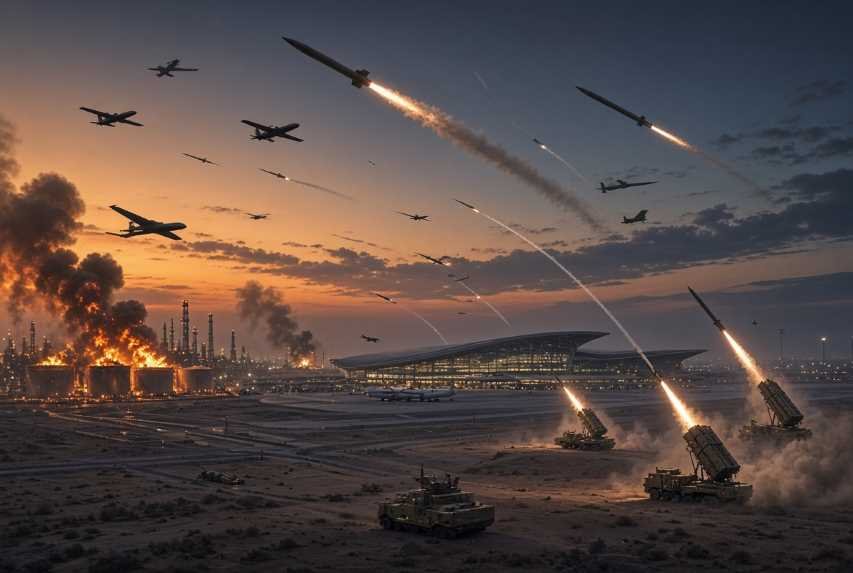
A missile strike that collapses part of an airport ceiling can kill and wound hundreds of people in minutes, cancel hundreds of flights, and force governments to move schools and offices online. When the same airport is hit repeatedly within days, and when oil storage tanks and refineries are also burning, the effects move outward through insurance markets, tanker routes, and refinery margins until they appear in higher diesel prices or delayed shipments in distant countries. In October 2026 this transmission is under way. Yemen’s Houthi movement has conducted successive attacks on Saudi airports and energy facilities while the Strait of Hormuz remains heavily restricted and Bab al-Mandab sits under the shadow of coastal fighting. The combination links a local military campaign to global energy and trade networks.
The central question is how attacks from Yemen, occurring alongside restrictions at the Strait of Hormuz and elevated risk at Bab al-Mandab, reshape military security, energy supplies, shipping patterns, economic stability, and diplomatic calculations worldwide. Answering it requires separating confirmed damage and casualties from claims that are still disputed, placing the current wave in the longer history of the Yemen conflict, and distinguishing effects already visible in markets and aviation from those that would appear only if disruptions deepen or lengthen.
Background: Yemen, Saudi Arabia, and the Regional Security Environment
The contemporary Yemen conflict took its present form when Houthi forces seized Sanaa in 2014 and pushed south. Saudi Arabia assembled a coalition and began military operations in March 2015 to restore the internationally recognized government. The ensuing years produced high civilian casualties, massive displacement, and a severe humanitarian crisis. Houthi forces developed and employed ballistic missiles, cruise missiles, and drones against Saudi airports, military bases, and energy sites. These cross-border attacks became a regular feature of the war.
An April 2022 truce sharply reduced major fighting and cross-border strikes. Front lines largely froze. Political and economic disagreements over ports, airports, revenue sharing, and the status of the recognized government remained unresolved. In 2026 the truce collapsed amid the wider war that began with U.S. and Israeli strikes on Iran on 28 February. Iran restricted traffic through the Strait of Hormuz. In July the Houthis announced measures against Saudi-linked shipping in the Red Sea. In September they advanced along the western coast, taking the port of Mocha and islands including Perim (Mayyun) that sit inside or adjacent to Bab al-Mandab. Saudi-backed Yemeni government forces subsequently opened counteroffensives supported by coalition air strikes.
The Houthis control the bulk of northern Yemen and have built substantial capacity to assemble and operate missiles and drones. Multiple independent assessments have documented Iranian-origin components, designations, and technical assistance in Houthi systems, together with commercially available parts from a range of countries. Iran denies violating arms embargoes. Yemen’s internationally recognized government, supported by Saudi Arabia, holds territory mainly in the south and east and has contested the recent coastal gains. Other southern actors have at times pursued separate agendas. The war therefore contains local Yemeni power struggles, regional rivalry, and external material support rather than a simple two-sided contest.
Saudi strategic priorities include securing the long southern border, protecting major airports that serve the capital and other cities, and safeguarding the energy infrastructure that supplies both domestic demand and export markets. The East-West pipeline, which carries crude from eastern fields to Red Sea terminals such as Yanbu, has grown in importance as a partial alternative to the restricted Strait of Hormuz. Successful strikes on airports disrupt commercial aviation, official travel, and pilgrimage-related movements. Strikes on refineries or tank farms reduce domestic fuel availability and limit export flexibility.
Recent Attacks from Yemen on Saudi Arabia: What Is Known?
Multiple international news organizations, Saudi official statements, and Houthi claims document a sustained series of missile and drone attacks on Saudi airports and oil facilities from September through mid-October 2026. Saudi authorities have confirmed impacts, casualties, fires, and temporary shutdowns in a number of cases. The Houthis have claimed many of the operations and described them as responses to Saudi-led air strikes inside Yemen. The level of independent corroboration differs by incident.
Airport attacks in early to mid-October 2026
King Khalid International Airport, north of Riyadh, was struck repeatedly. Earlier in the week of 6–10 October, attacks killed several people and damaged at least one commercial aircraft on the ground. On Saturday, 10 October, a projectile hit a terminal complex used for domestic flights. Saudi civil aviation authorities reported twelve people killed and 309 wounded, with some in critical condition. Among the dead were four Saudi citizens, two Bangladeshi nationals, and one national each from the United States, Egypt, Jordan, Syria, Palestine, and Sudan. An Indian national injured in the same strike later died. Video from inside the terminal showed passengers near a departure gate when the impact brought down part of the ceiling, filled the area with dust and debris, and sent people running. Flights were suspended or diverted. The Saudi-led coalition called the strike a war crime against a civilian target.
On Sunday, 11 October, another projectile struck Terminal 4 and started a fire. Authorities reported one person killed—a Pakistani resident—and eleven wounded. Air defenses intercepted at least one cruise missile in the vicinity. The airport closure was extended. Houthi spokesman Yahya Saree claimed responsibility for operations against the airport and warned that Saudi airports, except those serving Mecca and Medina, were legitimate targets. Coalition statements also recorded a projectile near King Fahd International Airport in Dammam and additional interceptions, including a ballistic missile aimed toward Khamis Mushait.
By the middle of the week the cumulative death toll linked to the Riyadh airport attacks stood in the high teens once later deaths from injuries were included. Damage assessments covered radar, communications equipment, and terminal structures. Large numbers of flights were canceled. Some schools in the capital shifted to remote instruction, and certain offices adjusted working arrangements.
Oil and energy facility attacks
In early September Houthi forces launched coordinated drone and missile waves against southern Saudi cities and sites. Saudi authorities confirmed strikes on Abha, Jazan, Najran, and Khamis Mushait that wounded dozens of people, including women and children, and started fires at energy facilities. The Energy Ministry reported temporary halts in some operations. The Jazan refining complex, with a capacity of roughly 400,000 barrels per day, was hit; satellite infrared data showed fire activity, and industry sources indicated the plant was taken offline. Storage tanks were damaged. The same facility had already been forced offline by an earlier strike in July.
Later in September the Houthis claimed attacks on Aramco facilities at Yanbu and on targets in Riyadh. Saudi statements recorded interceptions of ballistic missiles directed toward Taif and the Yanbu area. Claims of fires and direct hits at Yanbu were issued by the Houthis; the degree of independently confirmed major damage varied. In early October the group claimed further strikes on gas and oil facilities in the Eastern Province, including sites described as Shugadam and Tanajib, and asserted that fires resulted. Public Saudi commentary focused more heavily on the airport incidents and on retaliatory operations inside Yemen.
Separately, the East-West pipeline was damaged in mid-September by drone strikes that Saudi authorities attributed to Iraqi militias. Pumping stations were hit, Yanbu loadings stopped for a period, and throughput recovered only partially in subsequent weeks. These pipeline incidents reduced the volume of crude that could bypass Hormuz at a moment when Red Sea risks were also rising.
Saudi military preparation and why defenses have not fully protected the airports
Saudi Arabia has invested heavily for years in layered air and missile defense. The architecture includes long-range systems capable of engaging ballistic missiles at altitude, medium-range systems, shorter-range point defenses, airborne early-warning aircraft, ground-based radars, and integrated command centers. Patriot batteries and other interceptors have been deployed to cover major cities, airports, oil facilities, and military bases. In previous years these systems intercepted large numbers of incoming Houthi projectiles. Stocks of interceptors, spare parts, and trained crews were built up, and cooperation with the United States and other partners supplied additional sensors and technical support.
Despite this preparation, repeated strikes have reached King Khalid International Airport and other sites in recent weeks. Several factors explain the shortfalls. The kingdom’s critical infrastructure is spread across a very large territory. Defending Riyadh, southern border cities, Red Sea terminals, eastern oil facilities, and multiple airports simultaneously requires continuous radar coverage and rapid allocation of interceptors. When attacks arrive in waves or from different directions, the system must prioritize. Reporting has indicated that interceptor inventories have been under strain after months of elevated threat levels linked to the wider regional war. Each successful engagement consumes expensive missiles; unsuccessful or saturated attacks still deplete readiness.
Houthi capabilities have also evolved. Open reporting describes the use of missiles with higher terminal speeds and improved seekers, including thermal-tracking features that can home on heat sources such as aircraft engines or ground equipment. Low-flying cruise missiles and drones further complicate detection because they can exploit terrain or fly below optimal radar horizons for parts of their trajectory. Launch sites inside Yemen can be mobile, reducing the warning time available once a projectile is detected. Coordination of ballistic missiles, cruise missiles, and drones in the same operation forces defenders to engage different threat types with different systems at nearly the same moment.
Geographic and operational realities add difficulty. Riyadh lies hundreds of kilometers from the Yemeni border, yet modern missiles cover that distance in minutes. Airports are large, fixed targets with extensive open areas, fuel storage, and parked aircraft that present multiple aim points. Even when air defenses destroy most incoming weapons, a single leaker that reaches a terminal can produce mass casualties and major disruption. Command-and-control links, radar nodes, and interceptor batteries themselves can become targets or can be degraded by electronic interference. After successive days of alerts and engagements, crew fatigue and maintenance cycles further reduce sustained performance.
Saudi officials have acknowledged the pressure. Statements after the October airport strikes emphasized that defenses intercepted some projectiles while others penetrated. Coalition spokesman Major-General Turki al-Malki and Energy Minister Prince Abdulaziz bin Salman both described the attacks as serious and signaled that responses would follow. Retaliatory air strikes have targeted Houthi launch areas and military sites inside Yemen, and Saudi-backed ground forces have attempted to push back Houthi positions near the coast. These measures have not yet restored a level of protection that prevents repeated hits on high-value civilian infrastructure. The gap between substantial investment in defenses and the recent penetration of those defenses at Riyadh’s main airport is therefore visible in the casualty figures, flight cancellations, and extended closures.
Saudi responses and remaining uncertainties
The coalition has conducted air strikes against Houthi targets, including reported destruction of missile launch platforms, and has supported Yemeni government operations seeking to recover coastal territory. Additional interceptions have been announced in the Eastern Province and toward Khamis Mushait. Uncertainties persist over the exact mix of weapon types in each wave, the precise number of projectiles that reached their targets versus those destroyed in flight, the duration of outages at specific oil facilities, and the extent of real-time coordination between Houthi units and any external advisers. Casualty numbers for the airport attacks come from Saudi civil aviation and coalition statements and have been corroborated across multiple news organizations. Houthi claims of damage at energy sites are presented as claims and are weighed against available official comments and satellite indicators.
The current campaign differs from earlier periods in its focus on a major civilian airport deep inside the kingdom and in its timing alongside active combat for the Bab al-Mandab approaches and ongoing Hormuz restrictions.
The Strait of Hormuz: Why This Narrow Waterway Matters to the World
The Strait of Hormuz is the narrow maritime passage between the Persian Gulf and the Gulf of Oman, bordered by Iran and Oman. Designated traffic lanes run through constrained waters. For decades it has been the principal exit route for the majority of Gulf crude oil, refined products, and liquefied natural gas. In the first half of 2025, before the present war, flows reached approximately 20–21 million barrels per day of petroleum liquids—about one-fifth of global consumption and a large fraction of seaborne oil trade. Most cargoes were destined for Asia. Qatar’s LNG exports also depend on safe passage through the broader area. No full maritime alternative exists. Pipeline bypasses—the Saudi East-West system to Yanbu and the UAE Habshan-Fujairah line—provide several million barrels per day of capacity combined, well below normal Hormuz volumes.
Since late February 2026 the strait has been under severe restriction. Iran has attacked commercial vessels, especially tankers, issued warnings against unauthorized transit, and asserted control over the waterway. The United States has enforced a naval blockade of Iranian ports, escorted selected traffic along routes near the Omani coast, and struck Iranian naval and missile targets. Automatic Identification System tracking has shown commercial crossings reduced to a small fraction of pre-crisis levels for extended periods. Oil volumes have partially recovered through vessels running with transponders off, ship-to-ship transfers in the Gulf of Oman, U.S.-facilitated movements, and greater use of pipeline routes. Tracking services have reported crude flows through or around the strait ranging from roughly 8.5 million barrels per day in some recent weeks to recoveries near 13 million barrels per day in others, generally still below pre-war baselines. Refined-product movements have remained more limited. Tanker attacks continued into October, with multiple strikes recorded in single weeks.
Heightened tension without a complete new cutoff keeps a risk premium in oil prices, raises insurance and freight costs, and sustains elevated military deployments. A temporary additional disruption would trigger inventory draws, short-term price spikes, and rapid repositioning by traders and refiners. A prolonged severe restriction would tighten supplies for Asian importers, strain product markets, and feed into higher industrial and household energy costs. The exact price path would depend on the length of the shortfall, spare capacity available outside the Gulf, releases from strategic reserves, and any demand destruction. Past shocks show that prices often rise on anticipation before physical barrels are fully unavailable.
Bab al-Mandab: The Gateway to the Red Sea and the Suez Canal
Bab al-Mandab is the narrow strait connecting the Red Sea to the Gulf of Aden, lying between Yemen and the Horn of Africa. Virtually all commercial traffic using the Suez Canal to travel between Asia and Europe must pass through it or take the much longer route around the Cape of Good Hope. In ordinary conditions the waterway carries substantial volumes of containers, bulk cargo, and oil. Beginning in late 2023, Houthi attacks on commercial ships in the Red Sea, connected to the Gaza war, prompted many operators to divert. Traffic and Suez Canal revenues fell sharply. Partial recoveries occurred later, yet volumes stayed well below 2023 peaks.
In 2026 the risk increased further. The Houthis’ July announcement targeting Saudi-linked shipping, followed by their September seizure of Mocha and islands inside or beside the strait, placed launch sites and observation points closer to the main shipping lanes. Saudi crude moved by pipeline to Yanbu raised the amount of oil potentially exposed to Red Sea threats. Vessel counts have fluctuated but have remained suppressed relative to earlier baselines. From positions on the Yemeni coast and islands, anti-ship missiles, drones, mines, or fast boats can threaten passing traffic.
Rerouting around the Cape of Good Hope typically adds 10–14 days and several thousand nautical miles to an Asia-Europe container voyage. Fuel burn rises significantly, crew costs increase, ships complete fewer round trips per year, and freight rates adjust upward. Container equipment can become scarce on the preferred route, inventory costs grow, and delivery windows slip. Egypt forgoes toll revenue. An illustrative large container ship on the longer route consumes substantially more bunker fuel; the exact premium varies with speed, fuel price, and hull efficiency. These costs are already reflected in higher war-risk insurance and selective avoidance of the Red Sea.
Comparing the Strait of Hormuz and Bab al-Mandab
The two straits differ in location and primary cargo yet reinforce each other economically. Hormuz is the dominant oil and LNG exit from the Gulf and has only partial pipeline alternatives. Bab al-Mandab is the southern gate of the Suez route and matters more for containers and for oil already moved west by pipeline. Pressure on both at once pushes additional traffic onto the Cape route, raises costs for energy and manufactured goods, and reduces exporters’ flexibility. Present conditions feature active restrictions and attacks at both waterways rather than total closure of either.
Military Technology: Drones, Missiles, Radar, and Air Defense
One-way attack drones employed in the theater are generally low-cost relative to manned aircraft or many interceptors. They may be propeller-driven or jet-powered and guided by inertial systems, satellite navigation, or terminal seekers. They can be launched from mobile platforms in numbers, fly at low altitude to reduce detection, and carry warheads sufficient to damage fuel tanks, parked aircraft, or terminal structures. Range and reliability are limited by weather, electronic jamming, and air defenses. Reconnaissance drones mainly supply targeting information.
Ballistic missiles travel on high-arcing trajectories and arrive at high speed in the terminal phase, leaving short engagement windows. Cruise missiles stay lower and can alter course, making continuous tracking harder. Both types have been claimed in recent operations against Saudi targets. Defenders must detect, classify, and engage each threat with appropriate systems. Long-range interceptors handle high-altitude ballistic missiles; shorter-range systems protect specific sites against drones and cruise missiles. Saudi forces have destroyed many incoming weapons, yet the combination of volume, mixed threat types, and geographic dispersion has allowed some to reach airports and energy sites.
Radar networks, airborne surveillance, satellites, and ground sensors feed command centers that allocate interceptors. Electronic warfare can disrupt guidance or communications. Cyber operations may affect supporting networks. Artificial intelligence helps fuse sensor data and rank tracks, but its effectiveness depends on data quality, system integration, and resistance to deception. Human operators normally retain final engagement authority.
The cost imbalance is widely noted: inexpensive drones or missiles can compel the use of far more expensive interceptors. Public information on exact Saudi inventories and interception percentages is limited; observable outcomes—the repeated penetration of defenses at a major civilian airport—demonstrate that current stocks, coverage, and tactics have not prevented significant damage and casualties.
Maritime Technology and the Protection of Commercial Shipping
Tracking relies on AIS transmissions, satellite radar and optical imagery, coastal radar, and commercial data platforms. AIS signals can be switched off or falsified, so operators and analysts cross-check multiple sources. Satellite navigation supports routing but can be jammed or spoofed. Encrypted ship-to-shore links and cybersecurity measures protect operational information. Weather routing and risk models that incorporate recent incident data help companies choose speeds and paths. These technologies improve situational awareness and support escort or avoidance decisions, yet they cannot prevent physical attack once a vessel is within range of missiles or drones. Companies balance insurance costs, crew safety, and commercial obligations when deciding whether to transit.
Global Energy Markets: Oil, Natural Gas, and Electricity
Risk at both chokepoints has kept oil prices above $100 per barrel during periods of intensified attacks. The premium reflects both lower physical flows and expectations of further disruption. Diesel and other refined products have faced additional tightness. LNG exports from the Gulf remain exposed through Hormuz. Strategic stocks, spare capacity in other producing regions, and demand responses offer buffers that weaken if shortages persist. Prices frequently rise on anticipation before actual barrels are missing from the market, as refiners and traders adjust positions. Earlier shocks produced sharp initial increases followed by moderation when alternative supplies or reserve releases appeared. Longer-term growth in renewables, efficiency gains, and supplier diversification can reduce exposure over time but do not remove near-term reliance on existing maritime volumes.
The Economic Chain Reaction: From Shipping Disruptions to Household Inflation
Higher military risk raises war-risk insurance and security outlays. Shipping lines may slow vessels, reroute them, or suspend sailings. Freight rates and transit times increase. Importers encounter higher landed costs that can pass into wholesale and consumer prices, moderated by competition, inventories already on hand, exchange rates, taxes, and subsidies. Sectors sensitive to either energy prices or container delays include food and agricultural inputs, fertilizers, consumer electronics, automotive components, industrial machinery, construction materials, and pharmaceuticals. Tourism and aviation are affected directly by regional risk perceptions and by airport closures. Manufacturers and logistics firms respond by raising safety stocks or shifting suppliers. The ultimate effect on households differs by country according to import shares, fiscal space, and currency flexibility.
Egypt: Suez Canal Revenues, Foreign Currency, and Economic Vulnerability
Canal tolls supply an important share of Egypt’s foreign-currency earnings. Revenues dropped sharply in 2024 during earlier Red Sea attacks. Partial recovery in fiscal year 2025/26 lifted receipts to approximately $4.4–4.67 billion according to Egyptian official figures—an increase from the previous year but still far below the earlier peaks near $9–10 billion. Transit numbers and tonnage have improved from the lowest points yet remain vulnerable to security conditions at Bab al-Mandab. Further prolonged diversion would cut receipts, add pressure on the pound, raise costs of imported goods, and affect employment in ports and logistics. Tourism, remittances, and domestic economic policy also influence the external balance. Improvements in canal services, regional diplomacy, and broader diversification can strengthen resilience.
Saudi Arabia and Other Gulf Economies
Saudi Arabia faces simultaneous threats to airports, refining and storage sites, and export routes. Defense spending and insurance costs have risen. The East-West pipeline offers a valuable bypass, and officials have spoken of expanding its capacity in coming years, yet the line has already suffered damage and has operated below recent peaks. Visible successful attacks can weigh on investor confidence and tourism. Other Gulf states have differing exposures: the UAE can use its Fujairah terminal outside Hormuz; Qatar’s LNG is more tightly linked to Gulf exit routes; remaining producers vary according to field location and available terminals. Diversification programs continue in parallel with security measures.
Asia, Europe, Africa, and the United States: The Global Impact
China, Japan, South Korea, and India import large volumes of Gulf oil and depend on reliable sea lanes for both energy and manufactured exports. Europe feels the effects through energy prices, delayed components from Asia, and Mediterranean trade. The United States, despite substantial domestic production, remains linked to global oil prices and maintains major military and diplomatic roles in regional maritime security. Many African economies confront higher fuel and food import bills with limited foreign-exchange cushions. States with heavy import dependence and narrow fiscal margins are typically the most exposed to extended disruption.
Iran, International Alliances, and Geopolitical Competition
Governments, United Nations expert panels, and independent research organizations have repeatedly documented Iranian-origin components and technical support in Houthi missile and drone programs, while Iran denies responsibility for individual attacks. The 2026 war with Iran has tied the Yemen front more closely to the larger confrontation. The United States conducts escorts, maintains the blockade of Iranian ports, and strikes Iranian assets while pursuing intermittent talks. Saudi Arabia supplies air support to Yemeni government forces and carries out retaliatory strikes. European navies and major Asian importers share an interest in predictable navigation even when they differ on broader political questions. Incentives for de-escalation coexist with risks of miscalculation.
Humanitarian Consequences and Civilian Safety
Civilians in Yemen face continued displacement and constrained services amid renewed fighting. In Saudi Arabia the airport strikes have killed and injured residents, foreign workers, and travelers. Crews on commercial vessels operate under elevated threat in contested waters. Rising energy and freight costs can increase prices for food, fuel, and medicines, with sharper effects on lower-income households. Clear casualty reporting, protection of civilian sites, and humanitarian access remain essential under international humanitarian law.
Three Future Scenarios: What Could Happen Next?
These are analytical illustrations, not predictions.
In a limited and contained scenario, attacks continue at a reduced or steady rate, maritime traffic proceeds with higher insurance costs, and oil prices carry a moderate premium. Diplomacy and local arrangements prevent major new territorial shifts or lasting closures.
In a prolonged maritime insecurity scenario, repeated incidents keep diversion rates high, freight costs elevated, and Suez volumes suppressed. Energy markets stay volatile. Gradual inflationary pressure appears in import-dependent economies. Firms adapt with longer lead times and larger inventories.
In a wider escalation scenario, sustained interruption at one or both chokepoints creates larger physical shortfalls, sharper price rises, expanded military deployments, and broader economic slowdown. Recovery would require de-escalation and renewed confidence in safe passage.
Relevant indicators include the frequency and success rate of attacks, movements in insurance premiums, changes in tracked vessel volumes, statements on interceptor availability, and any progress in diplomatic contacts.
Solutions: How Can Countries and Businesses Reduce the Risks?
Governments can maintain and coordinate strategic petroleum reserves, improve real-time sharing of maritime threat information, pursue diplomatic channels aimed at de-escalation, and invest in diversified energy supplies and hardened infrastructure. Shipping companies can update route planning with current risk data, reinforce crew safety and cybersecurity practices, obtain suitable insurance, and communicate contingencies to customers. Energy companies can strengthen physical protection of key sites, preserve alternative export pathways, and hold operational inventories. Importers and manufacturers can broaden supplier bases and quantify cost exposures in advance. Egypt can keep enhancing canal services and logistics offerings. International bodies can support technical cooperation and confidence-building measures. Each action has limits; lasting risk reduction depends on political agreements that lower the incentives for continued attacks.
Frequently Asked Questions
- Why is Yemen strategically important to Saudi Arabia?
The long-shared border and Houthi control of northern territory have enabled repeated strikes on Saudi cities, airports, and energy infrastructure. Coastal positions also affect Red Sea export alternatives. - What is the difference between the Strait of Hormuz and Bab al-Mandab?
Hormuz is the main exit for Gulf oil and LNG. Bab al-Mandab is the southern entrance to the Red Sea and the primary Asia-Europe corridor via Suez. - Why is the Strait of Hormuz important to global oil supplies?
It normally handles roughly one-fifth of world petroleum liquids and lacks a complete sea alternative. - How does Bab al-Mandab affect the Suez Canal?
Nearly all Suez traffic between Asia and Europe must pass Bab al-Mandab. Threats there reduce canal transits and Egyptian revenue. - How can drone attacks threaten military and civilian infrastructure?
Low-cost one-way drones can be launched in quantity against fixed targets such as fuel tanks or airport terminals, forcing expensive defensive responses. - Can modern air-defense systems stop every missile or drone?
No. Systems intercept many threats, but saturation attacks, low-altitude flight profiles, mixed weapon types, and finite interceptor stocks allow some projectiles to reach targets. - Why do shipping companies divert vessels around Africa?
When insurance premiums or attack risks render the Red Sea route uneconomic or unsafe, the longer Cape of Good Hope passage becomes the practical alternative. - How can Red Sea insecurity affect Egypt’s economy?
Lower Suez traffic reduces foreign-currency earnings, which can pressure the currency and raise the cost of imports. - Could disruptions in the Gulf increase global inflation?
Yes, through higher oil prices and freight rates that raise costs for energy and traded goods. The scale depends on duration and policy responses. - Which countries are most vulnerable to energy and shipping disruptions?
Large Asian oil importers, European manufacturers that rely on timely Asian inputs, and developing economies with limited reserves. - How can AI and satellite technology improve maritime security?
They aid vessel tracking, anomaly detection, and imagery analysis, improving awareness when combined with other sources and human oversight. - What diplomatic measures could reduce the risk of further escalation?
Ceasefire arrangements, third-party mediation, practical agreements on navigation safety, and talks that address underlying political and economic disputes.
Why the World Should Pay Attention
The recent Houthi attacks on Saudi airports and oil facilities show how a focused military campaign can intersect with restrictions at the Strait of Hormuz and risks at Bab al-Mandab to influence global energy flows, aviation networks, and maritime trade. Confirmed casualties and repeated operational disruptions at Riyadh’s principal airport, together with reported impacts on refining and storage sites, have already affected flight schedules, insurance costs, and market sentiment. These events occur against the background of the 2026 Iran war and earlier Red Sea shipping crises. Saudi defenses, despite years of investment in layered systems and interceptor stocks, have not prevented multiple penetrations of a major civilian airport, illustrating the difficulty of sustaining comprehensive protection across a large territory against evolving missile and drone threats. Interconnected markets carry local military outcomes into higher costs and uncertainty for importers, manufacturers, and households elsewhere. Accurate reporting, continued adaptation of defenses and commercial risk management, economic buffers, and persistent diplomatic efforts remain the available means of limiting further spread of regional insecurity. Future developments will depend on the decisions of the parties involved and on the responses of governments and markets.
 |  |  |
 |  |  |