
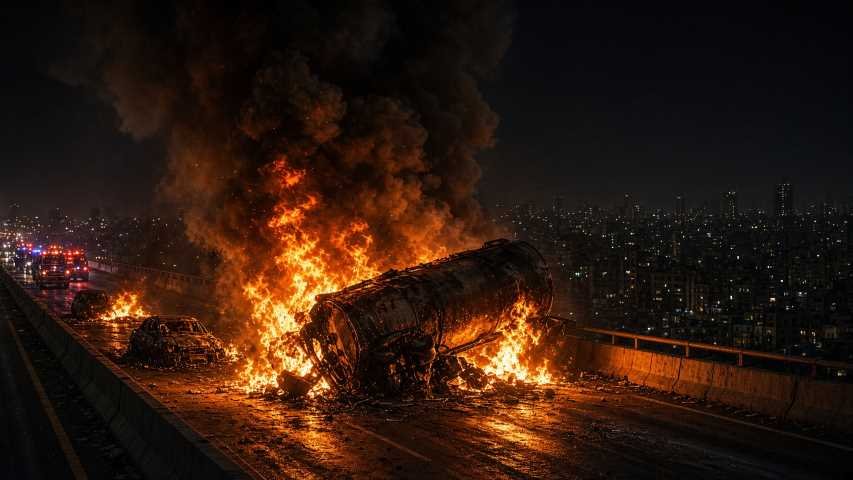
On the evening of 25 November 2026, during rush hour on an elevated stretch of Cairo’s Ring Road in the densely populated Warraq district of Giza, a tanker carrying petroleum products overturned after a collision. Petrol leaked, ignited, and the resulting fire spread rapidly through nearby traffic. Egypt’s Ministry of Health and Population later confirmed 31 deaths and 26 injuries. Preliminary assessments by the Public Prosecution indicated that roughly 27 vehicles—including cars, microbuses, and motorcycles—were destroyed. The incident occurred above Tunnel 10, beneath the Rod El-Farag Axis, in a residential area of Greater Cairo.
The scale of the fire, the high death toll on a major urban artery, and the involvement of a hazardous-materials vehicle drew intense national attention and condolences from regional and international bodies. Fuel-transport accidents differ from ordinary crashes because of the volume of flammable liquid, the potential for rapid fire spread through heat radiation and secondary ignitions, and the difficulty of rescue in confined or elevated roadway environments. This tragedy has renewed scrutiny of how petroleum products move through Egypt’s cities, the adequacy of existing rules, and the role technology and enforcement can play in prevention.
What Happened: A Detailed Timeline
The fire erupted around 6:30 p.m. local time on Wednesday, 25 November 2026. Early unverified accounts circulating in local media suggested various mechanical or external factors; the Ministry of Transport later stated that cause determination rested with prosecutors. Ministry of Electricity officials indicated that overhead power lines were intact when the fire began and that any damage or tripping of circuits occurred afterward as a consequence of the blaze.
According to the Public Prosecution’s account, based on the suspect’s statement (which investigators said matched scene inspection, witness accounts, and technical evidence), a 21-year-old private-car driver was traveling from the El-Marg direction toward Al-Haram at approximately 110 km/h with his father as a passenger. While changing lanes to overtake, the front left of his car struck the rear right of the tanker. He lost control and veered toward the far right side of the roadway. One of the tanker’s tires burst; the tanker struck a concrete barrier, overturned, and petrol leaked and ignited. The fire spread to surrounding vehicles. Eyewitnesses later described intense flames, explosions of vehicle tanks and tires, thick smoke, and people trapped in traffic. Two individuals who reportedly tried to warn others were among those killed.
Civil Protection forces and firefighters responded, ultimately controlling the blaze. Thirty-nine ambulances transported the injured to hospitals including Imbaba General, Warraq Central, Sheikh Zayed Specialized, and others. Health Minister Khaled Abdel Ghaffar reported critical burn cases (some covering 70–80 percent of the body), moderate burns, and cases of smoke inhalation. Five injured people were later discharged; eight were transferred to a burns unit. Forensic teams collected DNA samples to identify victims whose remains could not be identified by other means. By Thursday, wreckage had been cleared sufficiently for traffic to resume.
On 26 November, prosecutors detained the 21-year-old driver for four days pending further investigation and ordered drug testing. The investigation continues to determine the full circumstances and any criminal liability. The tanker belonged to a private contractor rather than the Ministry of Petroleum. President Abdel Fattah el-Sisi directed full medical care and support for the injured and bereaved families and ordered assessment of losses for compensation. Prime Minister Mostafa Madbouly visited hospitals, coordinated with relevant ministers, and called for exceptional assistance including bank investment certificates providing income to families and replacement vehicles. Substantial private and institutional donations (reaching roughly 200 million Egyptian pounds within hours of an appeal, according to Cabinet statements) supplemented state efforts. The Cabinet indicated that safety measures for petroleum-product transport would be reviewed once the investigation clarified the causes and circumstances.
These details rest on official statements from the Public Prosecution, Ministry of Health, and Cabinet. Preliminary casualty figures issued on the night of the incident were lower; the Ministry of Health’s updated toll is 31 dead and 26 injured. Full technical findings on vehicle condition, exact ignition sequence, and any contributing factors remain subject to the ongoing inquiry.
Technical Analysis: Why Fuel-Tanker Incidents Escalate So Quickly
Petroleum products such as gasoline are highly flammable liquids with low flash points. When a tank ruptures or a valve fails after an impact or rollover, large quantities of fuel can spill. Vapors mix with air and can ignite from sparks, hot surfaces, or electrical sources. Once alight, the fire releases intense radiant heat that can ignite nearby vehicles even without direct contact. Secondary explosions from other fuel tanks or tires are common. Smoke is dense and toxic, reducing visibility and creating asphyxiation risks. On an elevated roadway with concrete barriers, escape routes are limited and firefighting access is constrained.
Tanker design typically incorporates a chassis, a cylindrical or compartmentalized tank, baffles to reduce liquid surge, valves, and safety features such as rollover protection and emergency shutoffs. Stability depends on center of gravity, load distribution, suspension, tires, and braking. High-sided or partially filled tanks can be more prone to rollover under lateral forces from cornering, swerving, or impact. Tire condition, brake performance, and maintenance are critical. Road geometry—curves, slopes, barriers, and speed—affects both the likelihood of loss of control and the consequences once a spill occurs.
In dense urban corridors, the presence of many other vehicles multiplies the potential for a multi-vehicle fire. Speed limits, lane discipline, and the physical separation of heavy hazardous-materials traffic from general traffic all influence risk. No official investigation findings have established a specific mechanical failure on the tanker or any other technical defect as the cause of this incident; the preliminary account centers on the collision sequence described above. Broader engineering principles, however, explain why such events can become catastrophic.
Modern Technology That Could Reduce Risk
Several categories of technology are commercially available or in advanced deployment internationally.
Smart tanker and vehicle systems. Electronic stability control and rollover-prevention systems monitor lateral acceleration and can apply brakes selectively or reduce engine power. Advanced emergency braking and collision-avoidance systems use radar and cameras. GPS fleet tracking combined with telematics can log speed, hard braking, and route compliance in real time. Tank sensors for pressure, temperature, and leakage, linked to automatic emergency shutoff valves, can limit the volume of a spill. These systems exist on many modern hazardous-materials fleets in Europe, North America, and parts of Asia.
Artificial intelligence and monitoring. In-cab driver-monitoring systems detect fatigue or distraction via cameras and alert the driver or the company. Predictive maintenance uses vehicle data to flag potential failures before they occur. AI-powered traffic cameras and roadside sensors can detect incidents, estimate severity, and trigger alerts. Intelligent routing software can keep hazardous loads away from peak-hour congestion or sensitive areas where regulations allow.
Smart infrastructure. Intelligent transportation systems include variable message signs, automatic incident detection, and connected traffic signals. Smart barriers and improved lighting help manage consequences. Dedicated or time-restricted routes for hazardous materials, combined with enforcement technology, reduce exposure. Many of these elements are already used on major highways in Japan, Germany, the United States, and parts of the Gulf.
Emergency-response tools. Thermal imaging helps firefighters locate people and hot spots. Drones provide overhead views of large incidents without exposing personnel. Digital dispatch and real-time data sharing among police, fire, ambulance, and hospitals improve coordination. Specialized foam or other suppression agents are standard for fuel fires; robotic systems are emerging for high-risk scenes.
Many of these technologies are mature and commercially available. Implementation in Egypt would require capital investment, training, regulatory mandates, and reliable enforcement. Some—such as GPS tracking and basic stability systems—are already feasible on a prioritized basis for petroleum fleets. Fully connected vehicle-to-everything networks or widespread autonomous features remain longer-term.
Human Factors
Driver behavior remains central. Speeding, abrupt lane changes, and inadequate following distances increase collision risk. Fatigue from long hours, distraction, and insufficient training on the specific dynamics of tankers (surge, higher rollover risk) compound the problem. Companies are responsible for hours-of-service compliance, vehicle maintenance, and ensuring drivers hold the proper qualifications and periodic medical and competency checks. In the present case, the detained driver’s admitted speed and lane-change maneuver are under prosecutorial review; no final determination of responsibility has been made.
Government Response and the Broader Regulatory Framework
Egyptian authorities mobilized emergency medical and firefighting resources quickly. Presidential and prime-ministerial directives emphasized care for the injured, support for families, and eventual compensation. The Public Prosecution is leading the investigation, including forensic identification. The Cabinet has signaled that petroleum-transport safety rules will be examined once facts are clearer.
Egypt regulates hazardous-materials road transport through several instruments. Law No. 73 of 2019 established the Land Transport Regulatory Authority, which coordinates rules for petroleum-product movement with the ministries of petroleum, interior, and transport. Executive regulations (Minister of Transport Decision No. 90 of 2021) impose obligations on carriers: proper licensing, driver training specific to hazardous cargo, technical fitness of vehicles, emergency equipment, warning placards, adherence to approved routes and timings, and efforts to avoid residential areas when routes are not fixed. The Traffic Law (No. 66 of 1973) and its regulations govern vehicle and driver licensing and require special permits for dangerous goods. Environment Law No. 4 of 1994 addresses hazardous-substance handling. A 2018 Cabinet decision restricts trucks exceeding four tonnes from the Ring Road between 6 a.m. and midnight; questions have been raised about how the tanker was operating on that stretch during restricted hours. Egypt is not a contracting party to the European Agreement concerning the International Carriage of Dangerous Goods by Road (ADR), though its standards are frequently referenced internationally and Egyptian petroleum authorities have drawn on similar principles in safety guides.
Enforcement capacity, the number of inspections, and consistency of route restrictions are areas frequently cited by analysts as needing strengthening. The difference between rapid post-incident response and systematic prevention is clear: compensation and medical care address consequences; licensing, inspection, training, technology mandates, and infrastructure changes address probability and severity beforehand.
International Practices
Aspect | United States | United Kingdom / EU | Germany | Japan | Australia |
Core regulations | DOT / PHMSA Hazardous Materials Regulations; strict tanker specs, placarding, routing | ADR (for international) + national rules; driver Certificate of Professional Competence | ADR + stringent TÜV inspections | Strict vehicle standards, ITS integration | Heavy Vehicle National Law; dangerous-goods code |
Monitoring | Electronic logging, GPS common on fleets | Telematics, ANPR enforcement | Mandatory periodic inspections | Advanced CCTV and V2X pilots | Fatigue-management tech, GPS |
Driver requirements | Endorsement, training, medical | CPC + ADR training | Professional license + periodic checks | Rigorous licensing | Fatigue and competency rules |
Infrastructure / response | Designated hazmat routes, robust emergency planning | Variable message signs, multi-agency coordination | High engineering standards on Autobahns | Intelligent highways, rapid response | Long-distance freight focus, remote-area protocols |
Notable lessons | Post-incident rule tightenings after major spills | Emphasis on training after historical incidents | Engineering and inspection culture | Technology integration | Fatigue management for long hauls |
Real-world examples include U.S. tanker rollovers that prompted routing and stability-system discussions, European tunnel fires that led to stricter ADR vehicle and operational rules, and Japanese highway incidents that accelerated intelligent-transportation investments. Developing countries with similar urban density and mixed traffic face parallel challenges of enforcement and fleet modernization.
Historical Context and Wider Impacts
Major fuel-tanker fires and explosions worldwide have repeatedly shown the same pattern: an initial loss of control or impact, a large spill, rapid fire spread, and high casualties when the event occurs in traffic or near populations. Subsequent reforms have typically included better tank integrity standards, mandatory stability systems, stricter driver hours, designated routes, and improved emergency coordination. The Al-Warraq incident shares the urban-highway setting and multi-vehicle fire characteristics with several of those cases, though its specific sequence is still under investigation.
Economically, the disaster destroyed vehicles, disrupted a key artery, consumed emergency-service resources, and will generate insurance and compensation claims. Environmentally, smoke, unburned hydrocarbons, and firefighting runoff raise concerns about air quality and soil or water contamination near the site; monitoring and cleanup follow standard protocols for petroleum spills. Socially, the loss of life has produced grief, trauma for survivors and witnesses, and public anxiety about fuel movements through residential districts. Community and private-sector solidarity appeared quickly through donations and blood drives.
Practical Safety Guidance for the Public
If a fuel tanker overturns or begins leaking:
Increase distance immediately; do not approach to film or assist unless directed by professionals.
If in a vehicle nearby, move away from the scene if safe to do so and follow official instructions to evacuate.
Do not block emergency access.
Report the exact location, the nature of the incident (fuel spill/fire), and any visible hazards to emergency services.
Nearby residents should follow Civil Protection guidance on sheltering or evacuating; close windows against smoke.
Risks include intense heat radiation, toxic smoke, and possible secondary explosions. Untrained civilians should not attempt to fight fuel fires.
A Practical National Improvement Path
Short term. Intensify inspections of petroleum fleets for mechanical fitness, permits, and driver qualifications. Enforce existing speed and route rules more consistently. Review coordination protocols among Civil Protection, traffic police, and health services. Launch targeted public-awareness messages on safe distances from tankers.
Medium term. Mandate GPS/telematics and basic stability or collision-avoidance systems for hazardous-materials vehicles. Expand AI-assisted traffic monitoring on major corridors. Strengthen driver certification and company oversight. Identify and upgrade high-risk sections of the Ring Road and similar routes. Explore feasible dedicated or time-restricted corridors.
Long term. Build a national intelligent-transportation backbone with connected sensors and automatic incident detection. Raise vehicle-safety standards toward international benchmarks. Create an independent road-safety investigation body with public reporting. Set measurable national targets for reducing serious crashes involving hazardous materials. These steps involve capital costs, institutional capacity, and sustained political commitment, but they align with practices already producing results elsewhere.
Looking Ahead
Over the next 5–15 years, vehicle-to-everything communication, improved predictive analytics, and more capable semi-autonomous features on trucks could further lower risk. Smart tankers with continuous monitoring and automated response are already emerging. Satellite tracking and digital twins of highway networks allow better planning. Fully autonomous hazardous-materials transport remains experimental and costly; incremental, commercially available systems offer more immediate gains.
The Al-Warraq disaster took 31 lives in a matter of minutes on a road used daily by tens of thousands of people. The investigation will establish the precise sequence and any individual or organizational responsibility. Regardless of those findings, the event illustrates the elevated danger of transporting large volumes of fuel through dense urban traffic and the limits of reactive measures alone.
Modern vehicle-stability systems, real-time monitoring, rigorous maintenance, consistent enforcement of existing Egyptian rules, better routing, and improved emergency coordination are all within reach. Governments, transport companies, and drivers each hold part of the responsibility. Protecting residents who live beside major highways requires both physical and regulatory separation of hazardous loads from ordinary traffic where feasible.
Human life is not replaceable by compensation, however generous. Turning this tragedy into measurable reductions in risk—through technology, stronger oversight, and sustained attention—remains the most meaningful response.
 |  |  |