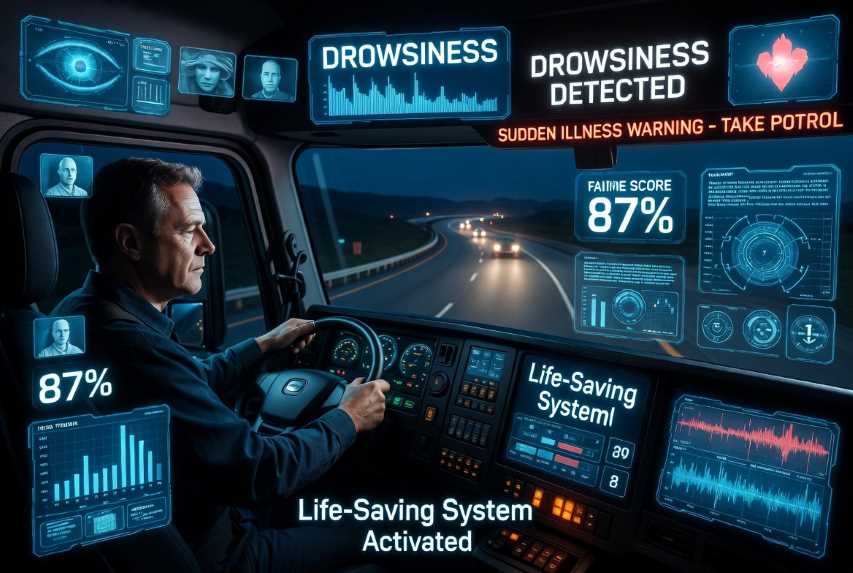
Long‑haul trucking is the backbone of global logistics, but it places immense physical and mental demands on drivers. Fatigue, micro‑sleep, and sudden medical events—such as heart attacks, seizures, or diabetic emergencies—are among the most lethal risks on highways, often leading to devastating collisions with multiple vehicles. Modern technology is rising to the challenge, equipping trucks with intelligent safety systems that can detect when a driver is falling asleep or becoming unwell, intervene to stabilize the vehicle, and summon help. This article explores these life‑saving systems in detail.
The Gravity of the Problem
Driver fatigue contributes to roughly 13% of all commercial truck crashes in the United States, while a significant number of “medical emergencies at the wheel” go unreported as a distinct category. A sleeping driver cannot brake; an unconscious driver cannot steer. At highway speeds, a heavy truck traveling even three seconds without control can cross multiple lanes. The resulting accidents are typically severe, with high fatality rates. The insurance industry, regulators, and fleet operators now recognize that passive measures (such as hours‑of‑service regulations and rest stops) are not enough; active, real‑time monitoring and intervention are essential.
Detection Technologies: How the Truck Knows Something is Wrong
The first line of defense is the ability to reliably detect that a driver is no longer in full control. Multiple sensor systems work together to create a comprehensive awareness picture.
Camera‑Based Driver Monitoring Systems (DMS)
Dashboard‑ or A‑pillar‑mounted cameras, often using infrared illumination for night and sunglasses‑proof operation, are the most common detection method. Advanced deep‑learning algorithms analyze the driver’s face and eyes up to 60 times per second, measuring:
PERCLOS (Percentage of Eyelid Closure): The proportion of time the eyes are more than 80% closed. Sustained PERCLOS is a classic sign of sleepiness.
Blink rate and duration: Drowsy drivers exhibit longer, slower blinks and irregular patterns.
Gaze direction and attention: If the driver’s head is tilted down (looking at a phone) or if the eyes are looking away from the road for an extended period, the system registers distraction. In the context of sudden illness, a fixed, unmoving stare or closed eyes for several seconds triggers an immediate alert.
Head pose and movement: A nodding head or a sudden slump are clear signals. Modern systems can detect micro‑nods that precede a full‑blown micro‑sleep.
Facial expression and pallor: Some advanced systems are beginning to detect changes in skin color (pallor or flushing) and grimacing that may indicate a medical crisis.
When a camera‑based DMS detects an impending or ongoing incapacitation event, it sends a signal to the vehicle’s safety controller.
Steering and Vehicle Behavior Analysis
Even without looking at the driver, the truck’s onboard computers can infer a problem by monitoring how the vehicle moves:
Lane‑keeping deviation patterns: Erratic steering corrections, a slow drift toward lane markings followed by a sharp jerk back, or a complete departure from the lane without a turn signal are all classic signs of drowsiness or unconsciousness.
Steering wheel torque sensors: In a healthy driver, small, continuous micro‑adjustments (steering entropy) are present. When these adjustments diminish and the wheel remains unnaturally still or exhibits a sudden, limp‑handed collapse, the system deduces impairment.
Accelerator and brake pedal behavior: A foot that lifts off the accelerator without braking, or conversely, sudden unexplained heavy braking, may indicate a medical event.
Wearable and Biometric Sensors
The trucking industry is increasingly integrating wearable technology into the driver’s environment:
Smart wristbands or rings: These monitor heart rate, heart rate variability, skin temperature, and electrodermal activity. A sudden bradycardia (very slow heart rate), tachycardia (excessively rapid heart rate), or a drastic drop in heart rate variability can signal an impending cardiac event. If the device detects a medical anomaly, it triggers an in‑cab alert and can escalate to emergency services.
Smartwatches and glasses: Some fleets pilot driver‑issued smartwatches that provide continuous health tracking and can also deliver silent haptic alerts to the wrist, waking a drowsy driver without startling them dangerously.
Physiological Monitoring Through Seats and Cabin Sensors
Beyond cameras and wearables, passive sensors embedded in the cab environment can detect trouble:
Capacitive seat sensors: These measure the driver’s posture, distribution of weight, and fidgeting. A sudden slack posture, leaning heavily to one side, or a complete lack of movement for a preset period triggers a “driver unresponsive” flag.
Infrared thermography: Thermal cameras can detect changes in facial temperature patterns associated with stress, drowsiness, or certain medical conditions.
Heart‑sound monitoring: Experimental contact‑free systems use Doppler radar or ultra‑sensitive microphones to monitor heart and respiratory rates through the driver’s clothing and seat back, looking for irregularities like ventricular arrhythmia or apnea.
Data from all these sensors is fused using sensor‑fusion algorithms to eliminate false positives—for example, the system only escalates if the camera, the steering entropy, and the seat sensor simultaneously indicate a problem.
Alert and Warning Mechanisms
Once the truck recognizes that the driver is drowsy, asleep, or unwell, it initiates a graduated sequence of alerts designed to re‑engage the driver if possible.
Visual alerts: A bright, flashing coffee‑cup icon, a prominent message on the dashboard display, and accent lighting that changes to alert colors (red or orange). Some trucks project a heads‑up display warning onto the windshield.
Auditory alerts: A distinctive chime, a spoken message (“Driver, please take a rest!”), or an increasingly urgent tone. The sound is directional, coming from the area of the driver’s seat, and is loud enough to penetrate the drone of engine and road noise.
Haptic alerts: The driver’s seat vibrates, the steering wheel pulses, or the seatbelt pretensioner gives a sharp tug. Haptic feedback is especially effective for waking a drowsy driver without the cognitive confusion of sudden noise.
Multi‑stage escalation: If the driver does not respond to the first level, the truck moves to level two (stronger vibrations, louder alarms), and eventually to active intervention.
Active Intervention Systems
When a driver is completely unresponsive, the truck must take over to prevent a crash. This is where active safety systems become life‑saving.
Automatic Safe Stop Maneuver
If the driver fails to respond to repeated warnings for a preset duration (often 15–30 seconds), the truck will execute a controlled emergency stop:
The system activates hazard lights and projects a “vehicle stopping” warning to other connected vehicles via Vehicle‑to‑Everything (V2X) communication.
It gradually reduces throttle, applies moderate braking while keeping the vehicle in its current lane using active lane‑keeping assistance, and brings the truck to a complete halt on the shoulder or as far to the side of the road as possible.
Once stopped, the truck automatically engages the parking brake, unlocks the doors for emergency responders, and initiates an emergency call.
Lane Keeping and Adaptive Cruise Control Integration
Modern trucks equipped with Level 2 advanced driver‑assistance systems (ADAS) continuously maintain lane position and a safe following distance. When driver incapacitation is detected, these systems can switch into a heightened safety mode:
Lane Centering is engaged with tighter tolerances to prevent drift.
Adaptive Cruise Control adjusts speed to maintain a safe gap to the vehicle ahead, slowing gradually if traffic ahead stops.
The system can even perform a lane change to a slower lane or the shoulder if it determines that is the safest course (this capability is still emerging and heavily regulated).
Emergency Communication
Simultaneously with taking control, the truck’s telematics unit:
Sends an SOS with GPS coordinates, truck ID, and the nature of the alert (driver unwell / asleep) to the fleet manager’s dispatch center.
Can automatically dial emergency services (eCall) and relay a pre‑recorded message, including seat‑belt status, vehicle type, and location.
Opens a two‑way voice channel so that a remote operator or first responders can speak to the driver if they regain consciousness.
Fleet Management and Data Integration
These systems do not operate in isolation; they are tightly integrated with fleet management platforms. Fleet safety managers receive real‑time dashboards that flag drivers with chronic fatigue patterns, allowing proactive intervention—rescheduling, mandatory rest, or health evaluations. Long‑term analytics can reveal routes that cause higher fatigue, times of day with peak drowsiness events, and even individual drivers’ circadian rhythm profiles. Privacy safeguards, including data anonymization and strict access controls, are critical and are being shaped by union agreements and evolving regulations.
Regulatory Landscape and Industry Standards
As of 2026, several jurisdictions have made driver monitoring systems mandatory:
European Union: All new heavy trucks must be equipped with advanced DMS and lane‑keeping assist under the General Safety Regulation. Systems that detect drowsiness and distraction are required, and emergency stop functionality is being phased in.
United States: The National Highway Traffic Safety Administration (NHTSA) has strongly recommended DMS and is considering mandates; several states already require or incentivize them. The National Transportation Safety Board (NTSB) has repeatedly called for mandatory collision‑avoidance and driver‑monitoring systems on commercial vehicles.
Euro NCAP and IIHS: Safety ratings for heavy trucks now include the presence and effectiveness of driver monitoring and automatic emergency stopping as key criteria.
Standards such as ISO 26262 (functional safety) and ISO 21448 (safety of the intended functionality) guide the development of these systems to ensure they are fail‑safe and do not introduce new hazards.
Challenges and Limitations
Despite their promise, these systems face significant hurdles:
False positives: An aggressive lane change to avoid debris might trigger an unnecessary emergency stop, causing a rear‑end collision. False negatives—failure to detect a silent heart attack—remain a life‑or‑death gap.
Driver acceptance and trust: Some drivers feel that in‑cab cameras are intrusive. Transparent policies, data minimization, and giving drivers control over non‑safety‑critical data can help build trust.
Cost: A comprehensive system can add thousands of dollars per truck. However, the cost is often offset by reduced crash‑related expenses, lower insurance premiums, and less downtime.
Environmental conditions: Heavy rain, snow, or direct low sun can momentarily degrade camera performance. Sensor fusion with LIDAR and radar helps mitigate this.
Medical privacy and liability: Determining whether the system should share health data with employers or insurers is a delicate legal and ethical area that regulators are still sorting out.
The Future: Predictive Health and AI
The next generation of safety systems is moving from reactive detection to predictive prevention:
AI‑based circadian models will combine a driver’s schedule, historical behavior, and ambient conditions to predict fatigue before it manifests, proactively suggesting rests or lowering speed.
Connected health ecosystems will link the truck’s cabin with a driver’s personal health record (with consent), allowing the vehicle to know, for example, that a driver is diabetic and should be monitored for hypoglycemic episodes.
Teleoperation: When the truck automatically stops on the shoulder, a remote operator could take control of vehicle functions—steering, braking, acceleration—to move it to a safe haven or assist an incapacitated driver while waiting for paramedics.
Autonomous fallback: As autonomous driving technology matures, the truck may simply hand over full control to the automation after detecting driver incapacitation, navigating to a pre‑defined safe stop location without any human input.
Safety systems that detect driver drowsiness and sudden illness are no longer futuristic add‑ons; they are rapidly becoming standard equipment on commercial trucks. By combining camera‑based driver monitoring, biometric sensing, intelligent vehicle behavior analysis, and automated emergency maneuvers, these technologies have already saved countless lives. The road ahead points toward fully integrated, predictive, and tele‑operated systems that will transform the truck cab into a proactive health and safety environment. For an industry that never stops moving, these silent guardians are the copilots that ensure every driver reaches their destination safely—even when the unexpected strikes.
 |  |  |
 |  |  |