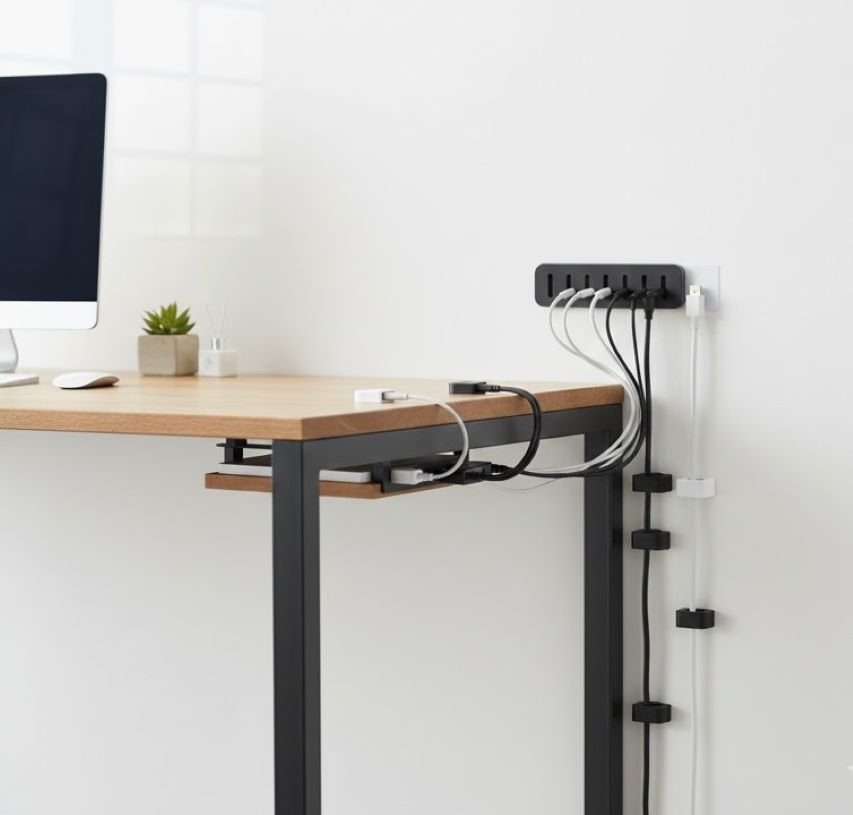
Self-Adhesive Cable Clips are small, simple organizational devices designed to secure and route cables, wires, and cords neatly against walls, desks, furniture, and other surfaces. They combine a permanent adhesive backing with a physical clip or channel to hold cables in place without the need for screws, nails, or drilling.
As a cornerstone of cable management systems, they provide an invisible, low-profile solution to the clutter and hazard of loose cables, promoting safety, aesthetics, and functionality in homes, offices, vehicles, and electronic installations.
Anatomy & Key Components
The Adhesive Backing
Composition: A high-tack, pressure-sensitive adhesive (PSA) layer, typically acrylic or rubber-based, protected by a removable silicone-coated paper liner.
Surface Type: Designed for permanent bonding to smooth, non-porous surfaces like painted drywall, glass, metal, plastic, and sealed wood.
Performance Factors: Key qualities include initial tack, ultimate bond strength, temperature resistance, and resistance to plasticizer migration (which can weaken the bond over time).
The Clip Body
Material: Most commonly PVC plastic (flexible) or ABS plastic (rigid). Silicone clips are also available for high-heat or delicate applications.
Design: The functional part that holds the cable. Designs include:
Hook & Loop (Velcro®) Straps: A sticky pad with an attached Velcro strap for wrapping and securing.
Cable Channel/Clam Shell: A U-shaped or two-part clip that snaps closed around the cable.
Adhesive Cable Tie Mounts: A sticky base with a slot to lock the head of a standard cable tie.
J-Hook or L-Hook: A simple, open hook for easy drop-in placement and removal of cables.
Release Liner
The waxy or silicone-coated paper backing that protects the adhesive during storage and shipping. It must be peeled off immediately before application.
Mechanism: How They Work
Surface Preparation: The target surface must be clean, dry, and free of dust, grease, or texture.
Adhesive Activation: Removing the release liner exposes the pressure-sensitive adhesive.
Bond Formation: Pressing the clip firmly onto the surface for the recommended time (usually 30+ seconds) creates a mechanical bond. The adhesive flows into microscopic surface imperfections, creating a strong, permanent hold after a 24-72 hour cure time.
Cable Retention: Once bonded, the clip body holds the cable via friction, a snap closure, or a strap, keeping it securely routed along the chosen path.
Step-by-Step Installation Guide
Plan the Route: Map out the cable path. Use a level for straight lines. Mark clip positions with a pencil.
Prepare the Surface: Clean the area thoroughly with isopropyl alcohol (rubbing alcohol). Let it dry completely.
Prepare the Clip: Peel off the protective release liner. Avoid touching the adhesive gel.
Apply and Press: Align the clip and press it firmly onto the surface for at least 30 seconds. Apply maximum pressure, especially around the edges.
Cure: Wait the recommended time (ideally 24 hours) before placing any strain on the clip by inserting the cable.
Load the Cable: Once cured, route your cable through the clip, hook, or strap. For snap-closed clips, you may need to detach the top half.
Ideal Applications & Use Cases
Home & Office: Managing computer wires (keyboard, mouse, monitor), phone chargers, TV/entertainment center cables, and desk peripherals.
Kitchen & Bathroom: Securing cords for appliances (blenders, electric kettles), night lights, or electric toothbrush chargers.
Workshop & Garage: Organizing extension cords, tool battery charger cables, and lighting wires.
Automotive & Marine: Routing wiring for dash cams, phone mounts, GPS units, and stereo equipment.
Retail & Display: Securing power cables for digital signage, price scanners, and display lighting.
Advantages & Benefits
No Tools or Damage: The primary advantage. Installs without drills, screws, or wall damage. Ideal for renters.
Extremely Low Profile: Creates a clean, nearly invisible cable management system.
Cost-Effective: Very inexpensive, often sold in bulk packs.
Quick Installation: Can be applied in seconds.
Versatile: Available in clear, white, black, and colors to blend with any décor.
Promotes Safety: Eliminates tripping hazards and prevents cable damage from pinching or tangling.
Limitations & Important Considerations
Surface Dependency: Only effective on smooth, clean surfaces. Will not adhere reliably to textured walls, brick, concrete, untreated wood, or dusty/dirty areas.
Not Truly Removable: While marketed as "damage-free," removal often risks:
Paint Damage: Can peel off paint, especially if the paint layer is weak.
Adhesive Residue: Leaves a sticky residue that requires solvents (like Goo Gone) to remove.
Permanent Bond: Difficult to reposition after initial application. Must be planned carefully.
Weight Limits: Not for supporting very heavy cables or creating tight suspending loops.
Heat & Chemical Sensitivity: Adhesive can degrade near heat sources or when exposed to certain chemicals or oils.
Comparison: Adhesive vs. Screw-In Clips
Factor | Self-Adhesive Clips | Screw-In Clips |
|---|---|---|
| Installation | Instant, tool-free. | Requires drill/driver, leaves holes. |
| Surface Damage | Potential for paint/residue. | Definite small holes. |
| Holding Strength | Good for light/medium duty. | Excellent for heavy-duty, permanent use. |
| Removability | Difficult, often damaging. | Easy (but leaves holes). |
| Best Surface | Smooth, sealed surfaces. | Any solid material (drywall, wood, masonry). |
| Ideal User | Renters, temporary setups, light cables. | Homeowners, permanent installations, heavy cables. |
Selection Criteria & Buying Guide
Cable Size: Measure your cable's diameter. Choose a clip with a capacity slightly larger than the cable.
Cable Weight: Heavier cables (like thick extension cords) require clips with a high weight rating and strong adhesive.
Surface Type: Confirm your surface is smooth and cleanable. If in doubt, use a screw-in option.
Access Needs: Do you need to remove the cable often? Choose J-hooks or Velcro straps.
Aesthetics: Choose a color (white, black, clear) that minimizes visual impact.
Quantity: Buy in bulk packs—cable management always requires more clips than initially estimated.
Brand/Quality: Opt for known brands (3M, Command™) for reliable adhesive performance.
Self-Adhesive Cable Clips are a triumph of simple, user-centric problem-solving. They transform the chaotic, unsafe mess of loose wires into orderly, intentional pathways with minimal effort and investment. Their core value lies in accessibility and convenience, making basic cable management achievable for anyone, anywhere.
 |  |  |
 |  |  |