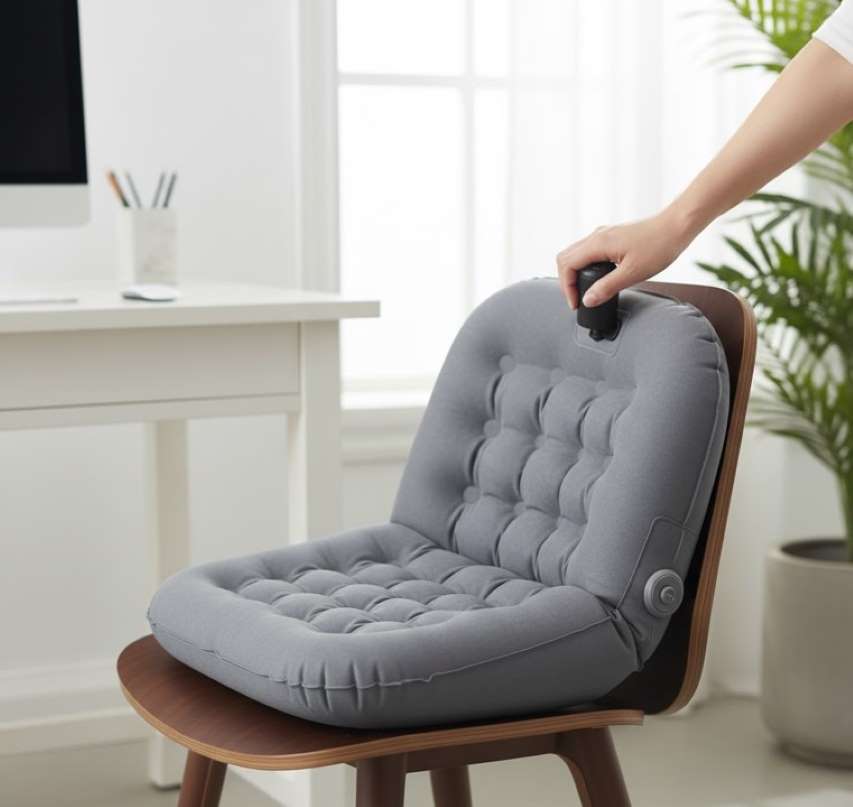
An Inflatable Seat Cushion is a portable, air-filled pad designed to provide customizable support, pressure relief, and enhanced comfort on chairs, car seats, stadium bleachers, or any hard, flat surface. By allowing users to adjust firmness via inflation level, it personalizes seating geometry to improve posture, reduce pain, and increase sitting tolerance for extended periods.
It bridges the gap between a permanent, bulky seat cushion and no cushion at all, offering an on-demand comfort solution that is lightweight, packable, and versatile for travel, work, healthcare, and outdoor activities.
Anatomy & Key Components
The Air Chamber & Structure
Primary Bladder: The main airtight chamber, typically made from PVC, Thermoplastic Polyurethane (TPU), or rubber. This holds the air and provides the cushioning structure.
Internal Baffles/Coils: Many designs feature internal welded seams or a "coil beam" construction that creates multiple air cells. This prevents air from sloshing side-to-side, improves stability, and can provide targeted lumbar or coccyx support.
Shape & Profile: Common shapes include rectangular, U-shaped (coccyx cutout), and wedge-shaped. The profile can be flat or contoured to follow the body's natural curves.
The Valve & Inflation System
Valve Type: A one-way Boston valve (similar to pool toys) is standard. It has an inner valve for inflation/deflation and an outer cap to seal.
Inflation Methods:
Oral Inflation: User blows into the valve. Most common and requires no tools.
Manual Pump: Some kits include a small hand or foot pump for easier, more hygienic inflation.
Electric Pump: Compatible with universal electric pumps for rapid inflation/deflation.
External Materials & Features
Cover Fabric: The outer layer, often made of polyester, nylon, or velvet. It may be:
Removable & Washable: For hygiene.
Non-Slip Bottom: Coated with silicone dots or gel to prevent sliding on the seat.
Moisture-Wicking: For breathability during prolonged use.
Carrying Accessories: Often includes a storage bag or strap for portability.
Types & Classifications
Type | Primary Design Focus | Best For |
|---|---|---|
| Standard Flat Cushion | General pressure distribution and elevation. | Hard chairs, bleachers, outdoor events, tailgating. |
| Orthopedic (Coccyx/U-Shape) | Relieves pressure on the tailbone (coccyx) and lower spine. A central cutout or U-shape suspends the tailbone. | Coccydynia (tailbone pain), post-partum recovery, post-surgical sitting, prolonged desk work. |
| Lumbar Support Cushion | Wedge-shaped or contoured to fill the curve of the lower back. | Improving seated posture, alleviating lower back pain, car/truck driving. |
| Hemorrhoid / Donut Cushion | Ring-shaped (annular) with a central hole to completely relieve pressure on the perineal and anal area. | Post-hemorrhoidectomy, episiotomy recovery, perineal injuries, prostate issues. |
| Heating/Cooling Gel Hybrid | Combines an inflatable air chamber with a gel layer that can be heated or cooled. | Therapeutic pain relief, menstrual cramps, sports injuries, temperature regulation. |
How It Works: The Mechanics of Comfort
Customizable Firmness: By adding or releasing air, users control the cushion's density and height, tailoring it to their weight, body shape, and comfort preference. Softer is not always better; optimal support often requires firm inflation.
Pressure Redistribution: The cushion increases the surface area supporting the body, dispersing weight away from bony prominences (ischial tuberosities, tailbone). This improves blood flow and reduces point pressure that causes pain and numbness.
Postural Alignment: Contoured and wedge designs gently guide the pelvis and spine into a more neutral position. A wedge cushion, for instance, tilts the pelvis forward, helping to maintain the spine's natural lumbar curve.
Vibration Dampening: In vehicles, the air chamber can absorb minor vibrations from the road, reducing fatigue.
Key Specifications & Performance Factors
Dimensions: Typically, 16" x 18" (40cm x 45cm) for standard cushions. Thickness ranges from 2" to 4" (5-10cm) when inflated.
Weight Capacity: Most support 250-400 lbs (110-180 kg).
Material Durability: Measured in denier (fabric) and thickness (PVC/TPU in mils). Higher numbers indicate greater puncture and abrasion resistance.
Inflation/Deflation Time: Oral inflation takes 1-2 minutes. A pump reduces this to under 30 seconds.
Cover: Look for features like machine-washable, non-slip bottom, and breathable mesh.
Step-by-Step Usage Guide
Unpack & Inspect: Remove from storage bag and ensure the valve is closed.
Initial Inflation: Open valve cap. Inflate orally or with a pump to about 50% firmness.
Test Fit: Place on seat and sit down. Note the feel—does it bottom out? Is it too hard?
Fine-Tune Inflation: While seated, add or release air in small increments until you achieve optimal support. The cushion should compress somewhat but prevent you from feeling the hard seat beneath.
Secure & Use: Ensure the non-slip bottom is in contact with the seat. Use for your intended activity.
Deflation & Storage: Open the inner valve to fully deflate. Roll or fold tightly, replace the cap, and store in its bag.
Ideal Applications & Users
Office Workers & Gamers: For all-day sitting at a desk to prevent back pain and improve posture.
Drivers & Commuters: For car, truck, or RV seats to reduce road fatigue and support the lower back.
Medical & Therapeutic Use: For patients recovering from surgery, injury, or with chronic conditions like sciatica, arthritis, or coccydynia.
Travel & Events: For airplanes, trains, stadiums, beaches, camping, and concerts.
Wheelchair Users: As a secondary, adjustable cushion for pressure relief (Note: not a substitute for a prescribed medical-grade wheelchair cushion).
Outdoor Enthusiasts: For bleachers, kayaks, hiking breaks, and sporting events.
Advantages & Benefits
Customizable Comfort: The single biggest advantage. Firmness is adjustable to the individual's precise needs.
Ultra-Portable: Deflates to a fraction of its size, making it easy to carry in a bag or backpack.
Lightweight & Versatile: Weighs only a few ounces, usable on virtually any seat.
Pressure Relief: Scientifically proven to reduce seat interface pressure, preventing pain and skin breakdown.
Improved Posture: Encourages a healthier sitting alignment, potentially reducing long-term musculoskeletal strain.
Cost-Effective: Significantly cheaper than high-end memory foam or gel cushions with similar benefits.
Easy to Clean: Most have wipeable or machine-washable covers.
Limitations & Considerations
Puncture Risk: Susceptible to sharp objects. Patching kits are available but a puncture renders it temporarily useless.
Air Leakage: Valves or seams can develop slow leaks over time, requiring occasional re-inflation.
Temperature Sensitivity: Air inside can expand in heat (causing over-inflation) or contract in cold (making it feel too soft).
Not for Primary Wound Care: While great for pressure redistribution, it is not a substitute for a medical-grade cushion prescribed for individuals at high risk of pressure ulcers.
Stability: Some very soft or fully inflated models can feel less stable than solid foam cushions.
Maintenance: Requires manual adjustment of air pressure as needed.
Selection Criteria & Buying Guide
Identify Your Primary Need: Is it tailbone pain (U-shape), lower back support (wedge), or general comfort (flat)?
Check Dimensions: Ensure it fits your typical seat (office chair, car seat, etc.).
Assess Material Quality: Look for TPU over PVC for better durability and eco-friendliness. Check denier (e.g., 300D+ is durable).
Evaluate the Valve: A robust, easy-to-use Boston valve is crucial.
Consider the Cover: A removable, washable, non-slip cover is a major plus.
Read Reviews: Pay attention to comments about long-term leakage and comfort.
Accessories: Decide if you need a carrying bag or a pump (highly recommended for frequent use).
The Inflatable Seat Cushion is a deceptively simple yet profoundly effective ergonomic tool. It harnesses the fundamental principle of air as a customizable support medium to solve a universal human problem: uncomfortable sitting. Its genius lies in its adaptive nature—it morphs to fit the unique contours and requirements of each user's body.
 |  |  |
 |  |  |