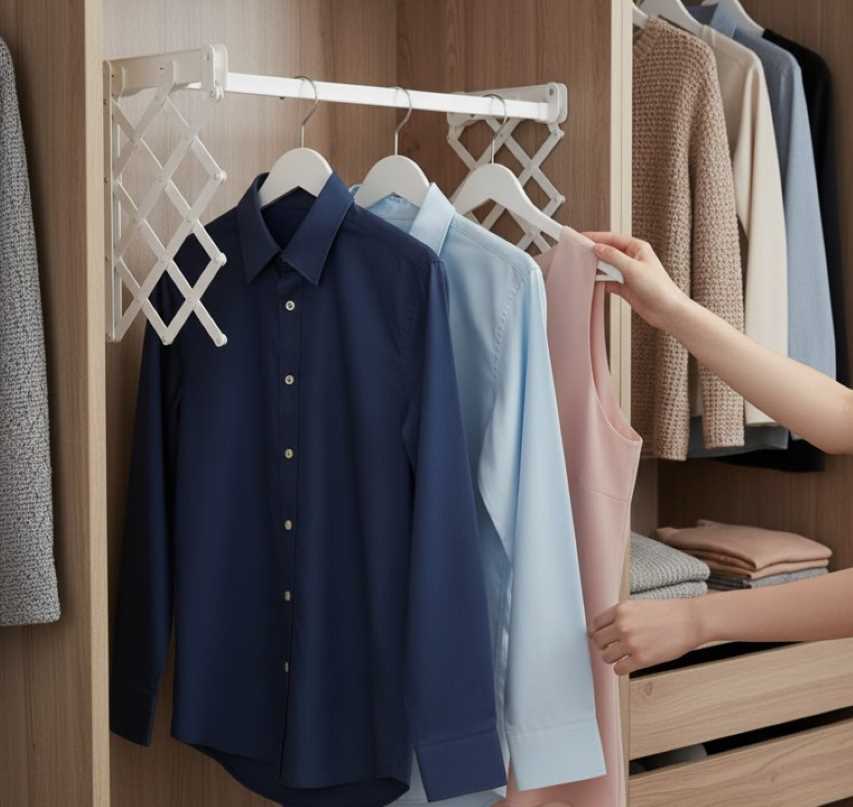
Space-Saving Innovation in Your Closet
A Foldable Clothes Hanger is a portable, space-optimized wardrobe accessory designed to collapse or fold into a compact shape for storage or travel. It addresses the fundamental challenges of closet clutter and packing efficiency, transforming a simple everyday object into a tool for better organization. While retaining the core function of a standard hanger, its intelligent design prioritizes adaptability and convenience.
Design, Structure & Common Materials
Component | Description & Purpose |
|---|---|
| Hinge / Pivot Point | The central innovation. Typically, a plastic, metal, or silicone rivet that allows the hanger to fold inward. |
| Arms / Shoulders | The two sides that hold garments. In foldable designs, they swing inward, often nesting together. |
| Hook | Usually fixed (non-folding) but may swivel or detach in some advanced models. Designed to save vertical space. |
| Body / Crossbar | The bottom section; may be a straight bar for pants or a contoured shape for tops. Some models feature a multi-tiered design. |
| Clips | Some models include foldable or removable clips for skirts or pants. |
| Common Materials | ABS Plastic: Lightweight, affordable, durable. Metal (Aluminum/Stainless Steel): Slim, strong, travel-friendly. Silicone/Rubber: Non-slip, gentle on fabrics. Often used as coatings. |
Primary Types & Mechanisms
Standard Bi-Fold Hanger: The most common type. The two arms fold together in a simple scissor-like motion, reducing width by over 50%.
Tri-Fold / Multi-Fold Hanger: Features additional pivot points, allowing it to fold into a very small, flat rectangle or square. Ideal for ultra-compact packing.
Cascading / Tiered Hanger: A vertical design with multiple folding arms stacked on a central hook, allowing 3-5 garments to hang from a single closet rod point.
Nesting Hangers: A set of hangers designed to interlock or "nest" within each other when not in use, saving thickness space rather than width.
Convertible Hangers: May transform from a shirt hanger to a pants/skirt hanger via removable clips or an extendable crossbar.
Core Functionality & Key Features
Folding Action: The smooth opening and secure locking in both the open (use) and closed (storage) positions are critical.
Locking Mechanism: A simple notch, friction hinge, or plastic tab ensures the hanger stays rigid when in use.
Weight Capacity: Varies by material. Metal models typically hold 5-10 lbs (2-5 kg), while plastic models hold 3-5 lbs (1-2 kg).
Non-Slip Surfaces: Textured arms, silicone coatings, or velvet finishes prevent delicate garments from slipping off.
Compact Profile: In its folded state, it should be slim enough to store in a drawer, suitcase compartment, or small box.
Step-by-Step: How to Use & Store
To Open: Hold the folded unit, gently pull the two arms apart until they click or lock into a straight, rigid position.
To Hang Garments: Use as you would a standard hanger. For best results, place the garment's shoulder seams at the ends of the arms.
To Fold for Storage: Ensure the hanger is empty. Press any release tabs (if present) and smoothly swing the arms inward until they lay flat.
Storage: Store folded hangers stacked in a drawer, stood on end in a box, or bundled with a strap or band. They take up to 80% less space than traditional hangers.
Primary Benefits & Advantages
Maximizes Space: Dramatically reduces closet rod crowding and storage footprint.
Essential for Travel: Pack flat in luggage, providing wrinkle-free hanging options at hotels or destinations. Eliminates the need for unreliable hotel hangers.
Improves Closet Organization: Creates visual space, makes garment selection easier, and reduces clutter.
Lightweight & Portable: Easy to carry in a gym bag, overnight kit, or for permanent movers/students.
Versatile Use: Suitable for a wide range of clothing: shirts, blouses, dresses, light jackets, and pants (if equipped with a bar or clips).
Cost-Effective Organization: An affordable solution to expand functional closet space without renovation.
Limitations & Considerations
Not for Heavy Items: Generally, not suitable for heavy coats, winter jackets, or weighted garments (like some suits), as they may stress the hinge.
Durability Variance: Cheap plastic models with thin hinges may break under stress or with frequent folding.
Potential for Slippage: Very smooth, untextured plastic arms can allow silky fabrics to slide off.
Bulkier than Ultra-Thin Hangers: When open, some foldable designs are thicker at the hinge than a single piece of molded plastic or wire.
Foldable vs. Traditional Hangers: A Comparison
| Aspect | Foldable Clothes Hanger | Traditional Hanger (Plastic/Wood/Wire) |
|---|---|---|
| Storage Efficiency | Excellent. Saves 50-80% space when folded. | Poor. Fixed, bulky shape. |
| Portability | Excellent. Ideal for travel and mobile living. | Poor. Awkward to pack and transport. |
| Closet Organization | Very Good. Reduces visual clutter on the rod. | Standard. Can lead to crowded rods. |
| Durability & Strength | Good to Very Good. Hinge is a potential weak point. | Very Good. Simple, solid construction. |
| Garment Care | Good (with non-slip features). | Good to Excellent (especially padded wood). |
| Cost per Unit | Slightly higher. | Typically lower. |
| Best Use Case | Travel, small closets, dorm rooms, seasonal storage. | Permanent, spacious walk-in closets, heavy garments. |
Applications Beyond the Bedroom Closet
Travel & Suitcase Packing: A packing essential.
Dorm Rooms & Small Apartments: Maximizes limited hanging space.
Retail & Market Sellers: Easy to transport and display samples.
Laundry Day: Use lightweight foldables as dedicated "clean laundry" hangers.
Guest Room Preparedness: Store a bundle compactly for visitors.
Garage Sales/Donations: Handy for hanging items for display before removal.
Maintenance & Care
Cleaning: Wipe with a damp cloth. Avoid submerging or harsh chemicals that may degrade plastic or loosen hinges.
Mechanical Check: Periodically ensure the hinge moves smoothly and locks securely. A drop of silicone lubricant can help a stiff hinge.
Load Awareness: Do not overload. Respect the intended weight capacity to prolong lifespan.
Storage: Store in a dry place. Avoid storing while holding damp garments to prevent mildew or metal corrosion.
Buyer's Checklist: Choosing the Right One
Intended Use: Is it primarily for travel (ultra-compact tri-fold) or home closet organization (sturdier bi-fold)?
Material Preference: Plastic for affordability, Metal for strength and slimness.
Capacity & Strength: Check weight ratings if hanging heavier items like denim jackets or multi-piece outfits.
Non-Slip Features: Essential for silks, satins, and thin-strapped garments.
Hook Design: A swivel hook is versatile; a closed loop is secure.
Ease of Folding: Test the mechanism (if possible). It should be smooth but secure.
Quantity & Value: Often sold in space-saving bundles of 5, 10, or 20.
A Simple Solution for Modern Living
The Foldable Clothes Hanger is a testament to the power of thoughtful, user-centric design. It solves tangible problems—closet chaos, packing dilemmas, and spatial constraints—with elegant simplicity. More than just a utilitarian object, it is an enabler of orderly and efficient living. For the frequent traveler, the city dweller with a modest closet, or anyone seeking to streamline their domestic space, investing in a set of quality foldable hangers is a small step that yields immediate and lasting organizational benefits. It proves that sometimes, the most impactful innovations are those that reimagine the ordinary.
 |  |  |
 |  |  |