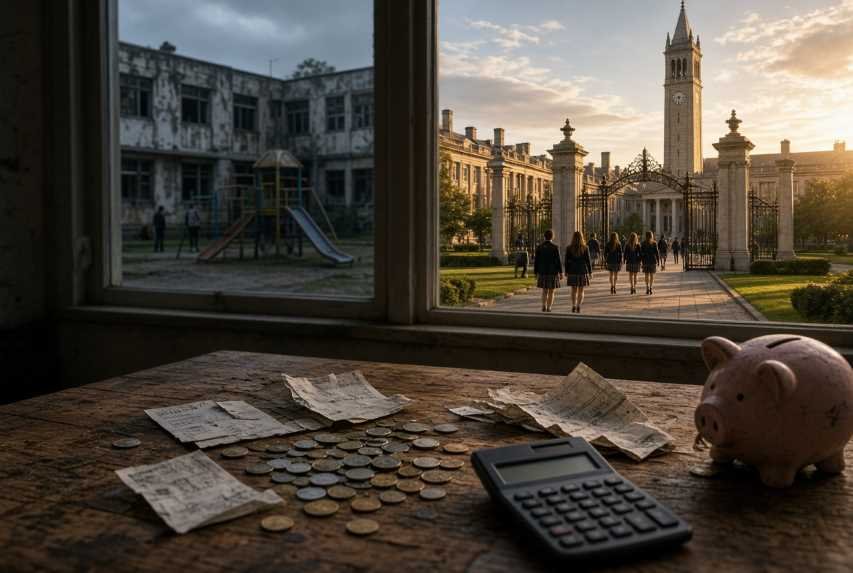
Subtitle: Private education has absorbed a large share of the world’s new students. That expansion has increased capacity and choice. It has also shifted costs onto households, widened social gaps, and raised a hard economic question: how much of this growth is genuine human-capital investment, and how much is a transfer of family income into an education industry?
Executive Summary
Over the past three decades, privately operated schools, colleges, and universities have moved from the margins of many national systems to the center of educational expansion. Private higher education now accounts for about one-third of global university enrollment — more than 80 million students. In several Latin American countries, the private share exceeds half of higher education. In India, private unaided colleges educate a majority of college students, and private unaided schools now enroll about four in ten schoolchildren. In parts of the Gulf, Lebanon, and some African and South Asian systems, private schools already dominate particular levels of education.
This growth is not mysterious. Public systems face rising demand, tight budgets, and uneven quality. Families, especially expanding middle classes, treat education as the main route to security. Investors treat it as a scalable service industry. Governments often welcome private providers because they absorb students without an equivalent rise in public spending.
Private education is not a single phenomenon. Elite nonprofit universities, low-fee community schools, religious institutions, government-subsidized private schools, and large for-profit chains operate under the same label and produce very different results. Some expand access and innovate. Others sell credentials of uncertain labor-market value at prices families struggle to pay.
The evidence does not support a simple verdict that private education is always better or always worse. It does support a more uncomfortable conclusion. Where regulation is weak, public investment is stagnant, and labor markets cannot absorb graduates as fast as universities produce them, the expansion of private education can:
raise household education spending and family debt;
convert schooling into a status competition;
deepen segregation by income;
weaken political pressure to improve public institutions;
generate credential inflation and graduate underemployment;
and transfer income from families to education businesses without a matching gain in productivity.
Whether private expansion strengthens a society depends less on the word “private” than on quality, affordability, regulation, public-system strength, and the real demand for skills.
Private education has become one of the defining features of twenty-first-century social policy. Families pay tuition, transport, uniforms, tutoring, and examination fees. Investors buy and franchise schools and universities. Governments license private providers, sometimes subsidize them, and often rely on them to close gaps that public budgets cannot fill.
The reasons are practical. Populations of school-age and university-age young people have grown in many regions. Demand for secondary and tertiary education has risen even faster than population, because completion of one level now commonly leads to demand for the next. Public universities and schools in many countries cannot expand classrooms, laboratories, and qualified staff at the same pace. Parents often believe private institutions are safer, better equipped, more disciplined, or more internationally oriented. Fiscal constraints after economic crises, and later after the COVID-19 shock and rising debt-service costs, have made it politically easier to allow private supply than to raise public education spending.
Public and private education are not opposites in every respect. Many “private” schools receive public subsidies. Many “public” universities charge fees. UNESCO defines private institutions as those not operated by a public authority, even if they are nonprofit, religious, or government-aided. The important distinctions are who controls the institution, who pays, who can be excluded for inability to pay, and whether the provider’s survival depends on enrollment revenue.
Private education can add places, specialized programs, and competition. This article takes those benefits seriously. Its main purpose, however, is to examine the less advertised consequences: the pressure on household budgets, the risk of a two-tier system, the commercialization of learning, the mismatch between degrees and jobs, and the possibility that education stops reducing inequality and starts reproducing it.
The article asks five questions. First, how large is private education, and where has it grown fastest? Second, why is it expanding? Third, what are the economic and social costs, especially for families and public systems? Fourth, when does private provision create real value rather than merely redistribute money? Fifth, what policy choices can preserve access and quality without turning education into an unaffordable private good?
Global Expansion
The scale of the shift
Schooling has expanded worldwide. UNESCO’s Global Education Monitoring work reports about 1.4 billion students in school in 2024, with large gains since 2000 in primary, secondary, and especially post-secondary enrollment. Tertiary education has grown even faster: global enrollment rose from about 100 million students around 2000 to 264 million in 2023, and the world gross enrollment ratio more than doubled, from 19 percent to 43 percent.
Private providers captured a large part of that expansion. Research led by Daniel C. Levy and the Program for Research on Private Higher Education finds that private higher education now educates roughly one-third of all higher-education students — more than 80 million people — and exists in nearly every country with a sizable university system. That is a historic reversal. For most of the twentieth century, outside the United States and a few other cases, universities were overwhelmingly public.
At school level the private share is smaller on average but highly uneven. Older World Bank compilations of UNESCO data put global private enrollment at about 17 percent in primary education and about 27 percent in secondary education by the late 2010s, with the highest school-level private shares in South Asia. Across OECD countries, about 18 percent of students from pre-primary to upper secondary attended private schools in 2021, with the share rising at higher school levels.
Regional patterns
North America. The United States remains globally influential because of its elite private universities, not because private schools dominate K–12 education. Private schools enroll roughly one in ten American K–12 students. In higher education, the U.S. private enrollment share has fallen from about half in earlier decades to around a quarter, below the current world average. The United States is still the center of high-cost private nonprofit higher education and of the world’s largest student-debt stock.
Latin America. This region has the highest private share of higher education, slightly above 50 percent. Brazil is an extreme case: official census figures put private higher-education enrollment at about 80 percent in 2024, much of it in for-profit and distance programs. Chile combined rapid massification with a heavily marketized school and university system. Peru’s private university enrollment has grown from hundreds of thousands in the late 2000s to well over a million.
Europe. Northern and much of continental Europe still treat school and university education as primarily public services, with low or no tuition in several countries. The private share is rising from a low base. Levy notes that Western European private higher education has grown to millions of students and, in some estimates, toward one-fifth of enrollment in parts of the region. Spain and France now have private higher-education shares approaching U.S. levels. The United Kingdom is different: most universities are legally public or publicly regulated, but high tuition and income-contingent loans have shifted a large part of the cost onto graduates.
Middle East and North Africa. Private provision is especially visible in the Gulf, Lebanon, Jordan, and in the rapid growth of private universities and higher institutes in Egypt. In several Gulf states, private and international schools educate a large share of expatriate and, increasingly, national children. Egypt’s official statistics for 2024/25 show about 4 million higher-education students. Public and Al-Azhar universities still hold the majority, but their share has fallen to about 59 percent, while private and national universities plus foreign branches rose to 12.4 percent and private higher institutes to 21.1 percent.
Sub-Saharan Africa. Public universities remain dominant in many countries, but private institutions have grown quickly where public capacity is tight. Kenya’s 2024 university statistics show private chartered universities enrolling about 23 percent of degree students. In South Africa, private higher education has grown toward 30 percent of higher-education enrollment while public university participation has been relatively flat. Across the region, low-cost private primary and secondary schools have expanded in cities where public classrooms are overcrowded.
South Asia. This is one of the world’s largest private-education markets. In India, the All India Survey on Higher Education for 2023–24 found that privately managed colleges — aided and unaided — accounted for about 71 percent of college enrollment, while private universities grew much faster than public universities over the previous decade. At school level, official UDISE+ figures show private unaided enrollment rising from about 31 percent in 2021–22 to about 40 percent in 2025–26. Bangladesh and Pakistan also have high private shares at some school levels.
East and Southeast Asia. Japan and South Korea already have mature, high private shares in higher education — on the order of 80 percent — now facing demographic decline rather than expansion. China expanded private colleges and minban institutions as public demand surged, though the private share of total higher education remains lower than in India or Brazil. International and bilingual private schools have grown in major East and Southeast Asian cities, often priced for upper-middle-class and expatriate families.
Two kinds of systems
The global map therefore divides into two broad patterns. In one group — much of Northern Europe, parts of Central Asia, and some state-dominated systems — private education is a minority supplement. In another group — Latin America, South Asia, Japan, Korea, parts of Africa and the Middle East — private institutions are a core delivery mechanism. The second group is where the economic and social consequences discussed below are most visible.
Illustrative private shares of education (latest comparable official or research estimates)
| Country / region | Level | Approximate private share | What the figure represents |
|---|---|---|---|
| World | Higher education | ~33% | Levy / PROPHE: about one-third of global HE enrollment |
| Latin America | Higher education | >50% | Highest regional private share |
| Brazil | Higher education | ~80% (2024) | Among the highest national private HE shares |
| India | Colleges | ~71% (2023–24) | Private aided + unaided college enrollment |
| India | Schools | ~40% (2025–26) | Private unaided recognised enrollment |
| Japan / Korea | Higher education | ~80% | Mature private-majority systems, now ageing |
| Chile | Schools / HE | Majority private or subsidized-private historically | Voucher-style school market plus private universities |
| Egypt | Higher education | ~12% private/national universities; ~21% private institutes (2024/25) | Public universities still largest single block |
| Kenya | Universities | ~23% (2024) | Private chartered universities |
| South Africa | Higher education | ~30% | Fast-growing private sector |
| OECD average | Pre-primary to upper secondary | ~18% (2021) | Wide national range |
| United States | K–12 | ~9–10% | Private schools are a minority |
| United States | Higher education | ~25–30% | Below current world private HE average |
Figures come from different years and definitions. “Private” may include government-aided, nonprofit, religious, and for-profit institutions. They should be read as orders of magnitude, not as a single official global census.
Why Private Education Is Expanding
The growth has multiple drivers that reinforce one another.
Demand has outrun public supply. Secondary completion has risen, and the number of young people seeking university places has grown faster than public campuses can expand. UNESCO data show tertiary enrollment more than doubling since 2000. In countries with high youth cohorts — India, Nigeria, Egypt, Pakistan, parts of East Africa — public admission cut-offs become a bottleneck. Private colleges absorb the students who miss public places.
Public budgets are constrained. Education competes with health, pensions, debt service, energy subsidies, and defense. UNESCO and World Bank financing analyses show that households already cover about one-quarter of global education spending, and a much higher share in lower-middle-income countries. Allowing private providers is a way for governments to expand enrollment without an equal rise in public expenditure.
Quality perceptions matter, even when they are unevenly justified. Families often equate private schools with smaller classes, English-medium instruction, better buildings, stricter discipline, or international curricula. In some places those advantages are real. In others they are branding. The perception itself is enough to move demand.
Education became an investment asset. For-profit school chains, university groups, and education funds treat enrollment as recurring revenue. Brazil’s large listed education companies, Indian private universities, and international school groups in the Gulf and Asia are examples. Once education is an investable sector, marketing, campus expansion, and recruitment targets follow.
Middle-class growth and status competition. As household incomes rise from low to middle levels, education is one of the first major purchases after housing and health. Parents compete for scarce “good” places. That competition feeds private tutoring and private schools even when public options exist.
Internationalization. English-language programs, foreign branch campuses, and internationally branded schools attract families who want mobility, overseas study, or a labor-market signal that a local public school may not provide.
Policy choice. Privatization is not only a market accident. Voucher systems, relaxed licensing, public–private partnerships, and explicit invitations to investors have been used in Chile, parts of Africa and Asia, and in higher education reforms across many middle-income countries.
Weaknesses in public systems. Overcrowded classrooms, teacher shortages, politicized appointments, decaying infrastructure, and examination-driven teaching push families who can pay toward private alternatives. Private growth then reduces the coalition of families with a direct stake in fixing the public system.
Economic Impact
Households, not only governments, finance the expansion
A central economic fact is easy to miss. When a government cannot or will not fund additional school and university places, the cost does not disappear. It moves onto families.
Global estimates compiled for education-finance tracking show governments still pay the largest share of education costs, but households contribute about 25 percent worldwide. That household share is much higher in lower-middle-income countries — on the order of two-fifths of total education spending in some compilations — than in high-income countries. In South Asia, household financing is especially large. In other words, private expansion in poorer countries is often paid for by parents who already spend a high share of income on necessities.
Tuition is only part of the bill. Families also pay:
application and examination fees;
uniforms, devices, textbooks, and transport;
private tutoring;
accommodation for students who leave home;
and, in higher education, interest on loans.
For households with several children, these costs compound. A family that can manage one private-school fee may be unable to manage three. That is an economic constraint on family size and on spending for housing, health, food quality, and savings.
Commercialization and price dynamics
Once education is sold in a market, prices respond to prestige and scarcity, not only to cost of provision. U.S. private nonprofit four-year published tuition and fees averaged about $45,000 in 2025–26, according to College Board figures, before living costs. Net prices are lower after aid, but the sticker price still shapes expectations and debt. In England, regulated undergraduate fees rose to £9,535 in 2025. In Japan, surveys of private-university households show first-year costs, especially for students living away from home, reaching several million yen and consuming a large share of annual income.
High prices do not automatically mean high quality. They can mean scarce brand-name places, weak price regulation, or the ability of institutions to charge what anxious families will pay.
Debt
The United States holds the world’s largest student-loan stock, on the order of $1.6 trillion. The United Kingdom also has a very large graduate-debt system relative to the size of its economy. Chile’s state-guaranteed loan program (CAE) produced more than a million debtors; by late 2025 official and reported figures pointed to widespread delinquency and a politically explosive collection problem. Debt is not unique to private institutions — public universities charge fees too — but private expansion often depends on fee-paying students and therefore on family savings or credit.
Debt changes life courses. Graduates delay housing, marriage, business formation, and children. Families that co-sign loans absorb risk across generations.
Transfers versus value creation
Economics distinguishes two processes that look similar in national accounts.
Value creation: education raises skills, productivity, innovation, and employability by more than it costs.
Transfer: households pay institutions for a credential whose labor-market return is weak, so money moves from families to owners, lenders, and campus operators without a matching rise in output.
Both can happen at once. A well-run private engineering college may create value. A low-quality private college that admits anyone who can pay, teaches little, and awards a degree that employers discount is mainly a transfer mechanism. Rapid private expansion increases the risk of the second pattern because new institutions can grow faster than quality-assurance systems.
Oversupply and weak returns
If universities expand faster than professional job creation, graduates enter unemployment, underemployment, or jobs that previously did not require a degree. ILO analysis finds that young people with tertiary degrees in low- and lower-middle-income countries face extremely high unemployment — on the order of 37 to 40 percent in the groups studied. In richer economies the problem is often overqualification rather than open unemployment. Australia’s 2025 Graduate Outcomes Survey found that about 41 percent of employed undergraduates considered themselves overqualified. U.S. labor-market research has found that a large share of recent bachelor’s graduates work, one year on, in jobs that do not require a degree.
That mismatch is an economic loss. Society spent real resources — buildings, teacher time, student years not spent working — for a signal that the labor market only partly rewards.
Economic channels of private-education expansion
| Channel | Potential benefit | Potential negative effect |
|---|---|---|
| Additional places | More students educated | Places added faster than quality or jobs |
| Household fees | Private resources enter education | Lower saving, housing, and health spending |
| Student loans | Studies financed over time | Long-term debt and delayed adult milestones |
| Education companies | Investment and jobs in the sector | Profit extracted from essential family spending |
| Prestige pricing | Funds elite teaching and research | Price becomes a status filter |
| Graduate output | Larger skilled workforce | Credential inflation and underemployment |
Social Inequality
Education can reduce inequality when a capable student from a poor family can reach the same classroom as a wealthy peer. Private expansion can reverse that logic if the best-resourced classrooms become fee-gated.
OECD PISA 2022 analysis found that, on average across OECD countries, about 26 percent of socio-economically advantaged students attended private schools, compared with 13 percent of disadvantaged students. That is a simple measure of segregation: private schools concentrate students who already have more home resources.
Inequality operates through several layers:
Access. Low-income students are less able to pay tuition, tutoring, transport, and unofficial “additional” fees.
Quality sorting. High-fee schools and elite private universities attract experienced teachers, better facilities, and peer groups with strong academic support at home.
Network effects. Private institutions, especially elite ones, offer internships, alumni networks, and social capital that public institutions may not match.
Credential hierarchy. Employers may treat a degree from a known private brand as a signal, even when the underlying skill difference is smaller than the price difference.
Reduced mobility. If the route into high-status professions runs through expensive schools, family wealth becomes the gate.
The result is not always a simple rich-versus-poor split. In India, Peru, Egypt, and parts of Africa, many private-college students come from lower-middle-income families who stretch to pay fees because public seats are scarce. That does not make the system equal. It means families with the least spare income take the largest financial risk for credentials of uneven value.
Education then risks changing function. Instead of being the main public instrument for equalizing opportunity, it becomes a market in which opportunity is purchased.
Impact on Public Education
Private growth changes the public system even when public schools remain the majority.
Attention and politics. When middle-class families leave public schools, the loudest constituency for public improvement shrinks. Budget fights become easier to postpone. The public system can be left with students who have fewer home resources and greater needs, while being judged against private schools that select more advantaged pupils.
Teachers and staff. Private institutions that pay more, or offer better working conditions, can recruit experienced teachers and professors from public institutions. The opposite also happens: some low-fee private schools underpay staff and rely on high turnover. Either way, public systems can lose stability.
Infrastructure gaps. Visible differences in laboratories, toilets, digital equipment, and sports facilities reinforce the belief that public education is residual.
Two-tier risk. A durable pattern is a high-cost private or subsidized-private track for families who can pay, and a strained public track for everyone else. Chile’s school market is the most studied example of how subsidies to private operators can shrink municipal enrollment and fragment the system. India’s recent shift toward private unaided school enrollment raises a similar structural question at much larger scale.
The competition argument. Private schools can push public institutions to improve — if funding follows quality, if families have real information, and if public schools have the authority and resources to respond. In practice, public schools often face rigid pay scales, political interference, and weaker maintenance budgets. Competition without capacity becomes sorting, not improvement.
Education as a Commercial Industry
The deepest change is conceptual. In many countries education is no longer treated only as a public service or a social right. It is a market with:
profit-seeking or surplus-seeking providers;
brand management and advertising;
enrollment targets;
international student recruitment as a revenue strategy;
franchised campuses and school chains;
private accreditation and certificate businesses;
and ranking-driven investment in visible prestige.
Profit is not automatically illegitimate. A firm that builds needed vocational colleges and places graduates in jobs can create value. The conflict appears when revenue depends on filling seats rather than on learning. Then institutions have an incentive to lower admission standards, inflate grades, over-promise employment, and expand programs that are cheap to teach rather than programs the economy needs.
International students illustrate the tension. In South Korea, recent university statistics show that about nine in ten international students are enrolled in private universities, which rely on them partly because the domestic college-age population is shrinking. Similar dynamics exist in the United Kingdom, Australia, and parts of Eastern Europe. Cross-border education can enrich campuses. It can also turn universities into export industries whose finances depend on visa policy and overseas middle-class savings.
The policy question is not rhetorical. Education can be all of the following at once: a public good with social externalities, a private investment in a person’s future earnings, and a commercial product. Societies get into trouble when the commercial product crowds out the public good.
Quality of Education
Private education is not a quality category. It is an ownership category.
At one end are research universities and long-established nonprofit schools with selective admissions, qualified faculty, and strong accountability. At the other end are lightly regulated colleges and low-cost schools that may have weak libraries, part-time instructors, overcrowded classrooms, and little research. Between them sit thousands of ordinary private institutions that are neither excellent nor predatory.
Quality differences that matter include:
admission standards;
faculty qualifications and time for teaching;
student-to-teacher ratios;
laboratories, clinics, and libraries;
external accreditation that is real rather than purchased;
and whether students are admitted because they are prepared or because they can pay.
High tuition is a weak proxy for quality. It can pay for excellent teaching. It can also pay for marketing, landscaping, and executive salaries. Grade inflation and “pay-to-pass” pressures are documented risks in fee-dependent institutions, though they also exist in some public systems.
Regulatory capacity is the hinge. Where licensing is slow, inspection is rare, and failing institutions are rarely closed, poor-quality private providers can persist for years, collecting fees from families who discover the problem only after graduation.
Impact on Families and Social Life
Expensive education changes the household, not only the student.
Parents work longer hours or take additional jobs. Grandparents contribute savings. Siblings receive unequal investment if the family can afford only one “good” school. Everyday spending on leisure, travel, and even nutrition can be cut. The pressure is social as well as financial. In many cities, sending a child to a local public school is interpreted as a failure of parental ambition.
That produces an education arms race: private school plus tutoring plus extra certificates plus a private university, each step justified as necessary because other families are doing the same. South Korean research on status competition in education, presented and debated in 2024–2026 economic forums, estimates that education-status pressure may have substantially reduced completed fertility among affected cohorts. The exact percentage is model-dependent and should be treated as an academic estimate, not a census fact. The direction of the mechanism is more robust: when each child is extremely expensive to educate, families have fewer children.
Education costs also interact with delayed marriage and later first births in high-income countries, where longer study and the need to repay loans push household formation into the thirties. That is not caused only by private schools. It is caused by the rising private cost and length of the education sequence.
Anxiety becomes a normal part of childhood and parenthood: entrance tests, league tables, tutoring schedules, and fear that a wrong school choice will close the child’s future.
Private Schools and Childhood
Private primary and secondary schools shape inequality earlier than universities do.
Fees begin before a child can choose. Transport, uniforms, activity charges, and tutoring add a second bill. Children are sorted into peer groups by family income as well as by ability. Facilities diverge: one school has laboratories and playing fields; another has rotas for toilets and shared textbooks.
The social consequences are not medical claims; they are observable patterns. Children in high-pressure private tracks may face heavy homework and test loads. Children excluded from those tracks may internalize the idea that they are second-class students. Friendships, accents, and future networks begin to split in primary school.
Low-fee private schools complicate the picture. In parts of Africa and South Asia they exist because public schools are far away, overcrowded, or poorly run. For some poor families they are not a luxury. They are a substitute. That fact does not cancel the equity problem. It shows that public failure and private expansion are often the same story.
Private Universities and Young Adults
For young adults the private university is both a promise and a liability.
The promise is a degree, a professional identity, and a chance at a better job. The liability is tuition, loans, and the possibility that the labor market will not honour the price paid. Students who borrow against expected professional salaries become vulnerable if they graduate into saturated fields — business administration, generic computing, law, or media studies in markets that already have more graduates than openings.
Frustration follows a predictable sequence: high fees, average teaching, a degree with a weak signal, unpaid internships, migration, or a return to the family home. In some countries this feeds brain drain, as graduates try to recover the cost of education in labor markets that pay more. In others it feeds political anger, as Chile’s student movements have shown for more than a decade.
Postgraduate study can become a consolation prize: another year of fees to delay unemployment and add another credential to a crowded market.
Impact on Labor Markets
Mass higher education changes what a degree means.
Credential inflation. When a large share of young people hold bachelor’s degrees, employers use the degree as a filter for jobs that once required secondary education. The degree becomes a ticket to the queue, not a guarantee of skilled work.
Skills mismatch. Private universities often expand inexpensive classroom programs faster than expensive technical, medical, or vocational programs. Labor markets, meanwhile, may need electricians, nurses, machinists, agricultural technicians, and mid-level digital specialists.
Graduate unemployment and underemployment. The ILO’s finding that tertiary-educated youth in poorer countries are heavily over-represented among the unemployed is a warning against treating university expansion as an employment policy. Australia’s overqualification data and U.S. underemployment research show that even rich economies can produce more graduates than graduate jobs.
Vocational neglect. If status and family spending concentrate on academic private universities, technical and vocational education remains underfunded and socially stigmatized. Countries then import or lack the practical skills their infrastructure and manufacturing need.
Workforce planning is the missing link. A private university can open a new campus in months. Creating professional jobs takes investment, industrial policy, and time. When those clocks are not aligned, private expansion manufactures disappointment.
Government and Public Policy
Private education expands faster than many states can supervise it.
Effective regulation includes licensing, accreditation, minimum faculty standards, financial-reserve rules, honest advertising, published fee schedules, student-protection funds, and the power to close institutions that fail. Many countries have the laws on paper and lack inspectors, data systems, and political willingness to shut popular but weak colleges.
When supervision lags:
diploma mills and low-quality campuses proliferate;
students discover unaccredited programs too late;
sudden campus closures leave families with no refund;
and advertising overstates job placement.
Subsidies and tax policy shape the market. If public money follows students into private schools without quality and equity conditions, governments may finance segregation. If private universities receive land, tax exemptions, or subsidized loans while charging high fees, the public bears risk and the private side keeps surplus.
The policy failure is not the existence of private schools. It is allowing a market in an essential service to grow without the consumer protection that societies demand in banking, medicine, or food safety.
Case Studies
United States: elite private higher education and mass debt
The United States invented much of the modern private research university. Its strongest private institutions remain globally influential. That success coexists with a mass-debt system. Published private-college prices are high; net prices after aid are lower but still substantial; outstanding federal student debt is measured in trillions of dollars. Private K–12 schooling remains a minority, which means the American equity problem in schooling is as much about unequal public districts as about private schools. In higher education, the problem is the combination of high prices, uneven returns by campus and major, and a cultural assumption that a degree is necessary even when the job is not.
Chile: market design, protest, and unresolved debt
Chile used vouchers and private universities to expand access quickly. School enrollment shifted from municipal public schools toward subsidized private schools. Higher-education enrollment exploded, and the gross enrollment ratio later exceeded 100 percent. The cost was social conflict and debt. The CAE loan system left more than a million debtors; delinquency became extreme; replacement proposals such as a graduate-contribution fund have been politically unstable. Chile shows that private expansion can raise participation and still leave a society convinced that education was sold rather than provided.
India: private colleges as the default route
India’s higher-education enrollment has passed 45 million students. Government universities still educate a majority of university-level students, but private colleges dominate college enrollment, and private universities have multiplied much faster than public ones. At school level, private unaided institutions now educate about 40 percent of children. This is demand-absorbing Privatization on a continental scale. It has increased access. It has also created a vast tier of institutions whose quality and employment outcomes vary sharply, while families pay fees that public planning did not have to finance.
Brazil: for-profit higher education and mass distance learning
Brazil’s private share of higher education is among the world’s highest. Large for-profit groups and distance-education programs absorbed students whom public universities could not. That generated scale and corporate education empires. It also raised familiar questions about quality, completion, and the labor-market value of inexpensive online degrees.
Egypt: public majority, private surge
Egypt still relies on large public and Al-Azhar universities. The recent official trend is a declining public share and rapid growth in private and national universities and, especially, private higher institutes, which now enroll more than one-fifth of all higher-education students. For a country with a large youth population and limited public budgets, private institutes absorb demand. For families, they add a fee barrier on top of already competitive public admissions. The quality range is wide: from internationally linked private universities to teaching-intensive institutes whose graduates face a crowded public-sector job queue.
Kenya and South Africa: private higher education as overflow capacity
In Kenya, private chartered universities enroll about one in four university students and a large majority of international students. In South Africa, private higher education has grown toward 30 percent of the sector while public university places have been relatively static. In both cases private institutions function as overflow valves. That can be useful. It becomes harmful if overflow institutions are weaker, more expensive, and less connected to public research and professional systems.
South Korea and Japan: private-majority systems under demographic pressure
These countries show the mature form of private higher education. Most students already attend private universities. The new problem is shrinking youth cohorts. Private universities recruit international students and compete for a declining domestic pool. Households still spend heavily on tutoring and private schooling because status competition did not disappear when enrollment became nearly universal. Korea’s fertility debate is a reminder that education markets can keep extracting effort and money after they have already delivered mass access.
Counterarguments and Positive Effects
A fair account must include what private education does well.
It adds capacity when public systems are full. It can offer specialized programs — bilingual curricula, religious education, niche professional schools — that a uniform public system may not provide. Some private institutions have better facilities and more flexible hiring. Competition can, under the right conditions, push public institutions to improve service and transparency. Private campuses employ teachers, builders, and administrators. International partnerships can raise local standards. Families gain choice.
These benefits are most likely to outweigh the costs when several conditions hold at once:
public education remains strong enough that private schooling is a choice, not an escape;
fees are moderate or well-subsidized for low-income students;
accreditation is strict and closures actually happen;
employment outcomes are published;
and private growth is complementary to vocational and public research systems rather than a substitute for them.
Where those conditions are absent, the advantages become marketing claims.
The Central Economic Question
Does private-education expansion create additional economic value, or does it sometimes redistribute household income to education businesses without a proportional rise in productivity or employment?
Human-capital theory says education is an investment. A student forgoes earnings today and pays tuition in order to earn more tomorrow. If the extra lifetime earnings, and the extra productivity those earnings reflect, exceed the cost, the investment creates value. There are also externalities: a more educated population can support better public health, civic institutions, and technological adoption.
The theory fails when the signal is diluted. If many private colleges produce similar degrees, employers cannot distinguish skill, and wages for ordinary graduates stagnate. The private return falls. The social return falls further if public subsidies or parental sacrifices funded the credential.
Opportunity cost matters. Years spent in a low-quality degree are years not spent in paid work, apprenticeships, or technical training. Household expenditure on fees is money not spent on housing, nutrition, or a small business. If the graduate’s income does not rise enough to justify those sacrifices, the economy has reallocated consumption toward education firms without raising output.
Inequality and mobility cut both ways. A funded private scholarship for a talented poor student can raise mobility. An unregulated fee market can lower it. Public investment in good local schools has a different distributional profile from private investment that only paying families can make.
The honest answer is therefore conditional. Private education creates value when it produces skills the economy can use at a cost families and governments can bear. It becomes a transfer industry when it sells hope, status, and credentials faster than it produces competence.
Long-Term Consequences
If present trends continue without stronger public systems and regulation, several outcomes are plausible.
Educational inequality could harden into parallel childhoods: one privately resourced, one publicly residual. Household financial pressure could remain a normal feature of parenthood. Graduate debt and underemployment could become standard early-adult experiences. Credential inflation could continue until a master’s degree plays the filtering role a bachelor’s degree plays today. Family size could fall further in societies where each child requires a private educational package. Other public services may be pushed toward similar Privatization, on the argument that “the market already educates.”
A more optimistic path is also possible. Governments could treat private providers as supervised partners rather than substitutes: publish outcomes, cap predatory practices, fund public institutions properly, and expand vocational routes so that university is not the only respectable path. In that scenario, private education remains a source of capacity and variety without becoming the main engine of inequality.
Neither scenario is automatic. Both are policy choices.
Solutions and Policy Recommendations
Practical responses follow from the evidence.
Rebuild public quality. Private demand often measures public failure. Smaller classes, maintained buildings, professional teacher careers, and fair assessment reduce the panic that sends families into the private market.
Fund education as a social investment. Households in lower-income countries already pay too much of the bill. Public finance should carry a larger share of basic and tertiary education where returns and equity gains are high.
Regulate private providers like other high-impact industries. Licensing, surprise inspection, capital requirements, and closure powers are essential.
Make prices honest. Publish full cost, not only tuition: uniforms, transport, laboratory fees, exam fees, and likely tutoring.
Protect students financially. Scholarships targeted by need, income-contingent repayment where loans exist, refund rights when campuses fail, and bans on deceptive placement claims.
Measure graduate outcomes. Institutions that live on fees should publish employment, earnings, and continuation data by program.
Rebalance toward vocational and technical education. Not every young person needs a private university place. Many need respected technical routes into real jobs.
Plan university growth against labor-market demand. Permission to open new programs should consider staffing, facilities, and employment evidence, not only investor interest.
Prevent a two-tier settlement. If governments subsidize private schools, subsidies should come with admissions, fee, and quality conditions that reduce rather than increase segregation.
Give families better guidance. Career information at secondary level can reduce costly, low-return degree choices.
Data and Evidence
This article separates types of claims.
Verified statistical evidence includes UNESCO figures on global enrollment and tertiary expansion; Levy’s research on the one-third private share of higher education; national official surveys such as India’s AISHE and UDISE+, Egypt’s CAPMAS higher-education bulletins, Kenya’s Commission for University Education statistics, Brazil’s higher-education census, U.S. College Board price data, and OECD indicators on private-school enrollment and socio-economic segregation.
Academic and institutional research includes ILO work on education and labor underutilization, OECD PISA analyses of private-school composition, Australian graduate-outcomes surveys, and economic studies of education-status competition and fertility in Korea.
Reasoned analysis includes the distinction between value creation and income transfer, the two-tier public-system risk, and the education arms race. These are interpretations of the evidence, not census facts.
Hypothetical scenarios in the long-term section are explicitly conditional.
Where country figures differ by definition — government-aided schools counted as private in one dataset and public in another — the article treats them as approximate.
Key Findings
Private higher education now educates about one-third of the world’s university students, more than 80 million people. The center of gravity has shifted from the United States to developing Asia and Latin America.
Private school shares remain lower on average than private university shares, but they are already high in South Asia, parts of Latin America, the Gulf, and several African cities. India’s private unaided school enrollment has reached about 40 percent.
Households fund a large and often underestimated share of education, especially in lower-middle-income countries. Private expansion frequently means family expansion of spending, not only investor expansion of supply.
Private education is internally diverse. Elite nonprofit universities and predatory low-quality colleges should not be judged as one thing.
Socio-economic segregation is visible in international assessment data: advantaged students are substantially more likely to attend private schools than disadvantaged students.
Rapid private university growth can outpace job creation. Graduate unemployment in poorer countries and overqualification in richer ones are both documented.
Public systems can lose political support, staff, and ambition when middle-class families exit.
Education-status competition can affect family budgets and, in some high-pressure societies, fertility decisions.
The core economic risk is not that private institutions exist. It is that fee-dependent expansion can transfer household income into an education industry without a matching rise in skills, productivity, or fair access.
Outcomes depend on regulation, public investment, affordability, and labor-market alignment.
The global spread of private schools and universities is one of the major social transformations of the past generation. It helped absorb a historic rise in the number of students. It created choice, specialized programs, and, in some places, excellent institutions. It also moved a growing share of the cost of becoming educated onto families, and it created a commercial layer whose success is measured in enrollment and revenue.
Is this expansion strengthening societies and economies, or is it creating new forms of pressure, inequality, and division? The evidence says it is doing both, and that the balance is now tipping in the wrong direction wherever public education is neglected and private provision is weakly policed.
Private education strengthens a country when it adds genuine capacity and quality that public systems cannot immediately provide, when poor students can still reach good classrooms, and when graduates can find work that justifies the cost. It weakens a country when a child’s path is priced, when public schools become residual, when degrees multiply faster than skilled jobs, and when parents finance the gap by sacrificing savings, health spending, and family life.
Education remains one of the few tools that can make a society both more productive and more just. That double promise survives only if schooling is treated as more than a private purchase. Markets can help deliver places. They cannot be allowed to decide who is allowed to learn.
Final Assessment
Private education is now a structural feature of world schooling, not a side experiment. Used as a regulated supplement to strong public systems, it can enlarge opportunity. Used as a substitute for public investment, it becomes a mechanism for extracting family income, sorting children by wealth, and producing more credentials than careers. The deciding variables are not ideology. They are quality, price, equal access, labor-market need, and the political choice to keep public education good enough that private education remains a choice rather than a necessity.
 |  |  |
 |  |  |