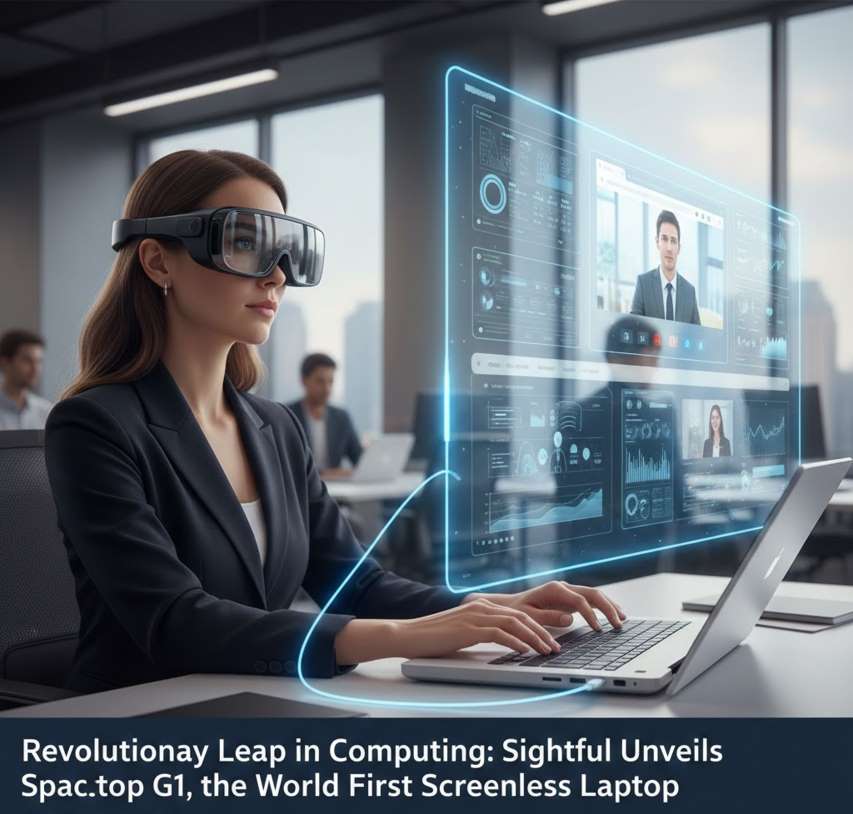
In a bold move that is redefining the boundaries of portable computing, the startup Sightful has launched the Spacetop G1, hailed as the world's first laptop without a traditional screen. Instead of relying on a built-in display, this innovative device pairs with Augmented Reality (AR) glasses to project a massive 100-inch virtual workspace directly into the user's field of view.
Announced in mid-2023 and now available following its October 2024 shipping date, the Spacetop G1 promises to transform how professionals work on the go, emphasizing privacy, ergonomics, and expansive digital real estate.
The Concept: Ditching the Screen for Immersion
At its core, the Spacetop G1 challenges the conventional laptop design by eliminating the physical screen altogether. The device resembles a standard laptop base—complete with a keyboard, trackpad, and ports—but where the lid would typically fold open to reveal a display, there is nothing.
In its place, users don a pair of lightweight, wired Xreal Augmented Reality glasses that connect directly to the laptop. These glasses overlay a virtual desktop onto the real world, allowing users to arrange windows, applications, and tools in a three-dimensional space around them.
SpaceOS: A Spatial Operating System
This setup creates what Sightful calls a "spatial operating system" known as SpaceOS, built on a modified version of Android. Unlike traditional laptops where you are confined to a single screen, the Spacetop G1 allows you to expand your workspace virtually up to 100 inches, with the ability to place applications in a nearly 360-degree arc.
For instance, you could pin a web browser to your left, a document editor straight ahead, and a video call to your right—all while maintaining awareness of your surroundings.
This approach creates distinct benefits:
Productivity: Boosts multitasking capabilities.
Ergonomics: Addresses common pain points like neck strain from hunching over a screen, promoting better posture during extended use.
Privacy: The virtual display is visible only to the wearer, making it ideal for sensitive work in public settings like airplanes or cafes.
"We wanted to free users from the limitations of physical hardware. In a world where screens are everywhere, why not make them invisible to everyone but you?" Tamir Berliner, CEO of Sightful
Under the Hood: Specifications and Performance
Powering the Spacetop G1 is a Qualcomm Snapdragon QCS8550 processor, paired with an Adreno 740 Graphics Processing Unit. While these specifications might not rival high-end gaming laptops, they are optimized for productivity tasks.
Technical Specifications Breakdown
Feature | Specification |
|---|---|
Processor | Qualcomm Snapdragon QCS8550 |
Graphics | Adreno 740 GPU |
Memory | 16 Gigabytes of LPDDR5 RAM |
Storage | 128 Gigabytes UFS 3.1 (approx. 102 Gigabytes available) |
AI Processing | 48 Trillions of Operations Per Second (TOPS) |
Camera | 5 Megapixel webcam (integrated into foldable case) |
Dimensions | 11.81 x 9.09 x 0.51-2.44 inches |
Weight | ~3.08 pounds (Base) + 0.18 pounds (Glasses) |
Connectivity | Two USB-C ports (one for charging); No headphone jack |
Hands-on tests show the system handles multitasking smoothly, including web browsing, document editing, email, and collaboration tools like Slack and Zoom. The inclusion of 48 Trillions of Operations Per Second for Artificial Intelligence processing hints at future features, though details on integrated Artificial Intelligence capabilities remain sparse.
Battery and Design Notes
Battery life is estimated to support a full workday under typical use, thanks to the efficient Snapdragon chipset. However, the wired Augmented Reality glasses mean you are tethered to the laptop, limiting mobility during active sessions—though the cable is long enough for comfortable head movement.
Software and Compatibility: A Custom Ecosystem
SpaceOS is the heart of the Spacetop experience, designed specifically for spatial computing. It supports popular web-based applications out of the box, including Google Workspace, Microsoft 365, and various productivity suites. Android application compatibility is promised in future updates, expanding its utility.
Unlike overlay solutions that slap a virtual desktop onto existing Operating Systems like Windows or macOS, SpaceOS remembers window placements using built-in sensors, creating a persistent, customizable workspace.
Expansion to Business-to-Business Markets
Sightful has also evolved the product line. While the original G1 hardware runs SpaceOS, the company now offers "Spacetop for Windows," an $899 software subscription that transforms compatible existing laptops (with Intel Core i7 or i9 processors) into Augmented Reality workspaces when paired with smart glasses. This Business-to-Business focused extension targets enterprises like Nestlé Purina and Deutsche Telekom, emphasizing secure, mobile productivity without hardware investment.
Hands-On Impressions: Pros, Cons, and Real-World Use
Early adopters and reviewers have praised the Spacetop G1 for its innovative form factor.
The Advantages
Visual Clarity: The glasses deliver bright, clear visuals with minimal lag, making text legible and interactions intuitive.
Ergonomics: It feels liberating not to stare down at a screen, potentially reducing eye strain and improving focus during long sessions.
Portability: It eliminates the need for external displays or stands, offering a portable "office anywhere" solution.
The Drawbacks
Software Limits: The Android-based Operating System limits compatibility with desktop software, pushing users toward web applications.
Hardware Constraints: The hardwired glasses can feel restrictive, and the overall design appears somewhat bulky when closed due to the protective bulge.
Performance Gaps: Video calls via the 5 Megapixel webcam yield decent but grainy results, and the lack of a discrete Graphics Processing Unit means it is not suited for graphics-intensive tasks like video editing or gaming.
Pricing, Availability, and the Future
The Spacetop G1 retails for $1,900, with early access reservations requiring a $100 deposit. Shipping began in October 2024, and it is available directly from Sightful. As of late 2025, user feedback on platforms like Reddit highlights its potential as a "cool innovation" for niche users, though some debate if it is essential or just hype.
Looking Ahead
Sightful envisions the Spacetop as a stepping stone to broader spatial computing. With advancements in Augmented Reality technology, future iterations could include wireless glasses, more powerful processors, and native support for major Operating Systems. As remote work continues to evolve, devices like this could become staples for professionals seeking privacy and flexibility in an increasingly digital world.
Whether the Spacetop G1 is a gimmick or a glimpse into the future remains to be seen, but one thing is clear: it is pushing the envelope on what a "laptop" can be. For those intrigued, it is worth exploring—after all, who wouldn't want a 100-inch screen that fits in your backpack?
 |  |  |
 |  |  |