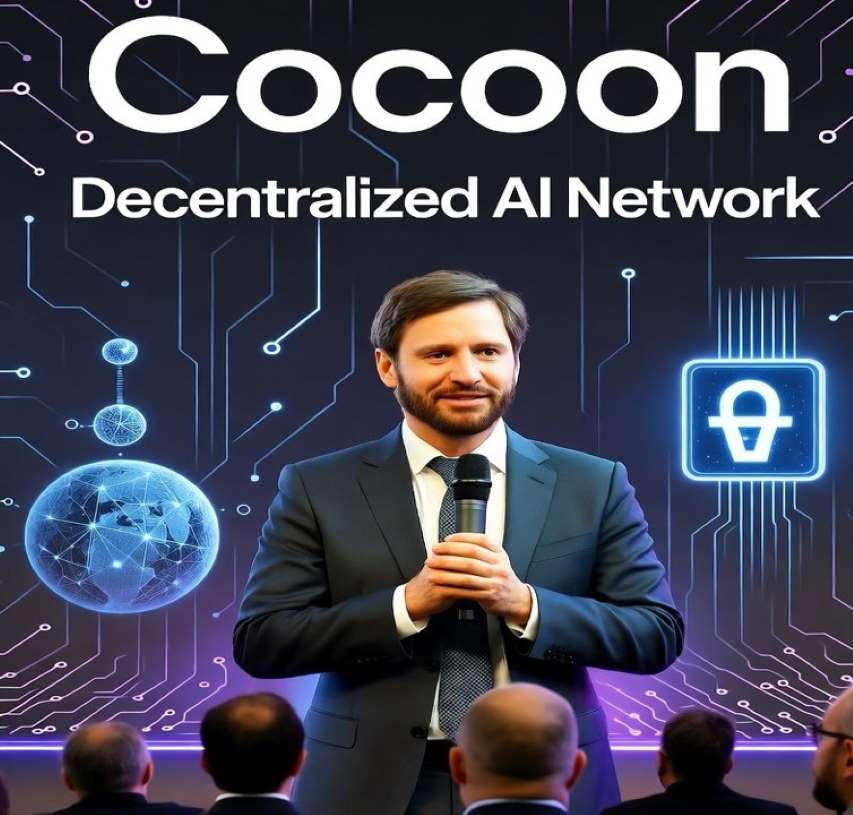
Pavel Durov, the founder and CEO of Telegram, has announced the launch of Cocoon, an innovative decentralized AI compute network built atop The Open Network (TON) blockchain. The project aims to liberate Artificial Intelligence from centralized control, transforming idle hardware into a revenue stream while ensuring unparalleled user privacy.
The announcement was made during Durov’s keynote at the Blockchain Life 2025 conference in Dubai on October 29, 2025.
💡 The Vision: Decentralizing AI Compute
Cocoon emerges as a direct response to the "AI compute crisis"—the growing monopolization of AI development by a few large corporations that control vast, expensive computing resources.
Problem | Cocoon's Solution | Core Benefit |
|---|---|---|
Monopolization | Creates a global, peer-to-peer network for AI inference. | Democratization of computing access for researchers and developers. |
High Cost | Allows users to rent out unused GPU capacity (from PCs, phones, etc.). | Reduces costs compared to traditional cloud providers (AWS, Google Cloud). |
Privacy Risk | Employs confidential computing to keep data encrypted throughout the process. | Unparalleled privacy for sensitive data and proprietary models. |
Goal: Cocoon will allow anyone with a GPU to contribute to a network that's secure, efficient, and rewarding, fostering a more inclusive AI future.
🛠️ Key Features of the Cocoon Network
Cocoon’s architecture blends cutting-edge AI technology with TON's robust layer-1 blockchain infrastructure.
Decentralized GPU Marketplace
Users lend their idle GPUs to perform AI tasks (known as inference), earning TON cryptocurrency tokens in return. This scales the network organically and provides a new source of passive income for participants.
Privacy-Centric AI Inference
The network uses advanced encryption protocols, such as homomorphic encryption, which allows AI models to run computations on encrypted data without ever decrypting the inputs. This aligns perfectly with Telegram's core ethos of digital privacy.
Seamless Telegram Integration
Developers can embed Cocoon's capabilities directly into Telegram Mini Apps. This enables AI-enhanced features—like real-time translation or image generation—to be used instantly within Telegram's ecosystem, leveraging its 900 million active users.
Governance and Economics
Built on TON: Tasks are distributed and verified using smart contracts on the TON blockchain, ensuring fair allocation and verification.
Community Governance: TON token holders will be able to vote on network upgrades and policies.
Sustainability: Staking TON tokens helps secure the network while offering additional yields to long-term participants.
🚀 The Road Ahead and Broader Implications
The public beta for Cocoon is scheduled to roll out in November 2025, following infrastructure testing and initial partnerships.
Potential Impact
Challenging Tech Giants: Cocoon offers a cheaper and more private alternative to centralized AI compute providers like OpenAI and Google.
Web3 Innovation: The network is expected to spur innovation in Web3 AI applications, including decentralized autonomous organizations (DAOs) and secure consumer data analysis apps.
TON Utility: The launch significantly boosts the utility and value of the native TON token and ecosystem.
Durov and TON
Pavel Durov, renowned for championing digital privacy since founding VKontakte and Telegram, has successfully guided Telegram toward deep blockchain integration with TON. This announcement is the culmination of that vision, aiming to create a decentralized internet where users maintain control over their data and digital assets.