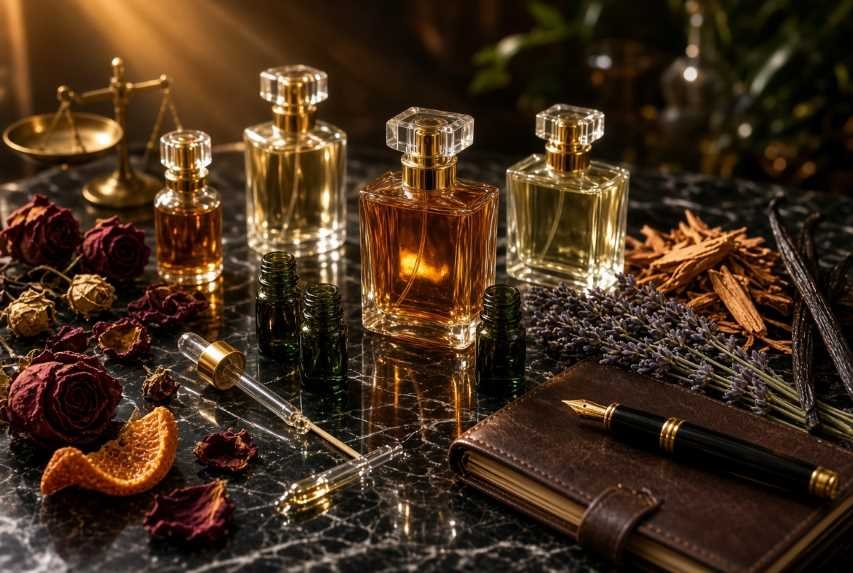
Making perfume at home is one of the most creative, personal, and satisfying projects you can do with simple ingredients and basic equipment. Instead of choosing a fragrance designed to appeal to thousands of people, you can create a scent that reflects your own taste, memories, and personality.
A perfume is more than a pleasant smell. It is a structured mixture of volatile fragrance materials, a carrier such as ethanol, and time. When you learn the basic principles of fragrance formulation, you begin to understand why a perfume smells different when you first spray it compared with several hours later, and why some notes linger while others disappear quickly.
Home perfume making is not the same as professional perfumery. Professional perfumers may work with hundreds of synthetic aroma chemicals, use specialized software, and follow strict stability and safety testing. Beginners can still make beautiful, wearable fragrances at home by using a small number of carefully chosen ingredients, measuring by weight, and documenting every trial.
This guide gives you a practical, safety-conscious introduction to creating your own perfume at home. You will learn what perfume is made of, how fragrance notes work, how to choose ingredients, how to formulate a simple blend, and how to improve your results over time.
Important: Always work with cosmetic-grade ingredients. Essential oils and fragrance materials are concentrated and can cause irritation or allergic reactions. Never assume that “natural” means automatically safe.
What Is Perfume Made Of?
At its simplest, perfume is a fragrance concentrate diluted in a carrier. The concentrate contains the aromatic materials. The carrier, usually ethanol, helps the fragrance evaporate evenly and makes it easier to apply.
The basic components of a homemade perfume are:
Fragrance Materials
These are the ingredients that create the smell. They include essential oils, fragrance oils, and individual aroma compounds. Each material evaporates at a different rate and contributes to the overall character of the perfume.
Essential Oils
Essential oils are complex natural mixtures obtained from plants. They are usually extracted by steam distillation or cold pressing. Examples include lavender, bergamot, cedarwood, and patchouli. They contain many volatile chemical components, which is why they can smell rich and change over time.
Fragrance Oils
Fragrance oils are manufactured scented preparations. Some are synthetic blends designed to imitate a natural scent, while others are creative fantasy fragrances such as “sea salt,” “white musk,” or “cashmere.” Not all fragrance oils are suitable for skin. Some are intended only for candles, diffusers, or soap. Always check the supplier’s documentation.
Aroma Compounds
Aroma compounds are individual molecules or simple mixtures used in professional perfumery. Examples include linalool, citral, vanillin, coumarin, and hedione. Some are naturally derived; many are synthetic. Beginners can use them, but they are usually handled more easily after some experience.
Alcohol
Ethanol is the most common carrier for fine fragrance. It dissolves many fragrance materials, creates a clear sprayable liquid, and helps the fragrance project. Perfumers’ alcohol is normally denatured ethanol with little or no added water. In home perfumery, high-proof unflavored vodka can sometimes be used, but it should be at least 90% alcohol by volume if possible.
Distilled or Demineralized Water
Water is sometimes included in commercial formulas, but it is not necessary for most beginner perfume projects. Water can cause cloudiness, reduce solubility, and encourage microbial growth. If you use water, it should be distilled or demineralized, not tap water.
Fixatives
Fixatives are ingredients that slow down evaporation and can help a fragrance last longer. Natural fixatives include benzoin, vetiver, sandalwood, patchouli, and labdanum. Some synthetic musks also act as fixatives. Fixatives are not magical: they change the odor profile and can only extend longevity within the limits of the formula.
Optional Additives
Some perfumers add tiny amounts of antioxidants such as tocopherol to oil-based perfumes, or cosmetic solubilizes when water is present. Beginners should usually avoid unnecessary additives.
The carrier influences how the perfume feels, sprays, and lasts. In this guide, ethanol-based perfume is the main focus because it is the most familiar fine-fragrance format.
Understanding Fragrance Notes
A well-structured perfume is usually described using three layers: top notes, heart notes, and base notes. These layers are not separate liquids. They are simply fragrance materials with different evaporation rates.
Top Notes
Top notes are the first impression. They are light, volatile, and noticeable immediately after application. They usually evaporate within a few minutes to about 30 minutes.
Common top notes include:
Bergamot
Lemon
Sweet orange
Lime
Grapefruit
Mandarin
Litsea cubeba
Basil
Eucalyptus
Peppermint
Heart Notes
Heart notes, also called middle notes, appear after the top notes begin to fade. They form the main character of the perfume and may last for 1–3 hours or longer.
Common heart notes include:
Lavender
Rose geranium
Palmarosa
Ylang ylang
Neroli
Clary sage
Rosemary
Black pepper
Cardamom
Base Notes
Base notes are the long-lasting foundation. They evaporate slowly and can remain on the skin for several hours or even all day. They give depth, warmth, and staying power.
Common base notes include:
Cedarwood
Sandalwood
Vetiver
Patchouli
Benzoin
Vanilla
Labdanum
Synthetic musk
Tonka bean
A simple balanced structure might look like this:
Layer | Example |
|---|---|
| Top | Citrus: bergamot, sweet orange |
| Heart | Floral or aromatic: lavender, geranium |
| Base | Woody, amber, or musky: cedarwood, benzoin |
Why is balance important? If a perfume has too many top notes, it may smell wonderful for ten minutes and then disappear. If it has too many base notes, it may feel heavy, flat, or slow to open. A good beginner strategy is to choose at least one material from each layer and keep the total number of ingredients small.
Essential Oils vs. Fragrance Oils
Many beginners ask whether they should use essential oils or fragrance oils. The answer depends on your goals, budget, and safety requirements.
Feature | Essential Oils | Fragrance Oils | Aroma Compounds |
|---|---|---|---|
| Source | Extracted from plants | Manufactured blends | Single molecules or simple mixtures |
| Scent character | Complex, variable, natural | Often more uniform and predictable | Very specific, may be clean or abstract |
| Cost | Can be expensive, especially rose or sandalwood | Usually more affordable | Varies widely |
| Stability | Can change with oxidation and age | Often more stable in product use | Can be very stable |
| Skin safety | Not automatically safe; some can irritate or sensitize | Depends on formulation; only use skin-safe grades | Depends on the molecule and dose |
| Use in fine fragrance | Very common in natural perfumery | Common in creative or budget-friendly perfumes | Standard in professional perfumery |
The phrase “natural does not automatically mean safer” is essential. Essential oils contain potent chemical constituents. Citrus oils can cause phototoxic reactions if not handled correctly. Clove, cinnamon bark, and some other oils can be strong sensitizers. Lavender and tea tree oils have been associated with allergic reactions in some people.
Fragrance oils are not automatically safer either. Some fragrance oils are intended only for room sprays, candles, or soap. Some contain solvents, dyes, or ingredients that should not be applied to skin at high concentrations.
Always use:
Skin-safe essential oils within recommended maximum levels
Fragrance oils labelled for cosmetic use
Materials with an IFRA certificate or supplier safety data sheet
The International Fragrance Association, known as IFRA, publishes safety standards for fragrance ingredients. Reputable suppliers often provide an IFRA certificate showing the maximum safe percentage for different product categories.
Equipment You Need
You do not need a professional laboratory to make perfume at home, but a few basic tools will make your work more consistent.
Basic Equipment List
Small glass bottles for trials
Glass mixing beakers or small glass vials
Disposable pipettes or glass droppers
Precision scale with 0.01 g accuracy
Fragrance blotter strips or thick paper strips
Small glass funnel
Disposable gloves
Labels or masking tape
Dark glass perfume bottles
Ethanol-resistant spray caps
Why Measure by Weight?
Drops are unreliable. The size of a drop changes depending on the viscosity of the oil, the dropper size, and the temperature. If you change supplier or use a thicker material, a drop can weigh more or less.
Weighing ingredients on a precision scale gives you a repeatable formula. Professional perfumery is almost always done by weight. A scale with 0.01 g readability is sufficient for small experiments.
For a 10 g trial perfume, a 0.01 g scale allows you to measure ingredients to the nearest 0.01 g, which is accurate enough for most beginner work. Record every ingredient in grams.
Ingredients and How to Choose Them
When you start, it is tempting to buy dozens of oils and mix many together. In practice, simpler formulas are easier to evaluate and improve.
Fragrance Families
Citrus
Citrus notes are bright, fresh, and uplifting. Examples include bergamot, sweet orange, lemon, lime, grapefruit, and mandarin. Some cold-pressed citrus oils can cause photosensitivity. Bergamot FCF or steam-distilled citrus oils are safer choices for leave-on skin products.
Floral
Floral materials range from soft and powdery to rich and sweet. Examples include lavender, rose geranium, palmarosa, ylang ylang, jasmine, and neroli. Floral notes often form the heart of a perfume.
Woody
Woody notes add dryness, depth, and sophistication. Examples include cedarwood, sandalwood, vetiver, cypress, and patchouli.
Spicy
Spicy notes can add warmth and contrast. Examples include black pepper, cardamom, coriander, nutmeg, and ginger. Clove and cinnamon are very potent and should be used with extreme caution due to sensitisation risk.
Fresh and Aquatic
True aquatic and marine notes are usually synthetic or fragrance-oil creations. In natural perfumery, freshness can come from herbs, citrus, and light florals. Eucalyptus, mint, rosemary, and tea tree can create a clean feeling, but they are not true aquatic notes.
Herbal
Herbal materials add green, aromatic character. Examples include basil, rosemary, thyme, sage, and clary sage.
Vanilla, Amber, and Sweet
Sweet base materials include vanilla absolute, benzoin, Peru balsam, tonka bean, and labdanum. They can make a fragrance feel warm and comforting. Some sweet materials, such as tonka bean, contain coumarin and are restricted in leave-on products.
Musk-Style Materials
Traditional animal musks are not used in ethical modern perfumery. Today, musk effects come from synthetic white musk, ambrette seed, or specially formulated fragrance oils.
Choosing Complementary Scents
Instead of mixing many ingredients at random, choose a theme. For example:
Fresh: bergamot, lavender, cedarwood
Soft floral: bergamot, rose geranium, palmarosa, sandalwood
Warm woody: bergamot, cardamom, cedarwood, vetiver, benzoin
A practical beginner rule is to limit your first formulas to 5–8 fragrance materials. This gives enough complexity to be interesting but not so many that the scent becomes muddy.
Basic Perfume Formulation
Fragrance concentration is one of the most important technical concepts in perfume making. The concentration is usually expressed as the percentage of fragrance concentrate in the final product.
| Category | Approximate Fragrance Concentration | Typical Character |
|---|---|---|
| Eau Fraîche | 1–3% | Very light, short-lived |
| Eau de Cologne | 2–6% | Fresh, light |
| Eau de Toilette | 5–15% | Moderate projection and longevity |
| Eau de Parfum | 15–20% | Stronger, longer-lasting |
| Parfum / Extrait | 20–40% | Rich, dense, long-lasting |
These ranges are approximate. Different brands and markets use different definitions. A 20% eau de parfum from one manufacturer may perform differently from another because the materials themselves matter as much as the percentage.
For beginners, a good starting point is 15–20% fragrance concentrate in ethanol. This concentration is strong enough to evaluate but not so concentrated that it is wasteful or automatically unsafe.
Safety note: Always check the maximum safe use level for each individual ingredient in a leave-on skin product. If an ingredient is restricted to 0.5% in the final perfume, you cannot simply include it at 5% of a 20% concentrate.
Step-by-Step: Make Your First Perfume
Step 1 — Choose a Fragrance Concept
Decide what kind of feeling you want. For example:
Fresh and clean
Soft and floral
Warm and woody
Sweet and amber
Green and herbal
Spicy and exotic
Light and musky
Choosing a concept helps you select ingredients that work together rather than combining unrelated scents.
Step 2 — Select Your Fragrance Materials
Choose a small number of complementary materials. A simple structure might include:
1–2 top notes
2–3 heart notes
2–3 base notes
Record the exact name, botanical name if applicable, supplier, and batch number.
Step 3 — Create a Small Fragrance Trial
Start with a very small batch. A 10 g finished perfume is enough for testing and adjustment. If the trial fails, you waste very little material.
Step 4 — Measure Accurately
Use a precision scale. Place a clean glass vial or beaker on the scale, tare it, and weigh each ingredient directly into the same container.
Example for a 10 g eau de parfum at 20% concentration:
Fragrance concentrates: 2.0 g
Ethanol: 8.0 g
If your concentrate formula says 30% bergamot, you weigh 0.60 g of bergamot.
Step 5 — Blend the Fragrance Concentrate
Weigh the base notes first, then the heart notes, then the top notes. This is not a strict rule, but it helps you stay organised. After weighing, close the container and swirl gently.
Do not stick your nose directly into the concentrate. Concentrated fragrance materials can overwhelm the nose. Use a blotter strip or wave the open container gently near your nose.
Step 6 — Add the Alcohol or Appropriate Carrier
Add the ethanol to the concentrate and swirl gently. The alcohol dilutes the fragrance and changes its projection. A concentrated blend may smell harsh or dense; once diluted, the different notes become easier to evaluate.
Step 7 — Mix Carefully
Mix by gentle swirling or repeated inversion. Avoid vigorous shaking if possible, especially with alcohol-based perfume, because it can introduce bubbles and may disturb delicate materials.
Step 8 — Let the Perfume Mature
Freshly mixed perfumes often smell sharp, unfinished, or unbalanced. Over days or weeks, the ingredients interact and soften. This process is called maceration or maturation.
Store the closed bottle in a cool, dark place. For an alcohol-based perfume, 1–2 weeks is a common minimum, but many formulas improve over 3–6 weeks.
Step 9 — Evaluate the Fragrance
Evaluate the perfume on a blotter strip first.
Dip the strip into the diluted perfume.
Smell it immediately.
Smell it again after 15–30 minutes.
Check after 2–4 hours.
Check again after 8 hours if possible.
For skin testing, wait until the perfume has matured and been properly diluted. Apply a small amount to clean skin on the inner forearm. Do not apply to broken or irritated skin. Observe for any reaction.
When evaluating:
The first few minutes show the top notes.
After 15–30 minutes, the heart notes emerge.
After several hours, the base notes dominate.
Step 10 — Adjust the Formula
Make one change at a time. If you change several ingredients simultaneously, you will not know which change made the difference.
| Problem | Possible Adjustment |
|---|---|
| Too strong | Reduce concentrate percentage or dilute further |
| Too weak | Increase concentration slightly or add longer-lasting base materials |
| Too sweet | Add a small amount of citrus, wood, or herbal contrast |
| Too sharp | Add a small amount of benzoin, vanilla, or sandalwood |
| Too floral | Add woody, citrus, or green materials |
| Too woody | Add floral, citrus, or softly sweet materials |
| Not long-lasting enough | Reduce top notes slightly and increase base notes, or use a higher concentration within safe limits |
Three Beginner Perfume Formulation Concepts
The following examples are educational starting points, not certified commercial formulas. They are expressed as percentages of the fragrance concentrate, not the final perfume. Always check each ingredient’s IFRA maximum skin-use level and supplier documentation.
Formula 1: Fresh Citrus & Clean
Fragrance concept: Bright, fresh, easy to wear.
Concentrate formula:
Ingredient | Role | Percentage |
|---|---|---|
Bergamot FCF | Top | 35% |
Sweet orange, steam-distilled | Top | 15% |
Litsea cubeba | Top | 5% |
Lavender | Heart | 20% |
Geranium | Heart | 10% |
Cedarwood Virginian | Base | 10% |
Patchouli | Base | 3% |
Benzoin | Base | 2% |
Why it works: The citrus top is bright, lavender and geranium give a clean aromatic-floral heart, and cedarwood with benzoin provides a soft, slightly warm dry-down. Patchouli is used in a small amount to add subtle depth without making the perfume heavy.
Expected evolution: It opens fresh and citrusy, becomes gently floral after about 20 minutes, and dries down to a clean woody-amber skin scent.
Dilution suggestion: 15–20% concentrate in ethanol.
Formula 2: Soft Floral
Fragrance concept: Feminine, soft, powdery, and comfortable.
Concentrate formula:
| Ingredient | Role | Percentage |
|---|---|---|
| Bergamot FCF | Top | 20% |
| Lavender | Heart | 10% |
| Rose geranium | Heart | 25% |
| Palmarosa | Heart | 10% |
| Ylang ylang extra | Heart | 5% |
| Cedarwood Virginian | Base | 10% |
| Sandalwood accord or Australian sandalwood | Base | 10% |
| Benzoin | Base | 8% |
| Patchouli | Base | 2% |
Why it works: Rose geranium and palmarosa create a rosy, green-floral heart. Ylang ylang adds sweetness, but only a small amount. Cedarwood and sandalwood give a soft woody base, while benzoin adds a powdery, slightly vanilla-like warmth.
Expected evolution: It opens with fresh bergamot, then becomes rose-like and softly floral. The dry-down is warm, slightly sweet, and clean.
Formula 3: Warm Woody & Amber
Fragrance concept: Deep, warm, unisex, and long-lasting.
Concentrate formula:
Ingredient | Role | Percentage |
|---|---|---|
Bergamot FCF | Top | 15% |
Black pepper | Top | 5% |
Cardamom | Top | 5% |
Clary sage | Heart | 5% |
Geranium | Heart | 10% |
Cedarwood Atlas | Base | 20% |
Patchouli | Base | 5% |
Vetiver | Base | 10% |
| Sandalwood accord or sandalwood | Base | 10% |
Benzoin | Base | 10% |
| Vanilla absolute, diluted | Base | 5% |
Why it works: Bergamot and cardamom give a fresh-spicy opening. Clary sage and geranium add an aromatic heart. Cedarwood, vetiver, sandalwood, benzoin, and vanilla create a warm, rich, long-lasting foundation.
Expected evolution: It starts fresh and slightly spicy, becomes herbal and woody, and dries down to a deep amber-woody scent with soft vanilla sweetness.
Reminder: These formulas use natural materials. Some of them, such as ylang ylang, black pepper, or cedarwood, can be irritating if used excessively. The percentages above are concentrate percentages; when diluted to 15–20% in ethanol, the actual skin exposure is much lower. Still, verify every ingredient before use.
How to Improve Longevity
Many beginners want a perfume that lasts all day. Longevity is influenced by several factors.
Ingredient Volatility
Light molecules such as citrus oils evaporate quickly. Heavier molecules such as sandalwood, vetiver, benzoin, and synthetic musks evaporate slowly. If a formula contains mostly top notes, it will not last long.
Base Note Structure
A perfume with a strong base-note structure will remain noticeable longer. Increasing the proportion of base notes while reducing top notes can improve longevity, but the opening may become less sparkling.
Concentration
A higher concentration of fragrance concentrate usually lasts longer, but only up to a point. Increasing the concentration also increases the risk of skin irritation and changes the scent character.
Application Method
Perfume lasts longer on moisturized skin. Apply an unscented lotion or oil before spraying. Perfume also lasts longer on pulse points such as the wrists, neck, and behind the ears, but avoid rubbing the skin after application.
Composition
Some fixative materials can slow evaporation. Benzoin, labdanum, vetiver, sandalwood, and certain synthetic musks are commonly used. However, they also change the odor. There is no single ingredient that can make every perfume last all day.
Storage and Ageing
Improper storage can degrade fragrance materials. Heat, light, and oxygen can destroy top notes and reduce overall quality. A properly stored perfume will perform better over time.
Common Beginner Mistakes
Using Too Many Ingredients
A formula with 20 ingredients may smell confused. Beginners should start with 5–8 materials.
Measuring Only by Drops
Drops are inconsistent. Use a 0.01 g scale and record everything by weight.
Making Large Batches Immediately
A 100 g batch is too large for a first experiment. Start with 5–10 g.
Not Recording Formulas
If you do not write down what you used, you cannot repeat or improve the result. Keep a notebook or digital file.
Testing Only Immediately After Mixing
Freshly made perfume changes during maturation. Test after days or weeks, not only after five minutes.
Using Unsuitable Ingredients on Skin
Some essential oils and fragrance oils are not safe for leave-on skin products. Check the supplier’s documentation.
Overusing Essential Oils
More essential oil does not automatically make a better perfume. It may make the perfume harsh, cloying, or irritating.
Ignoring Safety Information
Read labels, IFRA certificates, and safety data sheets. Pay attention to warnings about photosensitivity, sensitization, and maximum use levels.
Storing Perfume Incorrectly
Keeping perfume in sunlight or a warm bathroom can degrade it. Use a cool, dark place.
Changing Several Ingredients at Once
If you change three ingredients in one trial, you will not know which one improved or worsened the result. Change one variable at a time.
Safety First
Perfume making is enjoyable, but it involves concentrated substances.
Safety note: The information in this article is educational and does not replace professional safety assessment, medical advice, or legal guidance. Always consult supplier documentation and, if necessary, a qualified cosmetic safety assessor.
Skin Irritation
Even diluted essential oils can irritate the skin. People with sensitive skin, eczema, or allergies should be especially careful.
Allergic Reactions and Sensitization
Some fragrance materials can cause allergic contact dermatitis. Sensitisation can develop over time, even if you have used an oil before without problems.
Photosensitivity
Certain cold-pressed citrus oils contain furanocoumarins that can cause severe skin reactions when exposed to UV light. Bergamot FCF, steam-distilled lime, and similar low-furanocoumarin materials are safer choices for leave-on products. Avoid sun exposure on skin where phototoxic citrus oils have been applied.
Safe Dilution
Start with lower concentrations. For leave-on skin perfume, 10–20% total fragrance concentrate is a common home-use range, but the safe level depends on the individual ingredients.
Proper Labelling
Label every bottle with:
Product name
Date
Ingredients
Concentration
Batch number
Flammability
Ethanol is flammable. Keep it away from open flames, heaters, and sparks. Work in a ventilated area.
Ventilation
Fragrance materials can be overwhelming. Work in a room with good airflow.
Eye Contact
Avoid touching your eyes while handling fragrance materials. If a material gets into your eye, rinse gently with clean water and seek medical advice if needed.
Children and Pets
Keep all fragrance materials, especially ethanol and essential oils, out of reach of children and pets. Many essential oils are toxic if swallowed.
Application Categories
A fragrance material may be safe in wash-off products such as soap but not in leave-on skin products. It may be safe in candles but not in perfume. Always check the intended use category.
Never Assume Natural Is Safe
Clove, cinnamon bark, wintergreen, and many other natural oils are highly potent. Some can cause serious harm at relatively low doses. Use all fragrance materials with respect.
How to Store Homemade Perfume
Proper storage protects the fragrance and extends its useful life.
Bottles
Use glass bottles rather than plastic when possible. Dark amber, cobalt blue, or opaque bottles help reduce light exposure.
Sunlight
Ultraviolet light can degrade fragrance materials. Store perfume in a dark cupboard or drawer.
Temperature
Keep perfume in a cool place, ideally between 5°C and 20°C. Avoid bathrooms, windowsills, and cars.
Oxygen Exposure
Oxygen can oxidize fragrance materials. Keep bottles tightly closed and avoid leaving them open for long periods.
Headspace
A half-empty bottle contains more oxygen. If you have a large bottle, consider transferring a small amount into a smaller working bottle to reduce air exposure.
Labelling
Always label the bottle with the formula name, date, batch number, and ingredients. This is essential when you return to a perfume weeks later.
Signs of Change
A perfume may be degrading if it:
Changes color significantly
Smells sour or sharp
Becomes cloudy in an alcohol formula
Loses its original character
When in doubt, discard a small trial rather than using a perfume that may be oxidized or contaminated.
How to Create Your Own Signature Scent
A signature scent is not created in one afternoon. It develops through observation and refinement.
Choose a Fragrance Theme
Start with a simple idea: “fresh green garden,” “soft powdery floral,” “smoky wood,” or “warm vanilla amber.”
Select a Dominant Note
Pick one material that will be the center of the perfume. For example, if you love vetiver, let vetiver be the dominant note and choose other ingredients to support it.
Add Supporting Notes
Supporting notes should make the dominant note more interesting. If vetiver is dominant, you might add a small amount of grapefruit for brightness, geranium for softness, and benzoin for warmth.
Create Contrast
Contrast prevents a perfume from becoming flat. A sweet vanilla perfume may benefit from a small amount of black pepper or bergamot. A fresh citrus perfume may become more interesting with a touch of patchouli or cedarwood.
Balance Top, Heart, and Base
Make sure your formula has enough base to last, enough heart to give character, and enough top to create a pleasant opening.
Test Multiple Versions
Create several small variations. For example:
Version A: 20% top, 40% heart, 40% base
Version B: 30% top, 30% heart, 40% base
Version C: 25% top, 35% heart, 40% base
Compare them over several days.
Keep a Formulation Journal
Write down every trial, including the exact weights, the date, the materials, and your impressions at different time points.
Change One Variable at a Time
If you want more sweetness, adjust the sweet note slightly and keep everything else identical. This builds your understanding of each material.
A Simple Perfume Experiment for Beginners
This experiment teaches you how different fragrance families interact.
Purpose
To compare the effect of changing the ratio between top, heart, and base notes.
Materials
Choose one top note, one heart note, and one base note. For example:
Top: bergamot
Heart: lavender
Base: cedarwood
Procedure
Make three small 5 g trials at 10% concentration in ethanol. That means each trial contains 0.5 g concentrate and 4.5 g ethanol.
Trial | Top:Heart:Base | Bergamot | Lavender | Cedarwood |
|---|---|---|---|---|
A | 30:30:40 | 0.15 g | 0.15 g | 0.20 g |
B | 50:20:30 | 0.25 g | 0.10 g | 0.15 g |
C | 20:40:40 | 0.10 g | 0.20 g | 0.20 g |
Documentation
For each trial, record:
Ingredient name
Amount in grams
Percentage
Date
Batch number
Initial smell
Smell after 15 minutes
Smell after 2 hours
Longevity
This simple experiment helps you understand how changing the balance affects the opening, heart, and dry-down.
Troubleshooting Guide
Use this table to diagnose common problems.
| Problem | Possible Cause | Possible Solution |
|---|---|---|
| Too strong | Excessive fragrance concentration or too many potent materials | Dilute with ethanol or reformulate with lower concentrate percentage |
| Too weak | Low concentration or too many volatile materials | Increase concentration cautiously or add base notes |
| Too sweet | Too many sweet or balsamic materials | Add citrus, herbal, or woody contrast |
| Too sharp | Excessive citrus, eucalyptus, or aromatic top notes | Add a small amount of benzoin, sandalwood, or vanilla |
| Does not last | Too many light top notes, weak base structure | Increase base-note proportion within safe limits |
| Cloudy | Water contamination, insoluble resin, or incompatible material | Use dry ethanol, check solubility, avoid tap water |
| Changes color | Oxidation or unstable natural ingredients | Store in dark glass in a cool place, reduce air exposure |
| Smells flat | Too few heart notes or no contrast | Add a supporting heart note or a contrasting top note |
Homemade Perfume vs. Commercial Perfume
Homemade perfume and commercial perfume have different strengths.
| Feature | Homemade Perfume | Commercial Perfume |
|---|---|---|
| Cost | Can be lower per trial | Higher for luxury brands, but benefits from scale |
| Creativity | Unlimited personal freedom | Limited to available products |
| Ingredient control | You choose everything | Usually not fully disclosed |
| Consistency | Depends on your measurement skills | High, with strict batch control |
| Longevity | Variable, depends on formula | Often optimised with fixatives and advanced materials |
| Quality control | Your responsibility | Industry-tested |
| Safety testing | Limited, unless you commission an assessment | Required for cosmetic products in many markets |
| Complexity | Simple to moderate | Can contain dozens or hundreds of materials |
Commercial perfumes are usually developed by experienced perfumers and evaluated by panels. They may contain synthetic materials that provide projection, diffusion, and stability that are difficult to achieve with a simple natural formula. Homemade perfume can still be beautiful and personal, but it is not automatically superior in performance or safety.
How Much Does It Cost?
The cost of starting perfume making depends on how many materials and tools you buy. Costs vary by region, supplier, and quality, so this section discusses general categories rather than exact prices.
Basic Beginner Setup
A basic setup might include:
A 0.01 g precision scale
5–10 small essential oils or fragrance oils
A bottle of perfumer’s alcohol or high-proof ethanol
Small glass vials and pipettes
One dark glass perfume bottle
This is enough to make simple trials and learn the process.
Intermediate Setup
An intermediate setup might add:
A wider selection of fragrance materials
Blotter strips
More precise glassware
Additional bottles and labels
A formulation notebook
More base notes and fixatives
Advanced Hobbyist Setup
An advanced hobbyist might invest in:
A larger library of essential oils, fragrance oils, and aroma chemicals
A more precise scale
Magnetic stirrer
Refrigerated storage for unstable materials
Packaging and labelling supplies
Stability testing over months
Worth investing in early:
A good scale
High-quality cosmetic-grade ethanol
A small number of high-quality fragrance materials
Where beginners can save money:
Start with small bottle sizes
Use simple glass vials instead of expensive packaging
Test on blotter strips before buying large amounts
Avoid rare or expensive absolutes until you understand formulation
How to Scale Up
The journey from experiment to repeatable formula to larger batch requires discipline.
From Small Experiments to Repeatable Formulas
Keep accurate batch records.
Use the same supplier and material grade.
Record exact weights, not approximate drops.
Test at least three separate small batches.
Compare the results under the same conditions.
Batch Records
A batch record should include:
Formula name
Date
Batch number
Ingredient lot numbers
Exact weights
Alcohol type and amount
Maturation time
Observations
Consistency
Essential oils vary by harvest, distillation, and supplier. When you scale up, the same formula may smell slightly different. This is normal. Consistency improves when you use standardized materials and measure carefully.
Ingredient Traceability
Keep supplier information and lot numbers. If a problem occurs, traceability helps you identify the cause.
Packaging
Use clean, dry bottles. Test the bottle, cap, and sprayer with your formula to ensure compatibility.
Stability Testing
For larger batches, keep a small sample and evaluate it after 1 month, 3 months, and 6 months. Look for changes in colour, clarity, and odour.
Safety Documentation
Before making larger quantities for friends or customers, ensure you have the correct safety and regulatory documentation.
Commercial Production
Selling perfume commercially introduces legal, labelling, cosmetic safety, and regulatory requirements. These vary by country. In the European Union, for example, cosmetic products must comply with Regulation (EC) No 1223/2009. In other markets, different rules apply. If you plan to sell, seek professional cosmetic safety advice and check the requirements in your jurisdiction. Do not assume that a homemade product can be sold without additional compliance work.
Frequently Asked Questions
Can I make perfume without alcohol?
Yes. You can make an oil-based perfume using a carrier oil such as fractionated coconut oil or jojoba oil. Oil-based perfumes are usually applied with a roller ball and last closer to the skin. They may have a shorter shelf life than alcohol-based perfumes.
Can I use essential oils?
Yes, but only if they are safe for leave-on skin application at the concentration you use. Check IFRA guidance and supplier safety data.
How long should homemade perfume mature?
Alcohol-based perfumes commonly benefit from at least 1–2 weeks of maturation, and many improve over 3–6 weeks. Oil-based perfumes may be ready after 1–2 weeks. The exact time depends on the formula.
Why does my perfume smell different after several hours?
Fragrance materials evaporate at different rates. The top notes fade first, the heart notes become more noticeable, and the base notes remain later. This is normal.
How can I make perfume last longer?
Increase the base-note proportion, use a higher concentration within safe limits, apply to moisturized skin, and store the perfume correctly. Avoid adding more essential oil without checking safety.
Can I mix different perfumes together?
Yes, you can experiment with layering or mixing, but the result may not be stable. Try a small test first.
Can I use vanilla extract from the kitchen?
No. Kitchen vanilla extract contains water, sugars, and food ingredients that can spoil, become cloudy, and irritate the skin. Use vanilla absolute, vanilla oleoresin, or a cosmetic-grade vanilla fragrance oil.
Can I use vodka?
High-proof unflavored vodka can sometimes be used if it is at least 90% alcohol by volume. Standard 40% alcohol vodka contains too much water and may not dissolve many fragrance materials well. Perfumer’s alcohol is preferable.
How should perfume be stored?
Store in a tightly closed dark glass bottle, away from heat, sunlight, and moisture. Keep it in a cool place.
Why did my perfume become cloudy?
Cloudiness can be caused by water, undissolved resinoids, low-ethanol content, or incompatible fragrance materials. Use dry, high-proof ethanol and check solubility before making a large batch.
Can homemade perfume be sold?
Possibly, but selling cosmetics usually requires compliance with safety, labelling, and regulatory requirements in your country. Do not sell without professional advice.
How do I develop my own signature fragrance?
Work systematically. Choose a theme, select a dominant note, add supporting notes, balance top, heart, and base, test small versions, and keep a formulation journal. Change one variable at a time.
Do I need preservatives in alcohol-based perfume?
Alcohol-based perfumes with little or no water generally do not require preservatives. Oil-based perfumes may benefit from antioxidants, but vitamin E is not a broad-spectrum preservative.
What is IFRA?
IFRA is the International Fragrance Association. It publishes safety standards for fragrance ingredients based on scientific assessment. Many suppliers provide IFRA certificates.
Are fragrance oils safer than essential oils?
Not automatically. Safety depends on the specific formulation and concentration. Always use cosmetic-grade fragrance oils and check the supplier’s documentation.
Can I use isopropyl alcohol?
Isopropyl alcohol is not recommended for skin perfume. Use cosmetic-grade ethanol or perfumer’s alcohol. Denatured alcohol should be a skin-safe grade.
Beginner's Checklist
Use this checklist before you begin and before each trial.
Ingredients
Cosmetic-grade fragrance materials
Skin-safe essential oils or fragrance oils
Perfumer’s alcohol or high-proof ethanol
Distilled or demineralized water, only if required
Equipment
0.01 g precision scale
Glass vials or beakers
Pipettes or droppers
Blotter strips
Small funnel
Dark glass bottles
Labels
Safety Supplies
Disposable gloves
Ventilated work area
No open flames nearby
Eye protection if desired
Supplier safety data sheets
Formula Documentation
Ingredient names
Batch numbers
Exact weights
Percentages
Date
Maturation time
Testing
Blotter strip evaluation
Skin patch test when appropriate
Observations after application
Dry-down evaluation
Storage notes
Final Thoughts
Successful perfume making is a process of experimentation, measurement, patience, observation, and refinement. Your first perfume will probably not be perfect, but it will teach you something important about how fragrance materials behave.
Start small. Weigh carefully. Record everything. Change one thing at a time. Allow your perfume to mature. Evaluate it not just when it is first mixed, but after hours and days.
Over time, you will learn which combinations work for you and which materials you love. The goal is not to copy a commercial perfume exactly, but to create something personal, wearable, and enjoyable.
Perfume making is both an art and a science. It rewards curiosity and discipline. Keep experimenting, respect the materials, and enjoy the process.
Sources and Further Reading
International Fragrance Association, IFRA Standards
International Organization for Standardization, ISO 9235: Aromatic natural raw materials — Vocabulary
European Union Cosmetics Regulation (EC) No 1223/2009
Tisserand, R. and Young, R., Essential Oil Safety, 2nd edition
Research Institute for Fragrance Materials, RIFM
Sell, C., The Chemistry of Fragrances: From Perfumer to Consumer
These sources provide technical and safety information for fragrance materials and cosmetic products. Always consult current editions and relevant national regulations.
 |  |  |
 |  |  |