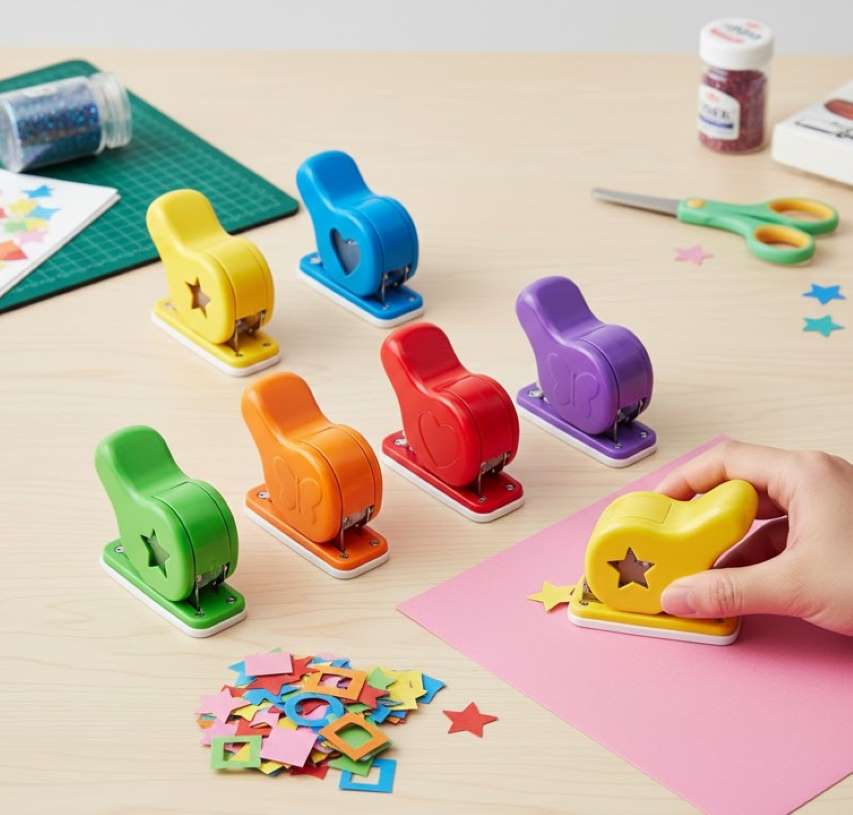
A Handheld ABS Craft Shape Puncher is a compact, manual tool crafted from durable Acrylonitrile Butadiene Styrene (ABS) plastic with an embedded steel cutting die. It is designed to quickly and precisely punch out small decorative shapes—such as stars, butterflies, leaves, flowers, hearts, Christmas trees, and animals—from paper, cardstock, and other thin materials. Operated by a simple squeeze mechanism, it is a staple in scrapbooking, card making, gift wrapping, and school projects, prized for its portability, ease of use, and perfect shape consistency.
Anatomy & Material Breakdown
Component | Material & Construction | Function |
|---|---|---|
| Upper Handle / Lever | Molded ABS plastic; often contoured and textured. | Provides grip and leverage; user squeezes this to activate the punch. |
| Lower Base / Jaw | Molded ABS plastic with a flat platform. | Supports the material; often has an alignment window for precise placement. |
| Pivot Pin / Rivet | Metal (usually steel or brass). | Acts as the fulcrum for the lever action, ensuring smooth operation. |
| Cutting Die | Hardened, sharpened steel formed into a specific shape (e.g., star). | The core component that cleanly shears the paper. |
| Return Spring | Small steel coil spring. | Automatically reopens the punch after squeezing. |
| Ejection Pad / Foam | Small piece of foam or soft plastic behind the die. | Prevents punched shapes from sticking and helps push them out. |
| Waste Chamber | Enclosed compartment within the ABS body. | Collects the tiny paper cut-outs ("chads") to keep the workspace tidy. |
Why ABS Plastic?
Durability: Impact-resistant and withstands repeated squeezing without cracking.
Lightweight: Makes the tool easy for children and adults to handle.
Cost-Effective: Allows for affordable production of a wide variety of shapes.
Colorful & Decorative: Can be easily molded into bright, attractive colors.
Mechanism: How the Squeeze Creates a Shape
Alignment: The paper is slid into the opening (often guided by a clear plastic window) until the desired spot is visible.
Application of Force: The user squeezes the upper lever toward the lower base.
Shear Action: This motion drives the steel cutting die downward through the paper, pressing it against a cutting plate or anvil in the base.
Cut Completion: At the end of the squeeze, the die completely penetrates the material, shearing out a perfect shape.
Return & Ejection: Releasing the grip allows the return spring to pop the lever open. The punched shape is either pushed out into a collection tray or remains in the chamber, while the main paper sheet is removed.
Common Shape Categories & Themes
Basics & Geometry: Circles, small stars, hearts, squares.
Nature: Butterflies, leaves (maple, oak), flowers, snowflakes.
Seasonal & Holiday:
Christmas: Trees, stockings, bells, candy canes.
Halloween: Bats, ghosts, pumpkins.
Easter: Eggs, bunnies, chicks.
Everyday: Animals (birds, cats), balloons, crowns, arrows.
Detailed Specifications
Typical Size: 2 to 4 inches long (5-10 cm); fits in the palm of your hand.
Punch Size: Creates shapes ranging from ¼ inch (6mm) to 1.5 inches (38mm) in diameter.
Material Capacity: Optimized for single sheets of:
Standard printer paper (80 gsm)
Cardstock (up to ~200 gsm / 65 lb)
Vellum, thin foil, washi tape sheets.
Operation: 100% manual, no batteries or electricity required.
Step-by-Step Usage Guide
Prepare: Work on a hard, flat surface (table, desk).
Position: Open the punch and insert your paper into the slot, using the viewing window to align precisely.
Punch: Squeeze the handles together firmly and completely with one hand until you feel a definitive click or snap.
Retrieve: Open the punch. Your main paper will have a clean shape cut out. The small shape may fall out automatically or can be tapped out from the storage chamber.
Maintain: Regularly open the waste chamber (if designed to open) to empty accumulated paper bits for optimal performance.
Ideal Applications
Greeting Cards: Creating layered embellishments, custom confetti, or window-card cut-outs.
Scrapbooking: Adding uniform decorative elements to pages and photo mats.
Gift Packaging: Making custom tags, decorating plain wrapping paper, or creating ribbon accents.
Bulletin Boards & Planners: Crafting decorative icons for calendars, to-do lists, and seasonal displays.
Kids' Crafts & School Projects: An easy, safe tool for children to create shapes for collages, posters, and artwork.
DIY Home Decor: Creating shapes for garlands, mobiles, or ornament detailing.
Advantages & Benefits
Perfect Consistency: Produces identical shapes every time—impossible with freehand cutting.
Extremely Easy to Use: Simple squeeze action suitable for all ages.
Highly Portable: Fits in a pencil case or craft bag.
Affordable & Accessible: Low-cost way to build a collection of shapes.
Safe: Enclosed blade protects fingers—much safer than craft knives for children.
Immediate & Tangible: No setup, software, or waiting required.
Limitations & Care
Limited Thickness: Cannot punch through thick cardboard, chipboard, or fabric.
Shape-Specific: Each punch makes only one shape.
Hand Fatigue: Can cause discomfort during large, repetitive projects.
Dull Blades: The steel die can eventually dull with heavy use or from punching abrasive materials (glitter paper, sandpaper).
Jamming: Overfilling the waste chamber or using overly thick material can jam the mechanism.
Care Instructions:
Store in a dry place to prevent rust on the metal die.
Keep away from excessive heat, which can warp ABS plastic.
Periodically wipe the die edge with a dry cloth to remove paper dust and residue.
Never attempt to sharpen the die yourself.
The Handheld ABS Craft Shape Puncher is a masterpiece of focused, accessible design. It encapsulates a specific, useful function—creating perfect small shapes—in an affordable, durable, and delightfully simple package. While limited in scope compared to electronic machines, it excels in instant gratification, reliability, and tactile craft enjoyment.
For quick embellishments, child-friendly projects, and adding a touch of handmade precision to any paper-based creation, this humble tool remains utterly indispensable. Its click-and-create simplicity continues to empower creativity, proving that the most effective tools are often the most straightforward.
 |  |  |
 |  |  |