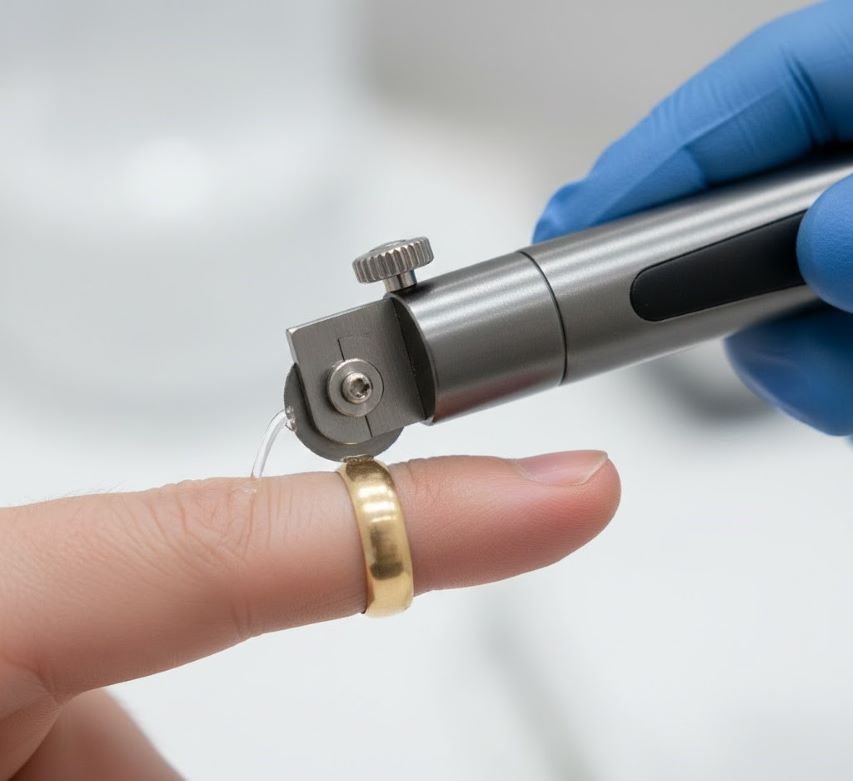
Lifesaving Tool for Emergencies
A Finger Ring Cutter is a specialized medical and emergency tool designed to safely and efficiently remove rings from fingers when they cannot be slipped off conventionally due to injury, swelling, arthritis, or entrapment. It is an essential instrument in hospital emergency rooms, fire and rescue services, jeweler's workshops, and industrial safety kits, providing a controlled, non-thermal method of ring removal that minimizes further injury to the delicate tissues and bones of the finger.
Core Design & Mechanism
Component | Description & Function |
|---|---|
| Cutting Blade/Guard | A small, high-hardness steel (often tungsten carbide) rotating circular blade or a shielded cutting tip. Designed to cut through metal but protect the skin. |
| Protective Finger Shield | A thin, flat metal plate or guard that slides between the ring and the finger skin, creating a physical barrier. |
| Drive Mechanism | Manual: A screw mechanism, lever, or geared handle that advances the cutter. Electric/Battery: A motor provides power for effortless cutting. |
| Adjustment & Grip | An adjustable jaw or hook to secure the ring and prevent rotation during cutting. |
| Handle & Ergonomics | Designed for a secure, non-slip grip, allowing precise control even in stressful situations. |
| Materials | Medical-grade stainless steel (304 or 316) for corrosion resistance, sterility, and strength. |
How It Works: The Principle of Protected Cutting
The tool operates on a simple but critical principle: interpose a protective barrier, then apply cutting force.
Preparation: The finger is stabilized. A topical lubricant may be applied.
Shield Insertion: The thin, flexible metal guard is carefully slid under the ring, separating the ring's inner surface from the finger's skin along the entire circumference.
Secure the Ring: The ring is engaged by the cutter's hook or jaw to prevent spinning.
Cut Initiation: The cutting blade (rotating disc or shearing tip) is positioned on the ring's surface.
Controlled Cutting: The user activates the drive mechanism. The blade cuts through the ring's metal, but the shield beneath deflects it, preventing any contact with the skin.
Ring Separation: Once cut through, the ring can be gently opened and removed with flat-nose pliers. A single cut is usually sufficient for most bands.
Step-by-Step: Safe Ring Removal Procedure
Pre-Cut Assessment:
Evaluate the Situation: Determine the cause (trauma, swelling, allergy). Check for neurovascular compromise (color, sensation, capillary refill).
Attempt Non-Invasive Methods: Use lubrication (soap, oil), elevation, and compression (via the string method) if appropriate and time allows.
Prepare the Tool: Ensure the cutter is clean, blades are sharp, and the battery is charged (if electric).
Cutting Process:
Position & Protect: Support the patient's hand on a stable surface. Gently slide the protective metal shield under the ring.
Engage the Ring: Place the ring in the cutter's jaw or hook. Ensure the shield remains fully between the ring and skin.
Align the Cutter: Position the cutting wheel perpendicular to the ring, usually on the thinnest or most accessible part (often the dorsal side).
Execute the Cut: Firmly and steadily turn the screw or activate the motor. Maintain downward pressure and ensure the shield does not slip.
Complete & Remove: Once a clear "click" or loss of resistance is felt, stop. Use ring-opening pliers to gently bend the ring apart at the cut.
Post-Removal Care: Clean the finger, assess for any minor abrasions from the shield, and treat the underlying condition.
Key Features & Technical Specifications
Blade Hardness: Measured on the Rockwell scale (e.g., HRC 60+). Must be harder than the ring metal.
Cutting Capacity: Maximum ring thickness and hardness it can cut (e.g., "Cuts up to 8mm wide, HRC 70 tungsten carbide").
Shield Material: Typically spring-tempered stainless steel or phosphor bronze for flexibility and strength.
Ergonomics: Non-slip grips, ambidextrous design, and lightweight construction for operator comfort.
Sterilization Compatibility: Autoclavable (steam sterilizable) construction for medical models.
Materials It Can & Cannot Cut
✅ Can Cut Effectively:
Common Jewelry Metals: Gold (all karats), Silver, Platinum, Palladium, Brass, Copper.
Harder Metals: Stainless Steel, Titanium (grade matters), Cobalt Chrome.
Extreme Hardness: Tungsten Carbide (requires diamond-coated or ultra-hard blades on powerful cutters).
⚠️ Challenging / ❌ Cannot Cut:
Ceramic Rings: Extremely hard and brittle. Will shatter, requiring a different, more controlled fracture method.
Silicon/ Rubber Bands: Not cut; must be stretched or sliced with a scalpel.
Multi-Strand or Braided Rings: May require multiple cuts.
Rings with Gemstones: The cutter must avoid the stone setting to prevent damage. Special care is needed.
Primary Benefits & Advantages
Prevents Further Injury: The shield protects the swollen or injured finger from lacerations during cutting.
Fast & Efficient: Removes a ring in 30-90 seconds, crucial in emergencies involving compartment syndrome or vascular compromise.
Minimal Pain & Trauma: A mechanical, non-thermal process that causes far less stress than aggressive pulling or other makeshift methods.
Ring Salvage Potential: A clean, single cut often allows a jeweler to later repair and resize the ring.
Versatility: One tool can handle a wide range of ring materials and finger sizes.
Psychological Relief: Quickly resolves a source of significant patient anxiety and pain.
Limitations & Critical Considerations
Operator Skill Required: Proper technique is essential to avoid pinching skin or damaging the finger.
Not for All Materials: As noted, ceramic rings require a specialized tool.
Blade Wear: Blades dull, especially after cutting hard metals, and must be inspected and replaced.
Space Requirement: Needs enough clearance to slide the shield under the ring. In cases of extreme swelling or deformity, this can be difficult.
Patient Cooperation: A distressed or moving patient can make the procedure hazardous; sedation or local anesthesia may be needed in a clinical setting.
Maintenance & Care of the Tool
Cleaning: Wipe down with disinfectant after each use. For medical settings, follow sterilization protocols (autoclave if applicable).
Blade Inspection: Check for nicks, dullness, or deformation. A dull blade will require excessive force and can slip.
Lubrication: Lightly oil the screw mechanism (if manual) periodically to ensure smooth operation.
Storage: Keep in a dry, protective case to prevent blade damage and contamination.
Battery Care (Electric Models): Follow charging guidelines to maintain battery health.
Buyer's Guide: Choosing the Right Cutter
Define Your Setting: Medical/ER: Prioritize speed, reliability, and sterilizability (electric or high-end manual). Jeweler/Workshop: Prioritize precision and ability to cut hard metals. First Responder/Industrial: Prioritize durability, portability, and ease of use (lever-action often preferred).
Cutting Capacity: Ensure it can cut the hardest material you anticipate encountering (e.g., titanium, tungsten carbide).
Ergonomics: The handle should feel comfortable and provide good leverage.
Safety Features: A positive-locking shield and a secure ring grip are non-negotiable.
Blade Replacement: Check availability and cost of replacement blades.
Brand & Quality: Reputable brands in medical (e.g., MityBrite, OHEL) or jewelry tools ensure reliability and safety.
Budget: Manual cutters start around $50; professional electric models can exceed $300.
An Essential Instrument of Care
A Finger Ring Cutter is more than a simple tool; it is a precision instrument of liberation and care. Its value lies in its elegant solution to a common yet potentially dangerous problem, blending mechanical ingenuity with a deep understanding of human anatomy. By providing a safe, rapid, and controlled alternative to destructive or traumatic removal methods, it serves as a critical asset in safeguarding both the physical integrity of the finger and the patient's overall well-being. For medical professionals, it is a standard of care. For jewelers, it is a tool of service. And for safety officers, it is a piece of vital emergency equipment. Investing in a high-quality ring cutter and the training to use it proficiently is an investment in preparedness, safety, and compassionate problem-solving.
 |  |  |
 |  |  |