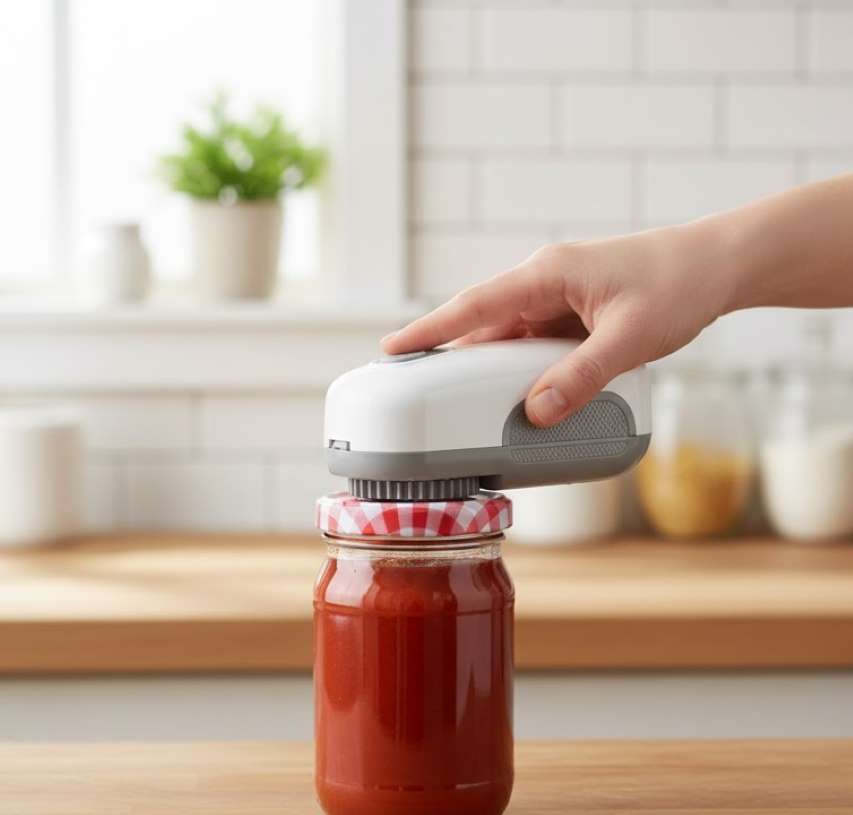
An Electric Jar Opener is a compact, countertop appliance designed to effortlessly open screw-top lids on jars, bottles, and containers. It eliminates the need for hand strength, wrist torque, or manual tools, providing a simple, safe, and reliable solution to one of the most common kitchen frustrations. It is an invaluable aid for individuals with arthritis, reduced grip strength, or hand mobility issues, and a welcome convenience for anyone.
How It Works: The Mechanism
The device uses a simple but clever motorized mechanism:
Placement: The jar is placed on a stabilizing platform or cradle, often with a rubberized surface to prevent slipping.
Alignment & Activation: The user aligns the jar's lid under the opening mechanism and presses a button (or in some models, lowers a lever).
Gripping: A series of motorized rubberized wheels or a geared grip engages the lid's edge.
Rotation: The motor spins the gripping mechanism, which rotates the lid counter-clockwise while the base or stabilizing platform holds the jar firmly in place.
Release: After a few seconds of rotation, the lid loosens. The user releases the button, removes the jar, and can easily unscrew the lid by hand.
Core Principle: It provides stabilization and targeted rotational force directly to the lid, bypassing the need for user-applied grip and torque.
Key Features & Components
Component/Feature | Description & Purpose |
|---|---|
Motor | The heart of the device. Provides the rotational power. Typically, quiet and low-torque for safety. |
Gripping Mechanism | Rubberized wheels or gears that contact and turn the lid. Often self-adjusts to different lid sizes. |
Stabilizing Base/Cradle | Holds the jar steady during operation. Usually has a non-slip silicone or rubber surface. |
Activation Button/Switch | A simple push-button or toggle switch to operate. Some have one-touch operation, others a hold-down button. |
Lid Size Range | Specifies the minimum and maximum lid diameters it can accommodate (e.g., 1" to 4"). |
Power Source | Most plug into a standard wall outlet (AC). Some are battery-operated (DC) for portability. |
Housing | Durable, easy-to-clean plastic, often with a compact, vertical design to save counter space. |
Primary Benefits & Advantages
Universal Access: Empowers individuals with arthritis, carpal tunnel, tendonitis, or general hand weakness to open containers independently.
Effortless Operation: Requires minimal physical force—just placement and a button press.
Safety: Reduces the risk of injury from knives, blunt force, or slipping with manual grippers. Also prevents spills and broken glass from excessive force.
Preserves Jar Integrity: Opens lids without denting or damaging them, allowing for easy resealing.
Consistency & Reliability: Successfully opens vacuum-sealed, sticky, or overly tight lids that stump manual methods.
Time-Saving: Solves a stubborn problem in seconds.
What It Can & Cannot Open
✅ Ideal For:
Glass jars (pickles, sauces, jams, baby food).
Plastic containers (sauces, condiments).
Metal tins with screw tops (some coffee, cocoa).
Sports drink bottles.
Medicine bottles with child-resistant caps (check model specifications).
❌ Not Designed For:
Pop-top or press-and-turn safety lids (like on medicine bottles)—these require a downward push it cannot provide.
Crimp-top lids (like on beer or soda bottles).
Extremely large containers (e.g., large pickles jars over 1-gallon).
Non-round or irregularly shaped lids.
Cans (requires a separate electric can opener).
Step-by-Step Guide to Use
Plug In & Place: Ensure the unit is plugged in (if not battery-operated). Place it on a stable, dry countertop.
Position the Jar: Set the jar squarely in the stabilizing base or cradle.
Align the Lid: Center the jar's lid directly beneath the opening mechanism.
Activate: Press and hold the operation button. You will hear a gentle motor hum and see the lid begin to rotate.
Release & Remove: After 2-5 seconds, release the button. The lid will be loosened. Lift the jar out and unscrew the lid completely by hand.
Resealing: To re-seal, simply screw the lid back on by hand. The device is for opening only.
Maintenance & Care
Cleaning: Wipe the exterior and the rubberized gripping wheels with a damp cloth. Do not immerse in water.
Declogging: If sticky residue (like syrup or honey) builds up on the rollers, clean with a cloth dampened with warm, soapy water.
Storage: Due to its compact size, it can be left on the counter or stored easily in a cupboard.
Troubleshooting: If lids stop opening, check for debris on the rollers or ensure the jar is properly aligned and stabilized.
Electric vs. Manual Openers: A Comparison
Aspect | Electric Jar Opener | Manual Gripper / Opener |
|---|---|---|
| Ease of Use | Extremely easy; push-button operation. | Requires some hand strength and dexterity. |
| Physical Effort | Minimal to none. | Moderate to high, depending on lid tightness. |
| Consistency | Very high; motor provides consistent force. | Variable; depends on user's strength and technique. |
| User Profile | Ideal for those with limited hand strength or mobility. | Suitable for those with average grip strength. |
| Lid Preservation | Excellent; rarely damages lids. | Can sometimes dent or warp metal lids. |
| Speed | Very fast (5-10 seconds). | Slower, depends on the struggle. |
| Cost & Space | Higher initial cost; requires counter/outlet space. | Lower cost; minimal storage space. |
Buying Considerations
Lid Size Range: Ensure it fits your most common jar sizes (check minimum and maximum diameter).
Ease of Operation: Look for one-touch or very simple button operation.
Stability: A unit with a wide, weighted, or non-slip base is safer and more effective.
Power Source: Plug-in models offer constant power. Battery-operated models offer placement flexibility.
Noise Level: Most are quiet, but read reviews if this is a concern.
Design & Footprint: Consider how much permanent counter space you're willing to dedicate.
Additional Features: Some models include a magnetic lid lifter or built-in storage for the cord.
Liberating the Kitchen
The electric jar opener is more than a simple gadget; it is a tool of independence and convenience. It transforms a daily moment of potential frustration into a seamless, effortless task. While not essential for every household, it proves to be an indispensable appliance for seniors, individuals with physical limitations, or anyone who values a streamlined, accessible kitchen. Its simplicity, reliability, and focus on solving a single problem extremely well make it a thoughtful and highly practical addition to the modern home.
 |  |  |
 |  |  |