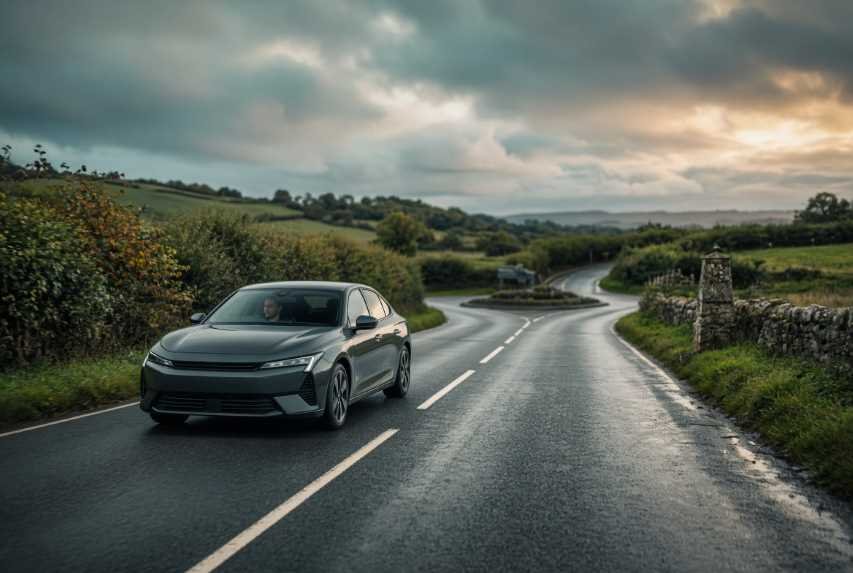
The History, Technology, and Everyday Reality of Driving on the Left in the UK
To a driver from the United States, Germany, France, Egypt, or most of the Gulf, a British car looks assembled the wrong way around. The driver sits on the right. Traffic streams down the left. Roundabouts swirl clockwise. Overtaking happens on the right. Even the windscreen wipers and headlight beams are arranged for a different geometry of the road.
None of this is a quirk of national stubbornness, and none of it is an accident of modern design. The United Kingdom’s combination of right-hand drive (RHD) vehicles and left-hand traffic (LHT) is the product of centuries of travel custom, the way people once sat on horses and wagons, the way early motor cars copied those habits, and a body of law that locked the custom in place before cars became common. About a third of the world’s countries still keep left. The UK is simply the most familiar example for many travelers.
This article explains the system from first principles: what RHD actually means, why Britain keeps left, how the cars are engineered, how people drive in practice, and why switching sides would be one of the most expensive and politically difficult infrastructure projects the country could attempt.
What Exactly Is an RHD Car?
Right-hand drive describes the position of the driver, not the side of the road. In an RHD vehicle the steering wheel, instrument cluster, and primary driver controls sit on the right-hand side of the cabin when you look forward.
Left-hand drive (LHD) is the mirror image: the driver sits on the left.
Two pairs of terms are easy to confuse and should be kept separate:
Term | Meaning |
|---|---|
| RHD / LHD | Where the steering wheel is inside the vehicle |
| LHT / RHT | Which side of the road traffic uses (left-hand traffic or right-hand traffic) |
In the UK the usual pairing is RHD + LHT: the driver sits on the right so that they sit nearer the Centre line of the road. That gives a better view of oncoming traffic and of the gap when overtaking. In the United States, Germany, or Egypt the usual pairing is LHD + RHT, for the same reason: the driver sits next to the Centre line.
RHD does not automatically mean a vehicle must drive on the left. An RHD car can be driven legally in a right-traffic country, and an LHD car can be driven in the UK. Both combinations create visibility problems. The driver is then sitting on the kerb side rather than the Centre-line side, which makes overtaking, judging gaps at junctions, and using some drive-through or toll lanes more awkward.
Where the controls sit
In a typical modern UK car:
Steering wheel, instrument cluster, and ignition or start button: right
Pedals: still clutch (if fitted) – brake – accelerator from left to right. Pedal order is the same in RHD and LHD cars. Only their position across the cabin changes.
Gear selector or automatic shifter: usually in the centre console. In a manual RHD car the driver changes gear with the left hand.
Indicator and wiper stalks: on the steering column. Stalk layout is not globally standardised. Many Japanese and some European cars sold in the UK put indicators on the right stalk; many German-origin cars keep indicators on the left. That is why visitors so often wash the windscreen when they meant to signal.
Exterior mirrors: both sides are required. The right-hand door mirror is the driver’s near-side mirror.
Handbrake or electronic parking control: center console or a switch near the driver.
The driver’s seat is placed on the right because road position, not handedness, is the design problem. The majority of people are right-handed in every country. The seat is on the right in Britain so the driver can see past oncoming vehicles, not because Britons are left-handed.
RHD vs LHD at a Glance
| Feature | RHD (typical UK car) | LHD (typical US/EU car) |
|---|---|---|
| Driver’s seat | Right side of cabin | Left side of cabin |
| Usual traffic system | Left-hand traffic | Right-hand traffic |
| Best view of oncoming traffic | Towards the centre line | Towards the centre line |
| Overtaking (in matching traffic) | On the right | On the left |
| Manual gear change | Left hand | Right hand |
| Pedal order | Clutch–brake–accelerator | Clutch–brake–accelerator |
| Headlight dip (factory spec) | Towards the left verge | Towards the right verge |
| Wiper sweep | Favours clearing the right (driver) side first | Favours clearing the left (driver) side first |
| Toll / drive-through window | Often on the “wrong” side abroad | Often on the “wrong” side in the UK |
| Legal to use in the other system? | Usually yes, with limits | Usually yes, with limits |
Left-Side vs Right-Side Traffic
| Feature | Left-hand traffic (UK, Japan, Australia, India…) | Right-hand traffic (US, most of Europe, China, Egypt…) |
|---|---|---|
| Keep to | The left | The right |
| Oncoming traffic | To your right | To your left |
| Typical vehicle | RHD | LHD |
| Roundabouts | Clockwise | Anti-clockwise |
| Near-side / kerb | Left | Right |
| Off-side / center line | Right | Left |
| First exit at a simple junction | Left turn is the simpler turn | Right turn is the simpler turn |
| Share of countries | Roughly 30% of countries; about 35% of world population | The large majority |
Figures for the number of left-driving jurisdictions vary with whether territories and dependencies are counted, but the usual modern range is about 70–76 countries and territories.
Why Does the UK Drive on the Left?
The short answer used in tourist guides is “swords and horses.” That slogan is not invented out of nothing, but it is also not a complete historical proof. The honest version is more interesting.
What is well supported
By the later eighteenth and early nineteenth centuries, keeping left was already ordinary practice on British roads. Parliament then wrote it down.
The General Highways Act 1773 included a keep-left instruction as traffic on improved roads grew denser.
The Highway Act 1835 made keep-left the general legal rule in Britain and was later applied across much of the empire.
Once motor cars arrived, they inherited an existing rule of the road. Early automobiles were treated as horseless carriages. They did not invent a new side of the road; they occupied the side already in use.
What is widely believed, and how far the evidence goes
A long-standing explanation runs like this:
Most people are right-handed.
A rider who kept left could hold the reins in the left hand and keep the right hand free for a sword, whip, or greeting.
Mounting a horse is also easier from the left if a sword hangs on the left hip.
Therefore travellers preferred the left.
This account appears in popular British history writing and is repeated by museum curators and motoring historians. It is a plausible reconstruction of habit, not a single surviving statute that says “keep left so you can draw a sword.”
There is also archaeological and military colour around the story. Some researchers point to wheel ruts at Roman sites, including a quarry where loaded carts appear to have left on the left-hand path, and to the idea that Roman soldiers marched on the left. These findings are suggestive. They do not, by themselves, prove a continuous, empire-wide Roman traffic code that survived unbroken until 1835.
A papal instruction of 1300, issued by Pope Boniface VIII for pilgrims travelling to Rome in a jubilee year, is often cited as an early official “keep left” rule. Surviving discussion of that edict is thinner than the popular retelling, and historians do not all treat it as a clear, enforceable Europe-wide traffic law.
Why much of continental Europe went the other way
France moved toward keeping right in the late eighteenth century. A common explanation is social and political: aristocratic carriages had used the left; revolutionary and later Napoleonic practice pushed ordinary traffic to the right and then exported that habit through conquest and influence. Whether Napoleon personally “banned the left because it looked aristocratic” is one of those stories that is told more confidently than the documents allow. What is solid is the outcome. France and much of mainland Europe standardized on the right. Britain did not.
In North America, large freight wagons pulled by teams of horses encouraged a different seating habit. Drivers often sat or rode on the left rear horse so the right (whip) hand could reach the team. Passing on the right then made more sense. Pennsylvania required driving on the right as early as 1792, with New York and New Jersey following in the early 1800s.
By the time cars replaced wagons, two large blocs already existed: a British-influenced keep-left world, and a Franco-American keep-right world.
Development of British RHD Automobiles
Early motor cars did not immediately settle the steering position. Some pioneer vehicles used tillers. Some early cars, even in right-traffic countries, had the wheel on the right because that was how coaches and racing machinery had been arranged.
In Britain the logic of left-side traffic pointed clearly toward a right-hand seat. The driver needed to see the center of the road, judge oncoming carts and later cars, and pass on the right. British manufacturers therefore standardized on RHD for the home market.
Examples of how the industry grew into that standard:
British factories such as Austin (the Austin Seven from 1922 became the people’s car of interwar Britain), Morris, Rover, Riley, and later Jaguar built RHD as the default domestic specification.
American firms that wanted British sales built RHD versions. Ford exported right-hand-drive Model Ts and later manufactured RHD cars in Britain, including models such as the Anglia and Prefect that were sized for narrow streets.
After 1945, export or death was official industrial policy. British factories produced both home-market RHD cars and LHD cars for Europe and North America. The Mini, the MGB, the Jaguar E-Type, and later the Range Rover all existed in both configurations.
The mechanical story is one of increasing rigidity. A 1920s car had a steering box, rods, a simple dashboard, and few electrics. Moving the driver from one side to the other was still a serious workshop job, but it did not involve airbags, fiber-optic networks, or camera calibration. A 2020s car is a rolling computer with crash structures designed around a specific seat position. Factory RHD and factory LHD are now two engineered variants of the same model, not a wheel bolted onto the other side.
Major RHD Vehicle Manufacturers
RHD is not a British monopoly. It is a market specification.
British and British-based luxury and specialist makers still treat RHD as a home language:
Jaguar Land Rover
Bentley
Rolls-Royce
Aston Martin
MINI (a British-born brand now produced within the BMW group, still offering RHD for the UK and other keep-left markets)
Japanese manufacturers are among the world’s most important RHD producers, because Japan itself keeps left:
Toyota
Honda
Nissan
Suzuki
Mazda, Subaru, Mitsubishi, and others
Japan is the reason used RHD cars are common in New Zealand, parts of Africa, the Caribbean, and some countries that officially drive on the right but import cheap Japanese vehicles.
Global volume manufacturers — Volkswagen Group, BMW, Mercedes-Benz, Hyundai-Kia, Stellantis, Ford, GM’s remaining brands — tool both RHD and LHD versions for whichever markets will take them. The steering rack, dashboard molding, wiring harness, airbag module, and headlamp unit are specified at the factory. That is cheaper and safer than converting cars later.
The Technology Behind RHD Vehicles
Building an RHD car is not a matter of sliding the seat across. Some parts move. Some parts are mirrored. Some parts stay put and are only reprogrammed.
Parts that are physically relocated or mirrored
Steering column and steering rack. The rack is a different part, not the LHD rack turned around. Geometry, mounting points, and power-assistance motor orientation have to match the right-hand column.
Firewall and pedal box. Brake booster, master cylinder, clutch master cylinder (if fitted), and accelerator cable or electronic throttle pedal move to the right. On many platforms the firewall pressing itself is a different panel.
Dashboard and instrument cluster. The binnacle sits in front of the right-hand seat. Airbag housings are side-specific because the driver’s airbag fires from the wheel and the passenger airbag from the other side of the dash.
Wiring harness. Modern cars have side-specific looms for the column switches, door modules, seat motors, and knee airbags.
Windscreen wipers. The parked position and sweep pattern are designed so the driver’s side of the glass is cleared first and most completely. An LHD wiper set on an RHD car leaves a dirty patch in front of the driver.
Exterior mirrors. Glass curvature and sometimes housing shape differ because the driver’s sightlines change.
Headlamps. Beam patterns are asymmetric. In a keep-left country the low beam is biased toward the left verge so that it lights the kerb and road signs without glaring into oncoming eyes on the right. Fit the wrong lamps and you dazzle other drivers. That is why travelers are told to use beam deflectors or touring kits when they take a UK car to the Continent.
HVAC controls and glovebox. These follow the dashboard moulding.
Parts that often stay in place
Engine, gearbox, and (on most modern cars) the transmission tunnel.
Pedal order.
Centre console shifter on most designs.
Many chassis’ sensors, until they are aimed.
Parts that are reprogrammed rather than moved
ADAS cameras and radar. Lane-keeping, adaptive cruise, automatic emergency braking, and driver-monitoring systems are trained on a particular seating position and traffic direction. A camera that expects the car to hug the left lane will misread a right-traffic motorway.
Blind-spot radar and corner radars.
Digital instrument maps and head-up displays.
Lighting menus on adaptive LED or matrix headlamps, which can sometimes be switched between LHT and RHT beam profiles in software — but only if the hardware allows it.
Parking sensors and 360-degree camera stitching.
A cheap conversion that moves the wheel and leaves the lamps, wipers, and cameras alone is how dangerous “cut-and-shut” RHD jobs are created. Proper factory or certified conversions treat steering, brakes, restraints, and lighting as a system.
How British Drivers Actually Drive
The Highway Code is the official rulebook for Great Britain. Northern Ireland has its own version with the same basic geometry. The habits below are what a visitor notices first.
Joining a road and turning
You keep left. When you pull out of a driveway or side road, you look for traffic coming from the right first, because that is the nearest stream, then from the left.
A left turn is the simple turn. You stay on the near side and do not cross oncoming traffic.
A right turn crosses the opposite stream. You wait in the junction or in a right-turn pocket, then sweep across to the left-hand side of the new road.
This is the exact mirror of driving in France or the United States.
Roundabouts: the feature that unnerves visitors
UK roundabouts run clockwise. You give way to traffic already on the roundabout, which approaches from your right.
A practical method that instructors still teach:
Approach in the correct lane. Signs and road arrows tell you which lane leads to which exit.
Signal left if you are taking the first exit.
For a straight-ahead exit on a four-arm roundabout, often no signal on entry, then left signal after you pass the exit before yours.
For a right turn or full circle, approach in the right-hand lane where marked, signal right, stay in that lane around the island, then signal left after passing the exit before the one you want.
Do not stop on the circulating carriageway to have an argument with your sat-nav.
Multi-lane roundabouts, “magic” roundabouts with mini-roundabouts at each entry, and signal-controlled roundabouts on big urban arteries all exist. The common error is to treat a UK roundabout as an American-style intersection and turn the wrong way onto it.
Overtaking and lane discipline
You overtake on the right. On a single carriageway that means moving toward the center line, checking the view that the right-hand seat is supposed to give you, and returning left. On a motorway the left lane is the travelling lane; the middle and right lanes are for overtaking. Hogging the right-hand lane is both bad manners and, on smart motorways and in police guidance, a source of congestion.
Motorways and dual carriageways
For cars and motorcycles, national limits as published by the UK government are typically:
Built-up roads with street lighting: 30 mph in England, Scotland, and Northern Ireland, unless signed otherwise.
Wales: default 20 mph in built-up areas since 2023.
Single carriageway: 60 mph
Dual carriageway and motorway: 70 mph
Vans, towing combinations, and heavy goods vehicles have lower limits. The national speed-limit sign is a white circle with a black diagonal stripe, not a number.
Narrow rural roads and residential streets
Much of Britain was laid out for carts, not two-ton SUVs. High-hedged lanes in Devon, Wales, or the Yorkshire Dales may be barely wider than one car. Passing places, courtesy, and low speed matter more than lane markings. In towns, parked cars often reduce the road to a single moving file. Judging width from the right-hand seat is a skill; visitors in large hire cars discover it the hard way.
Parking, reversing, and crossings
Parallel parking is common. The driver is next to the kerb when parked on the left, which makes it easier to watch the kerb and harder to watch passing traffic when opening the door. The Highway Code’s hierarchy of road users gives extra weight to pedestrians and cyclists. Zebra crossings require you to give way to people who have stepped onto them. Pelican, puffin, toucan, and parallel crossings have their own signal rules.
Bus lanes, cycle lanes, and “boxes” at junctions are painted aggressively in cities. Entering a bus lane at the wrong hour is an expensive camera offence.
British Drivers Driving Abroad
A competent UK driver is not automatically competent on a French autoroute or a Florida interstate on day one. The skills transfer. The habits fight back.
What usually feels natural: speed control, following distance, reading a sat-nav, using an automatic gearbox.
What usually feels wrong:
Sitting on the left in a hire car and having the kerb on the right.
Looking the “wrong” way at a T-junction. The last glance has to go toward the nearest oncoming stream, which is now from the left.
Roundabouts that run anti-clockwise.
Overtaking on the left.
Changing gear with the right hand, if the car is a manual.
Using the indicator stalk on the opposite side.
Paying a toll or grabbing food from a window designed for LHD cars.
RHD cars do appear in right-traffic countries — imported Japanese specials, diplomatic vehicles, or cars driven across from Ireland or the UK. They are legal in many places and awkward everywhere. Headlamps must not dazzle. Some countries restrict or discourage permanent use of “wrong-side” steering for ordinary registration.
Insurance follows the policy, not the romance of the road trip. A UK policy may give only minimum third-party cover in another country. Hire contracts have their own excess, license, and age rules. None of that is unique to RHD, but a driver who is already using extra attention on the “wrong” side of the road should not also be guessing about cover.
The human-factors point is simple. After a few days most people adapt. The dangerous moments are the first morning, the first tired night, and any moment when the brain goes onto autopilot — leaving a petrol station, turning out of a car park, or driving home from the airport after a long flight.
Foreign Drivers Visiting the UK
Drivers from the United States, Canada, Germany, France, Italy, Spain, China, Egypt, and most Gulf states all arrive from right-traffic cultures. They make the same family of mistakes.
Common difficulties:
Climbing into the left seat out of habit, then realizing the wheel is on the other side.
Pulling out onto the right-hand side of an empty road.
Looking left first at a junction and pulling into a car that was always coming from the right.
Entering a roundabout anti-clockwise, or stopping on it.
Signalling with the wipers.
Misjudging the left-hand kerb and clipping it with the front wheel.
Overtaking on the left because that is how it is done at home.
Treating a narrow B-road as a two-lane highway.
Practical adaptation that actually works:
Say “keep left” out loud for the first day.
Rest after the flight. Fatigue plus a mirrored road is a bad experiment.
Choose an automatic if you are not fluent with a left-hand gear change.
Let the passenger act as a second pair of eyes at junctions — without becoming a back-seat driver.
Follow a local car for lane choice on complex roundabouts rather than guessing.
Avoid central London by car unless you have a reason to be there.
Remember that speed limits are in miles per hour. A 30 mph sign is not a 30 km/h sign.
Legal position in outline, as of 2026 and subject to change: visitors can often drive in Great Britain on a full, valid foreign license for up to 12 months from last entry. EU and EEA licenses are treated more generously for short stays. An International Driving Permit is not always a legal requirement in the UK, but hire companies frequently ask for one if the licence is not in English or is from a country they consider unfamiliar. This is not legal advice. The official check is the UK government’s “Driving in Great Britain on a non-GB licence” service and the hire company’s own contract.
Rental Cars in the UK
Almost every hire car offered to tourists in Britain is RHD. That is the point of renting locally.
What to decide before you collect the keys:
Automatic versus manual. Automatics cost more and used to be scarce. They are now common and are the safer choice if you learned to drive on the left side of the cabin.
Insurance and excess. Basic cover often leaves a large excess. Check whether your credit card or travel policy actually covers UK hire cars. Many do not.
Age limits. Many firms want drivers 21 or 23 and over; some add a young-driver surcharge under 25. Super-luxury cars may require 25 or 30.
Navigation. Phone mounts and offline maps help in rural areas with poor data. Do not program the sat-nav while moving.
Speed limits and cameras. Average-speed cameras are widespread on roadworks and some A-roads. The limit is the limit for miles at a time.
Clean-air and congestion schemes. London is the famous case. Other cities have clean-air zones with their own cameras and daily charges. Check the vehicle’s compliance before you drive in.
Parking. Yellow lines, resident-permit zones, school zig-zags, and private car-park cameras are easy ways to turn a cheap rental into an expensive souvenir.
Tolls. There is no single national vignette. Crossings such as some bridges and tunnels charge separately. Dartford Crossing, for example, is paid online rather than in a booth.
Requirements change. Confirm license, insurance, and city-charge rules with official UK sources and the rental company at the time of travel.
The Special Case of London
London is a poor introduction to British driving and a good introduction to British traffic policy.
As of August 2026, a visitor who drives in the capital may meet several camera-enforced schemes at once:
Congestion Charge: central zone, £18 if paid on the day or in advance, £21 if paid within three days after travel. Hours: 07:00–18:00 Monday to Friday and 12:00–18:00 on Saturdays, Sundays, and bank holidays. No charge from Christmas Day to the New Year’s Day bank holiday inclusive. Residents can receive a large discount. Electric-vehicle discounts were reduced from the start of 2026 and depend on Auto Pay registration.
Ultra Low Emission Zone (ULEZ): covers all London boroughs (the M25 itself is outside). £12.50 a day for vehicles that do not meet the standard, 24 hours a day except Christmas Day. Most petrol cars from about 2005 (Euro 4) and diesel cars from about September 2015 (Euro 6) comply and pay nothing. Transport for London reports very high compliance among vehicles actually seen in the zone.
Low Emission Zone (LEZ): aimed at heavier diesel vehicles, with much larger daily charges.
Blackwall and Silvertown tunnel charges: separate crossing charges with their own hours.
On top of the charges come bus lanes, cycle superhighways, pedestrianized streets, banned turns, and a density of people that makes a private car slow even when it is legal. Many visitors correctly decide that the Underground, buses, trains, and walking are the rational transport system for central London, and that a hire car is for leaving the city.
The technology underneath this is the same technology that will matter to future RHD and LHD design: number-plate cameras, emissions databases, geofenced charging, and routing software that already knows which streets a given vehicle is allowed to use.
Safety and Human Factors
Switching traffic systems is a classic human-factors problem. The car is fine. The driver’s stored patterns are not.
Muscle memory puts the hands on the “home” stalks and the feet toward the “home” seat.
Spatial attention at junctions is biased toward the side from which traffic usually came in the driver’s own country.
Cognitive load rises. Tasks that were automatic — placing the car in the lane, preparing a roundabout exit — become conscious again. That slows reactions to a child, a cyclist, or a braking van.
Autopilot errors happen in low-demand moments: pulling out of a supermarket, turning into a hotel, starting off after a rest stop.
This is why experienced drivers still collide in hire cars. Expertise is specific. A person can be an excellent driver of LHD cars on the right and a beginner, for a day or two, at RHD cars on the left.
The useful countermeasure is not fear. It is slowness. Reduce speed, increase following distance, narrate the next action, and treat the first 50 miles as a training session.
Technology and the Future
Automatic gearboxes already remove one of the classic RHD/LHD differences: which hand moves the lever. Cameras already show the kerb that the driver can no longer judge by sitting next to it. Parking sensors, 360-degree views, blind-spot lights, lane-keeping assist, and adaptive cruise all reduce the penalty of sitting on the “wrong” side.
They do not yet abolish the distinction.
Lane-keeping systems still need to know which line is the edge and which is the center. Headlamps still throw an asymmetric beam. Airbags still sit in a dashboard designed around one seat. A self-driving system that can operate in both LHT and RHT is software-plus-map problem as much as a steering-wheel problem, but the passenger cabin will still have a designated operator’s seat for a long time, and regulators will still care which way the car is facing when it pulls out of a junction.
If fully driverless vehicles become normal, the political meaning of RHD versus LHD may fade. The physical meaning — which side of the cabin the controls occupy — will last as long as humans sometimes drive.
Countries That Drive on the Left
Left-hand traffic is heavily, but not exclusively, a map of former British influence.
Europe: United Kingdom, Ireland, Malta, Cyprus, plus Crown dependencies such as the Isle of Man, Jersey, and Guernsey.
Asia: India, Pakistan, Bangladesh, Sri Lanka, Nepal, Bhutan, Japan, Thailand, Malaysia, Singapore, Indonesia, Brunei, Timor-Leste, Maldives, Hong Kong, and Macau.
Africa: South Africa, Kenya, Tanzania, Uganda, Botswana, Zimbabwe, Zambia, Malawi, Namibia, Lesotho, Eswatini, Mozambique, Mauritius, Seychelles, and others in the same historical cluster.
Oceania: Australia, New Zealand, Papua New Guinea, Fiji, Samoa, Tonga, and a string of Pacific islands and territories.
Americas and Caribbean: Guyana, Suriname, Jamaica, Barbados, Bahamas, Trinidad and Tobago, and several other islands. The United States Virgin Islands are an unusual case: they keep left but many vehicles are LHD because of the American market.
Japan is the largest rich exception to the “British Empire” story. Japan keeps left for its own historical reasons, including early British help with railway engineering and domestic practice that never flipped. Thailand and Indonesia also sit outside a simple colony-to-metropole tale. The empire explains a lot of the map. It does not explain every tile.
Interesting Exceptions and Special Cases
LHD cars in the UK are legal. They are common among returning expatriates, diplomats, and imported European models. Overtaking on British A-roads is harder in them.
RHD cars in right-traffic countries appear as Japanese domestic-market imports, grey-market sports cars, and specialist conversions. Some jurisdictions restrict registration.
US Virgin Islands: left-side traffic with a large share of LHD vehicles.
Samoa, 7 September 2009: switched from right-hand traffic to left-hand traffic so that cheaper used cars could be imported from Australia, New Zealand, and Japan. It was the first national switch in decades. The change was politically noisy and operationally careful.
Sweden, 3 September 1967 (Dagen H): switched from left to right to match neighbours. Years of planning, hundreds of thousands of signs, and a cost that ran into hundreds of millions of kronor. Accidents fell in the short term because everyone was driving timidly.
Postal vans and some specialist trucks in keep-left countries have been built with the driver on the kerb side for easy access to letterboxes. That is a purposeful exception, not a standard car.
Buses place doors on the kerb side. An imported bus with doors on the wrong side is a practical nightmare.
Common Myths and Misconceptions
- “All RHD cars must drive on the left.”
False. Steering position and traffic side usually match, but they are not the same rule. - “The wheel is on the right because British people are left-handed.”
False. Handedness is the same as everywhere else. Seat position follows the center line of the road. - “RHD cars are always safer in left-driving countries.”
Mostly true for visibility when overtaking, not a magic shield. A distracted driver in the “correct” seat is still dangerous. - “Foreign drivers cannot legally drive in the UK.”
False. Visitors can usually drive on a valid home licence for a limited period. Hire firms may add extra paperwork. - “Driving on the opposite side is almost impossible for an experienced driver.”
Oversimplified. It is uncomfortable and error-prone at first. Most people manage it if they slow down. - “Every former British colony still keeps left.”
False. Some former territories switched to match neighbors or trading partners. The United States, Canada, and much of the Caribbean and Africa are reminders that empire is not destiny. - “Napoleon alone decided that Europe would drive on the right.”
Overstated. French practice mattered. So did wagons, later international standardization, and twentieth-century road building.
Could the UK Ever Switch to Driving on the Right?
In theory, yes. Sweden did it. Samoa did it in the other direction. In practice, for the UK, it would be a project of national-scale pain.
A switch would require:
Replacing or reversing a huge stock of road signs, gantries, and lane markings.
Redesigning thousands of junctions and nearly every roundabout in the country.
Moving bus stops, traffic-signal heads, pedestrian crossings, and cycle infrastructure.
Replacing or converting a national vehicle fleet that is overwhelmingly RHD.
Retraining every driver, rider, and child who has learned “look right, look left, look right again” as gospel.
Absorbing a temporary rise in mistakes even if, as in Sweden, caution reduced crashes at first.
The economic cost would run far beyond Sweden’s 1967 bill, because the UK’s roads, vehicles, and traffic volumes are larger and more tightly woven into cities. Public resistance would be fierce. Cultural attachment is real, but the blocking facts are concrete: infrastructure, fleet, and safety during transition.
There is no serious government program to switch. Alignment with France would help ferry traffic at Dover and the Channel Tunnel. It would not repay the cost.
Fascinating Facts
About a third of the world’s countries, and roughly 35 percent of the world’s people, keep left.
Pedals are not mirrored. Accelerator is still on the right in a UK car.
That is why a visitor’s left foot reaches for a clutch that may not exist, while the right foot still knows where the brake is.
Japanese used-car exports are one of the main reasons RHD vehicles appear in countries that do not keep left.
The Mini, the Jaguar E-Type, and the original Range Rover were all engineered in both RHD and LHD from early in their lives because export demanded it.
Headlamp dip is a legal and optical problem, not a cosmetic one. The wrong pattern blinds oncoming drivers.
Wales’s default 20 mph urban limit is a reminder that “the UK” is not one speed-limit map.
London’s Congestion Charge and ULEZ are enforced by cameras reading number plates, not by a person in a booth looking at your steering wheel.
The Highway Act 1835 did more to freeze Britain’s keep-left rule than any medieval knight.
Samoa switched sides in 2009 to buy cheaper cars, which may be the most honest traffic-policy reason of the twenty-first century.
On a UK motorway the left lane is for travelling; sitting in the right-hand lane at 60 mph is how you collect a line of angry headlights.
Many “I hit the wipers instead of the indicators” stories are stalk-layout stories, not side-of-the-road stories.
Diplomatic plates do not repeal physics. An LHD limousine in London still has a blind overtaking side.
Self-driving software can be taught both systems. Human reflexes take a weekend, a fright, and then years to become natural again.
The driver sits on the right in Britain for the same reason a driver sits on the left in Italy: to see the middle of the road.
FAQ
- Why does the UK drive on the left?
Because keep-left was already custom on British roads when Parliament wrote it into highway law in the late eighteenth and early nineteenth centuries. Older horse-and-sword explanations describe why that custom felt natural to right-handed riders; they are not a complete paper trail from the Roman army to the M25. - Why are British cars right-hand drive?
So the driver sits next to the center line in left-hand traffic and can see oncoming vehicles. - Is RHD the same as driving on the left?
No. RHD is the car. Driving on the left is the road rule. They usually go together. - Can an American drive a car in the UK?
Usually yes, as a visitor, on a valid US license for a limited period (commonly up to 12 months). Hire companies may want extra documents. Check current official rules before travel. - Is it difficult to drive in the UK for the first time?
It is strange for a day or two, especially at roundabouts and when leaving car parks. It is manageable if you use an automatic, slow down, and keep repeating “left.” - Which countries use RHD cars?
Countries that keep left generally use RHD as the factory standard: the UK, Ireland, Japan, Australia, New Zealand, India, South Africa, Malaysia, Thailand, Indonesia, and many others. - Can an RHD car be driven in a country that drives on the right?
Often yes, with lighting and registration conditions. Visibility when overtaking is worse. - Why are UK steering wheels on the right?
To put the driver on the off-side, beside oncoming traffic, in a keep-left system. - Why are UK roundabouts different?
They circulate clockwise and you give way to the right. That is the geometric consequence of keeping left. - Will self-driving cars eliminate RHD and LHD?
They may make the distinction less important for control, not overnight obsolete. Seats, airbags, legal responsibility, and mixed traffic will keep a driver’s side in the design brief for years. - Do I need an International Driving Permit in the UK?
Not always in law. Often in practice at the hire desk, especially if your license is not in English. - Are UK speed limits in miles or kilometres?
Miles per hour on signs. - Can I take my own LHD car to Britain?
Yes, subject to insurance, lighting, and registration rules if you stay long enough to import it. - Why do some Japanese cars in Europe have the wheel on the right?
They were built for Japan or another keep-left market and then exported used. - Will the UK ever drive on the right?
It is technically possible and practically improbable. The cost and disruption would be enormous.
Britain’s right-hand steering wheel is not a piece of automotive folklore bolted onto an otherwise ordinary car. It is the cabin expression of a road rule that is older than the motor industry. Riders and wagon drivers kept left. Parliament made the habit law. Factories placed the driver where the driver could see. Lighting engineers later shaped headlamp beams to the same geometry. Software engineers now train cameras to it.
The system feels backwards only if you learned the other one first. From the inside it is consistent: sit on the right, travel on the left, give way on the roundabout to the right, overtake on the right, dip the lights to the left. That consistency is why a London taxi, a Highland deer-track, and a Tokyo side street can all use the same basic human layout.
Technology will keep sanding down the sharp edges — automatics, cameras, lane-keeping, perhaps autonomy. It will not soon erase the historical fact underneath. The United Kingdom drives on the left because that is the side it was already using when the first cars arrived, and because rebuilding the alternative would mean rebuilding the country around the car all over again.
 |  |  |
 |  |  |