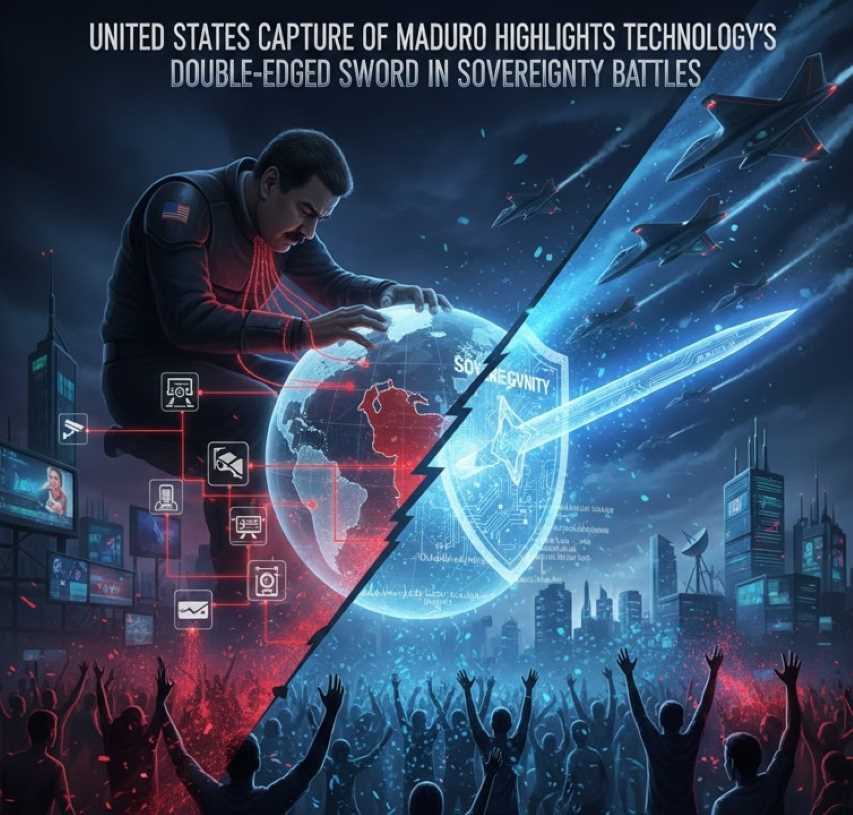
In a stunning escalation of United States-Venezuela tensions, American forces executed a daring raid on January 3, 2026, capturing Venezuelan President Nicolás Maduro and his wife, Cilia Flores, from a fortified military compound in Caracas.
The operation, dubbed "Operation Absolute Resolve," involved over 150 aircraft, elite Delta Force operatives, and precise intelligence that allowed for a swift extraction with no reported casualties. Maduro, now en route to New York to face narcoterrorism charges, marks a pivotal moment in international relations—one where advanced technology played a central role in both enabling the capture and sparking global debates on national sovereignty.
The Context: A Nation in Turmoil
The raid comes amid longstanding accusations against Maduro's regime, including drug trafficking, election fraud, and human rights abuses.
United States Reaction: President Donald Trump hailed the mission as a restoration of "American power," announcing intentions to oversee Venezuela's transition to democracy while tapping into its vast oil reserves.
Local Reaction: Venezuelans reacted with a mix of jubilation and anxiety; celebrations erupted in the streets while others feared instability.
Global Criticism: The event has ignited fierce criticism worldwide. Leaders like France's Marine Le Pen and Malaysia's Anwar Ibrahim condemned it as a blatant violation of Venezuela's sovereignty.
At the heart of this drama is technology's multifaceted role: as a tool for authoritarian control under Maduro, a weapon for United States intervention, and a flashpoint in the broader struggle to preserve national sovereignty in an era of digital warfare.
Technology as Maduro's Shield: The Digital Dictatorship
For years, Maduro's regime leveraged sophisticated technology to maintain power amid economic collapse and widespread dissent.
The "Fatherland Card" (Carnet de la Patria)
Central to this control was a digital identification system developed with Chinese technology giants ZTE and Huawei. Introduced in 2017, the card integrated surveillance infrastructure, tracking citizens':
Employment status
Medical history
Social media activity
Voting records
This system, born from Hugo Chávez's 2008 delegation to Shenzhen to study Chinese citizen-tracking methods, allowed the government to link essential food rations to political loyalty—effectively starving out opponents.
Telecommunications and Surveillance
ZTE employees were reportedly embedded in Venezuela's state telecommunications company, CANTV, managing servers with data on over 30 million people. The regime also employed the Israeli firm Cellebrite's digital forensics tools to spy on dissidents by accessing devices and monitoring communications. Maduro himself touted Huawei smartphones as impervious to United States spying, claiming they protected him from "gringos, spy planes, or satellites."
Election Technology and Fraud
Election technology was another cornerstone of the regime. Smartmatic, a voting system with roots in Venezuela, has been accused of enabling fraud. Former Venezuelan intelligence chief Hugo Carvajal, now in United States custody, confessed that Smartmatic was designed to rig elections and was exported globally.
Carvajal, who oversaw the National Electoral Council's Information Technology head, stated the software could alter results, helping Maduro cling to power after disputed 2018 and 2024 elections.
The Carter Center deemed the 2024 vote fraudulent, with opposition leader Edmundo González Urrutia claiming victory based on public ballots.
Electronic Warfare
Additionally, Venezuela ramped up electronic warfare following the 2018 drone assassination attempt on Maduro. They utilized Russian-assisted Global Positioning System (GPS) jamming to shield military assets—a tactic that disrupted regional aviation and prompted United States Federal Aviation Administration warnings. This "digital noose" not only suppressed internal opposition but also facilitated alliances with Iran, Russia, and China, weaponizing drugs and gangs like Tren de Aragua against the United States.
Technology as United States Sword: Cyber and Intelligence Dominance
The United States operation showcased how technology can pierce sovereign barriers. Joint Chiefs Chairman General Dan Caine described a raid reliant on "pinpoint intelligence," mapping Maduro's behavior—including sleep cycles, movements, and even weather patterns—for a flawless extraction. This "sovereign override" involved data fusion across signals intelligence, turning time and geography into exploitable territories.
Key Operational Elements:
Cyber Warfare: United States Cyber Command infiltrated Venezuela's power grid and communications networks, disabling defenses before the strike.
Strategic Policy: This drew from National Security Presidential Memorandum-13, which expanded cyber operations for deterrence, allowing preemptive disruptions akin to the 2025 strikes on cartel networks.
Precision Omnipresence: The raid's precision—lasting under 30 minutes—demonstrated a capability where cyber tools eliminate reaction time for adversaries.
Trump's team framed the action as self-defense against Maduro's threats to United States security, including drug flows and election interference via exported technology. Carvajal's confessions bolstered this, revealing regime ties to United States voting firms and a "war" on America through infiltrated borders.
Sovereignty in the Digital Age: A Fragile Balance
The capture has polarized views on sovereignty, creating a sharp divide in international opinion.
Arguments for Intervention
Proponents argue Maduro forfeited sovereignty by rigging elections and ruling tyrannically.
Venezuelans are celebrating liberation, and opposition leaders like María Corina Machado are calling for González to assume power.
Supporters view United States intervention as restoring democratic sovereignty, especially given Maduro's alliances with Russia, China, and Iran, which posed threats to United States borders.
Arguments Against Intervention
Opponents decry the operation as imperial overreach, setting a "dangerous precedent" where might trumps international law.
Global Leaders: Marine Le Pen warned that accepting such actions endangers all nations' sovereignty, while Anwar Ibrahim emphasized dialogue over force.
Legal Concerns: Legal experts question the raid's legality without congressional approval, likening it to post-September 11 regime changes. Even Pope Leo XIV urged respect for Venezuela's sovereignty.
The Economic and Geopolitical Impact
Business leaders are eyeing economic shifts, with oil markets bracing for repricing amid United States plans to develop reserves. However, the raid risks broader ruptures, potentially destabilizing allies like Cuba and boosting BRICS (Brazil, Russia, India, China, and South Africa) currencies.
As Venezuela navigates this upheaval, technology's role underscores a new reality: borders are increasingly porous to digital tools, challenging traditional notions of sovereignty. Whether this operation heralds stability or chaos remains uncertain, but it signals that in the 21st century, power is as much about code and data as it is about boots on the ground.
 |  |  |
![Sponsored Ad - JISULIFE Handheld Mini Fan, 3 IN 1 USB Rechargeable Portable Fan [12-19 Working Hours] with Power Bank, Fla...](https://m.media-amazon.com/images/I/51E76z7oaWL._AC_UL320_.jpg) |  |  |