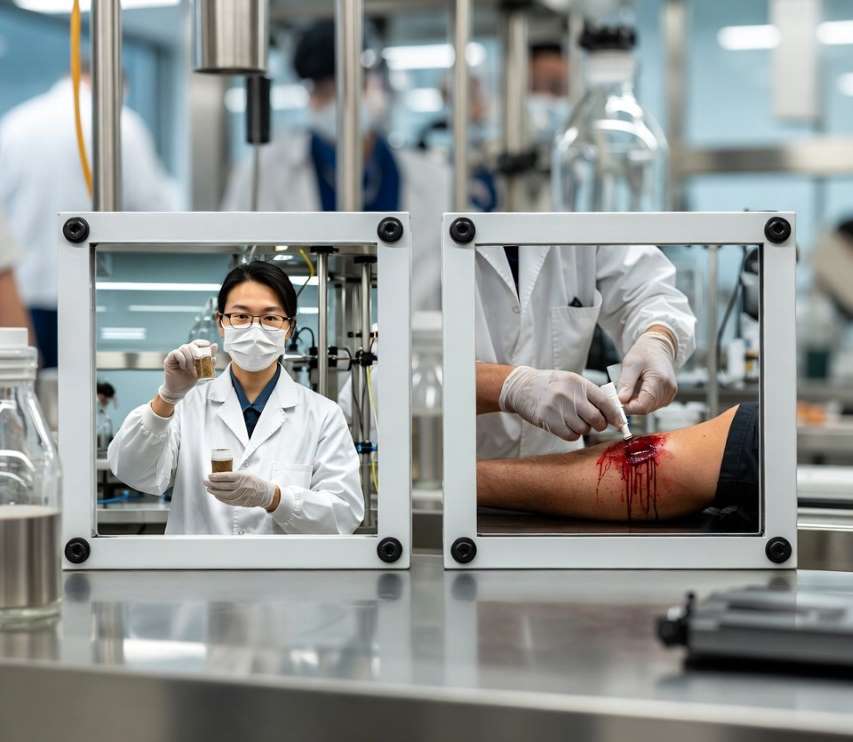
In a development that could redefine emergency medicine, battlefield trauma care, and even everyday first aid, researchers at South Korea's prestigious Korea Advanced Institute of Science and Technology have unveiled a groundbreaking spray-on powder capable of sealing severe wounds and stopping excessive bleeding in under a single second.
Named AGCL—a sophisticated blend of natural compounds sourced from seaweed, bacteria, and crustacean shells—this innovation represents a leap forward in hemostatic technology, promising to save countless lives in scenarios where traditional interventions simply fall short.
The announcement, spotlighted in a comprehensive study published this week in the esteemed journal Advanced Functional Materials, has ignited widespread enthusiasm across medical, military, and humanitarian circles.
The Urgent Need for Innovation
Globally, uncontrolled bleeding remains the leading cause of preventable death in trauma cases, claiming over 1.8 million lives annually according to the World Health Organization. Conventional approaches, such as tourniquets, pressure dressings, or commercial hemostatic agents like QuikClot, often struggle due to:
The need for precise application.
Extended time required to work.
Failure against deep, jagged injuries from gunfire, explosions, or heavy machinery mishaps.
AGCL disrupts this paradigm by delivering a lightweight, aerosolized powder that activates instantaneously upon contact with blood. It forms a resilient gel barrier that not only stanches the flow but also fosters accelerated tissue repair.
Unpacking the Science: Nature’s Building Blocks Reimagined
The spray involves a masterful fusion of biotechnology and materials science, utilizing three key natural components:
Alginate (The Gelling Agent): Harvested from abundant brown seaweed species like kelp. Upon exposure to calcium ions in blood plasma, it cross-links in milliseconds to create a matrix that swells and adheres to irregular wound surfaces, mimicking the body's own clotting process.
Gellan Gum (The Strengthener): A polysaccharide derived from the fermentation of the bacterium Sphingomonas elodea. This imparts mechanical robustness, allowing the gel to withstand pressures exceeding 40 kilopascals (equivalent to a vigorous grip). It prevents the clot from washing away under arterial pulsations.
Chitosan (The Active Healer): Derived from shrimp, crab, and insect exoskeletons. Its positively charged structure attracts negatively charged red blood cells to amplify coagulation. Additionally, its antimicrobial properties reduce infection risks by up to 90 percent against common pathogens like Staphylococcus aureus.
"This is not just a plug; it is an intelligent scaffold that guides healing while degrading biodegradeably over seven to fourteen days, leaving no residue."
Professor Steve Park, Lead Researcher and Materials Engineer at the Korea Advanced Institute of Science and Technology.
A Personal Mission: From Tragedy to Triumph
The genesis of AGCL is rooted in personal experience. Professor Steve Park was inspired by the limitations of field medicine he witnessed while serving in the Republic of Korea Army during joint exercises with United States forces.
He collaborated with immunologist Professor Sangyong Jon and Ph.D. candidate Youngju Son, a former Emergency Medical Technician.
Youngju Son's Motivation: "I joined the Institute driven by stories from my days as an Emergency Medical Technician: a construction worker dying from a rebar impalement, or hikers succumbing to femoral bleeds before rescue arrived. AGCL was born from that frustration—a tool so intuitive that a bystander could wield it effectively."
Supported by grants from the Korean Ministry of Defense and the Korea Advanced Institute of Science and Technology Bio and Brain Engineering seed fund—totaling 2.5 billion won (approximately 1.8 million United States Dollars)—the team iterated through over 500 prototypes to achieve this result.
Expert Voices: Optimism and Caution
The medical community has reacted with significant interest:
The Trauma Surgeon's View: Doctor Elena Ramirez of Mount Sinai Hospital in New York noted, "In Emergency Rooms handling 50,000 trauma cases yearly, we have lost patients to the 'lethal triad' of hypothermia, acidosis, and coagulopathy. If AGCL delivers on scalability, it could boost survival rates by 30 to 40 percent in those golden hours."
The Specialist's Caution: Doctor Marcus Hale, a hemostasis specialist at the University of Oxford, praised the natural sourcing but warned that the shellfish origin of chitosan poses allergy risks for 2 to 3 percent of the population. He emphasized the need for testing against Food and Drug Administration approved rivals.
Navigating the Horizon: Trials and Equity
The path to making this technology ubiquitous involves several upcoming milestones:
Human Trials: The consortium is preparing for Phase I human trials in late 2026, partnering with Seoul National University Hospital.
Regulatory Approval: Approvals from the Korean Ministry of Food and Drug Safety and the United States Food and Drug Administration could follow by 2028.
Cost and Access: The projected cost is 5 to 10 United States Dollars per unit, significantly lower than the 100 United States Dollars price tag of current competitors.
Professor Park emphasizes equity, stating, "We must prevent a 'rich-country-first' rollout." Initiatives like the Global Health Tech Transfer Program aim to distribute prototypes to Non-Governmental Organizations in sub-Saharan Africa, where road accidents cause 260,000 deaths annually from hemorrhagic shock.
In an era of escalating geopolitical tensions and climate-fueled disasters, AGCL embodies a tangible form of hope: a simple powder that defies death's grip.
 |  |  |
 |  |  |