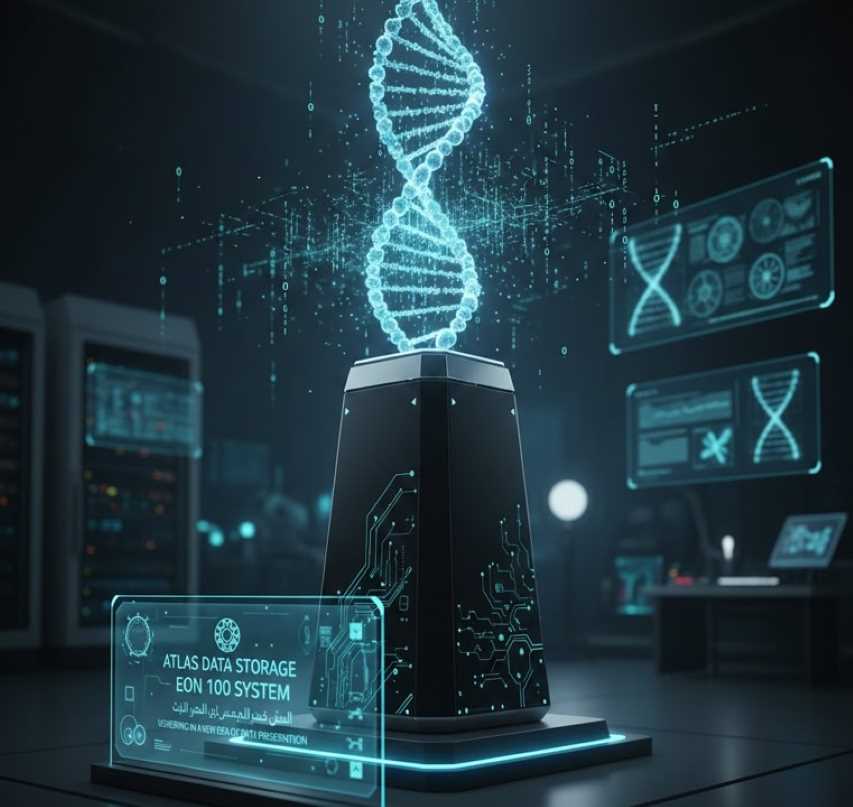
In a groundbreaking advancement for data storage technology, Atlas Data Storage has officially launched the Atlas Eon 100, heralded as the world's first scalable synthetic Deoxyribonucleic acid (DNA) data storage service.
Announced on December 2, 2025, this innovative system promises to redefine long-term data archiving by leveraging the remarkable properties of Deoxyribonucleic acid molecules. It offers unprecedented density, durability, and efficiency compared to traditional storage methods.
About Atlas Data Storage
Atlas Data Storage, a biotechnology startup based in South San Francisco, was spun out from Twist Bioscience in May 2025 with an impressive $155 million in seed funding. The company positions itself as a leader in synthetic Deoxyribonucleic acid data storage. The Eon 100 represents the culmination of over a decade of research and development across multiple scientific disciplines.
"This is the culmination of more than ten years of product development and innovation across multiple disciplines. We intend to offer new solutions for long-term archiving, data preservation for Artificial Intelligence models, and the safeguarding of heritage and high-value content."
Bill Banyai, Founder of Atlas Data Storage
Unmatched Density and Capacity
At the heart of the Atlas Eon 100 is its use of synthetic Deoxyribonucleic acid to encode digital information. Unlike conventional magnetic tape or hard drives, which degrade over time and require frequent maintenance, Deoxyribonucleic acid storage harnesses the natural stability of genetic material.
Massive Storage in Miniature Volume: The system can store vast amounts of data in a minuscule volume. Just one quart (approximately one liter) of Deoxyribonucleic acid solution holds up to 60 petabytes (60,000 terabytes).
Real-World Equivalent: This capacity is equivalent to approximately 10 billion songs, 12 million high-definition movies, or 660,000 4K resolution films.
Superior Density: The Eon 100 is an astonishing 1,000 times denser than Linear Tape-Open generation 10 magnetic tape, the current industry standard for archival storage.
Revolutionary Physical Footprint
The physical efficiency of the Eon 100 contrasts sharply with traditional infrastructure:
Compact Size: The system packs this immense capacity into roughly 60 cubic inches—about the size of a coffee mug.
Comparison to Tape: Storing the same amount of data on traditional tape storage would require over 15,500 miles of tape.
Efficient Replication: Using enzymatic processes, the Eon 100 can produce billions of identical data copies in a matter of hours, providing robust backup options without the energy-intensive hardware of conventional systems.
extreme Durability for the Future
Durability is a key selling point for the Eon 100. While magnetic tape has an average lifespan of 30 years, Deoxyribonucleic acid stored in the Eon 100 is designed to last for thousands of years under proper conditions.
It is also resistant to major environmental hazards, including:
Electromagnetic pulses
Extreme temperatures
Radiation
This resilience makes it ideal for preserving "irreplaceable archives," such as family photos, cultural heritage artifacts, scientific datasets, and training models for Artificial Intelligence.
Market Impact and Availability
The launch was strategically timed to coincide with the Association of Moving Image Archivists Conference on December 3, 2025, in Baltimore, Maryland, where Atlas Data Storage showcased the Eon 100 to industry professionals.
As global data generation explodes—projected to reach 181 zettabytes by 2025—solutions like the Eon 100 address the growing challenge of sustainable, long-term storage. While the system is not yet available for direct purchase through the website, it is positioned as a service offering, with plans to scale up to terabyte-level capacities in future iterations.
Looking Ahead to 2026
Industry experts have praised the development for its potential to disrupt the $50 billion data storage market. However, Atlas Data Storage acknowledges challenges such as the current high costs of Deoxyribonucleic acid synthesis and sequencing, as well as read/write speeds that lag behind electronic media. The company is actively addressing these through ongoing innovations, drawing on its roots in Twist Bioscience’s expertise.
As we enter 2026, the Atlas Eon 100 stands as a testament to the convergence of biotechnology and information technology. It signals a shift toward more resilient, eco-friendly storage paradigms, opening doors to futuristic applications such as storing humanity's collective knowledge in forms that could endure for millennia.
 |  |  |
 |  |  |