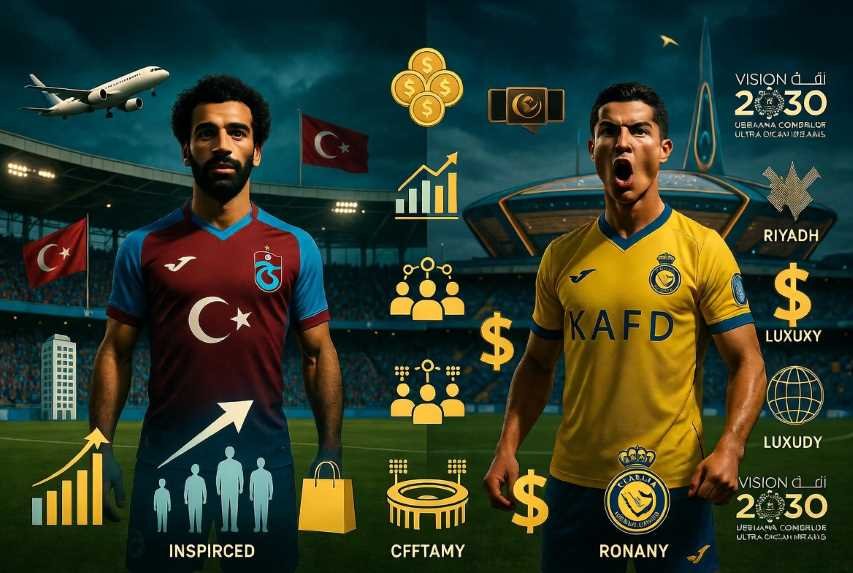
Two superstar transfers, two national strategies, and the expanding role of football as a driver of tourism, investment, soft power, and social change
Football is no longer simply a sport. It has evolved into a multi-billion-dollar global industry that intersects with national economies, tourism strategies, foreign investment flows, consumer culture, international branding, and even diplomacy. When a player of global stature changes clubs, the effects ripple far beyond the pitch. Ticket sales rise. Hotels fill. Airlines adjust routes. Social media algorithms amplify national images. Sponsors rewrite contracts. Young people find new role models. Governments measure soft-power returns.
In December 2022 and January 2023, Cristiano Ronaldo’s free transfer to Al-Nassr became the most visible symbol of Saudi Arabia’s deliberate, high-capital attempt to accelerate its sports economy and global image under Vision 2030. In August 2026, Mohamed Salah’s free-agent move to Trabzonspor offered a contrasting model: a still-elite European star choosing a passionate, mid-tier club in Turkey rather than the highest financial offer available in the Gulf or North America.
These two transfers illuminate different economic philosophies. One is a state-supported, top-down campaign designed to compress decades of commercial development into a few years. The other is a more market-driven, European-rooted bet on existing football culture, regional identity, and the commercial multiplier that a global name can generate inside a competitive domestic league. Examining both cases reveals how modern football functions as an economic and social instrument—and what each approach offers and risks for the countries involved.
The Two Transfers
Mohamed Salah: Career, Popularity, and the Historic Move to Trabzonspor
Mohamed Salah arrived at Liverpool in 2017 as a talented but still developing forward. Over nine seasons he transformed into one of the Premier League’s most complete attackers of his generation. He scored 257 goals in 442 appearances, won the Premier League, Champions League, FA Cup, League Cup, and Club World Cup, and repeatedly finished among the league’s top scorers and assist providers. His combination of pace, finishing, work rate, and consistency made him a cornerstone of Liverpool’s most successful period in decades.
Beyond statistics, Salah built extraordinary commercial and cultural capital. His global popularity, especially across the Arab world, Africa, and among Muslim communities, created one of the most valuable personal brands in football. Social media following, sponsorship deals with major international companies, and consistent media presence gave him influence that few players match. By the time he left Anfield in the summer of 2026—after a mutual agreement to terminate the final year of his contract—he remained a free agent with significant market power despite being 34.
The decision to join Trabzonspor on a two-year contract until June 2028 surprised many. Reports confirmed a package guaranteeing approximately €17 million ($19.6 million) per season, structured as a €10 million base salary plus a €7 million signing bonus each year, along with performance bonuses and a 20 percent share of merchandise revenue generated under his name. The deal ranks among the richest in Turkish Super Lig history and stands out because it was achieved by a club outside the traditional Istanbul “Big Three.”
Trabzonspor’s appeal rested on several factors: the opportunity to continue playing European football (the club had finished third the previous season and entered Europa League play-offs), a passionate and loyal fan base in a city with strong regional identity, a relatively quieter personal environment compared with major metropolises, and a commercial structure that still offered meaningful upside. For Salah, the move preserved a European stage while providing financial security and a share of the commercial value his presence would generate. For Trabzonspor, it represented the most ambitious single signing in the club’s modern history and an immediate elevation of its global visibility.
Cristiano Ronaldo: Arrival at Al-Nassr and the Transformation of a League
Cristiano Ronaldo’s move to Al-Nassr in late 2022 followed the mutual termination of his contract with Manchester United. At that point he was already one of the most decorated and marketable athletes in history—multiple Ballon d’Or winner, Champions League champion, record goalscorer for club and country, and the owner of a personal brand with over a billion social media followers across platforms.
The contract with Al-Nassr was widely reported as one of the most lucrative in football. Contemporary estimates placed the annual value, including salary, image rights, and commercial elements, in the region of $200 million. Over the subsequent seasons, extensions and performance components pushed his total earnings from the club into the hundreds of millions of dollars. Beyond pure salary, the deal included significant commercial arrangements and later reports of ownership-related elements that aligned his interests more closely with the club’s long-term commercial future.
Ronaldo’s arrival produced immediate and measurable effects. Al-Nassr’s social media following exploded—Instagram alone grew from under one million to approximately 30 million followers within a few years. League broadcasting rights expanded from a limited regional footprint to more than 140 territories. Commercial revenues for both the club and the Saudi Pro League rose sharply. Officials later cited figures including a reported 650 percent increase in certain revenue categories and substantial growth in sponsorship income. Jersey sales set records. Global media coverage of the Saudi Pro League increased by orders of magnitude.
The transfer did not occur in isolation. It formed the most visible early step in a broader strategy that saw other high-profile players follow and that positioned the Saudi Pro League as a serious commercial competitor. Ronaldo’s presence helped normalize the idea of elite European talent choosing the Gulf and accelerated the league’s integration into the global football conversation.
Immediate Economic Impact
Turkey: Localized Multipliers and National Visibility
Salah’s transfer is expected to generate concentrated economic effects around Trabzon while contributing more diffuse national benefits. Trabzon is a Black Sea city with strong local identity but historically limited international tourism relative to Istanbul, Antalya, or Cappadocia. The arrival of a global superstar immediately raises awareness of the city among football audiences worldwide.
Match attendance at Papara Park is projected to rise, particularly for high-profile fixtures and European nights. Higher attendance drives secondary spending on food, transport, merchandise, and hospitality. Hotels in Trabzon and surrounding areas stand to benefit from visiting supporters, media, and tourists drawn by the novelty of seeing Salah in a new environment. Airlines serving the region—both domestic connections through Istanbul and any international routes—can expect increased demand around key match dates.
Merchandise represents a particularly direct channel. With Salah entitled to 20 percent of revenue from products bearing his name, the club has a clear incentive to maximize sales of personalized jerseys, training wear, and lifestyle items. Turkish Super Lig clubs already generate meaningful merchandising income; a player of Salah’s brand strength can lift those figures substantially, especially among international online buyers.
Sponsorship and advertising opportunities improve for both the club and league partners. Major Turkish companies with existing relationships to football—airlines, automotive brands, telecommunications firms, and consumer goods companies—gain association value. Television and digital rights holders may see incremental international interest, particularly from Egyptian, Arab, and African markets. Digital subscriptions and streaming engagement around Trabzonspor content are also likely to rise.
On a national level, the transfer reinforces the Super Lig’s recent trajectory of higher ambition and spending. In the 2025 transfer window the league recorded one of the highest net spends in world football outside the Premier League and Saudi Pro League. Salah’s arrival adds credibility to that trend and signals that clubs beyond the traditional powerhouses can attract elite talent when the financial and sporting package aligns.
Saudi Arabia: Systemic Growth and Vision 2030 Alignment
Ronaldo’s impact operated at a systemic level. Foreign visitor interest in Saudi football increased, supporting sports tourism and related hospitality spending in Riyadh and other cities. International broadcasting deals expanded the league’s global footprint dramatically. Sponsorship and commercial partnerships grew in both number and value. Infrastructure investment accelerated as part of a wider entertainment and sports development push.
The transfer aligned closely with Vision 2030 objectives: economic diversification away from oil dependence, development of the entertainment and tourism sectors, enhancement of national branding, and the pursuit of major international events (including the successful bid for the 2034 FIFA World Cup). By placing one of the world’s most recognizable athletes at the center of the Saudi Pro League narrative, authorities achieved rapid soft-power gains and commercial acceleration that would have been difficult to generate through infrastructure alone.
Al-Nassr itself recorded significant commercial revenue growth. League-wide metrics cited by officials included substantial increases in broadcasting income, sponsorship, and overall commercial activity. The presence of Ronaldo helped attract additional high-profile players, further raising the league’s profile and average club valuations. While individual club finances have faced pressures—Al-Nassr has been reported to carry elevated debts in later seasons—the broader strategic goal of elevating Saudi football’s global standing was largely achieved in the short to medium term.
Football as an Economic Engine
Modern football clubs function as multi-product businesses. A superstar player influences nearly every revenue line:
Match-day revenue: Higher attendance, premium hospitality, and corporate packages.
Broadcasting rights: Domestic and especially international deals rise in value when global stars participate.
Sponsorship and commercial partnerships: Brands pay premiums for association with recognizable names.
Merchandise and licensing: Jersey sales, replica kits, and lifestyle products scale with player popularity.
Digital and media platforms: Streaming, social content, mobile apps, and fan engagement products generate recurring revenue.
Ancillary industries: Tourism, hotels, airlines, restaurants, retail, transport, and local services capture spending from visiting fans and media.
Economic multipliers in football are significant. Academic and industry studies of major clubs in Europe have shown that the total economic activity generated by a high-profile team or star can reach several times the direct club expenditure when induced tourism, media, and consumer spending are included. In Ronaldo’s case the multiplier operated nationally through league-wide commercial expansion. In Salah’s case the primary multiplier is expected to be more localized around Trabzon and the Black Sea region, with secondary national branding and Super Lig visibility effects.
Betting markets (where legal), gaming, and fantasy products also capture value from heightened interest. In both countries, the presence of global stars increases the overall commercial addressable market for football-related products and experiences.
Social Impact
Turkey
Salah’s arrival has already produced intense media excitement and public conversation. For Trabzon and the broader Black Sea region it represents a powerful affirmation of regional identity and ambition. Civic pride rises when a global name chooses a club outside the traditional centers of power. Youth inspiration is particularly relevant: young players in Trabzon, across Turkey, and in Egyptian and Arab communities see a pathway that combines elite performance with cultural familiarity.
Football culture in Turkey is already deep and passionate. The transfer reinforces that culture while adding a new layer of international visibility. Community engagement around the club is likely to increase, and charitable or social initiatives associated with Salah can gain amplified reach. Media coverage elevates everyday conversations about the Super Lig and creates shared national moments around the player’s performances.
Saudi Arabia
Ronaldo’s presence contributed to broader shifts in lifestyle and entertainment culture. Interest in professional football among young people rose. Participation rates and infrastructure for youth development received greater attention. Women’s football and wider sports participation formed part of the same modernization narrative. The transfer supported a deliberate strategy of international openness and sports diplomacy, helping to reshape global perceptions of the kingdom among sports audiences.
Public perception improved in measurable ways among international football fans, even as debates about the pace and nature of social change continued. The visibility of elite sport provided a shared cultural reference point that crossed generational and regional lines inside the country.
Global Media Exposure
Both transfers generated massive international coverage, but on different timescales. Ronaldo’s move produced sustained multi-year attention across traditional media, social platforms, search engines, and video platforms. Al-Nassr’s digital metrics grew dramatically; league content reached new audiences in Asia, Europe, Africa, and the Americas. Google search interest in the Saudi Pro League rose by orders of magnitude in the months following his arrival. YouTube, TikTok, Instagram, X, and Facebook engagement around Al-Nassr and league matches expanded correspondingly.
Salah’s transfer, although only days old at the time of writing, immediately dominated global football discourse. Major outlets across Europe, the Middle East, Africa, and North America covered the story extensively. Social media engagement was intense, particularly among Egyptian, Arab, Turkish, and Premier League audiences. Estimated combined global audience reach for content related to these two players runs into the hundreds of millions, creating significant soft-power value for both destinations.
The difference in scale and duration is instructive. Ronaldo’s impact was designed to be systemic and sustained. Salah’s impact is more concentrated but still globally visible, leveraging an existing European platform and his established personal brand.
Tourism Effects
Football tourism is a proven economic driver. Cities such as Barcelona, Madrid, Manchester, and Paris have long converted match-day visitors into multi-day tourists who spend on hotels, restaurants, shopping, museums, and local attractions. Riyadh has experienced measurable growth in sports-related visits since the influx of major players. Trabzon is now positioned to capture a similar, if smaller-scale, effect.
Expected increases include international visitors traveling specifically for matches, stadium tours, and related experiences; higher hotel occupancy around fixture dates; increased airline bookings; greater restaurant and retail spending; and secondary tourism to the Black Sea region’s natural and cultural attractions. Local businesses that can align with the new visitor profile—hotels offering packages, restaurants catering to international tastes, transport operators, and retail outlets—stand to benefit most directly.
The tourism effect is amplified when clubs progress in European competition, creating additional high-profile nights that draw both domestic and international interest.
Investment Impact
Global stars improve investor confidence by demonstrating that a league or club can attract and retain elite talent and global attention. This signal matters to international brands, sports companies, media organizations, technology firms, real-estate developers, hospitality operators, and infrastructure investors.
In Saudi Arabia the Ronaldo effect supported broader interest in sports-related real estate, stadium development, entertainment complexes, and smart-city initiatives linked to Vision 2030. In Turkey, Salah’s signing strengthens the commercial case for Super Lig clubs, potential stadium upgrades, digital infrastructure, and partnerships with international brands and technology providers. Both countries gain from the perception that their football ecosystems are dynamic and open to high-level talent.
Business Opportunities
Industries positioned to benefit most include:
Sports apparel and footwear brands
Broadcasting and streaming platforms
Advertising and marketing agencies
Airlines and airports
Hotels and hospitality groups
Restaurants and food-service operators
Ride-sharing and local transport
Retail and e-commerce platforms
Banking and insurance products tied to sports or tourism
Gaming, esports, and fantasy sports operators
AI analytics and sports-technology firms
Wearable technology and performance-data companies
Each of these sectors can capture incremental demand generated by higher visibility, increased visitor numbers, and greater consumer engagement with the clubs and leagues.
Technology’s Role
Technology multiplies the economic impact of major transfers. Artificial intelligence and big data enable sophisticated fan analytics, personalized marketing, and dynamic pricing. Smart stadiums improve the match-day experience through digital ticketing, cashless payments, facial recognition for access control, and enhanced connectivity. Blockchain applications can secure ticketing and create new digital collectible products. AR and VR experiences allow remote fans to engage more immersively. Streaming platforms and social-media algorithms distribute content globally at low marginal cost. Performance analytics tools help clubs extract more value from their squads and coaching staffs.
Both the Saudi Pro League and Turkish Super Lig have invested in these areas. The presence of global stars accelerates the return on those technology investments by increasing the size of the audience that can be monetized.
Challenges
Turkey faces familiar football-economy risks: financial sustainability of high-wage commitments, potential wage inflation across the league, competitive balance between the traditional Istanbul clubs and ambitious provincial sides, existing levels of club debt, and the impact of currency fluctuations on long-term planning and European competitiveness.
Saudi Arabia continues to confront questions about the long-term return on heavy investment in individual stars, the risk of over-dependence on successive marquee signings, the challenge of maintaining global interest once the initial novelty fades, the need to develop sustainable domestic talent pipelines, and the gradual introduction of financial discipline that resembles financial fair play concepts even in the absence of formal UEFA-style constraints.
Both models must eventually convert short-term attention into durable commercial structures, competitive sporting success, and broader economic diversification.
Comparison Table
Category | Salah to Trabzonspor | Ronaldo to Al-Nassr |
|---|---|---|
| Transfer significance | Historic for a non-Istanbul Turkish club and the Super Lig | Landmark catalyst for Saudi Pro League transformation |
| Estimated economic impact | Strong localized multiplier + national branding | Systemic, league-wide commercial and soft-power growth |
| Tourism | Expected rise in Trabzon and Black Sea regional visitors | Measurable increase in sports tourism to Riyadh and beyond |
| Sponsorship & commercial | Significant boost for club and associated Turkish brands | Major expansion of league and club commercial deals |
| Merchandise | 20% player revenue share; high global demand expected | Record jersey sales and sustained commercial growth |
| TV & media rights | Incremental international interest, especially Arab markets | Dramatic expansion to 140+ territories |
| Social & youth impact | Regional pride, youth inspiration, cultural resonance | Broad lifestyle, participation, and perception shifts |
| Foreign investment signal | Positive for Turkish football’s commercial credibility | Central element of Vision 2030 sports and entertainment strategy |
| Technology adoption | Accelerates smart-stadium and digital fan engagement | Supported league-wide digital infrastructure and content push |
| National branding | Enhances Turkey’s image as a competitive European football destination | Positions Saudi Arabia as an emerging global sports hub |
Future Outlook
Evidence-based projections suggest both countries will continue to treat football as a strategic sector, though along different trajectories. Saudi Arabia is likely to maintain high levels of investment while seeking greater commercial self-sufficiency, stronger performances in Asian competitions, and successful delivery of major events including the 2034 World Cup. The long-term test will be whether the league can develop sustainable domestic talent and revenue models that reduce dependence on successive waves of expensive foreign stars.
Turkey is positioned to benefit from continued European competition exposure, passionate domestic support, selective high-profile signings, and the commercial upside that global names can generate inside an existing football culture. The Super Lig’s ability to remain competitive in UEFA competitions and to convert star power into lasting commercial growth will determine how much economic value is retained.
Further superstar arrivals remain possible in both leagues. The competitiveness of Turkish clubs in Europe and Saudi clubs in Asia will serve as important indicators of whether the economic models deliver sustained sporting and commercial success. Football will remain a significant instrument of economic development, national branding, and soft power. The ultimate measure of success, however, will be the conversion of temporary global attention into durable infrastructure, diversified revenue streams, talent development systems, and broader economic benefits that outlast any individual player’s career.
FAQ
Why did Mohamed Salah choose Trabzonspor instead of a higher-paying offer in Saudi Arabia or MLS? He prioritized remaining in European competition, joining a club with a passionate fan base and a realistic path to continental matches, while still securing a substantial financial package and a direct share of the commercial value his presence would generate.
How does Salah’s salary at Trabzonspor compare with typical Super Lig wages? The guaranteed package of approximately €17 million per season is among the highest ever offered in the Turkish Super Lig and significantly exceeds the previous norms for even the biggest Istanbul clubs.
What concrete commercial results did Ronaldo’s arrival produce for the Saudi Pro League? Broadcasting expanded to more than 140 territories, certain revenue categories were reported to have grown by around 650 percent, Al-Nassr’s social media following grew dramatically, and overall league commercial activity and sponsorship income rose substantially.
Is Trabzon likely to see a meaningful tourism boost from Salah’s presence? Yes. Cities that host global football stars typically experience increased match-day and multi-day visitor spending on hotels, restaurants, transport, and local attractions. Trabzon’s relatively lower existing international tourism base means the percentage impact could be noticeable.
How do these transfers affect ordinary local businesses? Higher attendance and visitor numbers increase demand for hotels, restaurants, taxis and ride-sharing, retail, and entertainment. Merchandise retailers and online sellers also benefit from elevated demand for club and player-related products.
What are the main financial risks for Trabzonspor? The primary risks are the sustainability of the wage commitment if European revenue or commercial growth underperforms expectations, and the broader league-wide pressure that high individual salaries can create on competitive balance and club finances.
Has Saudi Arabia’s heavy investment in star players been judged a success so far? In terms of rapid global visibility, commercial acceleration, and soft-power gains, the early results have been significant. Questions remain about long-term financial sustainability at club level and the development of self-sustaining domestic talent and revenue models.
Can other countries copy the Saudi model? Only those with substantial sovereign or state-linked capital and a willingness to accept large short-term financial outlays in pursuit of longer-term diversification and branding goals. Most countries lack the fiscal capacity for a comparable approach.
Will more European stars follow Salah to the Turkish Super Lig? It is possible, particularly for players in the later stages of their careers who value European competition, passionate support, and competitive salaries. The Super Lig’s ability to offer a credible sporting and commercial package will determine the volume of such moves.
How should the ultimate economic success of these transfers be measured? By a combination of direct club and league revenues, induced tourism and consumer spending, sustained competitive performance, development of domestic talent and infrastructure, and measurable contribution to broader national economic and soft-power objectives over a multi-year horizon—not solely by short-term media attention or individual player salaries.
The transfers of Mohamed Salah to Trabzonspor and Cristiano Ronaldo to Al-Nassr illustrate two distinct ways that nations can harness global football stardom. Saudi Arabia pursued a high-capital, state-supported strategy designed to accelerate commercial development and soft-power gains on a compressed timeline. Turkey, through Trabzonspor, is testing a more organic, market-aligned approach that leverages existing European structures, regional identity, and the commercial multiplier of a still-elite global brand.
Both approaches generate real economic activity—tourism, merchandise, sponsorship, media rights, and secondary spending. Both create social and cultural effects that extend beyond the pitch. Both carry risks related to sustainability, competitive balance, and the challenge of turning short-term attention into long-term value.
What is clear is that football has become too economically and culturally significant for governments and clubs to treat as mere entertainment. The question is no longer whether star transfers matter for national economies and societies. The question is how effectively each country can convert the visibility and energy those transfers create into lasting prosperity, competitive strength, and positive social outcomes.
 |  |  |