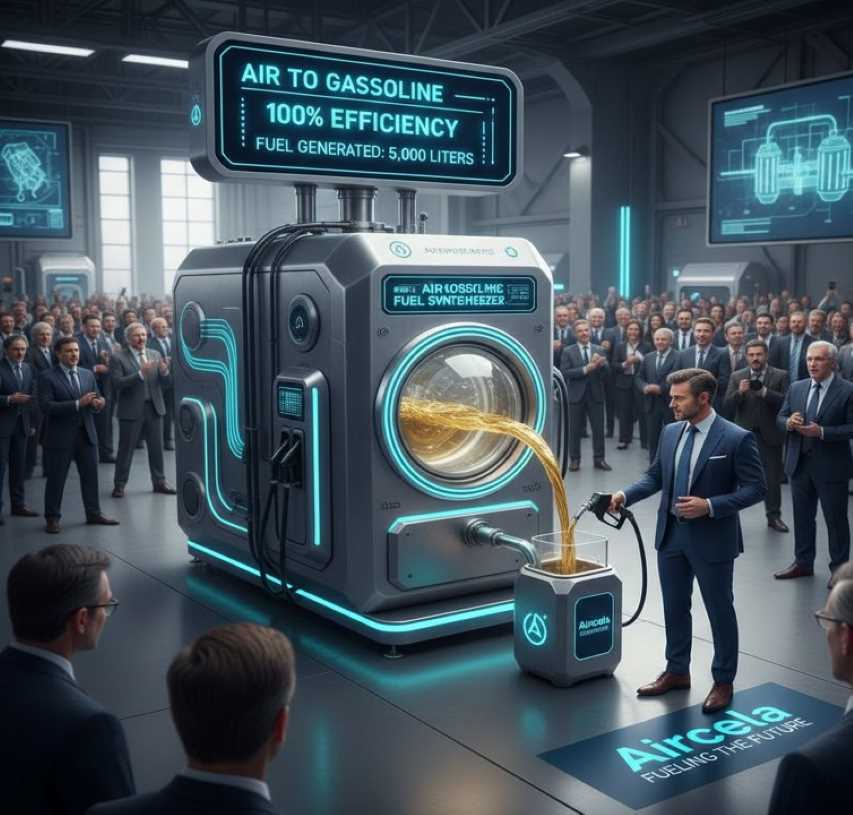
In a groundbreaking advancement for sustainable energy, the New York-based startup Aircela has unveiled the first United States machine capable of producing gasoline directly from the air. Demonstrated on a Manhattan rooftop in May 2025, this innovative technology promises to revolutionize fuel production by creating fossil-free gasoline using only three inputs: air, water, and renewable electricity.
The compact device, which is roughly the size of a standard refrigerator, combines Direct Air Capture (DAC) with on-site fuel synthesis. This offers a modular solution designed to decarbonize transportation without requiring any changes to existing internal combustion engines.
The Technology Behind the Magic
Aircela’s machine operates through a sophisticated yet efficient process rooted in established scientific principles. The procedure is broken down into three primary phases:
Carbon Capture: The process begins by capturing carbon dioxide (CO2) from the ambient air using a water-based solution containing potassium hydroxide. This acts as a sorbent to bind the carbon dioxide molecules effectively.
Electrolysis: Simultaneously, the system employs electrolysis to split water into hydrogen (H2) and oxygen (O2) gases. This stage is powered entirely by renewable energy sources, such as solar or wind power.
Synthesis: Once captured, the carbon dioxide is combined with the hydrogen in a synthesis reactor to form liquid hydrocarbons—essentially gasoline.
The Result:
The fuel produced is motor-grade and fully compatible with standard internal combustion engines. Crucially, it produces no net emissions when burned. Because the carbon dioxide used in its creation was originally pulled from the atmosphere, the carbon cycle remains neutral. This process eliminates the need for fossil fuels, ethanol, or other traditional inputs, creating a closed-loop system that could significantly reduce global reliance on crude oil.
Operational Design and Capacity
The machine’s design draws inspiration from the pioneering work of physicist Dr. Klaus Lackner, who developed early concepts of direct air capture in the 2000s. Aircela has engineered the device into a honeycomb-like structure, allowing for easy scalability and off-grid deployment.
Key Specifications:
Capture Rate: Each unit can capture up to 10 kilograms of carbon dioxide per day.
Fuel Yield: This capture rate yields approximately one gallon of gasoline daily.
Storage: The unit features an internal storage capacity of 17 gallons.
The Debut and Market Implications
The official unveiling took place on May 22, 2025, in Manhattan's Garment District. Aircela showcased a live demonstration to industry experts, investors, and media members. Attendees witnessed the machine in action as it produced gasoline in real-time, validating its on-site capabilities.
This event marked a significant milestone: it is the first United States-based Direct Air Capture technology to synthesize fossil-free fuel directly at the point of use.
"We are not just capturing carbon—we are turning it into something useful that fits seamlessly into our current infrastructure." — Aircela CEO
The company emphasized the technology's potential for widespread adoption. Initial deployments are slated for later in this year, targeting residential, commercial, and industrial applications, with ambitious plans to scale production by the end of the year.
Challenges and Future Outlook
While the technology is promising, it faces specific hurdles regarding energy efficiency and cost. Producing gasoline from air requires a significant amount of electricity. However, Aircela claims its modular design optimizes for renewables and minimizes waste.
Critical Perspectives:
Economic Factors: Critics note that widespread scaling will depend heavily on falling renewable energy prices and supportive government policies regarding carbon capture incentives.
Environmental Impact: Advocates hail the device as a major step toward net-zero emissions. It is viewed as particularly vital for "hard-to-electrify" sectors, such as aviation and long-haul trucking, where similar air-to-fuel processes are currently being explored.
As Aircela moves toward commercialization, this innovation could play a key role in combating climate change by repurposing atmospheric carbon dioxide into a valuable resource. This development underscores a shifting paradigm: the air we breathe might just power the vehicles we drive.
 |  |  |
 |  |  |