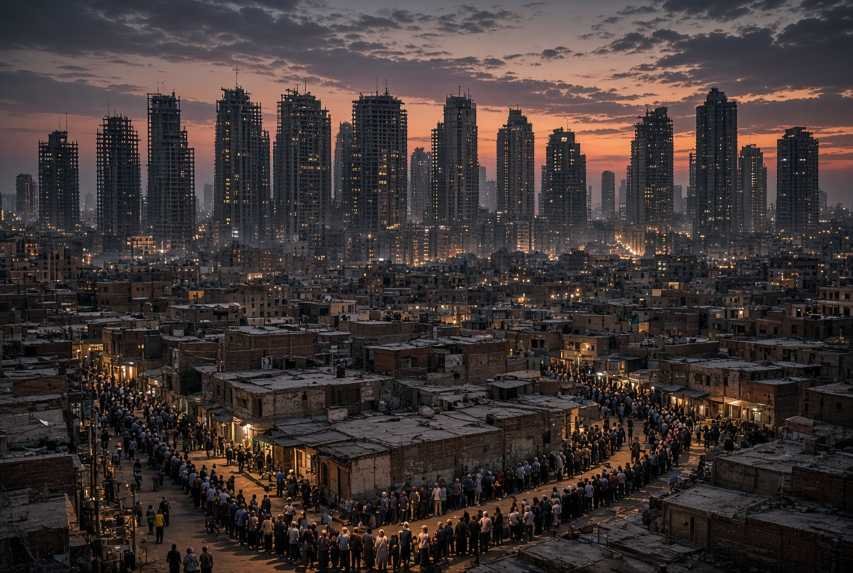
Owning a home has become progressively more difficult for large numbers of Egyptians even as the country has constructed millions of residential units and roughly doubled the share of its national territory classified as inhabited. Nominal property prices in Egyptian pounds have risen sharply for years, driven by repeated currency depreciation, inflation, higher costs for cement, steel, and imported materials, concentrated urban demand, government land policies, and the widespread use of real estate as a store of wealth and inflation hedge. At the same time, large numbers of completed units remain vacant or priced beyond the reach of typical household incomes, while informal construction continues to dominate new supply in existing urban areas. This is not simply a narrative of rising prices. It reflects structural mismatches between the location and quality of supply, genuine residential demand from household formation, speculative holding, financing constraints, incomplete property registration, and policy choices spanning more than seven decades.
Egypt’s domestic population stood at roughly 108–109.5 million by 2026, with about 11.9 million urban households and 15 million rural households according to CAPMAS estimates, and with continued concentration of people and economic activity in Greater Cairo, Alexandria, and other major centers. The construction and real-estate complex contributes substantially to output and employment—around 10.1 percent of GDP in fiscal year 2025/26 according to planning ministry data, with roughly 3.9 million workers—yet high housing costs reduce residual disposable income and can channel household and institutional capital away from manufacturing, agriculture, or technology. Real estate functions simultaneously as shelter, an investment asset, a preferred hedge against inflation and currency weakness, and, in segments of the market, a vehicle for speculation. Resolving the resulting tensions matters for macroeconomic stability, intergenerational equity, social cohesion, and long-term national development.
Understanding Egypt's Real Estate Dilemma
Why has owning a home become increasingly difficult for many Egyptians? The core problem is a widening gap between the cost of a modest formal unit and the incomes and savings of the majority of households. Even units offered under subsidized programs often require down payments and monthly installments that consume a large share of take-home pay after inflation has eroded purchasing power. Why do property prices continue to rise in nominal terms despite periods of slower economic growth and high interest rates? Because construction costs themselves have risen with the depreciating pound and imported inputs, because land in accessible locations remains scarce or is allocated at prices that developers pass through, and because many buyers treat apartments as financial assets rather than primary residences. How can a country have millions of housing units while many citizens struggle to find affordable homes? The numerical stock of units is not the same as the stock of units that are affordable, well-located relative to jobs, of adequate quality, and available on the market rather than held vacant. Is Egyptian real estate primarily a place to live, an investment asset, a store of wealth, or a speculative market? It is all of these at once, with the balance shifting over time and across income groups. The relationship between housing, economic stability, social equality, and national development is direct: housing costs shape consumption, savings behavior, family formation, commuting patterns, and the allocation of capital across the economy.
Historical Evolution of Egyptian Real Estate Over Several Decades
The modern Egyptian housing system took shape under state-led policies after the 1952 revolution. In the 1950s and 1960s, nationalization of major urban land and properties, combined with public housing programs and urban planning efforts, aimed to expand access for growing urban populations. Government-built blocks became a visible feature of cities. Rent-control measures, introduced or tightened in response to earlier economic stresses, locked in low rents for many units and reduced incentives for private maintenance and new rental construction. Supply lagged behind rapid rural-to-urban migration and natural increase.
The 1970s brought economic liberalization under the Infitah policy. Remittances from Egyptians working in the Gulf and elsewhere increased household purchasing power and fueled private construction. Demand shifted toward larger or better-located units, while informal settlement growth accelerated on the urban fringe as formal supply remained constrained. By the 1980s, population growth and urban expansion had produced extensive unplanned communities; private construction, much of it informal, accounted for the bulk of new units. State efforts continued but could not match the pace of household formation.
The 1990s saw further economic reforms, the creation or expansion of the New Urban Communities Authority (NUCA), and the launch of new cities intended to relieve pressure on the Nile Valley and Delta. Private real estate investment grew, though informal building remained dominant. From 2000 to 2010, private developers expanded gated communities and luxury projects in places such as New Cairo and Sixth of October, catering to upper-middle and high-income buyers while middle- and low-income formal supply stayed limited. Property became an increasingly attractive investment for those with capital.
The 2011–2015 period brought political transition, economic uncertainty, and currency pressures that slowed some activity but did not reverse underlying demand for housing as a physical asset. The 2016 currency flotation and subsequent devaluations sharply raised the cost of imported materials and reinforced real estate’s role as an inflation hedge. Large infrastructure and new-city projects, including the New Administrative Capital, accelerated. Between 2014 and 2024–2026, official accounts report that Egypt’s inhabited area roughly doubled from about 7 percent to 14 percent of national territory, with 39 new cities and related communities whose population rose from roughly 4.8 million to around 15 million. Ministry-affiliated entities implemented about 1.96 million housing units in that span, of which roughly 56 percent were designated for low-income residents.
From 2021 through 2026, global inflation, further currency depreciation (with the pound moving from around 15–16 EGP per dollar in earlier years toward the 50 range), rising construction costs, and high interest rates reshaped the market. Nominal property prices climbed steeply in many locations—sometimes doubling or more in EGP terms over short periods—while real (inflation-adjusted) prices showed more mixed or even negative movements over longer horizons according to some international compilations. Developer installment plans lengthened, foreign interest in coastal and large projects increased (including major agreements such as Ras El-Hekma), and the government continued social-housing programs alongside plans for further large-scale delivery. Throughout these decades, the interplay of state land allocation, private and informal building, demographic pressure, and macroeconomic instability shaped a market in which physical supply expanded faster than broad-based affordability.
Why Have Property Prices Become So High?
Multiple reinforcing factors explain the rise in nominal prices. Currency depreciation has been central: successive devaluations, including the 2016 flotation and later adjustments in 2022–2024, raised the local-currency cost of imported steel, aluminum, glass, and other materials while simultaneously increasing the attractiveness of property as a hedge. Construction costs rose sharply in EGP terms. Land prices, influenced by government allocation policies that have often favored large developers and strategic projects, also contributed. Population growth and household formation—Egypt added millions of people over the past decade, with a still-young age structure—generate ongoing demand, concentrated in major urban areas where employment and services are densest.
Developers’ margins, financing costs (with policy rates remaining elevated into 2026), and marketing through long installment schedules further support price levels. Speculation and hoarding of units as stores of value add demand that is not tied to immediate occupancy. Importantly, these dynamics must be distinguished: some price increases reflect genuine rises in building-material and land costs and inflation; others reflect pricing power in segments where buyers treat apartments as financial assets rather than primary residences. Official and market data show large nominal gains in places such as New Cairo, Sixth of October, and the North Coast (where averages reached figures such as EGP 168,000 per square meter in some 2026 reports), while purchasing power for middle- and lower-income households has been eroded by inflation that, while declining from 2023 peaks, remained in the low-to-mid teens in urban areas into late 2026. The housing price-to-income ratio has risen substantially in recent years according to analyses citing central-bank and research sources. Genuine construction-cost increases, inflation-driven adjustments, speculative pricing, and changes in real market value therefore coexist and must be separated when assessing whether current prices reflect sustainable fundamentals.
The Housing Supply Paradox: Millions of Units, Yet Housing Is Unaffordable
Egypt has produced large numbers of units—estimates from independent observers indicate more than one million annually in recent years, the large majority informal—yet affordability remains constrained. Official programs have delivered hundreds of thousands of social-housing units (social programs alone account for roughly 1.07 million implemented or under construction in recent tallies, with average unit prices around EGP 344,000 and subsidized 20-year financing near 8 percent in some offerings). At the same time, estimates of vacant or unused urban units run into the millions (one frequently cited figure is around 5.6 million), many held as second homes, seasonal properties, or pure investments. Luxury and upper-middle projects in new communities contrast with continued informal construction and residual overcrowding in older areas.
The paradox is explained by mismatches of location, quality, price, and tenure. Units in distant new cities may lack nearby employment; luxury apartments do not meet the needs of average households; and vacant investment properties do not enter the affordable rental or ownership market. This is less a pure numerical shortage than a combination of affordability shortfalls, distribution problems, and weak incentives to put existing stock into productive use. Data limitations persist: official housing bulletins track formal production by type and governorate, while informal building is harder to quantify comprehensively, and vacancy estimates vary by methodology. Geographic mismatch is acute—Greater Cairo dominates both demand and much formal high-end supply—while rural and secondary cities face different pressures. The existence of vacant apartments does not mean they are affordable or accessible to those who need them.
Economic Impacts on Egypt
The construction and real-estate complex supports GDP, employment in building, materials (cement, steel), furniture, transport, and related services, and generates government revenue through land sales, permits, and taxes. Large foreign-currency inflows have accompanied coastal and mega-projects. Banking exposure to developers and, to a lesser extent, mortgage borrowers creates linkages but also concentration risks. Households treat property as a preferred savings vehicle when inflation and currency risk are high, which can divert funds from bank deposits or productive investment in industry and technology.
Whether this produces sustainable growth is contested. Construction is labor-intensive and has helped absorb population growth, yet over-reliance on real estate can crowd out higher-productivity sectors, inflate asset prices, and leave the economy vulnerable to cost shocks or demand slowdowns. Expensive housing reduces residual income available for other consumption, with effects on retail and services. Recent contractual sales figures (EGP 1.048 trillion across roughly 64,500 units in the first nine months of 2026 among major developers) illustrate the sector’s scale, but unit volumes have not always risen in line with values, signaling price-driven rather than volume-driven growth. Capital allocation toward property rather than manufacturing or technology carries opportunity costs that become more visible when growth in non-construction sectors lags.
Social Impacts: How the Housing Crisis Changes Egyptian Society
High housing costs delay marriage and household formation for many young professionals, as down payments and installments consume large shares of income. Families already housed can face rising rents or maintenance burdens; those in the old-rent system have experienced decades of artificially low payments that discouraged new rental supply, a distortion the 2025 law seeks to unwind over a multi-year transition with staged increases and eventual termination of legacy contracts. Generational divides appear between owners who accumulated assets before major devaluations and younger non-owners. Spatial segregation has grown between gated communities and traditional or informal neighborhoods. Long commutes from affordable peripheral housing raise transport costs and time burdens. Rural-to-urban migration continues, placing pressure on city infrastructure. Low-income workers face acute insecurity, often relying on informal rentals or multi-generational overcrowding. These patterns affect living standards, fertility decisions, and social mobility. Different income groups experience the market differently: upper-income households can treat property as a portfolio asset, while lower-income households treat it as a binding constraint on family life.
Government Policies and Major National Projects
Successive governments have treated housing as both a social priority and a development tool. The New Urban Communities Authority has driven new-city construction; social-housing funds have delivered large numbers of subsidized units with mortgage support. The New Administrative Capital, New Alamein, and other projects combine administrative relocation, infrastructure, and real-estate development, with reported infrastructure spending in new cities exceeding EGP 350 billion over roughly twelve years. Road networks expanded substantially. Land-allocation rules have been adjusted to favor larger, proven developers. Mortgage initiatives, including subsidized rates and cash support, aim to improve access, while property registration remains incomplete for much of the stock. Public-private partnerships for low-income units (for example, agreements targeting 20,000 units with 80 percent affordable allocation) represent recent attempts to leverage private capital.
These efforts have expanded the urban footprint, replaced many unsafe areas (hundreds of thousands of alternative units for former residents of informal settlements), and provided formal options for some low- and middle-income households. Limitations include high costs relative to average incomes, incomplete occupancy in some new communities, emphasis on ownership over a robust rental sector, and the persistence of informal building. The 2025 old-rent reform addresses a long-standing market distortion but requires careful implementation to avoid displacement without adequate alternatives. Balanced assessment recognizes tangible gains in formal supply and infrastructure alongside ongoing affordability and spatial-efficiency challenges. Objectives, costs, beneficiaries, and long-term implications vary across programs: social housing reaches lower-income groups at scale but with eligibility and location constraints; mega-projects generate employment and infrastructure but concentrate high-end supply.
International Comparisons: What Can Egypt Learn from Other Countries?
Singapore’s Housing and Development Board model demonstrates large-scale public provision of affordable, high-quality ownership housing financed in part through the Central Provident Fund, with strong land management and integrated planning. High home-ownership rates among citizens were achieved through sustained state involvement and income-targeted subsidies; adaptation in Egypt would require reliable long-term financing institutions and clearer land-use discipline. Germany’s strong rental culture, tenant protections, and cooperative housing produce relative stability without heavy reliance on ownership as the primary wealth store. Austria’s Vienna model combines substantial public and limited-profit housing, mixed-income communities, and long-term affordability, keeping housing costs lower relative to incomes than in many peer cities.
Japan illustrates efficient construction techniques and the tendency for building values to depreciate while land retains value, reducing pure speculation in structures. China’s experience with property-driven growth, excess supply in some cities (“ghost” or under-occupied developments), developer leverage, and subsequent corrections underscores the risks of treating real estate as the dominant growth engine and household savings vehicle; vacancy rates and unfinished projects created macroeconomic vulnerabilities. Turkey’s combination of rapid urban expansion, inflation, and currency depreciation offers parallels on affordability pressures and foreign-investor interest. The United States highlights both the power and the risks of deep mortgage markets (including the 2008 crisis) and the constraints of zoning. The UAE, particularly Dubai, shows how foreign ownership, luxury development, and market cycles can attract capital but also produce volatility and limited relevance for broad domestic affordability.
Elements transferable to Egypt include Singapore-style long-term savings-linked finance, Vienna-style mixed-income social housing with professional management, stronger rental frameworks, and construction-efficiency practices. Full replication is constrained by differences in land ownership, fiscal capacity, governance, and household preferences for ownership. Policies that expand genuine affordable supply near jobs, improve registration and transparency, and moderate pure speculation are more immediately relevant than luxury-focused models. Comparison across affordability, ownership versus rental, government intervention, investment orientation, and sustainability show that models emphasizing broad access and mixed tenure have produced more durable social outcomes than those emphasizing rapid high-end supply alone.
Technology’s Role in Transforming Egypt’s Real Estate Sector
PropTech tools, AI-assisted valuation using transaction and market data, and big-data analytics can improve price transparency and reduce information asymmetries. Blockchain and digital registries offer pathways to secure, faster ownership records, addressing long-standing registration gaps that hinder mortgages and formal transactions. Online marketplaces, virtual and 3D tours, and Building Information Modeling already appear in larger projects and can lower marketing and design costs. Smart-building sensors, energy-efficient materials, and IoT systems reduce operating expenses. Emerging methods such as 3D printing and construction robotics remain limited but could eventually cut labor and waste. GIS supports better urban planning by mapping employment, transport, and infrastructure. Digital mortgage platforms can streamline applications. Practical gains include faster, less fraud-prone transfers, more accurate valuations that discourage extreme speculation, and construction efficiencies that modestly lower costs—provided supporting legal and data infrastructure is built. These technologies are not automatic solutions; they require complementary reforms in land administration and data standards.
The Role of Banks, Mortgage Finance, and Financial Institutions
Mortgage penetration remains low relative to the scale of housing need. High interest rates, inflation uncertainty, and large required down payments limit conventional bank products. Developer installment plans fill part of the gap but concentrate risk with builders and can mask true costs. Subsidized programs for social housing have expanded access for eligible households, with longer tenors (up to 20 years) and reduced rates. Islamic finance structures exist but are not dominant. Expanding long-term, affordable fixed- or moderately variable-rate products, backed by better property registration and credit assessment, would allow more households to purchase without prohibitive upfront sums. Developer financing needs careful oversight to avoid over-leverage. International experience shows that well-regulated mortgage markets support ownership when paired with supply measures; without them, they can amplify cycles. The distinction between developer-led installments and true long-term bank mortgages is important for household risk and financial-system stability.
Real Estate Speculation Versus Genuine Housing Demand
For many Egyptians with savings, apartments have served as a preferred hedge against inflation and currency depreciation, leading to purchases of units that remain vacant or are resold before completion. Secondary-market activity and pre-delivery trading reflect this. Rental yields in many locations have been modest relative to price levels, consistent with capital-gain rather than income motives. Genuine demand from new households coexists with this speculative layer. Policymakers can discourage pure hoarding through better taxation of vacant properties, improved rental regulation that encourages professional landlords, and measures that channel savings into productive alternatives, while preserving incentives for actual construction. Distinguishing the two requires better data on occupancy and transaction motives. Risks of a market correction exist if speculative demand weakens while construction costs remain elevated, though the presence of underlying demographic demand provides a floor that pure speculative markets lack.
The Environmental and Urban Planning Dimension
Rapid expansion has consumed agricultural land in the Nile corridor and raised infrastructure costs for distant new cities. Water scarcity, high energy use in buildings under extreme heat, construction waste, and limited green space are persistent concerns. New communities vary in the degree to which they incorporate mixed-use design, walkability, public transport links, and employment centers. Sustainable practices—green-building standards, efficient materials, integrated transport—remain unevenly applied. Evaluating success requires assessing not only units built but also resident access to jobs, services, and affordable mobility. Building new cities without corresponding employment and services simply relocates rather than resolves congestion and cost pressures.
Case Studies: Real-Life Egyptian Housing Scenarios
These illustrations use rounded, labeled assumptions drawn from publicly discussed price and income ranges; they are not official statistics.
A young professional in Greater Cairo earning roughly EGP 15,000–25,000 monthly faces down payments and installments on a modest new unit that can exceed 40–50 percent of income even under extended plans, delaying marriage.
A middle-income family with a subsidized mortgage on a social-housing unit manages payments near the upper limit of eligibility rules but has limited residual income after inflation.
A low-income rental household in an older neighborhood spends a high share of earnings on rent and faces uncertainty under evolving lease rules.
A mid-sized developer confronts rising steel and cement costs plus longer sales cycles, relying on installment cash flow.
An investor holding several vacant apartments treats them as inflation protection, accepting low or zero rental yield.
One family owns an unused unit in a new city while another cannot qualify for or reach affordable stock nearer employment.
A worker commuting from a peripheral affordable area spends hours and a significant income share on transport.
These patterns illustrate how the same market produces very different outcomes by income, location, and timing of purchase.
Possible Solutions: How Can Egypt Make Housing More Affordable?
A multi-pronged approach is required. On the government side, continued expansion of well-located social and mixed-income housing, greater transparency in land allocation, targeted taxation or incentives around vacant units, strengthened rental frameworks, accelerated registration, and transport investments that connect housing to jobs can improve outcomes. Economically, sustained progress on inflation and currency stability reduces cost pressures and the incentive to hoard property; local production of materials and longer-term mortgage products help. The private sector can deliver smaller practical units near employment, experiment with rent-to-own, and adopt transparent pricing. Technology investments in registries, valuation, and construction efficiency lower frictions. Social measures that support young families and expand affordable rental options address immediate pressures. Each element carries implementation costs, risks of capture or poor targeting, and the need for coordination among housing authorities, the central bank, local governments, and developers. Prioritizing units that are both affordable and accessible to employment is essential. Implementation requirements include legal changes for registration and vacant-property rules, fiscal capacity for subsidies, and administrative capacity for targeting; expected benefits include lower effective housing costs for eligible households and better capital allocation; risks include leakage of subsidies and continued informal building if formal options remain distant or slow.
Future Scenarios: Egyptian Real Estate in 2030, 2040, and 2050
An optimistic path features macroeconomic stabilization, broader mortgage access, higher shares of genuinely affordable and well-located supply, reduced speculative vacancy, and more productive capital allocation, yielding gradual improvements in affordability ratios.
A moderate scenario continues construction growth and new-city expansion with incremental policy tweaks, leaving affordability challenges persistent for lower- and middle-income groups.
A pessimistic scenario sees renewed inflation or currency pressure, further price escalation relative to incomes, rising inequality between owners and non-owners, and social strain.
Outcomes will depend on inflation control, the quality (not merely quantity) of new supply, financing reforms, and whether real estate remains the dominant savings vehicle. These are contingent projections, not forecasts; demographic momentum and existing stock will shape the baseline regardless of policy. Factors that determine which scenario materializes include the trajectory of the exchange rate and inflation, the success of efforts to link new housing to employment centers, the evolution of mortgage finance, and the degree to which policy discourages pure speculative holding without discouraging legitimate construction.
Final Assessment: Is Egypt Building Homes or Building an Affordable Housing Future?
Egypt has demonstrated capacity to expand its urban footprint, deliver large volumes of formal units, upgrade unsafe areas, and attract investment into real estate and infrastructure. These are measurable achievements. Yet the current model—marked by high nominal prices, substantial vacancy, dominance of informal production in older areas, and heavy reliance on property as a wealth store—has not produced broad affordability commensurate with the scale of building. Continuing to expand cities without tighter focus on location relative to jobs, tenure diversity (including a functional rental sector), registration, and measures that moderate pure speculation risks locking in higher costs and spatial inefficiencies.
Housing is simultaneously a commodity, an investment, and a fundamental social need. Balancing investor returns with citizens’ access requires policies that expand supply where people work and live, improve financing without fueling excess leverage, and treat transparency and efficient land use as priorities. Success should be measured not only by units completed or land urbanized, but by affordability relative to incomes, occupancy rates, commuting burdens, and the sector’s contribution to sustainable rather than merely construction-led growth. Decades of decisions have produced today’s market; the coming years will determine whether Egypt converts its construction capacity into a more inclusive and resilient housing system.
Policymakers, developers, banks, and citizens each have roles: the state in land policy, registration, and targeted supply; developers in practical, well-located projects; banks in sustainable long-term finance; and households in recognizing both the shelter and the investment dimensions of property. The ultimate test is whether the next generation of Egyptians can form households and access decent housing without disproportionate sacrifice of income or mobility.
 |  |  |