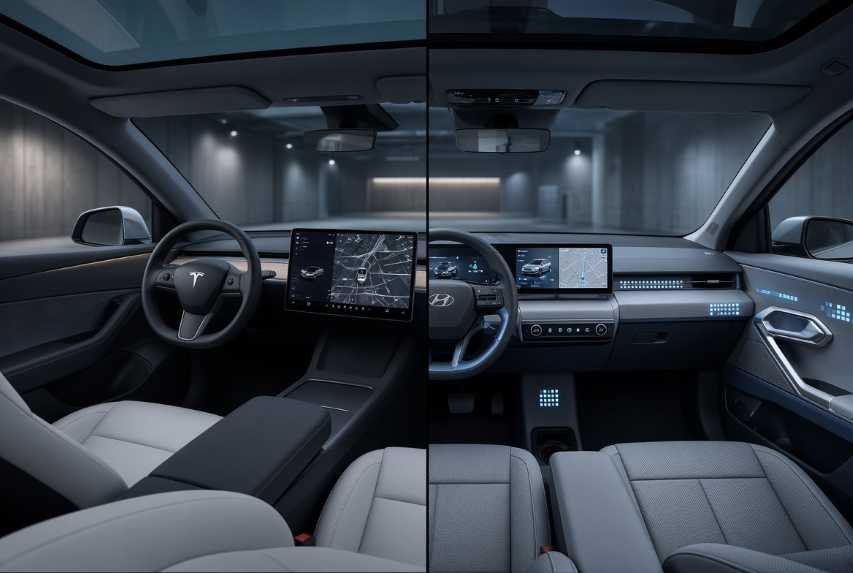
Electric vehicles have moved from niche technology to mainstream options. Battery energy density has improved, public charging networks have expanded, and software now shapes daily use as much as mechanical design. The 2026 Hyundai Ioniq 5 and 2026 Tesla Model Y represent two leading approaches in the compact-to-midsize electric SUV segment. Both deliver zero-tailpipe driving, useful range for most trips, and access to growing charging infrastructure. They differ sharply in design philosophy, charging architecture, software experience, interior usability, and long-term ownership characteristics.
Buyers often find the comparison difficult because both vehicles are practical daily drivers with advanced driver-assistance features. One emphasizes a distinctive retro-futuristic cabin, an 800-volt architecture, and a more conventional control layout. The other prioritizes minimalist design, high efficiency, frequent over-the-air updates, and deep integration with a proprietary charging network. The central question for 2026 is which combination of price, official and real-world range, charging convenience, comfort, technology, and total cost of ownership better matches an individual buyer’s driving habits, home charging access, and budget.
This analysis draws primarily on U.S. market specifications and ratings (EPA where applicable), manufacturer statements, and independent testing data available through late 2026. Figures are market-specific. European WLTP ratings and other regional variants differ and are not directly interchangeable with EPA numbers. Specifications apply to the noted drivetrain and trim; not every feature is available in every market or configuration.
Vehicle Overview and Background
Hyundai Ioniq 5
Hyundai established the Ioniq sub-brand to focus on dedicated battery-electric vehicles. The Ioniq 5, introduced earlier in the decade, uses the Electric-Global Modular Platform (E-GMP). This skateboard-style architecture places a flat battery pack under the floor, enabling a long wheelbase, low center of gravity, and spacious cabin relative to exterior length. The design draws on 1980s hatchback cues with pixelated lighting and a squared-off silhouette. For 2026, the U.S. lineup retains the 63 kWh standard-range battery on the entry SE and the 84 kWh pack on long-range variants, along with a native North American Charging Standard (NACS) port on recent production. Hyundai targets buyers seeking distinctive styling, passenger-focused comfort, Vehicle-to-Load capability, and ultra-fast charging on high-voltage stations, while also offering Apple CarPlay and Android Auto.
Tesla Model Y
Tesla accelerated mainstream EV adoption with the Model S, then scaled volume with the Model 3 and Model Y. The Model Y shares substantial underpinnings with the Model 3 but offers higher seating and more cargo volume. The 2026 model reflects the “Juniper” refresh, with updated exterior lighting, interior refinements, and a revised trim structure that includes Standard and Premium variants. Tesla’s philosophy prioritizes software, aerodynamic efficiency, a single large central touchscreen, and seamless access to its Supercharger network. Buyers typically value the minimalist interface, frequent software updates, strong real-world efficiency, and the established charging ecosystem.
The manufacturers’ approaches shape everyday use. The Ioniq 5’s 800-volt system and more traditional controls suit drivers who prefer physical buttons for climate and media alongside a distinctive cabin. The Model Y’s 400-volt architecture, software-centric controls, and Supercharger integration favor drivers who accept touchscreen reliance in exchange for network convenience and continuous feature improvements.
Exterior Design and Dimensions
The Ioniq 5 measures approximately 183.3 inches long, 74.4 inches wide, and 63 inches high, with a roughly 118.1-inch wheelbase. This relatively short overall length combined with a long wheelbase creates a roomy footprint that still fits many urban parking spaces. Ground clearance is typically around 6.1 inches on standard models. Curb weight generally falls between roughly 4,145 pounds for the lightest standard-range RWD and over 4,800 pounds for higher AWD trims. The squared styling, pixel lighting, and available glass roof create a distinctive presence. Flush or conventional door handles and a relatively upright greenhouse aid visibility and entry for many drivers.
The Model Y measures roughly 188.6–188.7 inches long, about 78 inches wide without mirrors (wider with mirrors), and approximately 63.8–63.9 inches high, with a 113.8-inch wheelbase. It sits slightly longer and lower in profile. Ground clearance is reported around 6.6 inches on many variants. Curb weights typically range from just over 4,000 pounds on lighter RWD models to the mid-4,000s on AWD versions. The aerodynamic shape supports efficiency. The Juniper updates refined the front lighting signature. Door handles are flush-style. A panoramic glass roof is standard on Premium and higher trims; the base Standard may use a textile headliner in some configurations. Visibility is adequate but the sloping rear glass can limit rear sightlines for some drivers.
The Ioniq 5’s more compact length and distinctive styling appeal to buyers seeking uniqueness and easier maneuvering in tight cities. The Model Y’s longer body and sleeker profile often feel more conventional as a family crossover and can offer a slightly different cargo-loading geometry. Aesthetics remain subjective; practical differences in length and wheelbase matter more for parking and interior space utilization.
Battery Technology and Electric Vehicle Architecture
The Ioniq 5 uses an 800-volt architecture on the E-GMP platform. This higher voltage allows higher charging power for a given current and contributes to the vehicle’s ability to accept up to 350 kW on compatible high-voltage DC stations under ideal conditions. The standard-range battery is listed at 63 kWh; long-range models use 84 kWh (gross figures commonly cited). Chemistry is lithium-ion (NMC-type in many long-range packs). Liquid thermal management supports battery preconditioning before fast charging. Regenerative braking is strong and adjustable. Battery warranty terms typically include multi-year coverage with a capacity retention threshold (often around 70 percent) for a defined period and mileage; exact U.S. terms should be confirmed with the manufacturer for the specific vehicle.
The Model Y uses a 400-volt architecture. Tesla does not publish exact battery capacities, but independent analyses and EPA-related data place Standard models in the approximate 60–70+ kWh usable range and Premium/Long Range and Performance models around 79–82 kWh nominal, with usable capacity slightly lower due to buffers. Chemistry varies; some Standard RWD configurations have used LFP cells in certain markets or periods, while higher-range packs commonly use NMC or NCA. Thermal management and preconditioning are integrated with navigation to Superchargers. Regenerative braking is strong in one-pedal modes. The battery and drive unit warranty is generally 8 years with mileage limits (often 100,000 or 120,000 miles depending on trim) and a 70 percent capacity floor.
Larger battery capacity does not automatically produce longer range; efficiency, weight, aerodynamics, tires, and drivetrain configuration all matter. The Model Y’s aerodynamic shape and powertrain calibration often yield competitive or superior efficiency despite the lower voltage architecture. Both vehicles support battery preconditioning, which is important for achieving peak DC charging rates, especially in cold weather. Real-world longevity depends on temperature exposure, charging habits (frequent 100 percent charges or prolonged high-state-of-charge storage can accelerate degradation), and usage patterns. Independent fleet data generally show gradual capacity loss of a few percent per year under mixed conditions, though individual results vary.
Driving Range and Energy Efficiency
Official U.S. EPA ratings for 2026 models (approximate, subject to exact configuration and wheels):
Comparison item | Hyundai Ioniq 5 | Tesla Model Y |
Model year and trim | 2026 SE Standard Range RWD / SE–Limited LR RWD / AWD variants | 2026 Standard RWD / Premium RWD / Premium AWD / Performance |
Drivetrain | RWD or AWD | RWD or AWD |
Battery capacity | 63 kWh / 84 kWh | Approx. 60–70+ kWh usable (Standard); ~79–82 kWh (Premium/Performance) |
Official driving range (EPA) | 245 mi (Std RWD); up to 318 mi (LR RWD); 290 mi (many AWD); 269 mi (Limited AWD); 259 mi (XRT) | 321 mi (Standard RWD); 357 mi (Premium RWD); 327 mi (Premium AWD); 306 mi (Performance); 294 mi (Standard AWD) |
Testing standard | EPA | EPA |
Energy consumption | Varies; often higher kWh/100 mi than efficient Model Y configs | Often more efficient; Premium RWD competitive |
Wheel size used for rating | Varies by trim (19-inch common) | Varies; larger wheels reduce range |
The longest official EPA range in the U.S. lineup is the Tesla Model Y Premium RWD at 357 miles. The Ioniq 5 long-range RWD reaches 318 miles. Efficiency generally favors the Model Y in comparable conditions because of its lower drag coefficient and powertrain tuning. City driving typically yields higher efficiency than highway driving for both vehicles. High speeds, strong headwinds, aggressive acceleration, air conditioning or heating, and cold temperatures reduce range. In winter, range can drop substantially (often 20–40 percent or more depending on temperature, preconditioning, and use of cabin heat); both vehicles benefit from battery preconditioning and seat heaters. Larger wheels and performance tires reduce efficiency. Drivers should plan with a practical reserve—commonly leaving 10–20 percent state of charge on arrival for buffer against weather, detours, or charger unavailability.
Illustrative example (not a guarantee): At 30 kWh/100 miles average consumption, a 300-mile trip requires roughly 90 kWh from the battery. An 84 kWh pack would need one substantial charge or careful planning; a higher-efficiency vehicle covering the same distance at 25 kWh/100 miles would use less energy. Real-world independent tests often show highway range below EPA figures, with results highly dependent on speed and conditions. Direct head-to-head comparisons require identical test protocols.
Charging Speed and Charging Infrastructure
Both vehicles support home Level 2 AC charging (typically 10–11.5 kW class onboard chargers depending on trim), public AC, and DC fast charging. Peak DC power alone does not determine session length. The charging curve (how power tapers as the battery fills), battery temperature, starting state of charge, and charger capability all matter. Battery preconditioning improves rates in cold weather.
The Ioniq 5’s 800-volt system enables manufacturer-claimed 10–80 percent charges in as little as about 20 minutes on a compatible 350 kW high-voltage station (using the included CCS adapter on many non-NACS sites). On native NACS Superchargers (V3/V4), Hyundai and independent reports indicate longer times, commonly around 30 minutes for 10–80 percent, because many Superchargers operate at lower effective voltage for the vehicle. The 2026 Ioniq 5 has a native NACS port for direct Supercharger access without an adapter and includes a CCS adapter for other networks. Peak rates on the highest-voltage stations can be high under ideal warm-battery conditions.
The Model Y supports up to 250 kW peak on compatible Superchargers for higher trims (lower for some Standard configurations). Typical 10–80 percent sessions fall in the mid-20- to low-30-minute range under favorable conditions. Tesla’s navigation automatically preconditions the battery en route to Superchargers. The native NACS port and exclusive or preferential access to the large Supercharger network remain major advantages in the United States, where Supercharger density and reliability have historically been strong.
Public charging costs vary widely by network, location, membership, and time of day; home charging is usually cheaper where electricity rates are moderate. Home installation costs depend on electrical panel capacity and distance to the parking location. In cold or hot weather, preconditioning and thermal management affect both vehicles. Tesla’s integrated route planning and network experience currently offer greater convenience for many long-distance drivers in the U.S. The Ioniq 5’s high-voltage capability shines on compatible non-Tesla high-power stations but requires more planning when relying primarily on Superchargers.
Performance, Acceleration, and Driving Experience
Claimed or tested acceleration varies by configuration. Ioniq 5 AWD models are commonly rated around 4.5 seconds 0–60 mph in independent tests for dual-motor versions producing up to 320 hp and 446 lb-ft. RWD long-range versions are slower. The Model Y Standard RWD is rated around 6.8 seconds; Premium AWD versions around 4.6 seconds; and the Performance around 3.3 seconds. Top speeds are typically in the 125 mph range for most variants, higher for the Performance.
Both vehicles deliver strong low-speed torque typical of electric powertrains, making urban acceleration and highway merging effortless. The Model Y Performance is the clear choice for maximum acceleration. Ride comfort on the Ioniq 5 is generally tuned for a composed, quiet experience with a focus on passenger comfort. The Model Y is competent but can feel firmer, especially on larger wheels. Steering is precise on both; the Model Y’s software-tuned systems and available adaptive damping on some trims influence the character. Regenerative braking is strong and customizable. Noise levels are low on both, though wind and road noise become more noticeable at highway speeds. Performance consistency under repeated hard acceleration depends on thermal management; neither vehicle is primarily designed as a track car except for specialized high-performance variants such as the Ioniq 5 N.
Interior Design, Comfort, and Passenger Space
The Ioniq 5 features dual 12.3-inch displays (instrument cluster and central touchscreen), physical climate and media controls on many trims, and a more conventional layout. Front seats are comfortable with available heating, ventilation, and memory. Rear legroom and headroom benefit from the long wheelbase and flat floor. A panoramic roof on higher trims brightens the cabin. Materials are generally well regarded for the segment. Storage includes useful door pockets and a sliding center console on some versions. Wireless charging and multiple USB ports are available. Child-seat installation is straightforward, and the higher seating position aids older passengers.
The Model Y centers on a large single touchscreen (approximately 15.4 inches) that controls nearly all functions, with minimal physical buttons. A driver display is absent in the traditional sense; information appears on the central screen. Seats are supportive, with available heating and ventilation on higher trims. Rear space is competitive. The minimalist aesthetic divides opinion—some find it clean and modern; others miss tactile controls. Storage is practical, and the front trunk (frunk) adds utility. Wireless charging and USB ports are present. Both vehicles support family use, though the Ioniq 5’s physical controls and conventional instrument layout may feel more familiar to drivers transitioning from gasoline vehicles.
Cargo Capacity and Everyday Practicality
Published cargo figures vary by measurement standard. The Ioniq 5 typically offers roughly 26–27 cubic feet behind the rear seats and around 58–59 cubic feet with seats folded (U.S. figures). The Model Y generally provides more total cargo volume, often listed near 74–76 cubic feet maximum, plus a usable frunk (capacity varies by drivetrain). Loading heights and opening sizes differ; the Model Y’s hatch is practical for bulkier items. Both fold rear seats for longer loads. Roof racks are available with load limits that should be verified. Towing capacity is higher on certain Ioniq 5 configurations with the hitch option and on Model Y models (up to around 3,500 pounds claimed on many Model Y variants). The Model Y’s greater maximum cargo volume and frunk give it an edge for families carrying bulky gear or for occasional utility use. The Ioniq 5 remains highly practical for daily shopping, luggage, and child-related equipment.
Infotainment, Software, and Connected Technology
The Ioniq 5 offers wireless Apple CarPlay and Android Auto, built-in navigation, Bluelink connected services, and over-the-air updates. Charging information and route planning are integrated. Physical controls reduce reliance on the touchscreen for frequent adjustments. Digital Key functionality is available.
The Model Y relies on its central touchscreen for navigation (with excellent Supercharger integration), media, vehicle settings, and entertainment features. Over-the-air updates frequently add or refine capabilities. The mobile app provides remote climate control, locking, location, and charging management. Smartphone key functionality is standard. CarPlay and Android Auto are not available in the conventional sense. Subscription options exist for premium connectivity and advanced driver-assistance features. Both systems support user profiles and diagnostics. Tesla’s software ecosystem is widely regarded as more seamless for charging and updates, while Hyundai’s approach retains broader smartphone integration and physical controls.
Driver Assistance, Safety, and Autonomous Driving Claims
Both vehicles include automatic emergency braking, forward collision warning, lane-keeping assistance, adaptive cruise control, blind-spot monitoring, and rear cross-traffic features as standard or widely available. Surround-view cameras and parking assists appear on higher trims. Highway driving assistance systems are present. Neither vehicle offers fully autonomous driving; available systems require driver supervision. Tesla’s Autopilot and Full Self-Driving (Supervised) packages provide more advanced hands-on or supervised features in supported conditions, but they remain driver-assist systems subject to regulatory and operational limitations. Independent crash-test results (NHTSA, IIHS, Euro NCAP) have generally been strong for both models in tested years; buyers should confirm the specific model year and market specification. Software-related recalls and service campaigns occur with both manufacturers and should be checked against official records for the vehicle identification number.
Price, Trims, and Value for Money in 2026
U.S. starting prices (approximate MSRP before destination, taxes, and options; subject to change):
Ioniq 5: Standard Range RWD from the mid-to-high $30,000s; long-range RWD and AWD models typically from the low-to-mid $40,000s into the low $50,000s for higher trims such as Limited. Significant price reductions occurred relative to earlier years.
Model Y: Standard RWD from $39,990; Standard AWD around $41,990; Premium RWD around $45,990; Premium AWD around $49,990; Performance around $57,990 (plus destination/order fees commonly totaling roughly $1,640).
Destination charges, taxes, registration, and options add cost. Federal and state incentives vary by household income, vehicle assembly location, battery sourcing, and purchase date; eligibility must be verified individually. Comparing equivalent range and equipment requires matching long-range RWD or AWD versions rather than the absolute base models. The Ioniq 5 often undercuts comparable Model Y pricing after recent adjustments, while the Model Y Premium RWD offers the highest official range.
Total Cost of Ownership
Illustrative five-year U.S. example (assumptions must be adjusted for local conditions): 12,000 miles per year, primarily home charging at $0.15 per kWh, 20 percent public DC charging at higher rates, average insurance, routine maintenance, and estimated depreciation. Home-charging scenarios favor both vehicles relative to gasoline equivalents because electricity is usually cheaper than gasoline on a per-mile basis. Frequent public fast charging raises costs significantly. Insurance can be higher for higher-performance or higher-value vehicles. Tires wear faster on heavier EVs and performance models. Depreciation depends on market demand, condition, and battery health. The lower purchase price of many Ioniq 5 configurations can improve the ownership math if efficiency and insurance differences are modest. The Model Y’s efficiency and residual values (historically strong for Tesla) can offset a higher initial price in some scenarios. Actual results vary with electricity rates, annual mileage, insurance quotes, and local service costs. Two scenarios—mostly home charging versus heavy public charging—should be modeled separately for any buyer.
Warranty, Reliability, Maintenance, and Repairability
Hyundai typically offers a 5-year/60,000-mile basic warranty and longer powertrain coverage (often 10 years/100,000 miles in the U.S.), with battery coverage that includes a capacity retention guarantee for a defined period. Tesla offers a 4-year/50,000-mile basic warranty and an 8-year battery and drive-unit warranty with mileage limits and a 70 percent capacity floor. Both require less routine maintenance than gasoline vehicles (no oil changes, fewer brake jobs due to regenerative braking). Tire replacement remains a recurring cost. Service center density differs; Tesla has a dedicated network, while Hyundai uses its broader dealer network. Independent repair options exist for both but high-voltage components often require specialized equipment. Long-term reliability data for 2026 models is still emerging; earlier Model Y and Ioniq 5 generations show mixed owner-reported experiences with software, build quality, and occasional component issues. Fewer mechanical parts do not eliminate electrical or software-related problems.
Environmental Impact and Sustainability
Neither vehicle has zero lifecycle impact. Battery production involves lithium, nickel, cobalt (in some chemistries), graphite, and energy-intensive manufacturing. Both manufacturers have recycling and material-sourcing initiatives, though transparency and outcomes vary. Operating emissions depend on the carbon intensity of the local electricity grid. In regions with substantial renewable or low-carbon generation, operating emissions are far lower than those of comparable gasoline SUVs. Vehicle weight influences tire wear and particulate emissions. Lifecycle assessments generally show EVs producing lower greenhouse-gas emissions over their lifetime than gasoline counterparts under most grid mixes, with the advantage growing as grids decarbonize. Direct comparisons between these two models depend on specific battery chemistry, manufacturing location, and usage patterns; neither is universally “greener.”
Ownership Experience and Customer Feedback
Independent reviews and owner surveys frequently praise the Ioniq 5 for ride comfort, distinctive design, interior space, and charging speed on high-voltage stations. Common notes include software maturity relative to Tesla and occasional variability in public charging experiences. Model Y owners often highlight efficiency, Supercharger convenience, software updates, and cargo practicality. Criticisms include touchscreen reliance, variability in build quality across production periods, and service wait times in some locations. Both vehicles show gradual battery degradation in fleet studies consistent with typical EV behavior. Surveys have limitations in sample size and self-selection; they should be weighed alongside professional long-term tests and official recall records.
Practical Performance in Different Countries and Climates
In the United States, Supercharger density favors the Model Y for long-distance travel, while the Ioniq 5’s NACS port and included CCS adapter provide broad access. In Europe, CCS is dominant; charging network density and pricing vary by country, and WLTP ranges apply. In the United Kingdom, both vehicles are available with local pricing, taxes, and incentives that differ from U.S. figures. In Egypt and other markets with limited public charging infrastructure, home or workplace charging becomes essential; import duties, local electricity tariffs, service availability, and parts supply should be verified locally. Extreme heat requires effective thermal management for both batteries. Cold climates reduce range for both and make preconditioning and cabin preconditioning valuable. Resale values and insurance costs also differ by market.
Who Should Buy Which Electric Vehicle?
Urban commuters with home charging may find either suitable; the lower-priced Ioniq 5 configurations often win on cost. Long-distance highway drivers who rely on public charging frequently benefit from the Model Y’s Supercharger integration and high efficiency. Families prioritizing maximum cargo volume and a frunk lean toward the Model Y; those preferring physical controls and a distinctive cabin may prefer the Ioniq 5. Technology enthusiasts who value continuous software improvements and advanced driver-assistance features often choose Tesla. Buyers who want Apple CarPlay/Android Auto and conventional controls favor Hyundai. Drivers in hot climates should confirm thermal management and local service support for either vehicle. Business fleets may prioritize total cost of ownership, service network density, and residual values.
Side-by-Side Comparison Table
Feature | Hyundai Ioniq 5 (2026 U.S. examples) | Tesla Model Y (2026 U.S. examples) |
Starting price (approx.) | Mid-to-high $30,000s | $39,990 (Standard RWD) |
Length / Wheelbase | ~183.3 in / ~118.1 in | ~188.7 in / 113.8 in |
Battery | 63 / 84 kWh | Approx. 60–82 kWh range |
Max EPA range | 318 mi (LR RWD) | 357 mi (Premium RWD) |
Peak DC charging | Up to 350 kW (high-voltage stations) | Up to 250 kW |
Typical 10–80% DC time | ~20 min (compatible 350 kW) / ~30 min (Supercharger) | ~25–30 min (favorable conditions) |
Motor output (examples) | Up to 320 hp AWD | Up to Performance levels; Standard lower |
Acceleration (claimed/tested) | ~4.5 s (AWD) | 3.3–6.8 s depending on trim |
Max cargo (approx.) | ~58–59 cu ft | ~74–76 cu ft + frunk |
Frunk | Limited / not primary focus | Available |
Smartphone integration | Wireless CarPlay / Android Auto | Not conventional CarPlay/Android Auto |
Driver assistance | Comprehensive suite | Comprehensive + optional advanced supervised systems |
Battery warranty (typical) | Multi-year with capacity floor | 8 years / mileage limit with 70% floor |
Unavailable or configuration-specific details are marked as such rather than estimated.
Advantages and Disadvantages
Hyundai Ioniq 5
Advantages: Distinctive design and spacious cabin relative to length; 800-volt architecture for very fast charging on compatible stations; physical controls and dual screens; native NACS with included CCS adapter; competitive pricing after reductions; strong warranty reputation in many markets; Vehicle-to-Load capability.
Limitations: Lower peak efficiency than the most efficient Model Y variants; Supercharger sessions generally slower than on high-voltage CCS stations; software ecosystem less mature in some owner reports; maximum cargo volume lower than Model Y.
Tesla Model Y
Advantages: Highest official range in the Premium RWD; strong real-world efficiency; seamless Supercharger access and route planning; frequent over-the-air updates; spacious cargo area with frunk; advanced supervised driver-assistance options; strong residual values in many markets.
Limitations: Higher starting prices for range-equivalent models; heavy reliance on touchscreen; no conventional CarPlay/Android Auto; service experience variability reported by some owners; 400-volt architecture limits peak charging rate relative to 800-volt competitors on the highest-power stations.
Real-World Buyer Scenarios
Commuter driving 40 km (25 miles) per day. Both vehicles easily cover this with overnight home charging. The lower purchase price of many Ioniq 5 trims may be decisive if home charging is available. The Model Y remains attractive if efficiency or software features are prioritized.
Family weekend trip of 300 km (186 miles). Both can complete the trip on a full charge under mild conditions. The Model Y’s higher efficiency and Supercharger density provide more margin and faster recovery if weather or traffic intervenes.
Long-distance driver traveling 500+ km. The Model Y’s combination of range, efficiency, and Supercharger network is generally more convenient in the United States. The Ioniq 5 is viable with careful planning around high-power stations.
Buyer without home charging. Public charging frequency rises. The Model Y’s Supercharger reliability and density become more valuable. Both vehicles work, but total cost and convenience favor the vehicle with better local public infrastructure access.
Household with rooftop solar. Home charging costs drop sharply for either vehicle. The lower purchase price of the Ioniq 5 can improve payback. Efficiency differences matter less when electricity is low-cost or free.
Business purchasing multiple vehicles. Total cost of ownership, residual values, service network, and driver preference for controls matter. Fleet data and local incentives should be modeled.
Driver in a hot climate with limited public charging. Confirm thermal management, local service capability, and home charging feasibility. Both vehicles manage heat, but infrastructure limitations affect both equally.
The Future of Electric SUVs
Battery chemistry continues to improve energy density and reduce cost, with greater use of LFP in some applications and ongoing work on higher-nickel and alternative chemistries. Faster charging, better thermal management, and preconditioning are already in production and will expand. Charging standards are converging around NACS in North America while CCS remains prevalent elsewhere. Software and connected services will continue to evolve via over-the-air updates. Advanced driver-assistance systems are improving but remain supervised. Battery recycling capacity is growing. Competition from Chinese manufacturers is increasing pressure on pricing and features globally. Consumer concerns about degradation and resale values persist; warranties and real-world data help address them. Technologies available in 2026 should be distinguished from experimental systems that are not yet widely commercialized.
Frequently Asked Questions
Is the Hyundai Ioniq 5 better than the Tesla Model Y in 2026?
It depends on priorities. The Ioniq 5 often offers lower pricing, physical controls, and very fast charging on high-voltage stations. The Model Y typically provides higher efficiency, longer range in top trims, and superior Supercharger convenience.
Which vehicle has the longer driving range?
The 2026 Tesla Model Y Premium RWD has the longest official EPA range at 357 miles. The Ioniq 5 long-range RWD reaches 318 miles.
Which electric SUV charges faster?
On compatible 350 kW high-voltage stations the Ioniq 5 can achieve shorter 10–80 percent times. On the Supercharger network the Model Y is generally more convenient and competitive in session length.
Which is cheaper to own over five years?
It varies with purchase price, electricity rates, insurance, and mileage. Many Ioniq 5 configurations have a lower starting price that can improve the total.
Is the Ioniq 5 or Model Y better for long-distance driving?
In the United States the Model Y is typically more convenient because of Supercharger density and efficiency. Both are capable with proper planning.
Final Verdict: Hyundai Ioniq 5 vs. Tesla Model Y (2026)
Neither vehicle is universally superior. The best overall value at comparable prices often favors the Ioniq 5 in the United States after recent pricing adjustments, provided the buyer’s charging needs align with available infrastructure. The most attractive combination of official range and efficiency belongs to the Model Y Premium RWD. Charging convenience in the United States currently favors the Model Y because of Supercharger density and integrated planning, although the Ioniq 5’s high-voltage capability is excellent on compatible stations. Families seeking maximum cargo space generally prefer the Model Y; those prioritizing passenger comfort, physical controls, and distinctive design may prefer the Ioniq 5. The Model Y offers the stronger software and connected ecosystem. Long-distance driving is more convenient in the Model Y for most U.S. drivers. Five-year economics depend heavily on purchase price, electricity rates, and insurance; the lower entry price of the Ioniq 5 can be advantageous. In markets with limited EV infrastructure, home charging capability matters more than the choice between these two vehicles. Prospective buyers should test-drive both, comparing a long-range RWD or AWD Ioniq 5 against a Premium Model Y in their typical driving conditions.
Recommendations
Best for technology-focused drivers: Tesla Model Y.
Best for comfort and practical everyday use with conventional controls: Hyundai Ioniq 5.
Best overall value, depending on local pricing and ownership conditions: Often the Hyundai Ioniq 5 at current U.S. pricing, or the Model Y if Supercharger access and maximum range are priorities.
The best electric SUV is not necessarily the one with the highest range, fastest acceleration, or largest screen. It is the one that best matches the buyer’s budget, driving habits, charging access, comfort requirements, and long-term ownership expectations.
Limitations and Uncertainty in the Evidence
Specifications, prices, and incentives change. Exact battery usable capacities for Tesla models are not officially published. Real-world range and charging times depend on temperature, speed, battery state, and charger conditions. Independent test results are not always directly comparable. Warranty details and incentive eligibility must be confirmed for the specific vehicle and buyer. Long-term reliability data for 2026 model-year vehicles remain limited. Buyers should verify current manufacturer specifications, local pricing, and charging infrastructure before purchase.
 |  |  |
 |  |  |