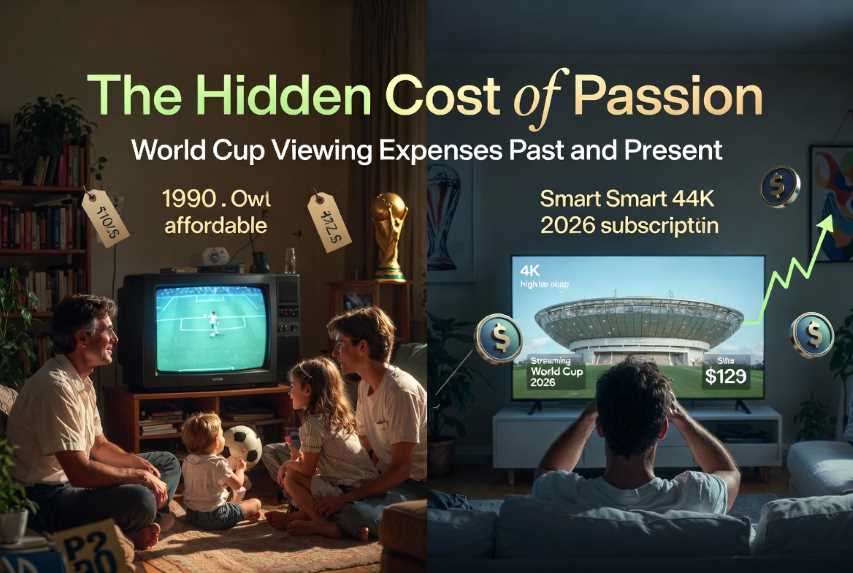
The FIFA World Cup stands as the single largest shared cultural experience on the planet. Every four years, billions of people pause their lives to follow the drama, the goals, the heartbreak, and the glory. It transcends sport, becoming a moment of national unity, family tradition, and global connection. Yet beneath the excitement lies a steadily growing financial reality: the actual cost of watching the tournament — whether inside a stadium or from home — has risen significantly compared with previous decades.
In the 1990s and early 2000s, the World Cup felt more within reach for ordinary supporters. Many matches aired on free or basic television, and stadium tickets, while never cheap, remained attainable for middle-class fans who planned ahead. Today, in 2026, the experience is simultaneously more spectacular in technical quality and noticeably more expensive for large numbers of people. Dynamic pricing, expensive media rights, and the dominance of subscription streaming have changed the economics.
This detailed comparison examines every major aspect of the cost shift: stadium attendance, home viewing across different countries, the deeper economic reasons behind rising prices, and — crucially — the many creative, legal, and practical strategies fans around the world are using to enjoy the tournament without paying the full advertised price wherever they can. The goal is to give a complete, balanced picture of how the beautiful game has become both bigger and, for many, more costly to access.
Attending Matches Live: Stadium Tickets — From Achievable Goal to Premium Experience
The Past: Stable Pricing and Greater Accessibility When the United States hosted the 1994 World Cup, the average ticket price sat at approximately $58. The cheapest group-stage seats could be found for around $25, while the most expensive final tickets reached $475. When adjusted for inflation to today’s values, those 1994 figures translate to roughly $131 on average, with premium final seats around $1,069.
This pattern of relative affordability held for decades. Tournaments such as France 1998, Germany 2006, South Africa 2010, Brazil 2014, and Russia 2018 maintained inflation-adjusted prices within a fairly narrow band. Category 3 (the most affordable public tickets) for group-stage matches typically ranged between the equivalent of $55 and $135 in current money. Even knockout-stage and final tickets stayed within reach for dedicated supporters who budgeted carefully or benefited from host-nation discounts (often called Category 4).
The overall atmosphere felt more inclusive. Families, groups of friends, and local fans could realistically aim to attend one or two matches. Many viewed a World Cup trip as a once-in-a-lifetime milestone rather than an unattainable luxury. Public transportation, reasonably priced accommodation in host cities, and simpler ticketing systems all contributed to this sense of accessibility.
Today (2026): Dynamic Pricing and Sharp Increases The 2026 World Cup, co-hosted by the United States, Canada, and Mexico with an expanded field of 48 teams and 104 matches, introduced widespread dynamic pricing. Official prices opened at higher levels than previous tournaments, and the secondary resale market has pushed costs even further for popular matches.
A clear comparison using inflation-adjusted historical data versus current 2026 Phase 3 prices illustrate the scale of change:
Group Stage (Category 3): Historical range roughly $55–$135 → 2026 approximately $201
Round of 16 (Category 3): Historical $77–$150 → 2026 approximately $294
Quarterfinals: Historical up to around $225–$541 (higher categories) → 2026 $680 (Category 3) to $1,439 (Category 1)
Semifinals: Historical up to around $389–$1,040 → 2026 $918 to $3,168
Final: Historical around $540 (Category 3) and $1,300 (Category 1) → 2026 $4,185 (Category 3) and $8,680 (Category 1)
Average ticket prices for the 2026 tournament sit around $1,300, with desirable seats or final tickets on the resale market frequently ranging from $1,000 into the thousands — sometimes significantly higher. Multiple analyses describe prices three to four times higher than recent previous tournaments, with the final in some cases reaching eight times previous levels. This represents roughly a 1,000 percent inflation-adjusted increase in average ticket prices since the 1994 United States-hosted edition, while median household incomes in the United States rose only about 32 percent over the same period.
Impacts on Fans The introduction of dynamic pricing has created volatility and frustration. Prices can fluctuate based on demand, sometimes rising sharply close to match day. Lawmakers in host regions have expressed concern that ordinary supporters are being priced out. Travel, hotels, food, and merchandise costs have also increased substantially in host cities due to high demand. The result is a tournament that feels more exclusive and premium-oriented, particularly for fans traveling from abroad or supporting smaller nations.
Watching from Home: The Evolution from Free Television to Subscription Models
The Past: Simple, Widely Available Access For much of the World Cup’s modern history, home viewing required little extra spending beyond owning a television. In the United Kingdom and several other European countries, major matches aired on public or major national broadcasters and were effectively free to air. In the United States, a combination of broadcast networks and basic cable channels carried key games without forcing viewers into expensive sports add-ons.
In Egypt and across much of the Arab world before the mid-2010s, state television channels or free-to-air options made the tournament accessible to almost every household. Families gathered around a single screen; cafes and public squares turned into unofficial viewing hubs. The 2010 South Africa and 2014 Brazil tournaments still felt largely inclusive despite the gradual growth of cable and early streaming. Watching the World Cup was a communal, low-friction experience for the vast majority of fans.
Today: Higher Quality but Often Higher Cost The value of broadcasting rights has grown enormously. FIFA now generates billions from media deals for each tournament. Broadcasters and streaming platforms must recover these costs, leading to more subscription-based models, tiered packages, and advertising.
Regional differences remain important in 2026:
In the United Kingdom, many matches continue on free-to-air BBC and ITV channels, preserving much of the traditional accessibility.
In the United States, all 104 matches air across Fox and FS1, but comprehensive viewing usually requires a live television streaming service. Some matches appear on ad-supported free platforms. Spanish-language options exist through other services at lower monthly prices.
In Egypt and the wider MENA region, beIN Sports holds exclusive rights. Full live coverage generally requires a beIN subscription or access through their TOD streaming platform, with tournament passes or bundles often in the range of $100–160 (sometimes discounted through partner promotions). Limited free content appears on official YouTube channels or through public fan zones.
Production values have improved dramatically. Viewers now enjoy 4K resolution, high dynamic range, multiple camera angles, real-time statistics, expert analysis, and on-demand replays. The technical experience is richer than ever. However, the financial model in many countries has shifted from “turn on the television” to “subscribe to one or more services.”
Why Have Costs Increased So Much?
Several interconnected forces explain the rise:
Media rights auctions have become highly competitive, driving fees higher with each cycle. Streaming platforms entering the sports space have intensified bidding wars. Dynamic pricing technology allows organizers to charge more when demand peaks. The expansion to 48 teams and 104 matches increases operational scale and content volume. Broader economic trends in elite sports — where events compete with other premium entertainment — have also played a role.
FIFA uses the revenue to fund global development programs, prize money, infrastructure, and the growth of women’s and youth football. At the same time, the higher costs are passed along to fans through tickets and subscriptions. The net result is a more commercialized tournament that generates substantial income for the sport’s governing bodies and commercial partners while creating affordability challenges for many supporters.
Creative and Legal Ways Fans Avoid or Minimize Paying
Faced with rising costs, supporters worldwide have developed practical, mostly legal strategies to enjoy the World Cup without bearing the full financial burden. These approaches differ between the past and present, and they vary significantly by region.
Strategies That Were Easier in the Past In earlier decades, many fans simply relied on free-to-air national television. In countries with strong public broadcasters, turning on the TV or radio was often sufficient. Cafes and community spaces provided free or low-cost communal viewing. Recording matches on VHS or later DVRs allowed people to watch later without extra fees. The need for elaborate workarounds was lower because core access was already inexpensive or free in most places.
Modern Legal and Creative Approaches Today, fans in paywalled markets must be more proactive. Common successful strategies include:
Using protected free-to-air broadcasts where they still exist. In the United Kingdom and certain other European countries, major matches remain available on public channels without additional subscriptions. Fans there often need no special effort.
Taking advantage of official free or low-cost highlights and summaries. FIFA’s own platform and major broadcasters’ YouTube channels provide extensive free highlights, goals, and analysis. Many casual fans find that following key moments and post-match discussion satisfies their interest without needing every minute live.
Public fan zones and giant-screen screenings. Cities around the world, including in Egypt and host nations, set up large free or low-cost outdoor viewing areas with massive screens. These events create a festive atmosphere and allow thousands to watch together without buying tickets or subscriptions. In Egypt, fan zones in the new administrative capital and other locations have drawn tens of thousands of people.
Sports bars, cafes, and restaurants. Many establishments install large screens and show matches. Fans pay for food or drinks but share the viewing cost among a group. This approach turns watching into a social outing rather than a solitary subscription expense.
Promotions, bundles, and short-term subscriptions. Streaming services frequently offer discounted monthly plans or tournament-specific bundles during the World Cup. In the MENA region, some food delivery services partner with streaming platforms to provide discounted access. Fans often subscribe only for the duration of the tournament and cancel afterward.
Household or small-group sharing. Within the same home, multiple people can legally use one subscription on different devices. Close friends or family sometimes coordinate to share login details or split the cost of a single account.
Ad-supported free streaming tiers. Platforms that rely on advertising rather than subscriptions carry selected matches or related content at no direct cost to the viewer. These services have grown in availability in several markets.
Watching selectively. Many fans focus only on their national team’s matches, high-profile games, or knockout stages rather than every group-stage fixture. This reduces the need for comprehensive (and more expensive) access packages.
Community and workplace screenings. Schools, offices, clubs, and community centers sometimes organize group viewings, especially for important matches involving the local or national team. These events spread any costs across many people or keep them minimal.
Using legal regional access tools where permitted. Some viewers employ virtual private networks to access broadcasts or pricing available in other countries that may be more affordable or include free options. Users should always verify that this complies with local laws and the terms of service of the platforms involved.
Focusing on atmosphere over completeness. For many supporters, the social experience — gathering with friends or joining public screenings — matters more than watching every second in perfect quality at home. This mindset reduces pressure to pay for premium individual access.
Regional Examples of Adaptation In Egypt and neighboring countries, fans frequently combine public fan zones, cafe viewings, official free highlights, and occasional bundled subscriptions during the tournament period. In the United States, viewers mix free ad-supported options for some matches with short-term streaming subscriptions or group bar outings. In the United Kingdom, many supporters continue to rely primarily on traditional free-to-air coverage supplemented by occasional streaming for extra matches.
These strategies show the ingenuity of fans who refuse to let rising costs completely exclude them from the global celebration.
Broader Impacts on Fans and Football Culture
Rising costs affect different groups unevenly. Families with children, younger supporters, lower-income households, and fans from smaller football nations often feel the pressure most acutely. Some experience a sense of missing out on a shared cultural moment. At the same time, the revenue generated supports football development worldwide, improves infrastructure, and helps grow the women’s game and grassroots programs.
The communal nature of watching has partially shifted. While public fan zones and bar gatherings preserve the social element, more viewing now happens on personal devices. This changes the shared experience but also allows greater flexibility.
Looking Ahead
The 2030 World Cup and future tournaments will likely continue the trends of high production values and commercial scale. Whether pricing models become more inclusive or remain premium-oriented will depend on decisions by FIFA, broadcasters, and host nations. Fan creativity in finding affordable ways to watch will almost certainly continue as well.
Conclusion
Comparing the cost of watching the World Cup today versus the past reveals a clear direction: greater commercialization and higher barriers for live attendance and comprehensive home viewing in many markets. Stadium tickets have moved from attainable to aspirational for large numbers of ordinary supporters. Home viewing has become more convenient and visually impressive but often requires subscriptions that were unnecessary in earlier eras.
Yet fans have responded with remarkable resourcefulness. By using free-to-air options where available, embracing public screenings and communal spaces, taking advantage of promotions and short-term access, focusing on highlights, and sharing experiences with others, millions continue to participate fully in the world’s biggest sporting event without bearing the maximum possible cost.
The passion for football remains undiminished. Supporters worldwide demonstrate that while the price tag may have grown, the love for the game and the determination to be part of its greatest moments endure. The World Cup continues to belong to the people — even when watching it requires a little extra creativity and planning.
 |  |  |
 |  |  |