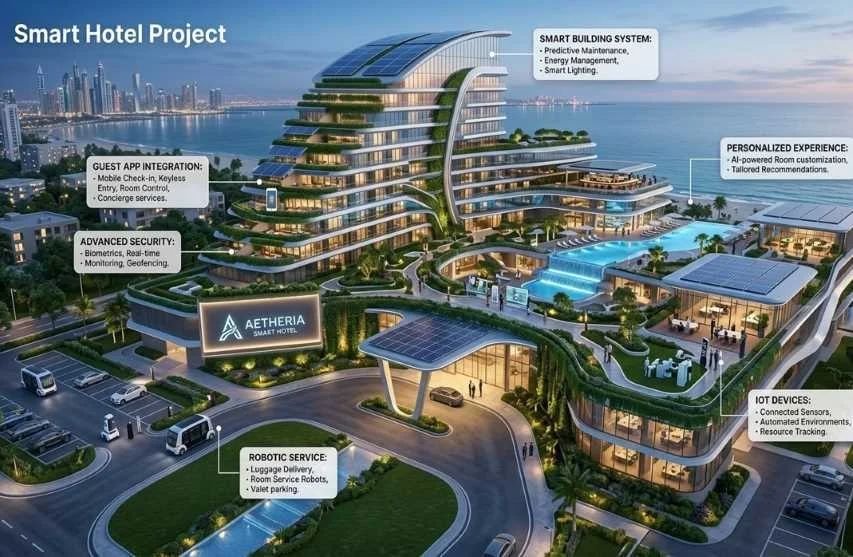
🤔 What is a Smart Hotel Project?
A Smart Hotel Project is the comprehensive integration of connected digital technologies—Artificial Intelligence (AI), the Internet of Things (IoT), 5G connectivity, cloud computing, robotics, and data analytics—into a hotel‘s infrastructure and operations. It transforms a traditional place to stay into a responsive, intuitive, and efficient ecosystem that anticipates guest needs, automates workflows, and optimizes every touchpoint from booking to checkout.
Unlike a standard hotel that relies on manual processes and isolated systems, a smart hotel connects everything: room controls, check-in kiosks, housekeeping schedules, energy management, service robots, and guest mobile apps all communicate through a unified platform. This interconnected “digital brain” creates a continuous loop of real-time data that informs better decisions, enhances guest satisfaction, reduces waste, and drives revenue growth.
According to industry reports, the global smart hospitality market is experiencing explosive growth. It was valued at 29.55 billion in 2025 and is projected to reach 92.37 billion by 2030, growing at a compound annual rate of over 25%.
✨ The Driving Forces: Why Hotels Must Go Smart Now
The hospitality industry is facing persistent challenges: labor shortages, rising operational costs, thin profit margins, and increasingly demanding guests who expect seamless, personalized experiences comparable to their digital lives at home. By 2026, AI had evolved from a futuristic concept into an essential operational tool, and this trend is accelerating.
Smart hotel projects deliver substantial, measurable benefits:
Metric | Typical Improvement |
|---|---|
Guest satisfaction scores | 10–20% increase |
Operational costs (energy) | 15–30% reduction |
Labor efficiency | 20–40% improvement |
Revenue per available room (RevPAR) | 15–20% increase |
Housekeeping task time | 20–30% reduction |
Response time to guest requests | Up to 35% faster |
🛠️ Core Technologies of a Smart Hotel Project
A smart hotel is built on several key technologies working in harmony.
🤖 Artificial Intelligence (AI) & Personalization Engines
AI serves as the cognitive engine of the smart hotel, powering everything from revenue management to guest interactions.
Hyper-Personalization: AI analyzes guest data—past stays, preferences, booking behavior, and even real-time feedback—to create tailored experiences. Hotels using AI-driven personalization have reported up to 30% higher upsell conversions and 20% faster response times.
Revenue Management & Dynamic Pricing: AI processes billions of data points (competitor rates, events, weather, booking patterns) to optimize room pricing in real time. Cloudbeds‘ Signals AI foundation model achieves up to 95% forecasting accuracy and helped London’s Mercure Paddington Hotel achieve 93% occupancy vs. a 64% competitor average.
Guest Marketing Automation: AI identifies guest segments and automatically delivers personalized offers, emails, and recommendations, building loyalty through relevance rather than generic promotions.
📱 Mobile Integration & Contactless Guest Journeys
Modern travelers expect to control their stay from their smartphones.
Mobile Check-in/Check-out: Guests complete ID verification, sign waivers, and make payments before arrival, then go straight to their room with a secure mobile digital key.
Room Controls via App: Guests adjust lighting, temperature, curtains, and TV from their phone, creating a familiar and convenient interface.
Service Requests: Order room service, request extra towels, or book spa appointments with a few taps—requests route directly to the appropriate staff or robot.
🌐 IoT Sensors & Smart Building Automation
IoT sensors are the nervous system of a smart hotel, collecting real-time data from every corner of the property.
Occupancy & Presence Detection: Infrared or motion sensors detect when a room is occupied, automatically adjusting HVAC and lighting to save energy when guests are out.
Environmental Monitoring: Air quality sensors track temperature, humidity, and CO₂ levels, ensuring optimal comfort and health. Minew‘s LSG01 sensors helped a global resort chain preemptively adjust systems and reduce utility costs.
Predictive Maintenance: Sensors monitor equipment health (HVAC, elevators, plumbing), detecting anomalies before failures occur. The UAE’s District 11 resort uses AI-driven predictive maintenance to reduce downtime and operational costs.
Asset & Staff Tracking: Bluetooth or RFID tags on luggage carts, cleaning equipment, and even staff badges enable real-time location tracking, reducing wasted search time and improving safety compliance.
🚪 Smart Room Automation
The guest room is where smart technology delivers its most visible impact.
Self-Adjusting Environments: When a guest books a room, the system begins preparing automatically—adjusting temperature, refreshing air, and displaying a personalized welcome message on the in-room panel. Upon return visits, the system recalls the ideal temperature, lighting levels, and more.
Voice Control: Smart speakers or voice assistants enable guests to control room features, ask for information, or request services without lifting a finger.
Smart Mirrors & Entertainment: Interactive mirrors display weather, news, and personalized messages while integrated TVs seamlessly connect to guest streaming accounts.
🤖 Service Robotics & Automation
Robots are no longer science fiction—they are practical tools addressing labor shortages and improving service speed.
The global hotel service robot market was valued at 3.3 billion in 2024 and is projected to reach 8.7 billion by 2032, growing at a CAGR of 12.96%.
Delivery Robots: Autonomous robots transport amenities, room service items, and luggage—reducing staff workload and improving service speed. Relay Robotics‘ Relay2 robot (launched 2023) carries twice the payload of earlier models.
Concierge Robots: Stationed in lobbies, these robots greet guests, provide directions, answer questions, and even assist with check-in. SoftBank’s Pepper and Keenon‘s delivery robots are deployed across hundreds of properties.
Cleaning Robots: Autonomous floor scrubbers, window washers, and even room sanitizers operate 24/7, maintaining cleanliness standards without human intervention.
Humanoid Robots: In October 2025, XMAN-R1, a full-sized humanoid service robot, began working at Shanghai Hongqiao Airport’s SM Hotel, marking a new era of “general + specialized” robot collaboration.
ROI metrics for hotel robots:
Payback period: 18–24 months
Labor savings: 20–40% in delivery and front-of-house duties
Guest satisfaction increase: 10–20%
⚡ 5G Connectivity & Edge Computing
5G technology serves as the “nerve center” of the smart hotel, providing the connectivity backbone that enables real-time responsiveness.
Ultra-Low Latency: 5G achieves end-to-end latency as low as 10 milliseconds, ensuring instant device responses and seamless guest experiences.
Massive Device Density: Supports up to 1 million IoT terminals per square kilometer, eliminating Wi-Fi congestion during peak occupancy.
Network Slicing for Security: 5G creates isolated “slices” for different data streams (guest transactions, operational data, security feeds), reducing privacy risks.
☁️ Cloud Property Management Systems (PMS) & Data Integration
The cloud platform acts as the central “brain,” unifying all smart subsystems.
Single View of the Guest: Integrates booking data, in-room preferences, F&B charges, spa services, and post-stay feedback into one guest profile.
Real-Time Synchronization: Room automation syncs with check-in/out status—preparing rooms for arrival and resetting energy settings upon departure.
Operational Dashboards: Managers monitor occupancy, energy usage, maintenance alerts, and staff productivity from a single screen.
🏗️ Types of Smart Hotel Models
Type | Description | Best For | Example |
|---|---|---|---|
| Traditional + Smart Upgrades | Existing hotels integrate selected technologies (mobile keys, smart thermostats, chatbots) without full overhaul. | Most existing hotels, independent properties, small chains. | Radisson trios in Sri Lanka deploying AI conversational agents across three properties. |
| Full-Service Smart Hotel | Comprehensive smart integration across all departments—guest rooms, F&B, housekeeping, engineering, sales. | Mid-range to luxury chain hotels, resorts. | Original Sokos Hotel Royal (Finland) with ABB’s KNX building automation, occupancy sensing, and virtual room keys. |
| Fully Autonomous / Unstaffed | Minimal or zero human staff; AI, robotics, and IoT handle check-in, luggage, cleaning, and service requests. | High-traffic urban areas, cost-sensitive models, niche concepts. | Pilot projects in Asia; Baidu’s “full-link agent solution” achieving 60% labor cost reduction and 50% faster service response. |
| AI-First / Tech Boutique | Designed from the ground up with AI as the core differentiator, offering hyper-personalization as the primary value proposition. | Luxury segment, experiential travel. | v3rso by Grupo Emiliano (Brazil)—first Brazilian hotel with an AI system that learns and adapts to each guest’s behavioral patterns. R$11 million technology investment. |
| Smart Work Resort / Bleisure | Blends hospitality with co-working, meetings, and digital nomad facilities, all managed through smart systems. | Hybrid business-leisure travelers. | District 11 (Sharjah, UAE)—3.5 million sq ft AI-designed smart work resort with a 368-key hotel, integrating predictive maintenance, dynamic pricing, and real-time usage analytics. |
🌍 Real-World Smart Hotel Projects
Project | Location | Key Focus | Impact |
|---|---|---|---|
| v3rso by Grupo Emiliano | São Paulo, Brazil | AI-powered hyper-personalization platform | R$11M investment; system recalls guest preferences (temperature, lighting) on return visits; “phygital” experience blending physical and digital. |
| Original Sokos Hotel Royal | Vaasa, Finland | Heritage building + smart building automation | ABB i‑bus® KNX system controls lighting, climate, occupancy detection; integrates with Opera PMS; virtual room keys; personalized welcome messages. |
| Radisson Blu AI Agent | Sri Lanka (3 properties) | Multi‑channel conversational AI (Emojot) | First hotel group in Sri Lanka with agentic AI—connects to PMS for real-time room availability, bookings, dining info; learns from guest feedback. |
| District 11 Smart Work Resort | Sharjah, UAE | AI-designed; predictive maintenance; dynamic pricing | 3.5 million sq ft, 11 buildings, 368 hotel rooms; AI optimises energy and usage patterns in real time. |
| Baidu Full‑Link Agent Pilot | Chongqing, China | AI dispatch hub + robot cluster + IoT | 60% labour cost reduction; 50% faster service response; 0.3‑0.4 human‑to‑room ratio improved; 99.2% night‑time security accuracy. |
| Cloudbeds Signals AI | Global (early adopters) | Causual AI forecasting (4B data points/hour) | 95% forecasting accuracy; Mercure Paddington achieved 93% occupancy vs. 64% competitor average; 15–20% RevPAR increase. |
| Global Resort IoT Case | Multiple locations | Minew LoRaWAN sensors + asset tracking | Reduced energy waste; improved air quality; real-time staff/asset location; unified hardware ecosystem. |
🧠 Common Questions About Smart Hotels
❓ How much does a smart hotel project cost?
Costs vary dramatically based on scale, existing infrastructure, and ambition:
Entry-level upgrades (mobile check-in + smart thermostats): 20,000–20,000–50,000 for a 50-room hotel.
Mid-tier integration (PMS + IoT sensors + KDS + basic chatbots): 50,000–50,000–200,000.
Comprehensive smart hotel (AI platform + robotics + full building automation): 500,000–500,000–2 million+.
Autonomous / AI‑first hotel: 10 million+ (v3rso invested R11 million, approximately $2 million USD).
However, ROI is typically realized within 18–36 months through labor savings, energy reduction (15–30%), and RevPAR growth (15–20%).
❓ Will robots replace hotel staff?
No. Automation handles repetitive, high-volume tasks (luggage delivery, cleaning hallways, answering FAQs), freeing human staff to focus on higher-value activities: genuine hospitality, handling complex guest requests, solving problems creatively, and building emotional connections. The future is human plus machine, not human versus machine.
❓ Do guests actually want smart technology?
Yes—when it works seamlessly and adds value without complexity. A 2025 Hotels.com survey found that guests prefer “ComfortTech” —practical, comfort-enhancing innovations like smart thermostats, customizable lighting, and voice-controlled rooms—over gimmicks. However, over 56% of hotels feel pressure to keep upgrading tech, and poorly implemented systems can frustrate guests. The key is intuitive, frictionless design.
❓ How do I start building a smart hotel?
Start with one high-impact area and expand systematically:
Implement a cloud-based PMS with integrated mobile check-in and digital keys.
Add IoT sensors for energy management (occupancy detection, smart thermostats) to immediately reduce utility costs.
Deploy an AI chatbot on your website and guest app to handle routine inquiries.
Introduce one service robot for luggage delivery or room service to test guest acceptance and ROI.
Measure results (guest satisfaction scores, operational metrics, RevPAR) before scaling.
🔐 Challenges and Considerations
💰 High Initial Investment
The upfront cost of smart infrastructure—sensors, robots, software platforms, and staff training—can be substantial, particularly for independent hotels. However, operators report clear ROI typically within 18–36 months through labor, energy, and waste savings.
🔒 Data Security and Guest Privacy
Smart hotels collect highly sensitive guest data (biometrics, room preferences, real-time location). With the average data breach cost exceeding $4.88 million (2024), cybersecurity cannot be an afterthought. Smart hotels must implement:
End-to-end encryption for all data transmission.
Network slicing (5G) to isolate guest and operational data streams.
Federated learning & edge computing to keep sensitive data local.
Compliance with GDPR, CCPA, and local privacy regulations.
Transparency—clear guest opt-in consent for each data collection type.
🔗 Integration with Legacy Systems
Many hotels have existing investments in property management systems (PMS), point-of-sale (POS), and building management systems that were not designed for IoT connectivity. Integration challenges are a primary reason some smart projects fail to deliver promised improvements. Solutions include:
API-first platforms that connect disparate systems.
Middleware to translate between legacy protocols and modern IoT standards.
Phased retrofits rather than full “rip-and-replace.”
👨🏫 Staff Training and Change Management
Technology is only effective if people use it. Front desk, housekeeping, and engineering staff may resist new workflows if they perceive the technology as complex or threatening. Successful implementations require:
Comprehensive, hands-on training before go-live.
User‑centered design—intuitive interfaces for staff dashboards.
Clear communication that technology supports, not replaces, employees.
Designating technology champions within each department.
⚖️ Guest Technology Acceptance
Not all guests are tech-savvy, and some may feel uncomfortable with facial recognition, in-room voice assistants, or robot interactions. A balanced smart hotel:
Offers traditional alternatives (front desk check-in, physical key cards, human service).
Provides clear opt-out options for data collection.
Ensures technology is invisible when not needed but available when desired.
🔮 The Future of Smart Hotels
Several key trends are shaping the next generation of smart hotels.
🧠 Agentic AI & Autonomous Decision-Making
Instead of simply following rules, AI “agents” will independently manage entire workflows. For example, a guest request for “two bottles of water” automatically triggers:
Inventory check → robot dispatch → elevator scheduling → door unlocking → guest notification → billing → housekeeping alert.
Baidu‘s full‑link agent solution already demonstrates this, achieving 60% labor cost reduction and 50% faster service response in pilot hotels. AI-scaling companies are upgrading processes across marketing, revenue, and operations.
🗣️ Conversational AI & Natural Language Interaction
Next‑generation AI agents go beyond pre‑scripted chatbots. They integrate directly with hotel data and APIs, enabling real‑time services like checking availability, modifying bookings, and providing personalized recommendations in natural conversation. Radisson’s trio of Sri Lankan hotels deployed such an agentic AI framework in September 2025, continuously learning from guest feedback to tailor every interaction.
🔄 Privacy by Design” with Edge AI & Federated Learning
Processing sensitive guest data locally on devices (Edge AI) rather than sending it to the cloud reduces legal and security risks. Federated learning allows AI models to improve without centralizing raw data. This approach is expected to dominate by 2026, addressing growing regulatory and consumer concerns.
🌿 Sustainable & Net-Zero Operations
Smart building automation is a powerful tool for reducing energy consumption and carbon footprints. The Royal in Vaasa, Finland, is being retrofitted as the most energy‑efficient hotel in the Sokos chain, with KNX building automation and occupancy‑based HVAC control. By 2030, IoT‑driven energy management is expected to be standard, with 5G IoT reducing hotel energy consumption by an additional 25–30%. Sustainability is no longer a differentiator—it is an expectation. Renewable energy use, plastic reduction, and zero‑waste initiatives grew significantly in 2025.
🚪 Smart Hotel as an “Urban Service Node”
5G technology will link hotels with surrounding business districts, transportation hubs, and attractions. Guests will book local experiences, order autonomous shuttle rides, and check venue occupancy—all from their hotel room interface. The hotel evolves from a place to sleep into a smart gateway to the entire city.
🏛️ AI-Designed Hotels & Adaptive Spaces
Architectural blueprints are becoming fluid. District 11 in Sharjah, the UAE‘s first AI‑designed smart work resort, uses AI to shape everything from building design to operational management. Future hotels will feature event spaces and room layouts that reconfigure as guest needs evolve, enabled by modular construction and AI‑optimized design.
🏁 The Time to Act Is Now
A Smart Hotel Project represents far more than a technology upgrade—it is a fundamental reimagining of how hospitality is delivered and experienced. By weaving together AI personalization, IoT sensors, 5G connectivity, robotics, and cloud-based management, smart hotels create environments where guests feel understood and cared for, staff are empowered and efficient, and owners achieve superior financial returns.
The journey is not without its challenges: upfront costs, data security, and staff training remain significant hurdles. However, the real‑world examples showcased here—from v3rso’s AI‑powered hyper‑personalization in Brazil to Royal’s energy‑efficient heritage renovation in Finland to District 11’s AI‑designed smart work resort in the UAE—demonstrate that these challenges are surmountable. The market is growing at over 25% annually, driven by rising guest expectations, labor pressures, and the undeniable ROI of smart operations.
For any hotel owner, operator, or investor looking to the future, the question is no longer “Should I go smart?” —it is “How quickly can I start?” The technology is mature, the use cases are proven, and the window for gaining competitive advantage is closing fast.
The hotel of tomorrow—efficient, sustainable, hyper‑personalized, and deeply connected—is being built today, one smart decision at a time. The future of hospitality is intelligent. Are you ready?
 |  |  |
 |  |  |