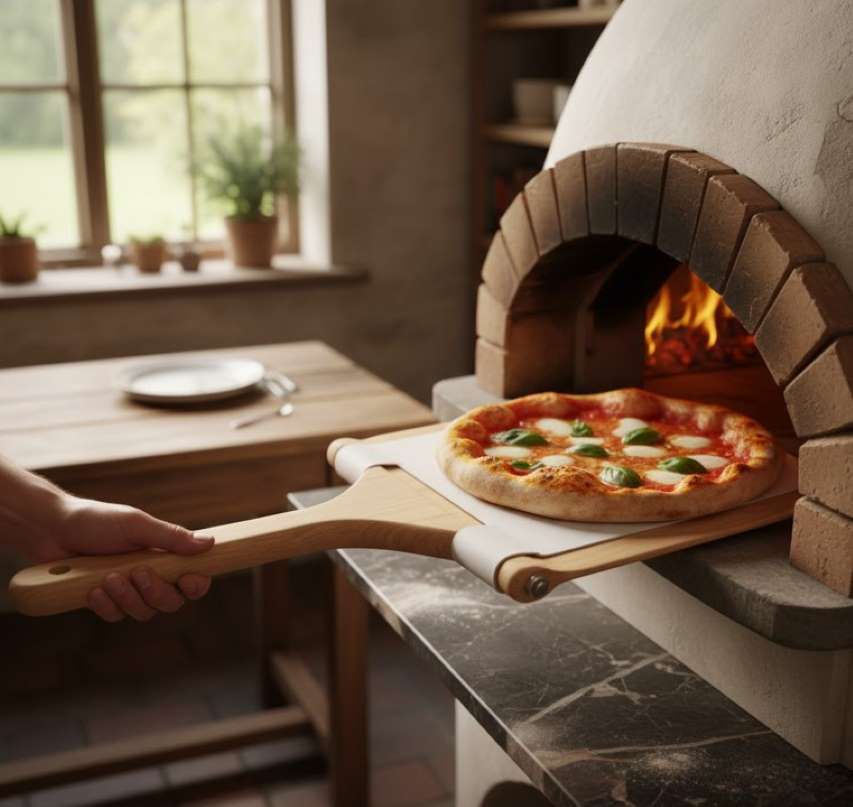
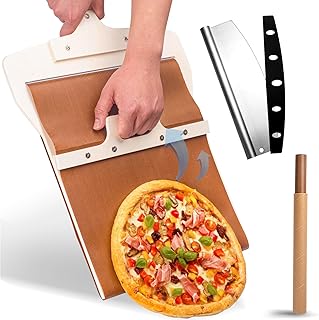
A Sliding Pizza Peel (often called a "super peel" or "magic peel") is a specialized pizza-making tool designed to transfer prepared pizzas onto a hot baking surface and remove them after baking with exceptional ease and minimal risk of distortion or topping displacement. Unlike traditional rigid peels that require a jerking or shaking motion, its defining feature is a fabric conveyor system that slides the pizza off via a smooth, controlled linear motion.
This innovative design addresses the most challenging moment in home pizza making: the successful launch, making it an invaluable tool for both beginners and experienced pizzaiolos seeking perfect, stress-free transfers.
Anatomy & Key Components
The Frame & Handle
Material: Typically, hardwood (like maple or birch) or food-grade plastic. Provides the rigid structure.
Design: A rectangular or round frame with an open center. The handle is integrated into the frame, designed for a comfortable, secure grip.
Function: Supports the sliding mechanism and provides the leverage needed for operation.
The Sliding Fabric Conveyor
Material: A durable, tightly-woven, and heat-resistant cotton canvas or food-safe polyester fabric. It is treated to be non-stick and is often removable for washing.
Attachment: The fabric is attached to a rod or dowel at the front end of the frame. This rod can roll freely, allowing the fabric to spool and unspool.
Core Mechanism: The fabric rests loosely across the open frame. When the rod is pulled, the fabric slides smoothly across the frame's surface, carrying whatever is on top of it.
The Support Surface
The "Bed": The area inside the frame over which the fabric slides. It must be perfectly smooth (often polished wood or plastic) to ensure frictionless movement.
How It Works: The "No-Shake" Transfer Principle
The sliding peel operates on a simple but brilliant principle of mechanical conveyance, eliminating the need for momentum.
Step 1 – Assembly & Loading
The fabric is pulled taut across the frame to create a flat, stable bed.
The pizza is assembled directly on the fabric, which has been lightly dusted with flour or semolina. This is a key difference from traditional peels.
Step 2 – The Alignment & Approach
The loaded peel is positioned at the edge of the hot baking stone or steel, with the front of the frame slightly overhanging the surface.
The pizza is aligned with the target landing spot.
Step 3 – The Sliding Transfer (The Launch)
The user holds the peel handle steady with one hand.
With the other hand, they gently and steadily pull the fabric rod backward (toward themselves).
As the fabric retracts, it slides out from under the pizza, which remains stationary relative to the moving fabric.
The pizza is deposited perfectly onto the hot stone in one smooth, controlled motion.
Step 4 – Retrieval
- The process is reversed for retrieval. The peel (with fabric extended) is slid under the baked pizza. A slight forward push of the fabric helps nudge the pizza fully onto the fabric bed, allowing for safe removal.
Types & Variations
Classic Sliding Peel: As described above, with a rectangular wooden frame and canvas conveyor. The standard for home use.
Metal-Rimmed Sliding Peel: Features a thin, angled metal edge around the front of the frame to help slip under baked pizzas more easily.
"Rolling" Peel Variant: Some designs use a series of small, rotating rollers instead of a solid bed to further reduce friction.
Size Variations: Ranging from small (12") for personal pizzas to large (16"+) for family-sized or Neapolitan pies.
Step-by-Step Usage Guide for Perfect Results
Prepare the Peel: Ensure the fabric is clean, dry, and lying flat. Generously dust the entire fabric surface with coarse semolina flour or rice flour. These are less absorbent than all-purpose flour and create better "ball bearings" for sliding.
Build the Pizza on the Peel: Stretch your dough and place it directly on the dusted fabric. Add sauce, cheese, and toppings promptly to prevent the dough from sticking.
Execute the Transfer: Position, hold, and pull the fabric rod in one confident, smooth motion. Do not hesitate.
Post-Launch Care: Immediately shake off excess flour from the fabric to prevent burning on subsequent launches. Let the fabric cool if doing multiple pizzas.
Cleaning: Remove fabric (if designed) and shake off dry flour. Wipe the frame. Hand-wash fabric occasionally; never machine wash/dry as it can shrink or degrade treatments.
Ideal Applications & User Profiles
Home Pizza Enthusiasts: The primary market. Eliminates the fear of failed launches and misshapen pizzas.
Users with High-Hydration Doughs: Wet, sticky doughs (like for Neapolitan or focaccia) are exceptionally difficult on traditional peels but slide easily on a properly prepared fabric peel.
Bakers of Other Goods: Excellent for transferring delicate, topped focaccia, flatbreads, or even large cookies onto baking stones.
Pizza Kitchens with Space Constraints: Where a long-handled peel for a jerking motion is impractical.
Anyone with Wrist or Mobility Issues: The sliding action requires less sudden force and coordination than a traditional peel shake.
Limitations & Considerations
Assembly Limitation: The pizza must be assembled on the peel. You cannot build it on a counter and then load it.
Fabric Maintenance: The fabric is an extra component that requires care—seasoning, cleaning, and eventual replacement.
Not for High-Volume Use: While durable, the fabric mechanism is slower for a kitchen making dozens of pizzas per hour compared to the swift flick of a pro with a metal peel.
Storage: The frame takes up similar space to a traditional peel, plus the fabric must be stored clean and dry.
Potential for Drag: If insufficiently floured, dough can stick to the fabric, causing a drag during the slide and distorting the pizza.
Selection Criteria & Buying Guide
Size: Choose an interior opening at least 2 inches larger than your largest pizza diameter.
Fabric Quality: Look for thick, tightly-woven, removable canvas. Check if it's pre-treated.
Frame Stability: The wood should be well-sanded and sealed. The front rod should rotate freely without wobbling.
User Reviews: Pay close attention to comments about fabric durability and smoothness of the sliding mechanism over time.
Brand Reputation: Established pizza tool brands (like Gi.Metal, etc.) often offer reliable models.
The sliding pizza peel is a game-changing innovation in home pizza craftsmanship. It replaces a skill-based, high-risk maneuver with a simple, reliable mechanical action. By solving the fundamental physics problem of friction and transfer, it democratizes the art of making perfect stone-baked pizza, allowing the cook to focus on dough and flavor rather than technique and anxiety.
 |  |  |
 |  |  |