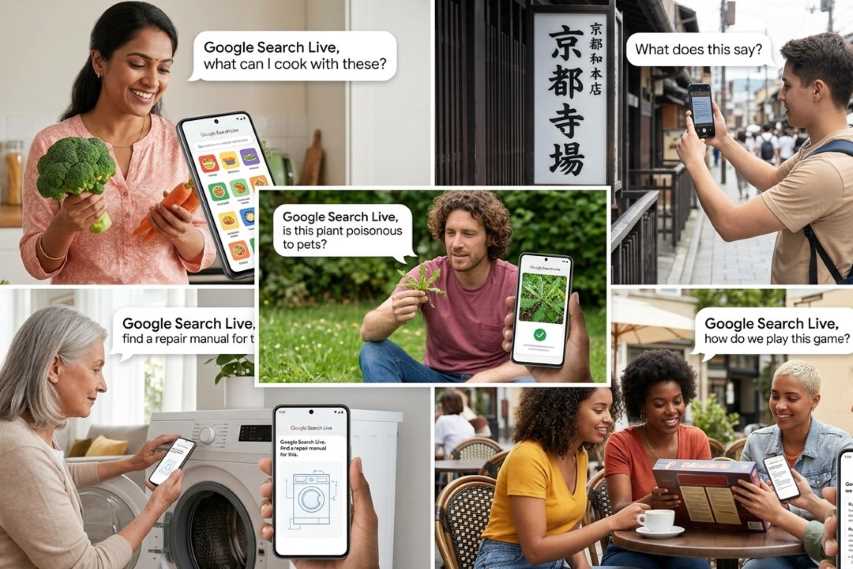
In a landmark move that promises to reshape how people interact with information online, Google has officially rolled out its highly anticipated Search Live feature on a global scale. The announcement, which builds on months of regional testing, marks a significant evolution in search technology by introducing seamless, conversational artificial intelligence experiences that go far beyond traditional text-based queries. Now accessible in more than 200 countries and territories, Search Live integrates voice input, live camera feeds, and advanced artificial intelligence to deliver instant, context-aware responses in real time.
This global expansion comes just weeks after the initial reveal on March 26, 2026, and represents a major milestone for Google’s ongoing efforts to make search more intuitive, inclusive, and helpful for everyday users. Whether you are a student researching on the go, a traveler navigating unfamiliar surroundings, or a homeowner tackling a do-it-yourself project, Search Live aims to turn your smartphone into a powerful, seeing-and-hearing companion that understands the world around you.
What Is Search Live and Why It Matters
At its core, Search Live transforms the way we search by replacing static keyword entries with dynamic, back-and-forth conversations. Users simply open the Google application, activate the Live mode, and begin speaking naturally while pointing their phone’s camera at objects, scenes, or situations in the real world. The artificial intelligence instantly analyzes the live video feed, processes the spoken query, and responds with clear spoken answers, relevant suggestions, and even follow-up questions to refine the interaction.
Imagine standing in your kitchen, holding up a handful of leftover ingredients, and asking, “What can I make for dinner with these?” Search Live not only identifies the items but also provides step-by-step recipe instructions, nutritional information, and variations based on dietary preferences—all while you continue the conversation hands-free. Or picture yourself on a hiking trail, spotting an unusual plant: point your camera, ask for identification, and receive details about its species, care tips, and whether it’s safe to touch.
The feature shines in practical, real-world scenarios where traditional search falls short. Mechanics can diagnose car issues by showing engine components; shoppers can compare products side-by-side in stores; parents can identify safe toys or explain complex concepts to children using visual aids. This multimodal approach—combining vision, voice, and vast knowledge—makes information retrieval faster, more engaging, and far more accessible than ever before.
Early adopters describe the experience as “having an expert friend who can literally see what you see.” By removing barriers like typing on small screens or struggling with precise keywords, Search Live democratizes access to information, particularly for non-native English speakers, people with visual impairments, or those in hands-busy situations.
A Brief History of the Feature and Its Rapid Evolution
Search Live did not appear overnight. Its journey began with limited previews in the United States back in July 2025, followed by a full United States launch in September 2025. The feature quickly expanded to India, where it gained massive popularity among users seeking practical, on-the-spot assistance in diverse languages and environments.
The global rollout now leverages the latest advancements in Google’s artificial intelligence lineup, specifically the newly optimized Gemini 3.1 Flash Live model. This upgraded system delivers faster processing, improved accuracy in noisy or low-light conditions, and native support for multilingual conversations across 98 languages. Earlier versions relied on foundational Gemini models, but the current iteration brings smoother dialogue flow, better accent recognition, and more reliable real-time analysis of camera input.
Google’s Director of Product Management for Search, Liza Ma, emphasized the significance of this expansion during the official announcement. She noted that the team focused on making the technology feel natural and reliable for users everywhere, regardless of location or language.
The development reflects Google’s broader vision for Artificial Intelligence Mode in Search, evolving from simple text results to immersive, interactive experiences. Over the past year, user feedback from initial markets helped refine everything from response speed to privacy controls, ensuring the global version meets high standards for safety and usefulness.
How to Access and Use Search Live on Your Devices
Getting started with Search Live is straightforward and requires no additional downloads beyond the latest version of the Google application, available on both Android and iPhone Operating System platforms. Here is a step-by-step guide to make the most of the feature:
Launch the Application: Open the Google application on your smartphone. Look for the prominent “Live” button located just below the main search bar or integrated within the Artificial Intelligence Mode section.
Grant Permissions: The first time you use it, allow access to your camera and microphone. These permissions enable the live video analysis and voice interaction.
Activate Live Mode: Tap the Live button to start. Your camera viewfinder will appear on screen, ready to capture whatever you point it at.
Ask Naturally: Hold your phone steady, speak your question clearly, and watch as the artificial intelligence processes the visual and audio input in real time. You can interrupt, ask follow-up questions, or switch topics seamlessly.
Control the Experience: On-screen options let you mute the microphone, toggle video on or off, or view a full transcript of the conversation for later reference. For quick visual searches without voice, you can also access Live capabilities directly through the Google Lens tab.
The interface is designed to be clutter-free and intuitive, with large, easy-to-tap controls even for users on the move. Battery optimization ensures the feature runs efficiently without draining your device during extended sessions.
What Sets Search Live Apart from Other Artificial Intelligence Tools
Several key innovations distinguish Search Live from competing conversational artificial intelligence offerings:
True Multimodal Intelligence: Unlike text-only chatbots, it processes live camera input alongside voice, drawing from Google’s extensive indexed knowledge for accurate, grounded responses.
Natural Conversational Flow: The system remembers context across multiple exchanges, allowing users to build on previous answers without repeating themselves.
Enhanced Privacy and Transparency: Responses often include source references when appropriate, and all processing adheres to strict data-protection standards. Users retain full control over what is shared.
Robust Real-World Performance: Advanced handling of challenging conditions—such as varying lighting, accents, background noise, or unusual camera angles—makes it reliable in daily life.
Broad Global Accessibility: By supporting dozens of languages and operating in regions with varying connectivity, it brings cutting-edge artificial intelligence to users who were previously underserved by similar tools.
Real-World Impact and User Benefits
The global availability of Search Live is already generating excitement across diverse communities. Educators report using it to make lessons more interactive, while small business owners appreciate instant market research or product identification during sourcing trips. Travelers benefit from on-the-spot translation and cultural insights, and health-conscious users can scan food labels for quick dietary analysis.
Accessibility experts highlight how the feature helps individuals with disabilities engage more independently with their surroundings. For example, someone with limited mobility can identify objects or get instructions without needing to type or navigate complex menus.
Looking Ahead: The Future of Intelligent Search
This global launch is just the beginning. Google has hinted at upcoming enhancements, including deeper integration with wearable devices, improved offline capabilities, and even more specialized modes for professional fields like medicine, engineering, and creative arts.
As artificial intelligence continues to advance, Search Live exemplifies the shift from passive information retrieval to active, collaborative problem-solving. It underscores Google’s commitment to building technology that feels personal, helpful, and truly embedded in daily life.
 |  |  |
 |  |  |