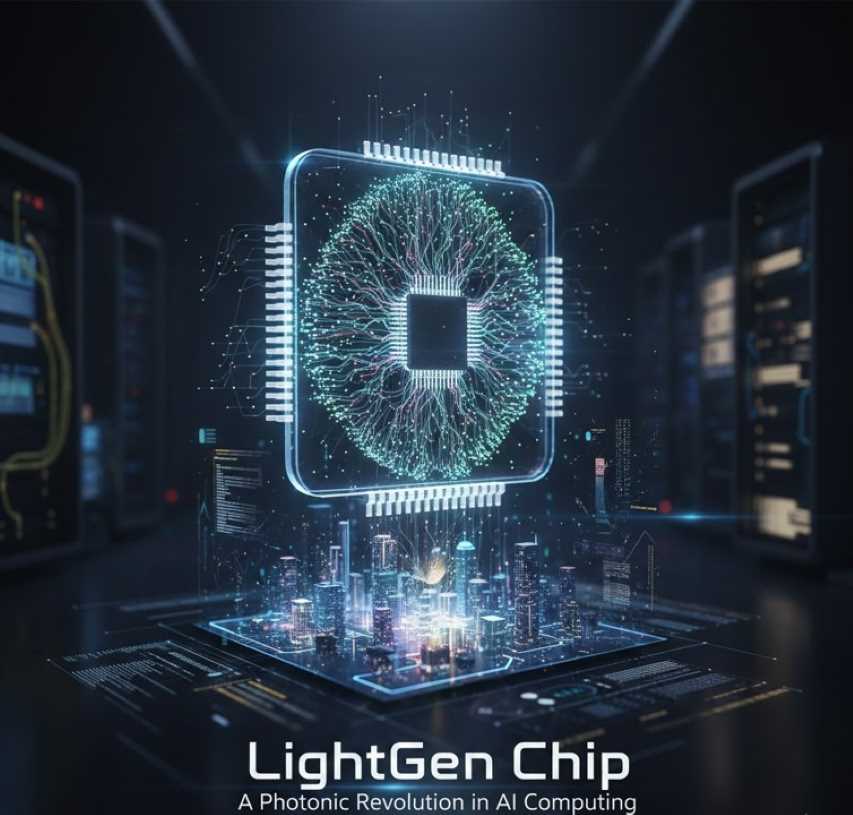
In a groundbreaking advancement that could reshape the landscape of artificial intelligence, Chinese researchers have unveiled the LightGen chip, an all-optical computing marvel that harnesses the power of light to outperform traditional electronic processors.
Developed by a collaborative team from Shanghai Jiao Tong University and Tsinghua University, this innovative chip promises to accelerate generative artificial intelligence tasks while drastically reducing energy consumption. This marks a significant leap forward in photonic computing technology.
The Paradigm Shift: From Electrons to Photons
At its core, the LightGen chip represents a fundamental departure from conventional computing, which relies on electrons flowing through transistors to process data. Instead, LightGen employs photons—particles of light—to perform computations.
This optical approach leverages the inherent advantages of light:
Speed: Photons travel at the speed of light, enabling incredible processing velocity.
Thermal Efficiency: Light generates minimal heat compared to electrical resistance.
Parallelism: It enables massive parallelism through phenomena such as optical interference.
Because photons move without the resistance and energy losses associated with electronic signals, operations are not only faster but also significantly more efficient.
Unprecedented Performance Metrics
The performance statistics of the LightGen chip are staggering when compared to traditional hardware.
Computing Speed: Approximately 35,700 trillion operations per second.
Energy Efficiency: 664 trillion operations per second per watt.
These figures significantly outperform those of leading electronic Graphics Processing Units, such as Nvidia's A100, specifically within generative artificial intelligence workloads.
Architecture: The "Photonic Brain"
The architecture of the chip is designed to mimic the interconnected structure of the human brain, yet it operates at the speed of light.
Scale: It integrates over two million photonic "neurons" onto a single compact die.
All-Optical Processing: Unlike hybrid systems that mix optical and electronic components, LightGen is fully all-optical. It handles tasks from input processing and semantic understanding to output generation entirely within the optical domain.
Bottleneck Elimination: By avoiding the conversion between light and electrical signals, the chip eliminates substantial latency and energy overhead.
Overcoming Technical Hurdles
One of the key innovations behind LightGen is its ability to overcome three major technical hurdles previously found in optical computing:
Massive Integration: The team successfully scaled up the integration of optical neurons to millions on a single chip using advanced fabrication techniques.
Dimensional Transformation: They developed methods for all-optical dimensional transformation, allowing the chip to manipulate data across multiple dimensions without electronic intervention.
Novel Training Algorithms: The researchers created a new training algorithm for optical generative models that does not rely on traditional "ground truth" data, enabling more flexible and efficient learning processes.
Practical Applications and Impact
In practical terms, LightGen excels in generative artificial intelligence applications. Tests have demonstrated its ability to create high-resolution images, synthesize three-dimensional scenes, and produce videos (including tasks like denoising and style transfer) over 100 times faster and more energy-efficiently than market-leading electronic hardware.
Why this matters: With traditional silicon-based chips approaching their physical limits—often described as nearing the end of Moore's Law—photonic alternatives like LightGen offer a promising path forward. This is particularly crucial for data centers and edge computing scenarios where heat output and power demands are critical constraints.
Limitations and Future Outlook
Published in the prestigious journal Science and led by Professor Chen Yitong, this research highlights how photonic technology could address the immense challenges of the generative artificial intelligence era.
However, the technology is not without limitations:
Specialization: It is currently optimized for generative tasks in constrained domains and may not yet match the versatility of general-purpose Graphics Processing Units for a broader range of workloads.
Manufacturing: Scaling production and integrating this new technology into existing digital systems will pose logistical challenges.
Nonetheless, this breakthrough underscores China's growing prowess in advanced semiconductor research. As the world watches, LightGen could herald a new era where light, not electricity, powers the future of computing.
 |  |  |
 |  |  |