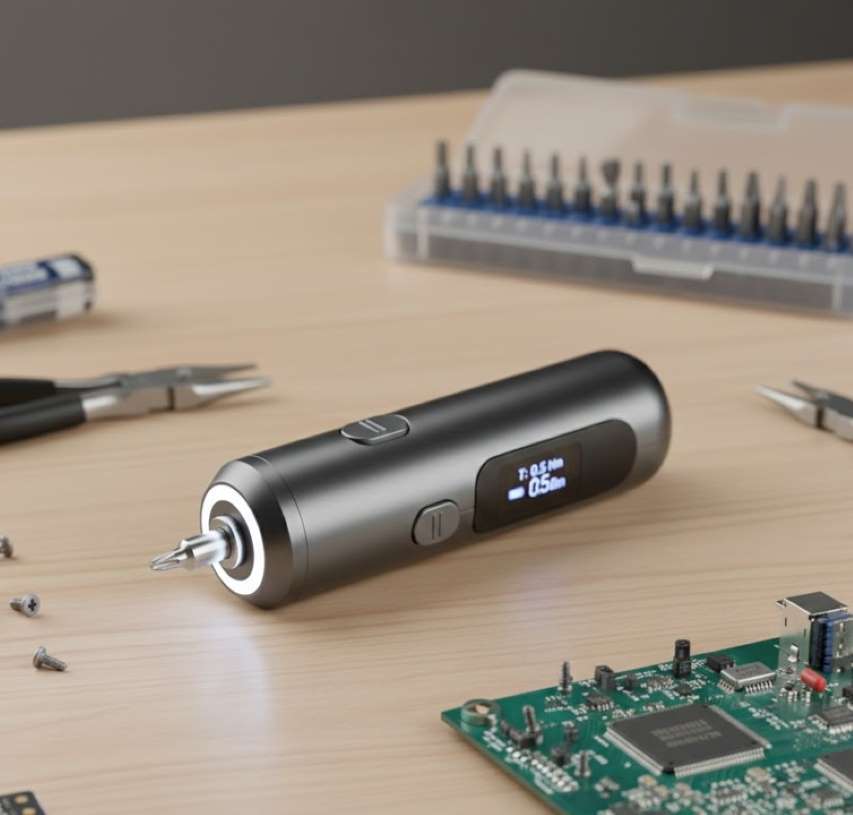
A Mini Cordless Electric Screwdriver is a compact, lightweight, handheld power tool designed for precision driving and removing of small screws in light-duty applications. It occupies the niche between a full-sized power drill/driver and a manual screwdriver, offering motorized assistance with enhanced control and accessibility for detailed work where larger tools are too bulky or powerful.
Characterized by its pen-like or pistol-grip form factor and battery-powered operation, it is engineered for convenience, reducing hand fatigue and increasing efficiency in repetitive or delicate fastening tasks.
Anatomy & Key Components
The Body & Grip
Form Factor: Typically, straight ("stick" or "pen-style") for precise, in-line control (like a writing instrument) or a miniature pistol-grip for a more traditional, ergonomic hold.
Material: High-quality ABS plastic or rubberized TPE overmold for durability and a secure, comfortable grip.
Size & Weight: Extremely compact, usually 4-7 inches (10-18 cm) long and weighing under 1 lb (0.45 kg), including the battery.
The Drive System
Motor: A small, efficient DC motor (often brushless in premium models) that provides rotational force.
Gearbox: A planetary or spur gear set that manages torque output and speed. Key for providing sufficient driving power in a small package.
Chuck/Collet: A ¼-inch hex quick-release collet is standard. It accepts a vast array of standard ¼-inch hex shank screwdriver bits (Phillips, flathead, Torx, hex, etc.) without the need for a key.
Clutch/Torque Control: Many models feature an adjustable torque clutch with multiple settings (e.g., 3-8 settings). This prevents over-tightening and stripping screws in delicate materials by disengaging the drive at a preset resistance.
Power & Control
Battery: Almost exclusively uses a rechargeable Lithium-ion (Li-ion) battery pack (e.g., 3.6V, 4V, 7.2V). Some ultra-basic models may use built-in, non-removable Li-ion batteries charged via USB.
Charger: A dedicated docking station or, more commonly now, a USB charging cable (USB-C or Micro-USB) for ultimate portability.
Controls:
Direction Switch: A forward/reverse slider or rocker switch, crucial for both driving and removing screws.
Trigger/Lock Button: A variable-speed trigger for control, sometimes with a lock-on button for continuous operation.
LED Work Light: A small but powerful LED positioned near the chuck to illuminate the work surface, a critical feature for low-light areas.
Key Specifications & Performance
Specification | Typical Range | Importance |
|---|---|---|
| Voltage | 3.6V - 7.2V | Indicates potential power. Higher voltage generally means higher torque, but also more weight. |
| Max Torque | 2 - 10 Nm (18 - 88 in-lbs) | The rotational force. Crucial for driving into different materials. Adjustable clutch protects delicate work. |
| Speed | 150 - 300 RPM (No-load) | Suited for precision, not speed drilling. Provides control for starting screws. |
| Battery Capacity | 1.3Ah - 2.0Ah (Li-ion) | Determines runtime. A 1.5Ah battery can drive hundreds of small screws on a charge. |
| Chuck Type | ¼" Hex Quick-Release | Universal compatibility with standard accessory bits. |
| Charging Time | 1 - 3 hours (USB) | Convenience factor. USB charging allows use with power banks, car chargers, etc. |
How It Works: Operation Workflow
Bit Selection & Insertion: Choose the appropriate screwdriver bit for the screw head. Insert it into the ¼" hex collet until it clicks or locks securely.
Power & Direction: Ensure the battery is charged. Set the directional switch to forward (clockwise) for driving screws or reverse (counter-clockwise) for removing them.
Engagement & Driving: Place the bit into the screw head. Apply gentle forward pressure and squeeze the trigger. The motor engages, rotating the bit. Start slowly to "seat" the screw, then increase speed.
Clutch Activation: If equipped, the adjustable clutch will disengage with a clicking sound once the preset torque is reached, preventing over-tightening.
Completion: Release the trigger. For removal, switch direction and repeat.
Ideal Applications & Use Cases
Electronics & Appliance Repair: Assembling/disassembling laptops, game consoles, smartphones, and small appliances where screws are tiny and precision is paramount.
Hobby & Model Building: Perfect for RC cars, drones, plastic models, and LEGO Technic sets.
Furniture Assembly: Ideal for flat-pack furniture (IKEA, etc.), cabinet hardware, and other tasks involving numerous small-to-medium screws.
General Home DIY: Hanging light fixtures, installing switch plates, assembling shelving, tightening loose hardware around the house.
Crafting & Jewelry Making: Working with miniature fasteners in detailed craft projects.
Travel & On-the-Go Toolkit: Its small size makes it perfect for a vehicle emergency kit or a compact tool bag.
Advantages & Benefits
Dramatically Reduces Hand Fatigue: Eliminates the repetitive twisting motion of a manual screwdriver.
Increases Speed & Efficiency: Completes fastening tasks in a fraction of the time.
Superior Access: Slim profile reaches into tight spaces where hands or full-sized drivers cannot fit.
Precision Control: Low speed, adjustable torque, and good balance allow for delicate work without damaging materials or screws.
Extreme Portability: Fits in a drawer or tool belt pouch. USB charging enhances this further.
User-Friendly: Intuitive for both professionals and casual users.
Limitations & Considerations
Not for Heavy-Duty Tasks: Cannot replace an impact driver or drill for large lag bolts, drilling into masonry, or heavy construction.
Limited Power: Struggles with long screws in hardwoods or driving into dense materials without a pilot hole.
Battery Dependency: Requires charging; a dead battery leaves you manual.
Bit Slippage: The quick-release collet, if worn or of low quality, can allow bits to slip or fall out under high torque.
Not a Primary Drill: While some models may come with a drill bit adapter, they lack the speed and power for efficient drilling, especially in metal.
Comparison: Mini vs. Standard Drill/Driver
Feature | Mini Cordless Screwdriver | Standard Cordless Drill/Driver |
|---|---|---|
| Primary Use | Precision screwdriving | Drilling holes & driving medium screws |
| Size/Weight | Very small & light (≤1 lb) | Larger & heavier (2-4 lbs) |
| Torque | Low to Medium (2-10 Nm) | High (20-80+ Nm) |
| Speed | Low (150-300 RPM) | High (0-2000 RPM) |
| Chuck | ¼" Hex Quick-Release | ½" or ⅜" Keyless Drill Chuck |
| Best For | Electronics, hobbies, assembly | Woodworking, construction, general DIY |
Selection Criteria: What to Look For
Ergonomics: Choose a grip style (pen or pistol) that feels comfortable and controllable in your hand.
Torque & Clutch: An adjustable clutch is highly recommended for versatile, safe use. Ensure the max torque suits your common tasks.
Battery & Charging: Prefer USB-C charging for modern convenience. Check if the battery is removable for easy replacement.
LED Light: A must-have feature for seeing screw heads clearly.
Accessories: Kits often include a selection of bits and a magnetic extension. Ensure they are of decent quality.
Brand & Reviews: Opt for reputable tool brands or highly-reviewed niche brands for better reliability and support.
The Mini Cordless Electric Screwdriver is the epitome of task-optimized tool design. It does not attempt to be a primary drill or heavy-duty driver. Instead, it excels brilliantly at its intended purpose: making the ubiquitous, often tedious task of driving small screws faster, easier, and more ergonomic.
For anyone who regularly works with electronics, assembles furniture, engages in hobbies, or simply wants to streamline light household maintenance, it is an invaluable and transformative addition to the toolkit. It bridges the gap between pure manual effort and overpowered machinery, proving that for countless precision tasks, smaller, smarter, and more focused is overwhelmingly better.
 |  |  |
 |  |  |