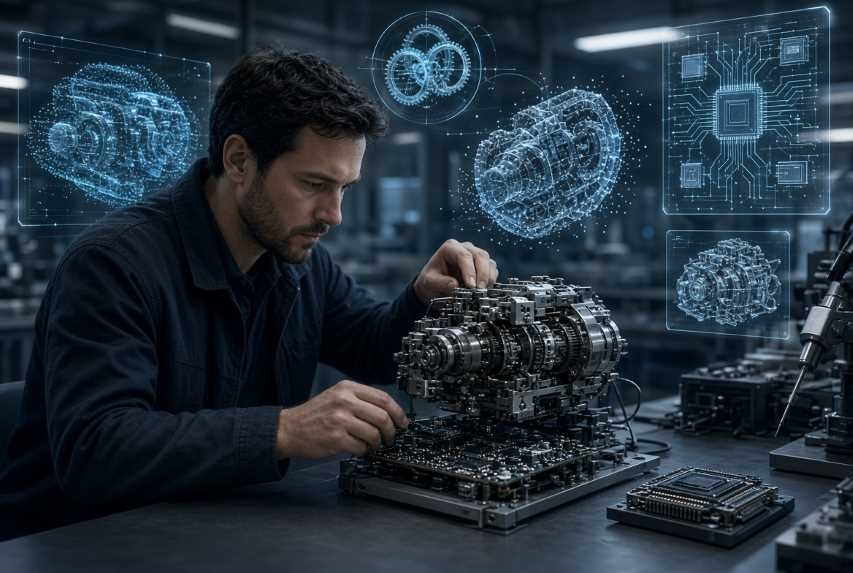
Reverse engineering is the disciplined process of examining an existing product, system, component, or piece of software to understand how it was designed, how it functions, and how it was made. Engineers start with the finished artifact and work backward—measuring, testing, disassembling, scanning, or analyzing it—to recover design intent, architecture, materials, algorithms, or manufacturing methods that may no longer be documented or available.
The word “reverse” distinguishes the activity from conventional (or “forward”) engineering. In forward engineering, designers begin with requirements and create a new solution from the ground up. Reverse engineering begins with something that already exists and reconstructs the knowledge needed to maintain, improve, replace, interoperate with, or learn from it. Primary objectives include recovering lost or unavailable documentation, enabling repair or spare-part production, supporting interoperability, analyzing competitors or threats for defensive purposes, preserving historical technology, and accelerating learning.
In a technology-driven world where products evolve rapidly, supply chains are global, and software and hardware become obsolete within years, reverse engineering has grown in importance. Companies keep decades-old industrial equipment running, cybersecurity teams dissect malware, automotive engineers study electric-vehicle battery and control systems, and researchers reconstruct ancient mechanisms. A simple everyday example is a repair shop measuring a broken mechanical part with calipers or a 3D scanner so a replacement can be manufactured when the original supplier no longer exists. Another is a security researcher examining a suspicious executable in a controlled environment to determine whether it steals data or encrypts files.
History and Evolution of Reverse Engineering
People have reverse-engineered tools, weapons, and machines for as long as technology has existed. Early humans observed and replicated hand axes and other stone tools. Ancient Greek and Roman engineers studied Egyptian water-lifting devices and mechanical systems, adapting and improving them. The Antikythera mechanism, recovered from a shipwreck near the Greek island of Antikythera in 1900–1901 and dated to roughly the late second or early first century BCE, is the most sophisticated surviving example from antiquity. Modern researchers have used X-ray imaging, computed tomography, and surface imaging to reconstruct its complex bronze gear trains, which modeled astronomical cycles including lunar and solar positions and eclipse prediction. The device demonstrates that Hellenistic engineers achieved levels of mechanical sophistication that were not matched again for more than a thousand years.
During the Industrial Revolution, reverse engineering became systematic. Manufacturers examined textile machinery, steam engines, and locomotives from rivals, measuring components, analyzing materials, and adapting designs for local production. World War II accelerated the practice dramatically. Allied forces reverse-engineered the German “Jerry can”—a robust gasoline container whose design features (including the triple-handle arrangement that allowed one or two people to carry it) were so practical that the Allies produced millions of copies. The Soviet Union undertook one of the largest reverse-engineering efforts in history with the Tupolev Tu-4 bomber. After three U.S. B-29 Superfortresses made emergency landings on Soviet territory in 1944, Stalin ordered exact copies. Engineers disassembled one aircraft, used a second as a reference, and flew the third for testing. The project involved roughly 900 factories and research institutes and produced on the order of 105,000 drawings. The resulting Tu-4 was extremely close in dimensions and performance, though Soviet engines, weapons, and some material thicknesses differed. Technical documents and hardware from the German V-2 rocket were similarly studied and adapted by both Soviet and Western engineers after the war, launching postwar rocketry programs.
The Cold War continued this pattern with aircraft, missiles, and electronics. With the rise of computers, reverse engineering shifted to electronic circuits and then to software. Early software reverse engineering relied on manual disassembly; later decades brought interactive disassemblers, decompilers, and automated analysis platforms. Today the practice spans mechanical, electronic, software, and biological domains and is increasingly assisted by artificial intelligence.
Main Types of Reverse Engineering
Reverse engineering takes different forms depending on the object of study.
Mechanical reverse engineering focuses on machines, engines, gears, frames, and industrial equipment. Engineers measure geometry, analyze materials, study wear patterns, and reconstruct kinematics or load paths. Applications include producing spare parts for obsolete machinery and improving durability or efficiency.
Hardware reverse engineering examines electronic circuits, processors, sensors, and integrated circuits. Techniques range from non-destructive inspection of printed circuit boards to more invasive methods such as decapping chips for microscopic examination. Goals include understanding architecture, extracting firmware, or identifying design flaws.
Software reverse engineering analyzes executable files, binaries, or running applications when source code is unavailable. Practitioners recover control flow, data structures, file formats, and protocols. Uses include legacy-system migration, interoperability, bug hunting, and documentation.
Cybersecurity reverse engineering applies the same techniques defensively. Analysts dissect malware, ransomware, and suspicious files to understand behavior, communication methods, and indicators of compromise. The work supports antivirus signatures, incident response, and vulnerability research. It is conducted under controlled conditions and with authorization.
Product reverse engineering studies complete consumer or industrial products to understand design choices, materials, assembly methods, and cost drivers. It can support competitive analysis, quality improvement, or aftermarket compatibility.
Chemical and material reverse engineering identifies composition, microstructure, and properties of alloys, polymers, coatings, or formulations through spectroscopy, chromatography, and microscopy. It helps recreate obsolete materials or verify supplier quality.
Biological and medical applications use analytical methods to understand biological structures, medical-device designs, or tissue properties. Examples include reconstructing implant geometry from scans or studying biomimetic principles, though ethical and regulatory constraints are strict.
Each type shares the goal of recovering usable knowledge; the methods and tools differ.
How Does Reverse Engineering Work? The Complete Process
A typical workflow proceeds through these stages:
Identify and select the target, clarifying the purpose (repair, interoperability, security analysis, etc.) and confirming legal permission.
Collect existing information—manuals, photographs, observed behavior, network traffic, or public documentation—and record visible characteristics.
Inspect and measure external features using calipers, coordinate measuring machines, cameras, or non-contact scanners.
Disassemble or access internal elements when safe and appropriate, documenting the sequence and orientation of every component.
Apply specialized tools: 3D scanning or CT imaging for geometry, oscilloscopes and logic analyzers for signals, or disassemblers and debuggers for software.
Reconstruct design intent, architecture, or logic—building CAD models, circuit diagrams, or high-level code representations.
Create technical documentation, drawings, or models that capture the recovered knowledge.
Test and validate the reconstruction against the original object’s measured behavior or performance.
Identify improvements, alternative designs, or failure modes that can guide future work.
Physical products emphasize dimensional accuracy and material properties. Electronic devices add signal analysis and firmware extraction. Software systems emphasize static examination of code structure and dynamic observation of runtime behavior in a controlled environment. The process is iterative; new findings often require returning to earlier steps.
Reverse Engineering Tools and Technologies
Modern practice relies on specialized instruments and software.
Mechanical and industrial tools include handheld and fixed 3D scanners (structured light, laser, and photogrammetry systems from manufacturers such as Artec, Hexagon, and others) that capture dense point clouds of freeform surfaces. Coordinate measuring machines (CMMs) provide high-accuracy contact or non-contact measurements of prismatic features. Industrial X-ray and computed tomography (CT) systems reveal internal geometry without full disassembly. Computer-aided design (CAD) software such as SolidWorks, Siemens NX, and specialized reverse-engineering packages like Geomagic Design X convert scan data into editable parametric models. Computer-aided engineering (CAE) tools then simulate stresses, flows, or thermal behavior.
Electronic and hardware tools include oscilloscopes and logic analyzers for capturing electrical signals, multimeters for basic measurements, signal and spectrum analyzers, and optical or electron microscopes for chip inspection. Printed-circuit-board analysis tools help trace connections and identify components. Firmware extraction may use debug interfaces (JTAG, SWD) or, in authorized research settings, more advanced techniques such as fault injection.
Software and cybersecurity tools center on disassemblers and decompilers. IDA Pro (with the Hex-Rays decompiler) has long been the commercial standard for interactive analysis across many architectures. Ghidra, released by the U.S. National Security Agency and available free of charge, provides a capable open-source alternative with broad processor support and a decompiler. Binary Ninja offers a modern commercial platform with strong scripting support. Additional tools include radare2/rizin and Cutter (open source), debuggers such as x64dbg and GDB, dynamic instrumentation frameworks like Frida, network analyzers, and sandboxes that safely execute suspicious code. Commercial, open-source, and specialized professional solutions coexist; choice depends on architecture coverage, decompiler quality, scripting needs, and budget.
Reverse Engineering in Software Development
Software engineers use reverse engineering when source code, design documents, or original developers are unavailable. Common tasks include recovering the architecture of legacy business applications, understanding undocumented file formats or network protocols so modern systems can interoperate, diagnosing compatibility problems between old and new platforms, and documenting aging systems before migration. Practical examples include analyzing older Windows binaries to extract data-handling logic for a rewrite, examining mobile-application binaries to understand communication with backend services, and reverse-engineering database file formats so data can be extracted from discontinued systems. The work is often combined with clean-room techniques that separate analysis from new implementation to reduce intellectual-property risk.
Reverse Engineering in Cybersecurity
In defensive security, reverse engineering is essential for malware analysis and vulnerability research. Static analysis examines a binary without running it—disassembling code, identifying strings, mapping control flow, and looking for suspicious patterns. Dynamic analysis executes the sample in a controlled sandbox or virtual machine while monitoring file, registry, network, and process activity. Combining both approaches is common.
The 2010 discovery and analysis of Stuxnet illustrates the depth possible. Researchers at firms including Symantec and Kaspersky, along with independent experts such as Ralph Langner, reverse-engineered the worm’s multiple zero-day exploits, its propagation methods, and its payload that targeted Siemens programmable logic controllers. The code manipulated frequency-converter settings to damage uranium-enrichment centrifuges while masking the sabotage from operators. The analysis revealed how digital code could produce physical effects and informed subsequent industrial-control-system defenses. Similar techniques are used today to classify ransomware, map command-and-control communications, and support digital forensics and incident response. Responsible vulnerability research follows coordinated disclosure practices.
Reverse Engineering in Consumer Electronics and Industrial Products
Engineers routinely examine smartphones, tablets, computers, automotive systems, cameras, industrial robots, household appliances, and medical equipment. In the automotive sector, reverse engineering supports spare-part production, aftermarket diagnostics, and competitive study of battery-management systems, motor controllers, and electronic control units in electric vehicles. Independent researchers and manufacturers use scanning and firmware analysis to understand component selection, manufacturing methods, thermal management, and energy efficiency. The same methods help keep aging industrial machinery and medical devices operational when original manufacturers no longer supply parts.
Reverse Engineering and Artificial Intelligence
Artificial intelligence is accelerating reverse engineering. Machine-learning models assist in identifying components from images, classifying malware families, and detecting patterns in large code bases. AI-powered tools help convert 3D scan data into editable CAD more quickly and can suggest reconstructions of missing geometry. Digital twins—virtual replicas updated with real-world data—allow simulation of component behavior. Generative AI shows promise for drafting technical documentation or proposing alternative designs from recovered information, though results still require expert validation.
Limitations remain significant. AI systems can hallucinate missing details, struggle with highly obfuscated code or proprietary process knowledge, and introduce errors that propagate into manufactured parts or security conclusions. Over-reliance without human oversight risks incomplete or incorrect reconstructions. Ethical and intellectual-property questions also arise when AI is trained on or applied to third-party products.
Real-World Case Studies and Examples
Antikythera mechanism. The challenge was understanding a corroded bronze geared device whose purpose was unknown. Modern X-ray tomography and surface imaging, combined with inscription analysis, revealed it as an astronomical calculator modeling lunar and solar cycles. The work demonstrated previously unrecognized Hellenistic mechanical sophistication and produced functional reconstructions.
Soviet Tu-4 bomber. After three B-29s landed in the USSR, Soviet industry lacked a comparable strategic bomber. Stalin ordered an exact copy. Engineers disassembled one airframe, measured tens of thousands of parts, adapted to metric standards and available materials, and produced the Tu-4 within about two years. The aircraft closely matched B-29 dimensions and performance, giving the Soviet Union a strategic bomber capability far sooner than independent development would have allowed.
Stuxnet analysis. The problem was an unknown, highly sophisticated worm spreading on Windows systems. Researchers reverse-engineered its dropper, exploits, and PLC payload, discovering it targeted specific frequency converters used in uranium enrichment. The findings exposed the first widely analyzed cyber-physical attack and drove improvements in industrial-control-system security.
Legacy industrial equipment and obsolete components. Manufacturers and repair organizations regularly scan or measure discontinued mechanical and electronic parts, create CAD models or extract firmware, and produce replacements. The results extend equipment life, reduce downtime, and lower dependence on single suppliers.
These cases illustrate both the power and the limits of the technique: success depends on access to physical or digital artifacts, appropriate tools, skilled analysts, and clear objectives.
Business and Economic Importance
Reverse engineering reduces research-and-development costs by allowing companies to learn from existing designs rather than starting from zero. It extends product lifecycles through repair and spare-part manufacturing, improves manufacturing efficiency by revealing better processes, and supports local production in regions that lack original design data. For startups and smaller manufacturers it lowers barriers to entry and builds engineering expertise. In developing economies it can reduce reliance on imported finished goods and accelerate technological catch-up; in developed economies it sustains installed bases of expensive capital equipment and supports competitive innovation. Over-reliance on pure copying, however, can stifle original design capability.
Advantages and Disadvantages
Advantages include rapid understanding of complex systems, shorter development cycles, better interoperability, recovery of knowledge about obsolete technology, improved security through defensive analysis, and stimulation of independent innovation.
Disadvantages and challenges include high costs for advanced scanning, laboratory, and software tools; time-consuming analysis; risk of incomplete or inaccurate reconstructions; difficulty with highly integrated or protected designs; legal and intellectual-property constraints; and the temptation to copy rather than innovate. Reverse engineering is most beneficial when documentation is lost, interoperability is required, security analysis is authorized, or replacement parts are otherwise unavailable. When clear requirements and design freedom exist, conventional forward engineering is usually preferable.
Legal, Ethical, and Intellectual Property Issues
Legality depends on jurisdiction, purpose, methods, and any contractual restrictions. In the United States, trade-secret law generally treats reverse engineering of a lawfully obtained product as a proper means of acquisition (the Defend Trade Secrets Act explicitly excludes it from “improper means”). Copyright law has recognized intermediate copying for interoperability as fair use in cases such as Sega Enterprises Ltd. v. Accolade, Inc. The Digital Millennium Copyright Act contains limited exceptions for interoperability and good-faith security research, but anti-circumvention rules still constrain certain activities. Patents are not avoided by reverse engineering; practicing a patented invention still requires permission. End-user license agreements and contracts may prohibit reverse engineering, and courts have enforced such clauses in some cases.
In the European Union, the Software Directive provides rights to observe, test, and, under strict conditions, decompile for interoperability; contractual terms that override these rights are generally unenforceable. Other countries maintain their own balances. Ethical practice requires respecting applicable law, obtaining permission where required, following responsible disclosure for vulnerabilities, and avoiding use of improperly acquired trade secrets. Reverse engineering is neither universally legal nor universally illegal.
Reverse Engineering vs. Other Engineering Approaches
Approach | Primary Objective | Starting Point | Typical Output | Common Applications |
Forward engineering | Create new solution | Requirements | New design and product | New product development |
Reverse engineering | Understand existing artifact | Finished product | Recovered design/knowledge | Repair, interoperability, analysis |
Re-engineering | Improve existing system | Existing design + needs | Enhanced design | Modernization of legacy systems |
Refactoring | Improve internal structure | Existing code | Cleaner code, same behavior | Software maintenance |
Product cloning | Produce identical or near-identical copy | Finished product | Replica | Aftermarket or unauthorized copies |
Competitive analysis | Benchmark features and performance | Competitor products | Insights for own design | Product strategy |
Traditional R&D | Discover and invent | Scientific principles | Novel technology | Fundamental innovation |
Education, Careers, and Required Skills
Practitioners need strong foundations in mathematics and physics, mechanical or electrical engineering principles, electronics and circuit design, and programming (C, C++, Python, and assembly are especially useful). Knowledge of operating systems, computer architecture, cybersecurity fundamentals, CAD/3D modeling, and technical documentation is essential. Analytical thinking, systematic problem-solving, and clear communication complete the skill set.
Relevant university degrees include mechanical engineering, electrical engineering, computer engineering, computer science, and cybersecurity. Professional training, vendor certifications in specific tools, and practical laboratory experience are common pathways. Career opportunities exist in manufacturing and industrial maintenance, automotive and aerospace, semiconductor and electronics companies, cybersecurity firms, digital forensics, medical-device companies, research institutions, and government laboratories.
The Future of Reverse Engineering
Over the next 5–15 years, AI-assisted workflows, automated component identification from images or scans, and tighter integration with digital twins are already moving from emerging to practical use. Advanced semiconductor analysis continues to improve with better imaging and simulation. Additive manufacturing and 3D printing make it easier to produce reconstructed parts quickly. Robotics and autonomous inspection systems are beginning to assist large-scale measurement. Cybersecurity challenges will grow as systems become more connected and protected. Sustainable manufacturing and circular-economy goals will increase demand for repair-oriented reverse engineering. Quantum computing may eventually affect both the difficulty of analyzing certain cryptographic systems and the tools available for simulation, but widespread practical impact remains speculative. Human expertise will remain central for validation, judgment, and ethical decision-making.
Practical Beginner's Guide
Safe, legal starting projects include:
Creating a 3D model of a simple mechanical object (for example, a bracket or gear) using a consumer 3D scanner or photogrammetry and free or low-cost CAD software. Required knowledge: basic geometry and CAD. Difficulty: beginner. Outcome: understanding of scan-to-model workflow.
Non-destructive inspection of an old electronic device you own (visual examination, multimeter measurements of accessible points, documentation of connectors). Required knowledge: basic electronics safety. Difficulty: beginner. Outcome: familiarity with hardware documentation.
Analyzing an open-source software application whose source is available, then comparing your observations with the code. Required knowledge: programming basics. Difficulty: beginner to intermediate. Outcome: appreciation of how compiled code relates to source.
Examining a publicly documented file format (for example, a simple image or archive format) by reading specifications and writing a small parser. Required knowledge: programming. Difficulty: intermediate. Outcome: protocol and format analysis skills.
Reconstructing a simple, non-proprietary electronic circuit from a schematic or physical board you own, using a breadboard. Required knowledge: circuit fundamentals. Difficulty: intermediate. Outcome: hands-on hardware understanding.
Always obtain permission, respect applicable laws and licenses, work in controlled environments for any software that could be harmful, and prioritize safety.
Frequently Asked Questions
- What exactly is reverse engineering?
It is the process of analyzing a finished product or system to understand its design, function, and construction when original documentation or source materials are unavailable or incomplete. - Is reverse engineering legal?
It depends on the jurisdiction, the purpose, the methods used, intellectual-property rights involved, and any contracts. It is often lawful for interoperability, security research, and analysis of lawfully obtained items, but restrictions exist. - Is it the same as copying a product?
No. Reverse engineering seeks understanding; copying seeks to reproduce the product. Understanding can lead to original improvements rather than identical replicas. - Can reverse engineering recover lost source code?
It can recover high-level representations, logic, and structure through decompilation, but the result is rarely identical to the original source and may lack comments, variable names, and exact structure. - What is the difference between a decompiler and a disassembler?
A disassembler translates machine code into assembly language. A decompiler attempts to produce higher-level source-like code (for example, C-like representations). - Can reverse engineering help protect computers from malware?
Yes. Defensive analysis of malware reveals behavior, indicators, and weaknesses that antivirus products, detection rules, and incident responders use. - Is reverse engineering used in the automotive industry?
Yes, for spare-part production, diagnostics, competitive analysis of electronic systems, and maintenance of older vehicles. - What tools do beginners need?
Basic measuring tools, free or low-cost CAD software, a consumer 3D scanner or photogrammetry setup for mechanical work, and free software tools such as Ghidra for simple binary examination. Start with open-source or personally owned items. - How is AI changing reverse engineering?
AI assists with pattern recognition, scan-to-CAD conversion, malware classification, and documentation drafting, but human experts still validate results. - What careers are available in this field?
Roles exist in manufacturing engineering, cybersecurity and malware analysis, automotive and aerospace, semiconductor analysis, digital forensics, medical-device support, and research.
Reverse engineering is a foundational discipline that lets engineers, researchers, and organizations understand, maintain, secure, and improve the technologies that surround us. From ancient geared astronomical calculators to modern industrial controllers and software systems, the practice recovers knowledge that would otherwise be lost and turns it into practical capability. It reduces costs, extends the life of valuable equipment, strengthens defensive cybersecurity, and supports both competition and collaboration.
When combined with artificial intelligence, advanced imaging, digital twins, and additive manufacturing, reverse engineering will continue to accelerate the cycle of understanding and improvement. The next generation of technological development will be shaped not only by those who invent new things, but also by those who can rigorously understand what already exists—and use that understanding responsibly to build what comes next.
 |  |  |