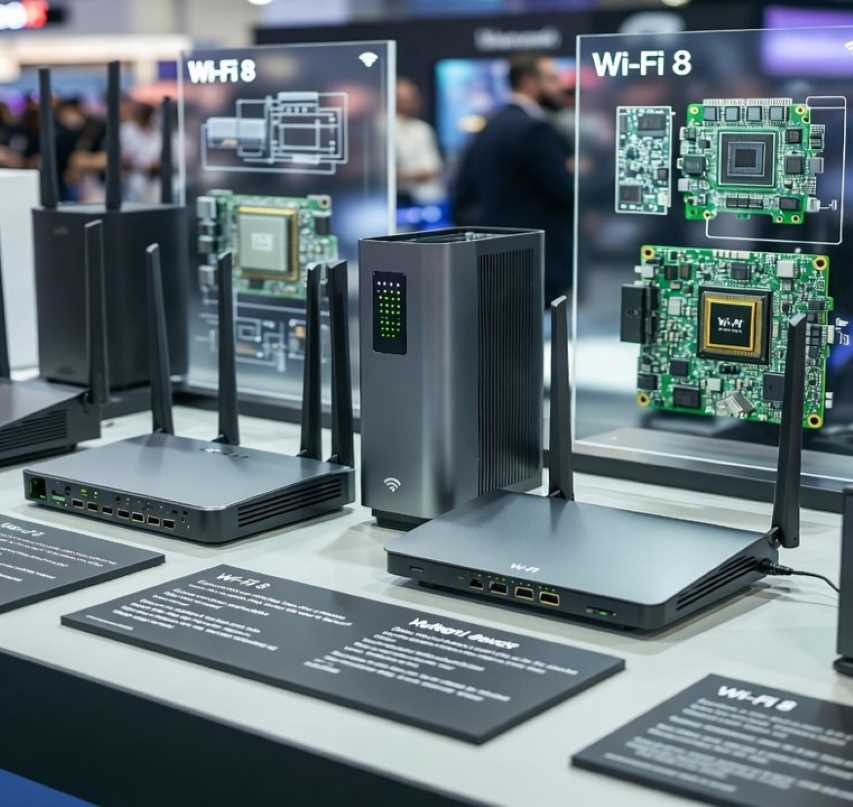
A Leap Toward Ultra-Reliable Wireless Connectivity
LAS VEGAS – The Consumer Electronics Show (CES) 2026 has commenced with a surprising development in the realm of wireless technology. While many consumers are arguably still in the process of upgrading to Wi-Fi 7, industry leaders such as MediaTek, ASUS, and Broadcom have unveiled the first glimpses of Wi-Fi 8. These companies are showcasing draft hardware and computer chips that promise to revolutionize connectivity.
This early debut highlights a significant philosophical shift: rather than chasing raw speed, the industry is prioritizing robust reliability, particularly in crowded and dynamic environments.
These announcements arrive while Wi-Fi 8—officially known as IEEE 802.11bn or Ultra High Reliability—is still in its draft phase. The full standard is not expected to be ratified until late 2028; however, companies are already demonstrating prototypes based on early specifications. This strategy mirrors the rapid evolution seen in previous wireless generations, where hardware development often precedes final standards to accelerate market adoption.
MediaTek Leads the Charge with Filogic 8000 Family
MediaTek captured significant attention by introducing its Filogic 8000 family, a suite of Wi-Fi 8 chips designed for both gateways—such as broadband routers and enterprise access points—and client devices, including smartphones, laptops, televisions, streaming gadgets, tablets, and Internet of Things products. Positioned as pioneers of the Wi-Fi 8 ecosystem, these chips aim to power premium and flagship devices, thereby enhancing Artificial Intelligence-driven applications that demand seamless, low-latency connections.
At the Consumer Electronics Show, MediaTek demonstrated its Wi-Fi 8 solutions, emphasizing ultra-reliable connectivity for latency-critical scenarios such as Extended Reality, cloud gaming, and industrial automation.
Key innovations include:
Multi-Access Point Coordination: Features such as Coordinated Beamforming, Coordinated Spatial Reuse, and Multi-Access Point Scheduling reduce interference and boost efficiency in dense networks.
Dynamic Subband Operation: Allows for superior spectrum sharing.
Enhanced Long Range: Provides improved signal coverage.
Distributed-Tone Resource Units: Delivers stronger uplink performance and reduced latencies.
The first devices featuring Filogic 8000 chips are scheduled to launch later in 2026, marking a swift transition from concept to market.
ASUS Unveils ROG NeoCore: A Futuristic Wi-Fi 8 Concept Router
Not to be outdone, ASUS debuted the ROG NeoCore, a striking Wi-Fi 8 concept router that discards traditional antennas in favor of a sleek, polyhedral design resembling a twenty-sided die with a hollow base. This device, part of the Republic of Gamers lineup by ASUS, was showcased alongside the world’s first real-world Wi-Fi 8 performance test, proving the technology’s readiness beyond theoretical benchmarks.
The NeoCore promises the same theoretical data speeds as Wi-Fi 7 but delivers significant operational improvements:
Throughput: Up to two times higher mid-range throughput.
Coverage: Up to two times wider coverage for Internet of Things devices.
Latency: Up to six times lower P99 latency (latency at the 99th percentile) through smarter multi-access point and multi-client operations.
Powered by the proprietary AiMesh technology and Artificial Intelligence Network Engine from ASUS, the router embodies the "Smarter Spectrum, Better Experience" vision. It enables seamless collaboration between smart home devices, Artificial Intelligence assistants, and cloud services.
Real-world tests at the Consumer Electronics Show compared Wi-Fi 8 to Wi-Fi 7, highlighting improvements in scenarios such as cloud streaming and real-time voice communication, with near-zero-latency responsiveness for multi-device gaming. ASUS plans to release its first Wi-Fi 8 home routers and mesh systems in 2026, building on its leadership in Wi-Fi 6 and Wi-Fi 7 certifications.
Broadcom's Contributions: Chips for Residential Gateways
Broadcom also entered the competitive landscape with a trio of Wi-Fi 8 components: the BCM4918 application processing unit and two dual-band radios, the BCM6714 and BCM6719.
These components are tailored for residential routers and service provider gateways, focusing on high-bandwidth Bluetooth integration and full compliance with IEEE 802.11bn specifications. Features include third-generation digital pre-distortion for a 25 percent reduction in peak power and advanced power management for overall energy efficiency.
What Sets Wi-Fi 8 Apart? A Focus on Reliability Over Speed
Unlike Wi-Fi 7, which emphasized multi-gigabit speeds and wider channels, Wi-Fi 8 prioritizes "ultra-high reliability" in challenging conditions. It maintains the 2.4 Gigahertz, 5 Gigahertz, and 6 Gigahertz bands with up to 320 Megahertz channel bandwidths, offering peak physical layer rates up to 23 Gigabits per second—similar to Wi-Fi 7. However, the true advantages are found in network stability:
Throughput Boost: At least 25 percent higher performance in congested or interfered environments.
Latency Reduction: 25 percent lower latency at the 95th percentile, which is ideal for gaming and Virtual Reality.
Packet Loss Improvement: 25 percent fewer dropped packets, especially when roaming between access points.
Advanced Coordination: Multi-Access Point features like Coordinated Spatial Reuse and Dynamic Sub-Channel Operation allow for up to 80 percent better throughput in dense areas.
Power Efficiency: Refined wake cycles and energy scheduling ensure longer battery life in low-power devices.
Seamless Mobility: Improved peer-to-peer communication and edge performance for moving devices reduce connection drop-outs during streaming and gaming.
These enhancements make Wi-Fi 8 perfect for Artificial Intelligence workloads, Internet of Things ecosystems, and high-density settings such as offices, stadiums, or smart homes.
Implications for Consumers and the Industry
This early showcase at the Consumer Electronics Show signals that Wi-Fi 8 could arrive sooner than expected, with routers potentially hitting shelves by late 2026. However, client devices such as laptops and mobile phones may not support the standard until 2027, limiting immediate utility. For now, it serves as a teaser of what is to come: more stable networks that complement 5G cellular technology and enable the next wave of connected experiences.
As the Consumer Electronics Show 2026 unfolds, the debut of Wi-Fi 8 underscores the relentless pace of the technology industry. Stay tuned for more updates on how this standard will shape our wireless future.
 |  |  |
 |  |  |