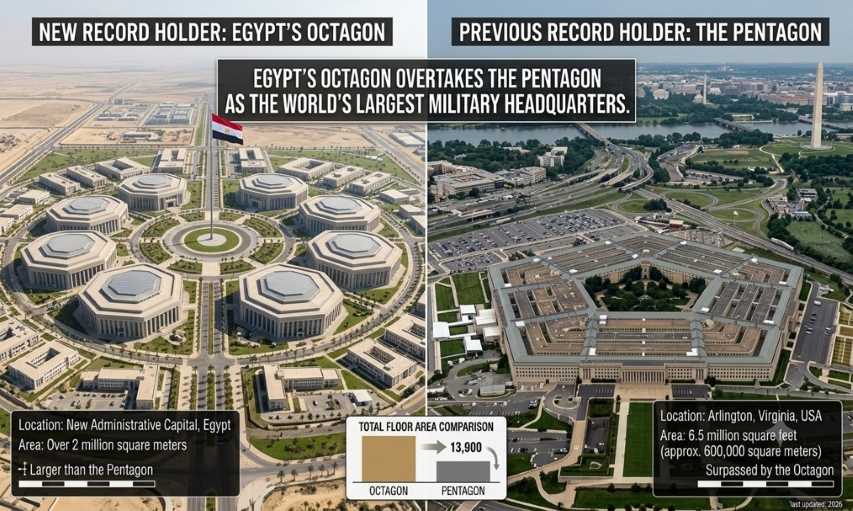
In a ceremony rich with symbolism on July 4, 2026, President Abdel Fattah el-Sisi inaugurated Egypt’s new State Strategic Command Center, popularly known as The Octagon, in the New Capital east of Cairo. This sprawling complex immediately claims the title of the largest defense headquarters and office building complex on Earth by both total floor area and overall land footprint. Far more than an oversized headquarters building, The Octagon represents a deliberate reimagining of how a major regional power organizes, protects, and projects its military command infrastructure in the twenty-first century.
The project’s timing carries particular weight. The Middle East continues to experience elevated risks from multiple overlapping conflicts, proxy confrontations, maritime disruptions, and hybrid threats. In this environment, the ability to maintain centralized yet resilient command and control become not merely advantageous but essential. The Octagon was designed precisely for these conditions — providing Egypt with a modern, integrated platform to monitor developments across several fronts, coordinate responses rapidly, and sustain operations even under stress.
While comparisons with the United States’ Pentagon are inevitable, the two structures differ profoundly in philosophy, scale, design language, and supporting infrastructure. The Octagon does not merely exceed the Pentagon in size. It addresses contemporary regional realities that demand distributed resilience, multi-domain integration, and the capacity to manage both conventional and asymmetric challenges simultaneously.
The Pentagon: An Enduring Symbol Born of Urgency and Ingenuity
The Pentagon stands as one of the most recognizable buildings in the world and remains the second-largest office building by floor space. Its origins lie in the urgent demands of World War II. In the early 1940s, the U.S. War Department was scattered across dozens of temporary buildings in Washington, D.C. Senior leaders recognized that this fragmentation was inefficient and vulnerable. The solution was radical: construct a single, massive headquarters capable of housing the entire defense apparatus under one roof.
Construction began in September 1941 and was completed in just 16 months — an extraordinary feat of engineering and organization under wartime pressure. The building’s distinctive five-sided shape was not purely aesthetic. It allowed the structure to fit within existing road networks and property lines while maximizing internal efficiency. The design features five concentric rings (labeled A through E from the inside out) connected by radial corridors. This layout ensures that no two points within the building are more than a seven-minute walk apart, despite the enormous scale.
The Pentagon contains approximately 6.5 million square feet of floor space, of which roughly 3.7 million square feet serve as office space. It includes five floors above ground and two basement levels. The building spans about 28.7 acres, with an additional 5.1-acre central courtyard. Inside are 17.5 miles of corridors, 7,754 windows, and facilities ranging from cafeterias and medical clinics to a small shopping concourse and exercise areas. On any given workday, roughly 23,000 military personnel, civilian employees, and contractors work within its walls.
Beyond its physical attributes, the Pentagon carries immense symbolic weight. It has survived the 9/11 attacks, undergone extensive renovations, and continues to serve as the nerve center for the world’s most powerful military alliance. Its concentric-ring design provides a degree of compartmentalization and redundancy — damage to one section does not necessarily paralyze the entire structure. For decades it has embodied centralized command, rapid internal communication, and the projection of global military power. Its lessons in resilience and efficient movement of people and information remain relevant even as threats have evolved far beyond those of the 1940s.
The Octagon: Egypt’s Monumental Statement of Modern Military Organization
Egypt’s Octagon takes an entirely different approach suited to current and emerging regional conditions. Rather than concentrating everything inside a single massive building, the complex consists of multiple interconnected structures arranged in a deliberate octagonal geometry. The name derives directly from this eight-sided layout. Eight outer octagonal buildings represent the eight branches of the Egyptian Armed Forces. These surround two central ministerial buildings that serve as the core command and coordination hub. All structures are linked by longitudinal corridors that converge on the main central facilities, creating both physical connectivity and symbolic unity.
Construction of the Octagon began around 2018 as a flagship component of the New Administrative Capital project. The broader initiative seeks to relieve pressure on overcrowded Cairo by relocating key government ministries and institutions to a purpose-planned city in the desert. The defense headquarters was prioritized early because of its strategic importance. President el-Sisi personally oversaw progress through multiple site visits, underscoring the project’s national priority status. The facility was formally inaugurated on July 4, 2026, in a high-profile ceremony attended by senior military and government officials.
The scale is staggering. The entire complex occupies approximately 22,000 acres — roughly 89 square kilometers or 34 square miles. Within this secured perimeter, the total built floor area reaches about 50.5 million square feet (approximately 4.7 million square meters). This makes the Octagon roughly 7.8 times larger than the Pentagon in usable floor space and dramatically larger in overall land area. The complex is divided into 13 distinct zones, each assigned specific operational, logistical, administrative, or support functions. This zoning allows for clear separation of activities while maintaining rapid connectivity through the central hub.
Architecturally, the Octagon draws heavily on Pharaonic traditions. The forms evoke ancient Egyptian monumental architecture while incorporating modern materials and engineering standards. The design language is intentional: it connects Egypt’s contemporary military capabilities with its civilizational heritage of large-scale organization and enduring construction. In addition to the primary command buildings, the complex functions as a self-contained military city. It includes places of worship, clubs, hotels, schools, playgrounds, residential quarters, shopping facilities, hospitals, and various civil and administrative service buildings. This integrated approach ensures that personnel and their families can live, work, train, and recover within a secure environment.
Security is robust. Two dedicated Republican Guard units provide primary perimeter protection, supplemented by layered defensive systems and advanced surveillance. The design incorporates redundancy and resilience principles similar in spirit to the Pentagon’s concentric layout, but executed across a distributed campus rather than a single structure. If one section is compromised, others can continue functioning with minimal disruption — a feature particularly relevant in an era of hybrid threats that may target command nodes.
Detailed Comparison: Where the Two Headquarters Diverge and Converge
While both facilities serve as the central nervous system for their respective nations’ defense establishments, the differences in execution are profound and reflect different strategic environments.
Scale and Footprint The most obvious distinction is sheer size. The Pentagon is an enormous single building; the Octagon is a vast, multi-building campus. In raw floor area, the Octagon is nearly eight times larger. In land area, the disparity is even greater. The Pentagon’s building footprint is measured in tens of acres; the Octagon’s secured zone covers tens of thousands of acres. This gives the Egyptian facility room for expansion, training areas, logistical depots, and future specialized facilities that the Pentagon simply cannot accommodate on its existing site.
Design Philosophy The Pentagon’s five-sided shape and concentric rings optimize internal movement and create natural compartmentalization within one structure. The Octagon’s eight outer buildings plus central hub emphasize representation of multiple service branches and distributed functionality. The octagonal geometry allows each branch to have dedicated space while remaining physically and operationally linked to the central command. This distributed model may offer advantages in survivability and specialized workflows under contemporary threat conditions.
Symbolic and Cultural Expression The Pentagon reflects mid-twentieth-century American functional modernism — efficient, imposing, and pragmatic. The Octagon deliberately incorporates Pharaonic architectural motifs, projecting national identity and historical continuity. For Egypt, the design choice reinforces the narrative that the modern armed forces are heirs to a long tradition of state organization and monumental achievement.
Operational Capacity and Amenities The Pentagon is densely packed with offices and support spaces for its 23,000 daily occupants. The Octagon’s vastly larger floor area and self-contained city model allow for a broader range of functions on-site: extended residential options, comprehensive medical facilities, educational institutions, recreational amenities, and dedicated zones for logistics, intelligence, cyber operations, and crisis management. This reduces external dependencies and enhances operational security and continuity.
Construction Timeline and Context The Pentagon was built in wartime haste under extreme pressure. The Octagon was developed over roughly eight years as part of a long-term national development strategy. The difference reflects contrasting circumstances: one born of immediate global conflict, the other of deliberate, sustained investment in future capabilities amid persistent regional volatility.
Technological Integration Both headquarters have evolved with technology, but the Octagon was designed from the ground up for contemporary requirements. It incorporates advanced command-and-control systems, data centers, and cybersecurity infrastructure intended to support network-centric operations and rapid response across air, land, sea, and information domains. The 13-zone layout facilitates specialized technical environments while maintaining centralized oversight.
The Octagon in the Context of Regional Volatility and Recent Incidents
The Middle East in 2026 remains a region of elevated and multifaceted risks. Ongoing conflicts, proxy confrontations, maritime disruptions, and the growing sophistication of hybrid threats have created an environment in which command infrastructure must be both highly capable and resilient. The Octagon’s design and capabilities are directly responsive to these conditions.
Maritime security challenges in the Red Sea, including repeated attacks on commercial shipping by Houthi forces, have demonstrated the vulnerability of critical sea lanes. These incidents have forced rerouting of vessels around the Cape of Good Hope, causing significant delays and increased costs for global trade. Egypt’s Suez Canal, a vital source of national revenue and a strategic artery, has been directly affected by the resulting drop in transit volumes. A modern, centralized command facility enables faster fusion of intelligence from multiple sources, quicker coordination with naval and air assets, and more effective protection of Egypt’s maritime approaches and economic interests.
Tensions along the Gaza border and the broader Israeli-Palestinian conflict have created persistent security dynamics on Egypt’s eastern frontier. Managing refugee flows, preventing arms smuggling, maintaining border stability, and responding to potential spillover incidents require precise, real-time coordination across multiple services. The Octagon’s integrated structure and advanced communications systems are built to support exactly this kind of multi-domain situational awareness and rapid decision-making.
Proxy conflicts and militia activities across Syria, Iraq, and Yemen continue to generate risks of escalation that can affect neighboring states. Non-state actors equipped with increasingly advanced weapons, including drones and precision-guided munitions, have shown the ability to strike targets at distance. In this environment, the ability to maintain resilient command nodes that cannot be easily neutralized by a single strike becomes strategically important. The Octagon’s distributed yet centrally coordinated campus provides a measure of protection against such threats that a single-building headquarters would find harder to achieve.
Cyber and information-domain threats have also intensified across the region. Attacks on critical infrastructure, disinformation campaigns, and attempts to disrupt military communications are now routine features of conflict. The Octagon’s dedicated data centers and cybersecurity capabilities are designed to defend against these threats while enabling Egypt’s own information operations and intelligence integration.
Terrorism and insurgent risks, although significantly reduced in the Sinai Peninsula through sustained Egyptian counter-terrorism efforts, have not disappeared entirely. The need for continuous monitoring, rapid response, and coordination between ground forces, air support, and intelligence services remains. A purpose-built strategic command center with clear zoning and redundant systems supports these ongoing requirements more effectively than legacy facilities.
The cumulative effect of these risks — maritime disruption, border pressures, proxy threats, cyber-attacks, and the potential for rapid escalation — creates a strong rationale for the kind of investment Egypt has made. The Octagon provides not only greater capacity but also greater resilience and speed of response. In a region where incidents can develop quickly and across multiple domains simultaneously, the ability to bring together commanders, intelligence analysts, logisticians, and cyber specialists in a purpose-designed environment offers a tangible operational advantage.
Strategic and Technological Advantages in a Volatile Region
The Octagon’s 13 specialized zones allow for focused development of capabilities in areas such as joint operations planning, intelligence fusion, logistics sustainment, medical support, and cyber defense. This specialization, combined with physical proximity and secure internal communications, shortens decision cycles during crises. When incidents occur — whether a maritime attack in the Red Sea, a border incident, or a cyber intrusion — the facility enables leaders to draw on relevant expertise immediately without the friction of dispersed locations.
The self-contained nature of the complex further enhances resilience. In scenarios where external infrastructure is degraded or access is restricted, the Octagon can continue functioning with internal resources for extended periods. This autonomy is particularly valuable in a region where supply lines or external support could be contested.
Egypt’s armed forces have demonstrated success in complex operations, including large-scale counter-terrorism campaigns and participation in multinational peacekeeping and training activities. The Octagon provides a physical and organizational platform on which these capabilities can be further refined and integrated. It supports the evolution toward more networked, data-driven operations while preserving the human command element that remains central to effective military leadership.
Broader National and Geopolitical Implications
Beyond immediate operational benefits, the Octagon forms part of Egypt’s broader national development and modernization agenda. By anchoring a major strategic asset in the New Administrative Capital, the project contributes to the decentralization of government functions and the creation of a modern administrative ecosystem. It also serves as a visible demonstration of Egypt’s ability to conceive, finance, and deliver world-class infrastructure projects.
Internationally, the facility sends a clear signal of seriousness about defense modernization. Partners see a professional, forward-looking military establishment with the institutional capacity to manage complex security challenges. Potential adversaries see a nation that has invested in the command infrastructure necessary to deter aggression and respond effectively if deterrence fails.
The project also reinforces Egypt’s traditional role as a stabilizing force in the region. A strong, well-commanded military contributes to deterrence against wider conflict and supports diplomatic efforts aimed at de-escalation and conflict resolution. In an era when several Middle Eastern states face internal and external pressures, Egypt’s demonstrated capacity to maintain and upgrade its core defense institutions provides a measure of reassurance to allies and a factor for stability.
Challenges, Priorities, and Balanced Perspective
Any project of this magnitude invites legitimate questions about resource allocation. Egypt faces economic pressures, including the need to address inflation, unemployment, and infrastructure demands across many sectors. Critics sometimes argue that visible investments in military facilities should be weighed carefully against accelerated spending on social services, education, healthcare, and economic diversification.
Supporters counter that national security is a foundational prerequisite for all other development. A stable security environment enables tourism, foreign investment, and long-term planning. They point to Egypt’s successful campaign against terrorism in the Sinai as evidence that sustained investment in military capability produces tangible results for national stability and economic recovery.
These are normal and healthy debates in any democracy. The Octagon itself does not resolve questions of priorities, but it does illustrate the scale of commitment Egypt has chosen to make in its defense sector.
The comparison between the Pentagon and The Octagon ultimately reveals two different answers to the same fundamental question: how should a nation organize the command of its armed forces in an era of complex, multi-domain threats? The United States answered that question in the 1940s with a single, highly efficient building that has served for generations. Egypt has answered it in the 2020s with a vast, symbolically rich, and functionally comprehensive campus designed specifically for the security environment of the Middle East today and in the years ahead.
The Octagon’s inauguration on July 4, 2026, marks more than the opening of a new headquarters. It marks Egypt’s assertion of its place among nations capable of conceiving and executing defense infrastructure at the highest level of ambition and execution. In a region marked by persistent risks — from maritime attacks and border pressures to proxy conflicts and cyber threats — the facility provides enhanced capacity for monitoring, coordination, resilience, and response.
As the world’s largest military headquarters complex, The Octagon sets a new reference point for what is possible when strategic vision, engineering capability, and national will converge. Its full operational impact will unfold over years of service, but its scale, design, and purpose already ensure it will be studied, discussed, and compared with the Pentagon and other great headquarters for decades to come. In an uncertain regional environment, it stands as both a practical instrument of security and a powerful symbol of Egypt’s determination to shape its own future.
 |  |  |
 |  |  |