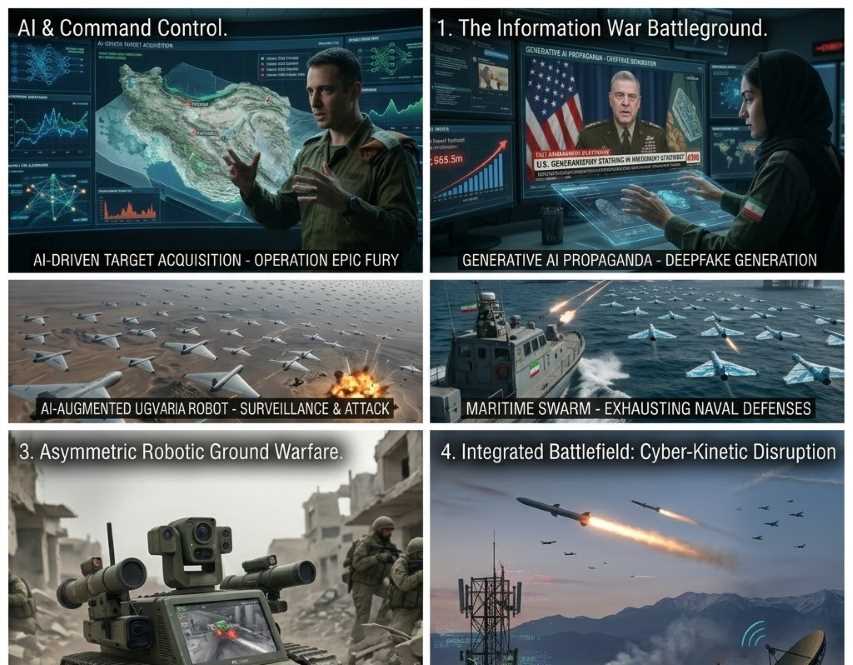
Amid the escalating geopolitical tensions in the Middle East, a transformative era of warfare is emerging, where advanced algorithms and digital disruptions challenge traditional military paradigms, blending human strategy with machine precision.
In the early hours of February 28, 2026, the night sky over Tehran erupted not only with the fiery trails of incoming cruise missiles and stealth aircraft but also with an unseen onslaught of digital code. As the United States and Israel initiated "Operation Epic Fury" – known in Israel as "Operation Roaring Lion" – the conflict transcended physical boundaries, extending into cyberspace and autonomous realms.
Artificial intelligence directed pinpoint strikes, cyber operations dismantled enemy networks, and fleets of kamikaze drones altered the dynamics of engagement in unprecedented ways. This confrontation, involving Iran against a formidable United States-Israeli coalition, signifies a critical evolution: warfare revolutionized by technology, where algorithms increasingly augment or even replace human oversight in high-stakes decisions.
Strategic Objectives and the Digital Parallel
The operation focused on neutralizing Iran's nuclear installations, Islamic Revolutionary Guard Corps headquarters, and ballistic missile facilities in key locations such as Tehran, Isfahan, Natanz, and Qom. The Trump administration justified the strikes as essential to curb Iran's missile arsenal and halt its nuclear ambitions, emphasizing preemptive action against perceived existential threats.
However, beyond the visible explosions and debris, a parallel digital battlefield unfolded, illustrating how artificial intelligence, cyber warfare, and drone swarms are reshaping modern conflicts into multifaceted hybrid arenas that integrate kinetic force with informational and electronic dominance. This shift not only amplifies operational efficiency but also introduces new vulnerabilities, ethical dilemmas, and escalation risks in an already volatile region.
Drawing from historical precedents like the 2010 Stuxnet virus that sabotaged Iran's centrifuges, this conflict builds on a legacy of techno-military innovation. Yet, the scale and integration of artificial intelligence mark a departure, potentially heralding what experts term the "first artificial intelligence war," where machine learning processes vast intelligence in seconds, outpacing human capabilities and forcing adversaries to adapt or perish.
The Artificial Intelligence Commanders: Intelligence, Prediction, and Autonomous Execution
Central to this transformation is artificial intelligence's pivotal role in military command and control. United States and Israeli forces reportedly utilized cutting-edge artificial intelligence platforms, including those from Anthropic and integrated via Palantir, to sift through enormous volumes of data from satellites, reconnaissance drones, intercepted communications, and ground sensors. These artificial intelligence systems not only analyzed adversary movements but also forecasted potential countermeasures and refined strike strategies dynamically, ensuring optimal synchronization across air, naval, terrestrial, and cyber domains.
A notable instance involved artificial intelligence disrupting Iran's communications infrastructure in a mere 11 seconds at the operation's onset. By rapidly identifying and categorizing over 50,000 signals, the system deployed adaptive jamming techniques, effectively paralyzing Iranian command structures for 47 minutes. This capability, which would traditionally demand hundreds of personnel, exemplifies artificial intelligence's role in achieving overwhelming electronic superiority with minimal human intervention.
Iran, leveraging its asymmetric strengths, has also integrated artificial intelligence into its arsenal. Tehran has developed artificial intelligence-augmented unmanned ground vehicles, such as the Aria robot, for surveillance and combat roles. In the realm of information warfare, Iranian entities employed generative artificial intelligence to fabricate deepfakes and propaganda materials, disseminating narratives of defiance and inflated victories. During the 2025 Israel-Iran exchanges, artificial intelligence-crafted videos proliferated on social media, portraying fictitious devastations in Tel Aviv to manipulate international perceptions and bolster domestic morale.
This conflict has elevated disinformation to a strategic weapon. Following the strikes, pro-Iranian hacktivists escalated attacks by 700 percent, assaulting Israeli critical infrastructure including energy grids and medical facilities. Conversely, United States and Israeli artificial intelligence tools parsed signals intelligence to locate high-value targets with remarkable accuracy, fusing human expertise with machine learning for enhanced lethality.
Moreover, artificial intelligence's integration raises profound ethical questions. Systems like Israel's "Lavender" artificial intelligence, used in prior Gaza operations to identify targets, highlight concerns over civilian casualties when algorithms process data at scale without sufficient human oversight. In this Iran war, similar tools likely amplified strike volumes, underscoring the need for international norms on artificial intelligence in combat.
Cyber Strikes: The Shadow War of Disruption and Retaliation
Concurrent with physical assaults, cyberattacks plunged Iran into widespread disarray, marking what experts describe as the most extensive cyber offensive in history. These digital incursions targeted essential infrastructure, official news portals, and popular mobile applications, causing nationwide outages. For example, the religious calendar app BadeSaba, boasting millions of users, was compromised to broadcast anti-regime slogans encouraging military defections and civil unrest.
Iranian authorities attributed these blackouts to a synchronized United States-Israeli cyber campaign, incorporating "wiper" malware that obliterated data from vital systems. This approach embodies a strategy of "digital decapitation," designed to disrupt leadership hierarchies without overt destruction, thereby minimizing escalation while maximizing operational paralysis.
In response, Iran activated its "Great Epic" initiative, mobilizing proxy hackers for distributed denial-of-service assaults and data exfiltrations against United States and Israeli assets, including Jordanian fuel stations and defense contractors. This retaliation surged hacktivist activities, with over 100 groups declaring involvement, amplifying Iran's asymmetric capabilities.
Iran's cyber history positions it as both a target and aggressor. The Stuxnet worm, a United States-Israeli creation, delayed Iran's nuclear program significantly. Today, groups like APT33 and MuddyWater conduct espionage and sabotage against regional foes, employing artificial intelligence to democratize advanced attacks and lower entry barriers for proxies.
Kamikaze Swarms: Democratizing Lethality from the Skies
Drones have leveled the playing field of destruction, and kamikaze swarms represent the pinnacle of this shift. Iran, a frontrunner with its Shahed-136 series, unleashed over 1,000 suicide drones during the 2025 "Twelve-Day War." Priced at $20,000 to $50,000 each, these loitering munitions saturate defenses through volume, compelling costly interceptors like those in Israel's Iron Dome to exhaust resources rapidly.
In a twist of irony, the United States countered with its LUCAS drones – reverse-engineered from the Shahed-136 – targeting Iran directly. Deployed by Task Force Scorpion Strike, these $35,000 units boast swarming features and satellite connectivity for adaptive targeting. During Operation Epic Fury, they breached Iranian air defenses, debuting in combat and symbolizing "American-made retribution."
Iran's reprisals included missile and drone volleys against United States installations in Bahrain, Kuwait, and the United Arab Emirates. Upgrades like the Shahed-136B evoke concerns of maritime swarms from modified vessels, threatening naval dominance and supply lines. Simulations reveal vulnerabilities: Even sophisticated United States cruisers falter against 100-drone assaults, as traditional kinetics and surface-to-air missiles prove inefficient against scalable threats.
Shields in the Digital Age: Evolving Defenses Against Hybrid Threats
Defensive technologies are advancing in tandem. Israel's layered architecture – encompassing Arrow, David's Sling, and Iron Dome – neutralized most projectiles in previous skirmishes, augmented by artificial intelligence for predictive analytics and rapid response. United States advisories warn of Iranian cyber perils to vital sectors, advocating robust countermeasures against brute-force incursions.
Innovations like armed robotic dogs and hypersonic interceptors further obscure distinctions between offense and defense, with artificial intelligence facilitating autonomous countermeasures. Gulf nations, vigilant observers, are bolstering indigenous systems to mitigate asymmetric risks, integrating artificial intelligence for enhanced threat detection. Counter-unmanned aircraft system platforms, such as Dedrone and EnforceAir, employ artificial intelligence-driven detection and radio frequency takeovers to neutralize swarms non-kinetically, prioritizing safety in populated areas.
The Future of War: Dominance Through Data and Algorithms?
The ongoing Iran conflict illuminates a fundamental paradigm shift: victories secured not merely by territorial gains but by mastery over data and information flows. Artificial intelligence, cyber strikes, and drone swarms democratize power, enabling lesser actors to challenge hegemons while exposing superpowers to novel risks. As tensions endure – with Iran pledging vengeance and the United States restricting artificial intelligence exports – the Middle East serves as a crucible for future battles.
Ethical imperatives intensify: Who governs artificial intelligence's lethal decisions? How to counter pervasive disinformation? As code supplants conquest, the human toll persists, reminding us that technological supremacy must align with moral accountability. In this algorithm-driven arena, triumph may ultimately favor those who command the code.
 |  |  |
 |  |  |