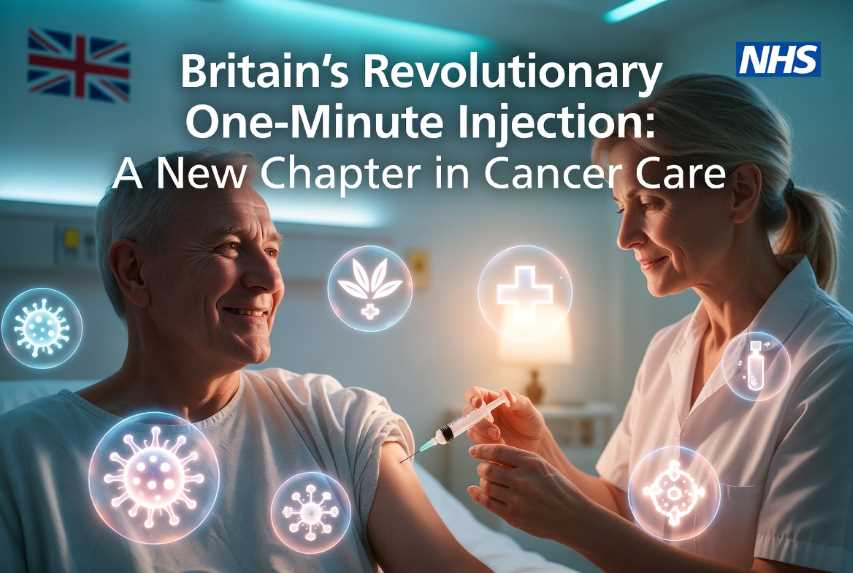
In May 2026, the UK’s National Health Service (NHS) began a historic rollout of a new cancer treatment that is as stunning in its speed as it is in its potential reach. This is an injectable form of the immunotherapy drug pembrolizumab (Keytruda), capable of treating 14 different types of cancer with a jab that takes as little as 60 seconds. For tens of thousands of patients, this innovation promises to slash the time spent in hospital by up to 90%, freeing them from lengthy intravenous drips and giving back precious hours of their lives.
🧬 What Is Pembrolizumab and How Does It Work?
Pembrolizumab is a type of monoclonal antibody and a leading example of a class of drugs known as checkpoint inhibitors. It works by blocking the activity of PD-1 (Programmed Cell Death-1), a protein found on the surface of T‑cells that normally acts as an "off‑switch" to prevent the immune system from attacking the body’s own tissues.
Many cancer cells hijack this safety mechanism by expressing a matching protein called PD‑L1, effectively telling the immune system "don’t attack." By blocking PD‑1, pembrolizumab releases the brakes on the body’s T‑cells, enabling them to recognize and destroy tumour cells throughout the body.
💉 The New Injectable Formulation
Until now, pembrolizumab was administered via intravenous (IV) infusion, a process that could take up to two hours per session and required specialist sterile preparation by hospital pharmacy teams.
The newly approved subcutaneous (under‑the‑skin) injection is supplied in a pre‑filled syringe, ready for immediate use. It is administered into the fatty tissue of the abdomen or thigh and requires no complex preparation. This slashes administration time by approximately 90%, meaning a treatment session that once occupied an entire morning or afternoon in hospital can now be over in just one or two minutes.
🧾 The 14 Cancers It Treats
The subcutaneous injection is approved for use against 14 different types of cancer—a remarkable breadth for a single medicine. These include:
Lung cancer
Breast cancer
Head and neck cancers
Cervical cancer
and others including bladder, kidney, liver, stomach, oesophageal, and certain subtypes of lymphoma and skin cancer
The treatment is given every three weeks as a one‑minute injection, or every six weeks as a two‑minute injection, depending on the specific cancer type and individual patient needs.
🏥 A Major Boost for NHS Productivity
The scale of the impact is enormous: around 14,000 patients start pembrolizumab therapy every year in England alone. The move to an injectable form is estimated to save the NHS more than 100,000 hours of preparation and treatment time annually—equivalent to roughly 11 years of clinic time.
This efficiency gain directly translates into more patients being seen and treated. James Richardson, National Specialty Advisor for Cancer Drugs at NHS England, called it a "win‑win innovation": patients spend far less time in hospital, while clinical teams gain vital capacity to care for others.
🗣️ A Lifeline for Patients
Beyond the numbers, the human impact is profound. Professor Peter Johnson, NHS National Clinical Director for Cancer, described the rollout as offering "a lifeline for thousands of patients," adding:
"It’s fantastic that this new rapid jab can now take just a minute to deliver – meaning patients can get back to living their lives rather than spending hours in a hospital chair. Managing cancer treatment and regular hospital trips can be really exhausting... this innovation makes therapy much quicker and more convenient".
Health and Social Care Secretary Wes Streeting—himself a kidney cancer survivor—spoke with personal conviction:
"As a cancer survivor, I know how important quick treatment is, and this rollout will offer quicker, more convenient care, saving patients time and helping them in their recovery with less time in hospital. ... Through innovations like this, we’re making every penny and every second count, and ensuring patients get NHS care that fits around their lives, not the other way around".
👩🦳 The Patient Experience
Shirley Xerxes, an 89‑year‑old patient from St Albans, was one of the first in the UK to receive the new subcutaneous injection at the Mount Vernon Cancer Centre. She described the experience as nothing short of transformative:
"I can't believe how little time it took. I was only in the chair for a matter of minutes. It means more time to live my life".
Similarly, 79‑year‑old Trevor Garfield from Weston‑Super‑Mare, treated at Bristol Hematology and Oncology Centre—one of the first hospitals in the UK to offer the new jab—praised the "swift" delivery that allowed his hospital visit to be completed in a fraction of the previous time.
🔬 Evidence and Regulatory Backing
The approval of the subcutaneous formulation is grounded in robust clinical evidence. Randomized Phase 3 clinical trials demonstrated that the injection achieves comparable drug levels in the body (pharmacokinetics) and equivalent tumour response rates and safety profiles to the intravenous form, while patients consistently reported a preference for the quicker, more convenient injection.
The UK’s Medicines and Healthcare products Regulatory Agency (MHRA) licensed the formulation, and the NHS moved swiftly to make it available, becoming one of the first health systems in the world to roll out the injectable form at scale.
📈 A Broader Context: The Cancer "Super‑Jab" Revolution
The pembrolizumab rollout follows the introduction in 2025 of a subcutaneous form of nivolumab (Opdivo), another PD‑1 inhibitor, which treats 15 different cancer types with a 3‑ to 5‑minute injection. Together, these near‑instant treatments now cover almost 30 types of cancer on the NHS.
This broader shift toward subcutaneous immunotherapy represents a fundamental change in cancer care delivery: shorter, simpler treatments that reduce burden on hospitals, staff and—most importantly—on patients and their families.
🔮 A Glimpse of the Future
The NHS’s rapid adoption of subcutaneous cancer injections signals a clear strategic direction under the National Cancer Plan for England, which explicitly prioritises moving more cancer treatment out of traditional hospital settings and into community and home environments whenever possible.
Ongoing research continues to explore whether pembrolizumab can benefit even more cancer types and whether it can be used in earlier‑stage disease, potentially increasing the number of patients who could benefit from this rapid‑access treatment.
🧭 The launch of the one‑minute pembrolizumab jab is more than a medical milestone—it is a practical, everyday revolution for the thousands of patients who, from now on, can receive cutting‑edge cancer treatment in the time it takes to brew a cup of tea. It reflects a broader vision of modern cancer care: one that is not only effective but also humane, efficient and designed around the people it serves. As Professor Johnson put it, this is about giving people their lives back—and that may be the most important breakthrough of all.
 |  |  |
 |  |  |