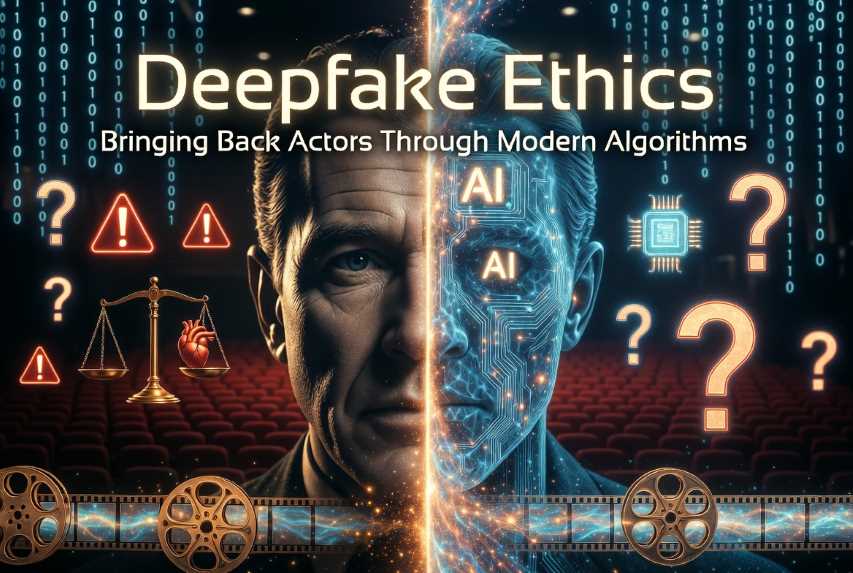
In an era where artificial intelligence can conjure lifelike performances from the past, the line between tribute and exploitation has never been thinner. Deepfake technology—once a niche tool for viral memes and amateur video edits—has evolved into a powerful force capable of digitally "resurrecting" deceased actors, allowing them to star in entirely new films, deliver fresh voiceovers, appear in commercials, or even interact with living cast members long after their passing. This technological marvel raises profound ethical questions that touch the very heart of human creativity, identity, and mortality: Who truly owns a person's likeness after death? Can consent ever be meaningfully posthumous when the individual is no longer here to voice their wishes? And what does this mean for the soul of storytelling itself, when machines can perfectly mimic the irreplaceable spark of human performance?
This comprehensive exploration delves deeply into the technology driving these digital revivals, real-world case studies from Hollywood and beyond, the multifaceted benefits that proponents highlight, the complex ethical dilemmas that critics warn against, the evolving legal frameworks attempting to govern this new frontier, the broader societal impacts, and forward-looking strategies for responsible innovation. As AI algorithms grow more sophisticated by the day in 2026, the film industry—and society at large—stands at a critical crossroads between groundbreaking innovation that honors artistic legacies and the risk of unchecked exploitation that could erode trust in visual media forever. With deepfakes now accessible not just to major studios but to independent creators, the stakes have never been higher for ensuring these tools serve humanity rather than commodify it.
The Technology Behind Digital Resurrection: From Basic Tricks to Hyper-Realistic AI
At its core, modern deepfake technology relies on a sophisticated ecosystem of machine learning algorithms that analyze enormous datasets of an actor's images, videos, audio recordings, and even subtle mannerisms to create hyper-realistic replicas capable of new, original performances. What began as experimental computer vision projects has transformed into a production-ready toolkit that blurs the boundaries of reality.
The foundation rests on Generative Adversarial Networks (GANs), a groundbreaking method pioneered in 2014. In this setup, two neural networks engage in a competitive "game": the generator creates fabricated images or video frames attempting to mimic real footage, while the discriminator acts as a critic, constantly evaluating whether the output is authentic or artificial. Through thousands or even millions of iterative training cycles on high-resolution archival material, the generator refines its output until the results are virtually indistinguishable from genuine recordings. This adversarial process allows for the seamless synthesis of facial expressions, skin textures, lighting interactions, and micro-movements that once required painstaking manual animation.
Building upon GANs, contemporary advancements incorporate diffusion models and transformer-based architectures, which have revolutionized the field. Diffusion models operate by starting with pure random noise and progressively "denoising" it step by step into photorealistic visuals, guided by detailed prompts and reference data. These models excel at maintaining consistency across entire scenes—handling complex elements like changing camera angles, dynamic lighting, or interactions with other performers—something earlier deepfakes struggled with. Meanwhile, autoencoders compress vast amounts of facial data from an actor's lifetime of work into compact mathematical representations, which can then be reconstructed and manipulated onto new body doubles or motion-captured performances.
Voice synthesis adds another layer of realism through neural audio models that clone not just timbre and pitch but also emotional inflection, breathing patterns, accents, and even idiosyncratic pauses unique to an individual. The practical workflow in a modern studio begins with producers curating hundreds of hours of reference material: old film clips, interviews, home videos, and high-quality photos. AI systems then map these onto new scripts, often using a living stand-in actor for body movements via motion capture suits, while the deepfake algorithm overlays the deceased performer's face and voice. The end product is a fluid, affordable digital double ready for entirely original dialogue or action sequences.
Challenges remain, of course—such as achieving perfect synchronization with lip movements, avoiding the subtle "uncanny valley" glitches in prolonged scenes, or adapting to period-specific costumes and environments. Yet by 2026, breakthroughs in real-time processing and multi-modal AI (combining video, audio, and even 3D modeling) have made these revivals faster and cheaper than ever, democratizing access beyond big-budget blockbusters. Tools powered by advanced generative systems now allow for on-the-fly adjustments during editing, turning what was once months of post-production into a matter of weeks. This technological leap has shifted deepfakes from novelty to staple, prompting urgent ethical reflection on their use.
The Evolution of Digital Resurrections: From Early CGI Experiments to AI-Driven Performances
Digital attempts to bring back actors predate widespread deepfakes, but AI has dramatically accelerated and refined the process, moving from noticeable CGI artifacts to near-seamless integrations.
Early examples relied heavily on traditional visual effects: In the 2016 film Rogue One, the late Peter Cushing was recreated as Grand Moff Tarkin through meticulous CGI modeling and performance capture, with explicit approval from his estate. This marked one of the first major Hollywood tests of posthumous digital likenesses, igniting initial whispers of "digital necromancy." Similarly, Carrie Fisher appeared as Princess Leia in Star Wars: The Rise of Skywalker (2019) via a combination of archival footage and advanced CGI, a decision made with family involvement shortly before her untimely passing.
The shift to full AI integration became evident in more recent productions. For instance, in Alien: Romulus (2024), Ian Holm's android character was revived four years after his death using a blend of AI facial reconstruction and practical animatronics. Director Fede Álvarez worked closely with Holm's family to secure consent, yet the final product still prompted widespread critical discussions about whether the result felt honoring or eerily artificial. Another high-profile case involved Val Kilmer in the 2026 film As Deep as the Grave, where his AI-generated replica took on the role of Father Fintan, drawing from extensive archival audio and visual data. Kilmer's family granted permission, positioning it as a respectful continuation of his legacy, but public backlash was swift—viewers described the performance as "terrifyingly lifelike yet soulless" and accused studios of prioritizing profits over artistic purity. Directors countered by calling it an "ethical blueprint" for future collaborations, emphasizing transparency in the creative process.
Beyond these, other controversies have emerged globally. Voice recreations, such as attempts to feature the late French actor Alain Dorval in new dubbing projects (ultimately scrapped in 2025 due to family objections), highlight how even audio-only deepfakes can stir emotions. Planned revivals of icons like Diane Keaton or cultural figures in non-Hollywood contexts—such as Salvador Dalí appearing in museum interactive exhibits or Lola Flores in Spanish advertising campaigns—have revealed cultural divides in acceptance. Some audiences embrace the nostalgia and educational value, while others feel a deep sense of unease, arguing that these recreations commodify grief and rewrite personal histories without the original artist's input.
These cases illustrate a clear evolution: Early CGI efforts were limited by cost and detectability, often requiring heavy manual intervention. Pure AI now enables entirely new performances from scratch, scripted dialogue never spoken by the actor in life, and even cross-generational interactions. As the technology matures, the question shifts from "Can we do this?" to "Should we—and under what conditions?"
The Ethical Dilemmas: Consent, Dignity, Deception, and Broader Societal Impacts
While the technology dazzles with its creative potential, the ethical landscape is fraught with complexities that demand rigorous scrutiny from creators, audiences, and regulators alike.
Posthumous Consent and Control Over Legacy
The most fundamental issue is that the deceased cannot provide ongoing approval for new roles or portrayals. Estates or immediate family members often step in as decision-makers, but this proxy system raises thorny questions: What if the actor themselves would have vehemently objected? For example, Robin Williams' daughter Zelda has publicly advocated against unauthorized AI deepfakes of her father, describing them as invasive intrusions into his carefully curated public image. Without clear, legally binding directives established during an actor's lifetime—such as detailed wills specifying allowable uses—decisions risk becoming battles between profit-driven studios and grieving relatives. This dilemma extends to mismatched roles: Imagine a revered dramatic legend digitally forced into a lighthearted comedy or an action franchise that contradicts their personal values.
Dignitary Harm and the Risk of Misuse
Deepfakes possess an inherent power to fabricate not just performances but potentially harmful or misleading content. Even "benign" revivals can lead to dignitary harm by placing icons in contexts they never chose; from endorsing products they might have rejected to appearing in narratives that distort their real-life beliefs. Malicious applications amplify this: fabricated videos could spread misinformation, create scandalous scenarios involving historical figures, or even enable non-consensual intimate depictions. The broader erosion of trust in visual evidence—what scholars call the "liar's dividend"—means that genuine footage could be dismissed as fake, undermining journalism, history, and public discourse.
Economic and Professional Impacts on the Living
Reviving deceased stars could displace opportunities for emerging and working actors. Why invest in training new talent or paying living performers when studios can "hire" a legendary name at a fraction of the cost, with no scheduling conflicts or salary negotiations? This economic pressure threatens the entire ecosystem of film production, from extras to lead roles, potentially homogenizing storytelling by favoring recycled icons over fresh voices. Unions like SAG-AFTRA have raised alarms about long-term job losses and the devaluation of human artistry.
Psychological and Cultural Ripples
Audiences often report a profound discomfort known as the uncanny valley effect—where something looks almost human but not quite—exacerbated by deepfakes. Focus groups reviewing recent revivals have described mixed feelings of nostalgia laced with existential unease, as if witnessing a ghost performing on screen. On a cultural level, these technologies risk commodifying identity itself, transforming unique human lives into perpetual intellectual property assets. Philosophically, they challenge notions of mortality, authenticity in art, and the sacredness of memory: Does digitally extending a career honor the person's spirit, or does it deny the natural closure that death provides?
Critics have likened the practice to a modern form of Frankenstein hubris, while proponents argue it preserves cultural heritage for future generations. The debate underscores a need for nuanced guidelines that prioritize empathy over efficiency.
The Legal Landscape: Emerging Protections, Global Variations, and Persistent Gaps
Regulation is racing to catch up with technology, but the framework remains patchwork and often reactive.
In the United States, landmark legislation such as California's AB 1836 (enacted in 2024) requires explicit consent from an actor's estate for any AI-generated likeness in films, television, video games, or digital advertisements. This has been hailed by performers' guilds as a significant step toward protecting legacy rights. Federally, advocacy from organizations like SAG-AFTRA has pushed for bills such as the NO FAKES Act, which aims to establish nationwide safeguards for voice and likeness, including mandatory compensation structures and contractual clauses for digital replicas. States like New York have introduced requirements for clear disclaimers labeling synthetic performers, particularly in commercial contexts.
Internationally, approaches vary widely. European frameworks emphasize personal dignity and data protection, often extending stronger postmortem rights than in the U.S. Some Asian markets, with booming entertainment industries, are experimenting with hybrid models that balance innovation with family veto powers. However, enforcement gaps persist: Non-commercial deepfakes shared on social media frequently evade oversight, and cross-border productions complicate jurisdiction.
High-profile lawsuits continue to test these boundaries, setting precedents for how estates can challenge unauthorized uses. Best practices emerging from the industry include on-screen transparency notices, detailed pre-production contracts, and third-party audits of AI outputs. Yet without unified global standards, the risk of forum-shopping by studios remains a concern.
Benefits and Opportunities: Harnessing AI for Positive, Responsible Revivals
Amid the controversies, deepfake technology offers compelling upsides when applied thoughtfully and ethically.
Creatively, it enables the completion of unfinished projects—such as integrating an actor into a sequel they began filming before passing—or exploring speculative "what if" narratives that enrich franchises. Cost efficiencies make high-caliber talent accessible to smaller independent films, fostering diverse storytelling that might otherwise never reach audiences. In education and preservation, deepfakes can breathe life into historical figures for documentaries, museums, or classrooms, making abstract lessons vivid and engaging without fabrication.
Therapeutic applications are also emerging: Voice cloning for audiobooks or personalized messages can provide comfort to fans and families alike. When paired with family approval, artistic merit, and clear labeling, these tools extend legacies in meaningful ways—celebrating contributions rather than exploiting them. Done right, digital resurrection becomes a bridge connecting generations through shared cultural touchstones.
Industry Responses, Future Outlook, and Pathways to Responsible Innovation
Studios and guilds are responding with voluntary ethical codes, pilot programs for watermarking AI content, and collaborations on detection software to empower viewers. By 2030, experts predict even more advanced multimodal systems capable of real-time deepfakes, necessitating proactive measures like mandatory AI literacy education in schools and public awareness campaigns.
The path forward demands a balanced ecosystem: technological safeguards such as embedded digital watermarks, stronger international treaties, and industry-wide standards that reward consent-driven projects. Audiences, too, play a role by supporting transparent productions and demanding accountability.
Celebrating Life or Denying Death?
Deepfake ethics in the realm of bringing back actors through modern algorithms is far from a simple black-and-white issue. These powerful tools offer an exhilarating bridge to the past, promising creative renewal and cultural continuity, yet they compel us to confront deep questions about consent, dignity, authenticity, and the human essence in an increasingly synthetic world. As examples from recent blockbusters demonstrate, the technology is here to stay—whether we wield it to honor irreplaceable talents or risk reducing them to pixels on a profit ledger.
Ultimately, true artistic immortality stems not from flawless algorithms but from the genuine emotions and connections they evoke. The responsibility falls on creators to prioritize purpose over possibility, on regulators to close loopholes with compassion, and on society to engage critically with the media we consume. When we digitally resurrect actors, are we truly celebrating their lives and gifts—or subtly denying the profound finality of death that makes every human performance so precious? The answer will define not just the future of cinema, but our collective relationship with technology, memory, and what it means to be alive.
 |  |  |