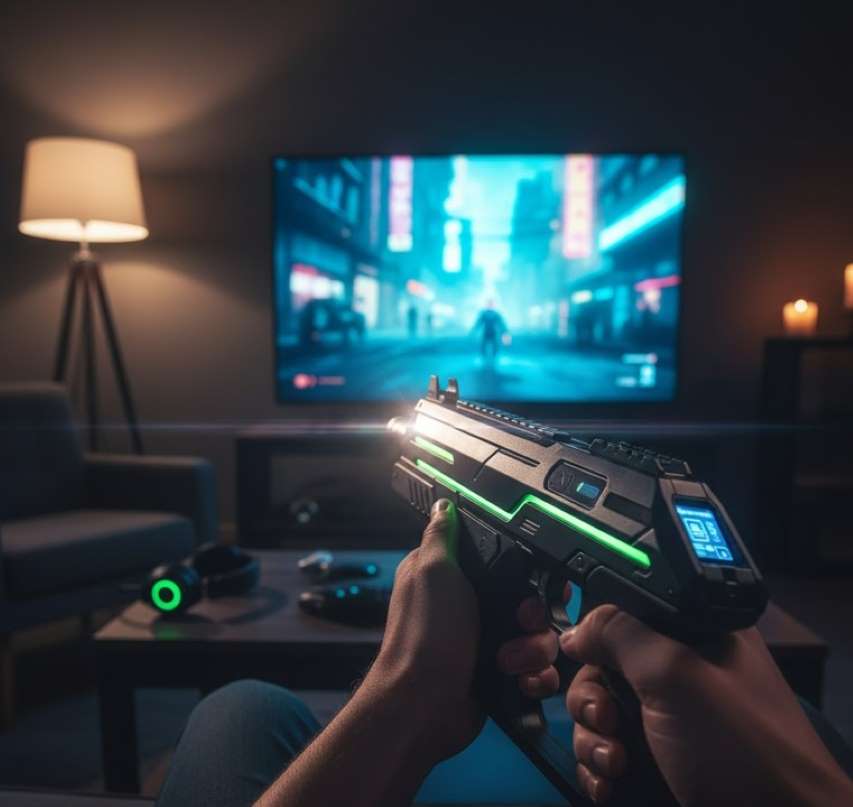
A Shooting Game Gun Controller, commonly known as a light gun or guncon, is a specialized video game peripheral shaped like a pistol or rifle. It allows players to interact with arcade or console shooting games by pointing and firing at targets on the screen, creating an immersive, direct-action experience that transcends standard button-based controllers.
Unlike traditional controllers that rely on abstract input (e.g., moving a cursor with a thumb stick), the gun controller aims to replicate the natural, intuitive action of aiming and shooting. Its functionality has evolved from simple optical sensing to sophisticated motion-tracking and IR-camera-based systems.
Primary Components & Materials
Exterior Shell & Form Factor
Body: Molded plastic (often ABS), shaped as a revolver, semi-automatic pistol, SMG, shotgun, or rifle.
Weight & Balance: May include weighted components to simulate realistic heft.
Grip: Ergonomically contoured, often with rubberized texturing for comfort and stability.
Barrel: A hollow or solid plastic extension. In modern controllers, it often houses an IR camera or sensors.
Core Input Controls
Trigger: The primary action button for firing. Typically has analog or digital pressure sensitivity.
Secondary Buttons: Often include buttons on the grip or side for actions like reloading, switching weapons, or throwing grenades (e.g., A, B buttons).
Directional Pad / Stick: Sometimes integrated for menu navigation or character movement in hybrid games.
Start/Select Buttons: Located on the body for system functions.
Reload Mechanism: Can be a button, a pump-action slide on a shotgun model, or a "shake-to-reload" motion sensor.
Internal Electronics & Connectivity
Motion Sensors: Modern controllers use accelerometers and gyroscopes (Inertial Measurement Units - IMUs) to track tilting, rotating, and rapid movement (e.g., recoil simulation or shaking to reload).
IR Camera/Sensor: Found in controllers like the Nintendo Wii Remote or PS Move, it tracks IR lights emitted by a sensor bar to calculate on-screen aiming.
Vibration Motor (Rumble): Provides haptic feedback for recoil, impacts, or other game events.
Connection: Historically used proprietary wired connections. Modern versions connect via Bluetooth or a proprietary wireless dongle. Arcade cabinets typically use direct USB or serial connections.
Key Gameplay Mechanics & Features
On-Screen Reticle: Most games display a cursor or crosshair representing where the gun is aimed.
Recoil Feedback: The controller may physically vibrate or jerk (in advanced models) to simulate gun kick.
Reload Actions: Players often must point the gun off-screen (to an ammo source) and pull the trigger, or perform a specific motion (e.g., pumping a shotgun controller).
Cover Mechanics: In arcade rail-shooters like Time Crisis, a foot pedal is often used to make the character pop out from cover.
Multiplayer Support: Many systems support two players with separate gun controllers for cooperative or competitive play.
Advantages & Appeal
High Immersion: Creates a direct, physical connection between player action and on-screen result.
Accessible Gameplay: The "point and shoot" mechanic is instantly understandable, lowering the barrier to entry.
Physical Engagement: Encourages standing and moving, offering a more active experience than sitting with a standard controller.
Arcade Authenticity: Brings the classic arcade shooting gallery experience into the home.
Novelty & Nostalgia: Strong nostalgic appeal for fans of classic light gun games.
Limitations & Challenges
Display Dependency: Classic light guns only work with CRT televisions. They are incompatible with modern LCD, OLED, or Plasma screens due to different display technologies (progressive scan vs. CRT's instantaneous electron beam).
Calibration Required: Modern IR and motion-based guns often require setup and calibration for accurate aiming.
Accuracy Drift: Motion-based controllers can suffer from gyro drift over time, requiring re-centering.
Fatigue: Holding a gun-shaped controller steady at arm's length can cause "gun arm" fatigue during long sessions.
Space Requirements: Some systems require clear space between the player and the sensor bar/camera.
Limited Game Library: Dedicated shooting games are a niche genre, so the controller often has limited use.
Modern Implementations & Alternatives
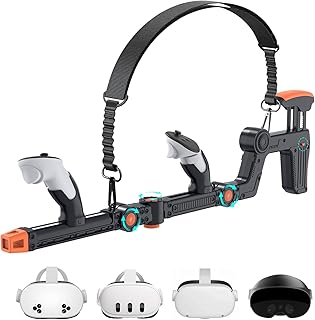
VR Gun Controllers: In Virtual Reality, motion-tracked controllers held in gun-shaped stocks provide the most immersive shooting experience, with true 1:1 tracking and 3D spatial interaction.
Arcade Cabinets at Home: Enthusiasts modify old light guns with LCD- compatible solutions (like the Sinden Lightgun, which uses an onboard camera to track a border on the screen) to play classic games on modern displays.
Gyro Aiming in Standard Controllers: Many modern console shooters (e.g., Splatoon, Fortnite) offer gyro-assisted aiming using the standard gamepad's built-in gyroscope, providing a similar precision-aiming feel.
Selection Criteria & Buying Guide
Consider these factors if purchasing a gun controller:
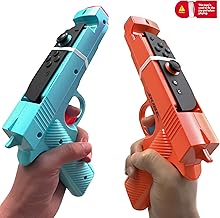
Console/Platform Compatibility: Ensure it is designed for your specific system (e.g., PlayStation, Nintendo, PC).
Display Technology: If buying a classic light gun, you must have a CRT TV. For modern TVs, choose a modern IR/motion-based model or a specialty solution like the Sinden.
Game Library: Check if there are enough games you want to play that support the peripheral.
Build Quality: Look for solid construction, a comfortable grip, and responsive triggers.
Wired vs. Wireless: Wired offers zero latency; wireless offers convenience and freedom of movement.
Intended Use: For casual party games, a simple Wii Remote may suffice. For serious arcade emulation, a dedicated, precise light gun solution is better.
The Shooting Game Gun Controller is an iconic peripheral that represents the enduring desire for tangible, physical interaction in gaming. While its technology has dramatically shifted from the CRT-dependent light gun to the motion-sensing, camera-tracked devices of today, its core appeal remains unchanged: the simple, visceral thrill of aiming and firing.
It carves out a unique niche in the gaming landscape, serving as a bridge between the classic arcade era and modern motion-controlled and VR experiences. For fans of rail-shooters, light gun classics, or anyone seeking a more active and immersive way to play, it remains an unparalleled tool for virtual marksmanship.
 |  |  |
 |  | ![FASTSNAIL [Switch 1/2 Compatible] Shooting Game Gun for Nintendo Switch 2/1/OLED, Detachable Gun Handle with portable for ...](https://m.media-amazon.com/images/I/61zt16cmaNL._AC_UY218_.jpg) |