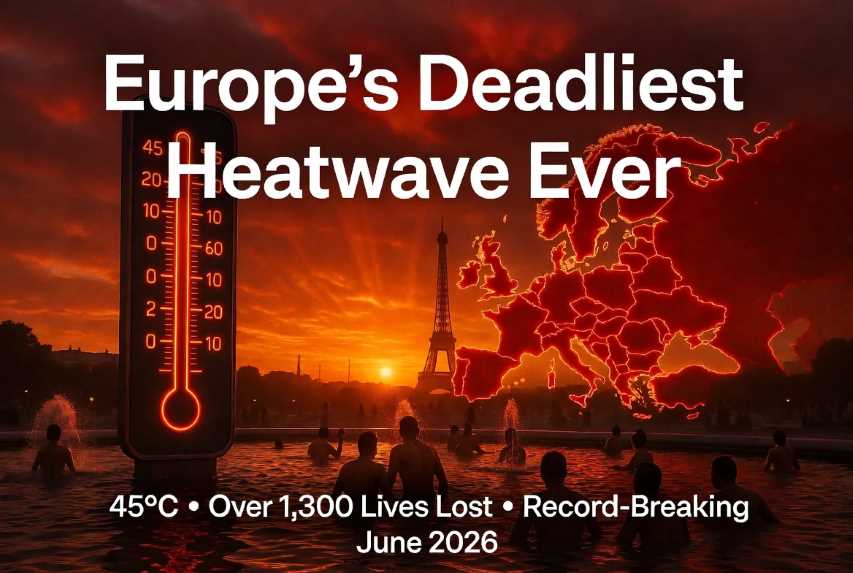
Europe is living through its most brutal and record-shattering heatwave in modern history. For nearly two weeks, a merciless “heat dome” parked over the continent has pushed temperatures to unprecedented levels, with peaks of 40–45 °C (104–113 °F) recorded from the Iberian Peninsula deep into Central and Eastern Europe. What began as an unusually early and intense May heatwave has evolved into a late-June catastrophe that scientists are already calling the most severe event of its kind ever documented on the continent.
The human cost has been devastating. The World Health Organization has confirmed more than 1,300 excess deaths directly linked to the extreme temperatures since June 21 alone, with France bearing the heaviest burden at approximately 1,000 additional fatalities. Spain, Italy, Germany, and the United Kingdom have also reported significant rises in heat-related mortality. Beyond the statistics lie countless personal tragedies: elderly residents dying alone in sweltering apartments, children drowning while seeking relief in dangerously warm rivers, outdoor workers collapsing on the job, and families watching helplessly as loved ones suffer.
This is not merely uncomfortable summer weather. It is a full-scale humanitarian, infrastructural, and environmental emergency that has exposed deep vulnerabilities in European societies and delivered a sobering preview of the climate future scientists have long warned about.
The Meteorology Behind the Monster: An Omega Block and a Saharan Heat Dome
The current crisis was driven by a rare and persistent weather pattern known as an “omega block.” This high-pressure system created a massive, slow-moving dome of hot, dry air that effectively blocked cooler Atlantic weather from reaching much of the continent. The result was a prolonged period of clear skies, intense solar radiation, and air masses originating from the Sahara that grew hotter with each passing day.
Temperatures across France, Spain, Germany, Poland, and neighboring countries ran between 5 °C and 12 °C above seasonal averages for extended periods. Night-time lows frequently remained above 25 °C in many urban areas, denying people the vital recovery period that cooler evenings normally provide. Meteorologists noted that this combination of extreme daytime heat and insufficient nocturnal relief turned what might have been survivable conditions into a lethal trap for the most vulnerable.
Country-by-Country: Where Records Fell and Lives Were Upended
France endured the most extreme conditions. On June 23, the southwestern town of Pissos recorded 44.3 °C, the highest temperature ever measured in France during June. Bordeaux reached 42.1 °C, while Paris experienced its hottest June days in decades, with the capital struggling under sustained heat that pushed infrastructure and emergency services to breaking point. More than 845 schools closed completely, and another 1,800 had to radically alter schedules. Rail services were repeatedly disrupted as tracks expanded and buckled. Around 68,000 households suffered power outages at various points, largely because the national grid was overwhelmed by air-conditioning demand and because several nuclear power plants had to reduce output — their river-cooling systems could no longer cope with water temperatures that were simply too high.
Germany broke temperature records on three consecutive days. The town of Coschen in the east hit 41.7 °C, while other stations near the French border recorded 41.5 °C. In Berlin, police resorted to using water cannons to spray overheated crowds gathered in public squares. Hospitals across the country reported sharp increases in heat-related admissions, particularly among the elderly and those with pre-existing respiratory or cardiovascular conditions.
Poland witnessed history on June 28 when Słubice recorded 40.5 °C — a new national all-time temperature record, eclipsing the previous mark set more than a century earlier in 1921. Low rainfall earlier in the season left forests tinder-dry, forcing authorities to issue severe wildfire warnings and set up emergency water stations in multiple municipalities.
Spain saw parts of the country exceed 45 °C. The combination of extreme heat and pre-existing drought conditions placed enormous pressure on reservoirs and agricultural regions. At least two confirmed heatstroke deaths were reported — a 90-year-old woman in a nursing home near Bilbao and a 68-year-old man in Almería. Wildfire risk remained critically high across large areas of the country.
The United Kingdom, despite its usually temperate climate, was not spared. A new June temperature record of 36.7 °C was set in Somerset. East Surrey Hospital declared a critical incident, limiting services to life-threatening emergencies only as demand for care surged. Many homes and offices without air conditioning became unbearable, leading to widespread reports of sleep deprivation and heat exhaustion.
Other nations, including the Czech Republic (41.1 °C), Hungary (up to 41.8 °C), Italy, Belgium, and even Denmark, all recorded either new June or all-time national highs. The breadth of the event — affecting both traditionally hot southern regions and northern areas unaccustomed to such extremes — made this heatwave uniquely dangerous.
The Human Stories Behind the Statistics
Behind every excess death statistic are real people whose lives were forever altered. In France, the number of drownings rose dramatically as desperate residents — many of them young people and families — sought relief in rivers, lakes, and the sea. Among the victims was promising young footballer Kenzo Kies, who drowned while trying to cool down. Two children died after being left in parked cars. Emergency services reported call volumes up by as much as 75% compared with the same period last year.
In Spain, care home staff described harrowing scenes of elderly residents struggling to breathe in rooms that could not be adequately cooled. One nursing home worker near Bilbao recounted how a 90-year-old resident passed away despite staff efforts to keep her hydrated and in the shade. Similar stories emerged from Italy, where power cuts left many apartment blocks without functioning elevators or air conditioning, trapping frail residents on upper floors.
In Belgium, wildlife rescue centers reported being overwhelmed with calls about birds and small mammals suffering from heat stress. Volunteers described finding dehydrated hedgehogs and young birds that had fallen from nests because parents could no longer find enough water or shade.
Outdoor workers — delivery drivers, construction crews, farmers, and street cleaners — bore a disproportionate burden. Many described finishing shifts with pounding headaches, nausea, and dizziness. Several European countries issued temporary work restrictions during peak heat hours, but enforcement was inconsistent and many low-wage workers felt they had no choice but to continue.
Healthcare Systems Pushed to the Limit
Hospitals and emergency services across the affected regions faced extraordinary pressure. In the United Kingdom, multiple hospitals declared critical incidents. In France, emergency medical calls rose by more than 20% in some departments, with heat-related illnesses compounding existing staffing shortages. Intensive care units saw increased admissions for heatstroke, dehydration, and exacerbation of chronic conditions such as heart and lung disease.
Mental health impacts are only beginning to be understood. Prolonged heat is known to increase irritability, anxiety, and sleep disorders. Psychologists reported rises in patients presenting with heat-aggravated depression and panic attacks, particularly among those living alone or in poorly insulated housing.
Infrastructure and Economic Strain
The heatwave exposed critical weaknesses in infrastructure designed for a cooler climate. Railway networks suffered repeated disruptions as metal tracks expanded and overhead power lines sagged. Airports faced delays when runway surfaces became too hot for safe operations. Energy grids strained under record demand for cooling, while simultaneously losing generation capacity from thermal power plants unable to use river water for cooling.
Agriculture and food production also took heavy hits. Livestock farmers reported increased mortality among animals and sharp drops in milk yields. Wine-growing regions in France and Italy expressed concern about grape quality and potential long-term damage to vines. Vegetable and fruit harvests faced stress from both heat and water shortages, raising fears of higher food prices in the coming months.
Tourism, a vital economic sector for many southern European countries, experienced a paradoxical effect. While some beach destinations saw high visitor numbers, many cultural sites, outdoor festivals, and hiking trails were forced to close or severely restrict access during the hottest hours. Tourists described feeling trapped in hotel rooms without adequate cooling, and several popular attractions issued health warnings or reduced operating hours.
A Climate Change Reality Check
Scientists have been unequivocal: this heatwave would have been virtually impossible without human-caused climate change. Attribution studies show that the extreme night-time temperatures recorded during this event are now roughly 100 times more likely than they were just two decades ago. Europe is warming faster than almost any other region on Earth, and events that were once considered once-in-a-century occurrences are becoming disturbingly frequent.
The 2003 European heatwave, which killed an estimated 70,000 people, served as a wake-up call. Yet nearly a quarter-century later, many cities still lack sufficient green spaces, reflective building materials, widespread air conditioning in public housing, and robust early-warning systems tailored to the most vulnerable populations. The 2026 event has made it painfully clear that adaptation efforts have lagged far behind the pace of climate change.
How Governments and Societies Responded
National and local authorities activated heat action plans, issued red alerts, opened cooling centers, and urged residents to check on neighbors. France extended school closures and adjusted working regulations. Several countries deployed additional emergency medical teams and increased public messaging about hydration and avoiding outdoor activity during peak hours.
Yet critics argued that responses remained reactive rather than proactive. Many cooling centers were underutilized because vulnerable populations — particularly the elderly and those with mobility issues — lacked transportation or information about them. Social media filled with stories of people unable to reach help in time. The tragic drownings highlighted another gap: while authorities warned against swimming in unsupervised areas, the sheer desperation caused by the heat led many to ignore the risks.
Looking Ahead: What This Heatwave Means for the Future
As cooler air finally begins to push into Western Europe in early July, attention is turning to the longer-term implications. Climate scientists warn that without rapid and deep cuts in greenhouse gas emissions, summers like 2026 will become the norm rather than the exception within the next 10–20 years. Urban areas will feel the effects most acutely due to the urban heat island effect, where concrete and asphalt absorb and radiate heat long after sunset.
There are rays of hope in innovation and adaptation. Cities experimenting with cool roofs, expanded urban forests, reflective pavements, and district-level cooling systems have shown measurable reductions in local temperatures. Advances in weather forecasting powered by artificial intelligence are improving early warning accuracy, potentially saving lives in future events. Passive cooling architectural designs and next-generation building materials offer ways to keep indoor environments comfortable without massive increases in energy consumption.
Yet experts emphasize that technological solutions alone are insufficient. Stronger building codes, better protection for outdoor workers, expanded access to cooling for low-income households, and — most critically — accelerated global action to limit further warming remain essential.
Practical Steps Individuals Can Take
While systemic change is needed, individuals can take immediate steps to protect themselves and their communities during extreme heat:
Drink water regularly, even when not thirsty, and avoid alcohol and excessive caffeine.
Never leave children, elderly relatives, or pets unattended in vehicles.
Check on neighbors, especially those living alone or with limited mobility.
Use fans and cross-ventilation strategically; close curtains or blinds during the hottest part of the day.
Wear lightweight, loose-fitting, light-colored clothing and a wide-brimmed hat when outdoors.
Reschedule strenuous outdoor activities for early morning or late evening.
Learn the signs of heat exhaustion (heavy sweating, weakness, dizziness) and heatstroke (hot, dry skin, confusion, rapid pulse) and seek medical help immediately if they appear.
Support local initiatives to create more shaded public spaces and cooling centers.
A Defining Moment for Europe and the World
The summer of 2026 will be remembered as the moment when Europe’s climate reality could no longer be ignored. The images of people wading desperately into fountains in Paris, of hospitals overwhelmed, of farmers and outdoor workers pushed to their physical limits, and of families grieving preventable losses will linger long after temperatures return to normal.
This heatwave was not just a weather event. It was a stress test of societies, infrastructure, healthcare systems, and political will. The results have been sobering. Yet within the crisis lie opportunities — to accelerate the transition to cleaner energy, to redesign cities for resilience, to strengthen social safety nets, and to treat climate adaptation with the same urgency once reserved for economic growth.
For the thousands who lost loved ones, for the millions who suffered in silence, and for future generations who will inherit whatever climate we leave them, the question is no longer whether Europe can afford to act. It is whether it can afford not to.
The heat will eventually break. The records may stand for a time. But the lessons of this summer must not be allowed to fade with the first autumn rains. Europe — and the world — has been given another unmistakable warning. The only remaining question is whether we will finally listen.
 |  |  |
 |  |  |