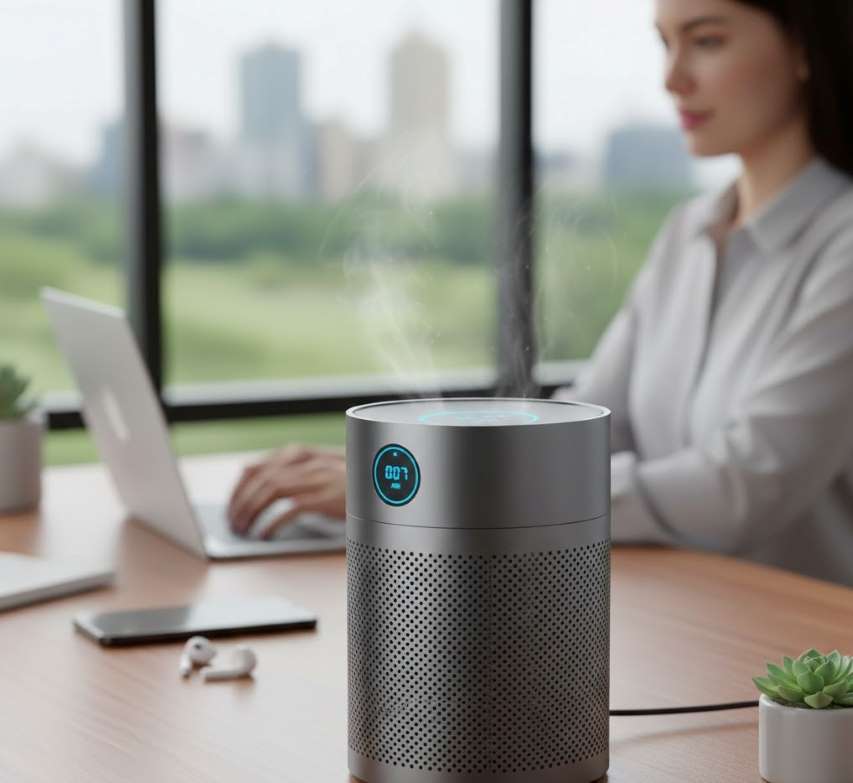
Breathing Easier Anywhere
A Portable Air Purifier is a compact, self-contained device designed to remove airborne contaminants from the immediate surroundings in personal spaces. Unlike whole-home systems that integrate with HVAC ductwork, these mobile units provide targeted, on-demand air cleaning wherever they are placed—whether on a desk, in a bedroom, during travel, or inside a vehicle. They have evolved from niche medical appliances into essential wellness tools for allergy sufferers, urban commuters, and health-conscious individuals seeking control over their breathing environment in an increasingly polluted world.
Core Technology: How Portable Air Purifiers Work
Portable air purifiers operate on a simple yet scientifically refined principle: draw in ambient air, capture or neutralize pollutants, and circulate clean air back into the space. The effectiveness of this process depends on the technologies employed.
Mechanical Filtration (HEPA)
The gold standard in air purification is High-Efficiency Particulate Air (HEPA) filtration. A true HEPA filter captures 99.97% of particles as small as 0.3 microns—including dust, pollen, mold spores, pet dander, and even bacteria. This efficiency is achieved through a dense mat of randomly arranged fibers that trap particles via interception, impaction, and diffusion.
The Washington State Department of Health emphasizes that "mechanical portable air cleaners with a HEPA filter are highly effective at removing indoor air contaminants”. Crucially, consumers should avoid devices advertising "HEPA-like," "HEPA-style," or "99% HEPA," as these do not meet the true standard.
Activated Carbon Filtration
While HEPA filters excel at capturing particles, they do not remove gases or odors. Activated carbon filters address this limitation. These filters are processed to create millions of microscopic pores that adsorb (chemically bind) gaseous pollutants, including:
Volatile Organic Compounds (VOCs) from paints, cleaning products, and new furniture
Cooking odors and smoke
Traffic-related pollutants like nitrogen dioxide (NO₂)
Toluene and other industrial chemicals
Most effective portable purifiers combine HEPA and activated carbon in multi-stage filtration systems.
Filter-less Systems
Emerging alternatives include water-based purifiers that use hydro-filtration to capture pollutants while simultaneously humidifying the air. These require no replacement filters but may have different effectiveness profiles.
Key Performance Metrics: Understanding the Numbers
Clean Air Delivery Rate (CADR)
CADR is the most important metric for evaluating an air purifier's performance. Developed by the Association of Home Appliance Manufacturers (AHAM), it measures the volume of filtered air delivered per minute, typically expressed in cubic feet per minute (CFM) or cubic meters per hour .
The Washington State Department of Health provides clear guidance: choose a device with a smoke CADR equal to at least two-thirds of your room's area (in square feet). For example, a 300-square-foot room requires a CADR of at least 200 CFM.
Room Area (sq ft) | Minimum Recommended Smoke CADR (CFM) |
|---|---|
200 | 133 |
300 | 200 |
400 | 267 |
500 | 333 |
600 | 400 |
Table: Recommended portable air cleaner sizing for 5 air changes per hour
Room Coverage
Manufacturers typically specify a maximum room size based on achieving a certain number of air changes per hour (ACH). For allergy sufferers, 4-5 ACH is recommended. A purifier rated for 250 m³/h CADR can handle spaces up to approximately 30 square meters (320 square feet) .
Noise Levels (Decibels)
Since portable purifiers often operate in bedrooms and workspaces, noise is a critical consideration:
20-30 dB: Whisper-quiet; suitable for sleep (Philips achieves 20.5 dB in Sleep mode; Smart Air QT3 operates at 29 dB on low )
30-45 dB: Moderate; acceptable for daytime use
45-55+ dB: Noticeable; may be disruptive for light sleepers
The U.S. EPA recommends keeping indoor noise levels below 45 dB.
Energy Consumption
Most portable purifiers consume surprisingly little power:
Philips PureProtect Mini: 23W maximum (less than a light bulb)
Smart Air QT3: 9W on high
Industrial portable units: 9-185W depending on speed
Key Features & Smart Capabilities
Modern portable air purifiers incorporate increasingly sophisticated features:
Air Quality Sensing
Real-time monitoring: Sensors detect particulate matter (PM2.5) and sometimes gases
Auto mode: Automatically adjusts fan speed based on detected pollution levels
Visual feedback: Color-coded indicators (green = good, yellow = moderate, red = poor)
Connectivity & Control
Smartphone apps: Remote monitoring, scheduling, filter life tracking (Philips Air+ app)
Voice control: Compatibility with Google Assistant and Alexa
Data visualization: Graphs showing air quality trends over time
User Convenience
Timer functions: 2/4/8-hour settings for energy saving
Sleep mode: Dimmed displays, ultra-quiet operation
Child lock: Prevents accidental setting changes
Filter replacement indicators: Eliminates guesswork
Design Considerations
Compact footprint: Many models occupy less than 1 square foot of desk space
Portability features: Integrated handles, lightweight construction (as light as 0.72 kg)
Aesthetics: Available in various colors and finishes to complement decor
Applications and Use Cases
Home Environments
Bedrooms: Quiet overnight operation for allergy-free sleep
Kitchens: Activated carbon filters capture cooking odors
Nurseries: Protect infants from airborne irritants
Home offices: Maintain concentration with cleaner air
Travel and Commuting
Hotel rooms: Unknown air quality and ventilation
Airplanes: Personal breathing zone protection during flights
Trains and buses: Reduce exposure to recirculated pathogens
Ride-share vehicles: Quick odor and particle removal
One traveler reported using the QT3 on a transatlantic flight, noting: "It's great to have something with you that might make a difference rather than just being stuck there, helpless" .
Dormitories and Shared Housing
College dormitories present unique air quality challenges:
Poor ventilation and shared HVAC systems
VOCs from furnishings and cleaning products
Smoke, vaping, and strong fragrances from roommates
Limited control over building maintenance
The average dorm room is approximately 228 square feet, making compact purifiers with appropriate CADR ideal solutions .
Medical and Sensitive Populations
Allergy sufferers: HEPA filtration removes triggers like pollen and dust mite allergens
Asthma patients: Reduces exposure to respiratory irritants
Immunocompromised individuals: Additional protection against airborne pathogens
Medication storage: Some use purifiers to maintain clean environments for sensitive medications
Vehicle Interiors
Car-specific purifiers address:
Traffic-related pollution during commutes
Odors from food, pets, and smoking
VOCs off-gassing from interior materials
Recirculated cabin air
Operation, Maintenance, and Optimization
Proper Placement
For optimal performance:
Place at breathing level (desk, nightstand, table)
Keep away from walls and obstructions (at least 1-2 feet clearance)
Position in areas with good air circulation
For personal protection, direct airflow toward your breathing zone
Cleaning and Care
Exterior: Wipe with soft, damp cloth
Vents: Vacuum intake and outlet grilles periodically
Sensors: Clean according to manual to maintain accuracy
Pre-filters: If washable, rinse monthly and dry completely before reinserting
When to Replace Filters
Visible dust accumulation on filter surface
Reduced airflow despite cleaning
Unusual odors or noise
Filter replacement indicator activation
After heavy smoke events (wildfires, etc.)
Energy Optimization
Use auto mode to run only when needed
Run on lower speeds during occupied hours if CADR is adequate for room size
Consider multiple smaller units instead of one large unit for zoning
DIY Alternatives
For those with budget constraints, the Washington State Department of Health acknowledges that Do-It-Yourself box fan filters can be a less expensive option. The BC Centre for Disease Control provides factsheets on constructing these units . However, commercial units offer verified performance, safety certifications, and quieter operation.
Investing in Breathable Air
A Portable Air Purifier represents a tangible investment in daily wellness. By removing airborne pollutants—from invisible allergens and pathogens to noticeable odors and smoke—these compact devices transform personal spaces into healthier environments. The technology has matured significantly: modern units combine true HEPA efficiency with activated carbon adsorption, whisper-quiet operation, smart sensors, and energy-conscious design.
 |  |  |
 |  |  |