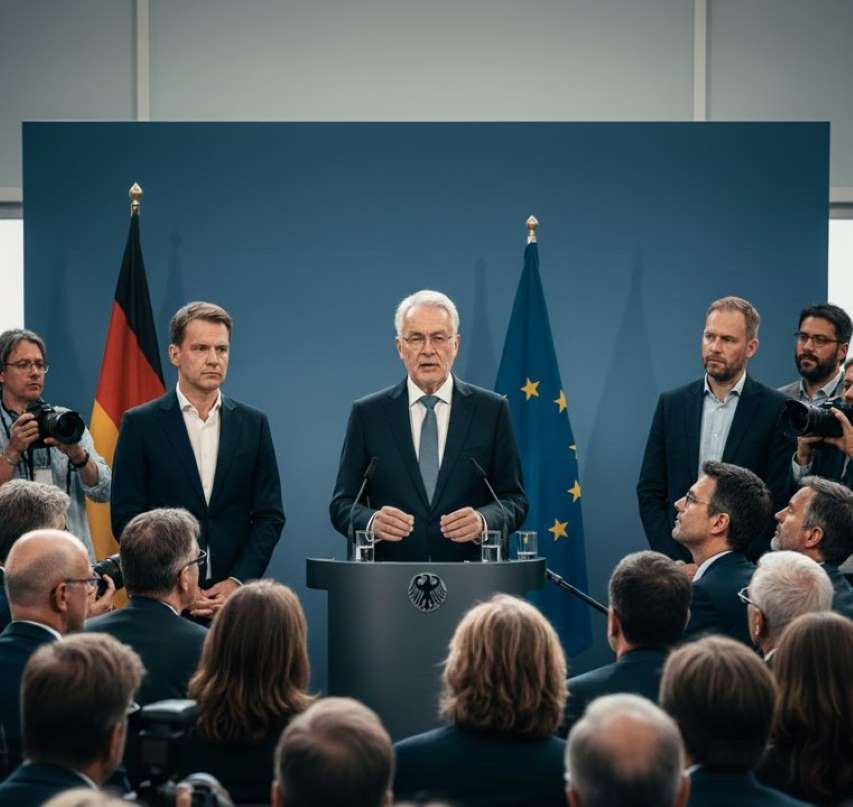
In a significant challenge to the European Union's climate policy, German Chancellor Friedrich Merz has officially called upon the European Commission to abandon its mandatory 2035 phase-out of new diesel and gasoline car sales.
This bold maneuver is designed to protect Germany's vital, yet struggling, automotive industry.
Advocating for Flexibility and Hybrid Technology
On Friday, Chancellor Merz announced his intention to send a formal letter to European Commission President Ursula von der Leyen, advocating for exemptions that would permit certain hybrid vehicle technologies to be sold beyond the 2035 deadline.
Rationale: This push comes amid increasing economic pressure on Europe's largest car market, highlighting a growing tension between the bloc’s environmental aspirations and industrial realities.
Existing Policy: The EU's 2035 phase-out is a cornerstone of its Green Deal, intended to achieve carbon neutrality by 2050 by allowing only zero-emission vehicles, such as fully electric cars, to be sold as new after that date.
The German Government's Position
Merz, leading a coalition government, emphasized a "technology-neutral" approach to climate protection, asserting that a hard cap on internal combustion engines is unrealistic given the "precarious" state of the German auto sector.
"I will ask the commission, even after 2035, to continue to allow battery-electric vehicles that also have a combustion engine," Merz stated. "It is much more opportune and pragmatic to invest more effort and money in the development of efficient, hybrid systems that will combine the best of the world of internal combustion engines on the one hand and electric mobility on the other."
Key coalition partners, including Vice-Chancellor Lars Klingbeil of the Social Democrats (SPD), have backed this stance, prioritizing job preservation and the "future viability" of the German automotive industry. This position marks a policy shift for the SPD, who ultimately aligned with Merz's conservative party.
Industry Concerns and Support for Revision
Germany's major automakers—including Volkswagen, BMW, and Mercedes-Benz—have been vocal in their support for revising the ban.
Executive Warnings: Industry leaders have cautioned that the 2035 deadline risks derailing the sector due to high investment costs in electric vehicle (EV) technology and fierce competition, particularly from Chinese manufacturers who dominate the EV supply chain.
Call for Realism: Executives like Mercedes-Benz's Ola Källenius have argued that "Europe’s transformation plan for the auto industry must move beyond idealism to acknowledge current industrial and geopolitical realities." Volkswagen CEO Oliver Blume called for "reality checks" on achieving 100% EV sales by 2035.
Supporting the Transition
To encourage domestic demand and support the transition, the German government has unveiled a new subsidy program.
Subsidy Details: The scheme, set to launch next year, will offer low- and medium-income households up to €5,000 for the purchase or lease of electric or plug-in hybrid vehicles. Bonuses will be provided for models featuring a large proportion of components made in Germany.
The European Commission's Response
The European Commission has signaled a willingness to engage in dialogue.
Flexibility Indicated: Commission Vice-President Stéphane Séjourné has indicated a willingness to demonstrate "flexibility" in implementing the phase-out, while a spokesperson affirmed the body would "carefully study" Germany's position.
Anticipated Announcement: A key announcement on December 10 is expected to outline measures to support Europe's automotive industry, potentially including incentives for affordable electric vehicles and battery production.
Prior Stance: However, the Commission previously reaffirmed the 2035 target as "achievable," arguing that the industry's challenges are "structural" and solvable through targeted support, rather than a policy reversal.
Environmental and Industry Backlash
Environmental organizations and several car manufacturers that have heavily invested in electric vehicles are strongly opposing Germany's request.
Environmental Criticism: Groups like Transport & Environment (T&E) accuse Berlin of "clinging to the past," warning that reliance on combustion engine technology is "blind to reality."
Pro-EV Camp: Companies such as Volvo and Polestar, along with over 150 e-mobility sector managers, have urged the Commission to hold firm, arguing that softening the ban would jeopardize billions of euros in existing investments in electric vehicle infrastructure and battery factories.
Hybrid Doubts: T&E has also highlighted data suggesting that plug-in hybrids emit significantly more carbon dioxide than official tests indicate, questioning their viability as a long-term bridge technology.
This development intensifies the debate over Europe's green transition, risking a fracture in European Union unity on climate policy. As other member states have already aligned with the 2035 ban, the outcome of the Commission's review will be a pivotal moment that could reshape the future of mobility across the continent.