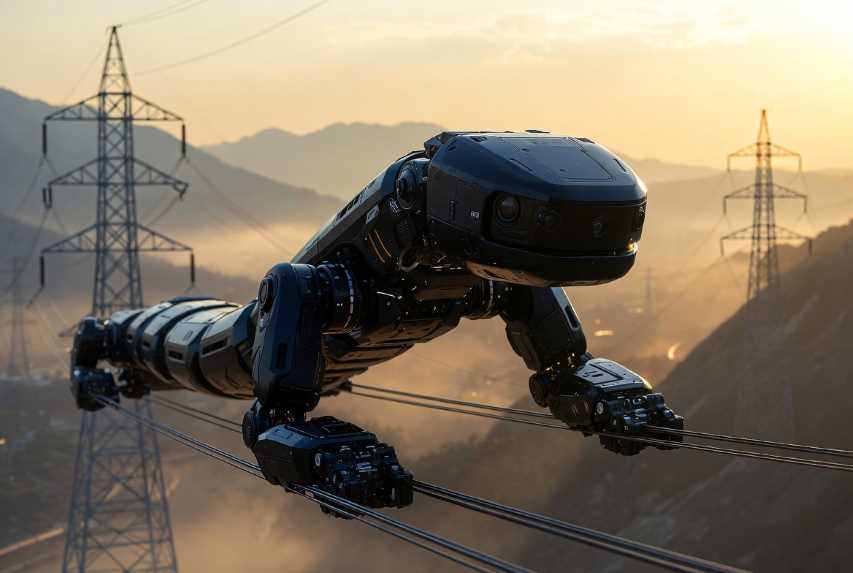
Innovative snake-like robots crawl along live high-voltage lines in Kunming, detecting faults in real time while powering themselves directly from the grid they protect — a major step forward in safe and intelligent infrastructure maintenance
In the rolling hills and urban outskirts of Kunming, capital of Yunnan Province in southwestern China, an unusual sight has become increasingly common along the region’s power lines. Sleek, segmented robotic devices that closely resemble snakes are steadily making their way along energized high-voltage cables. These machines are not there by accident. They have been deliberately deployed by local power authorities to inspect, monitor, and help protect one of the most critical pieces of modern infrastructure: the electricity grid.
This development marks a significant shift in how power utilities approach maintenance and fault detection. Instead of relying primarily on human workers climbing tall towers or sending drones into restricted airspace, China Southern Power Grid and its local subsidiary, the Guandu District Power Supply Bureau, are now using autonomous robotic systems that can operate continuously on live lines. The robots have already covered more than 130 kilometers of distribution lines, proving their value during one of the most demanding periods of the year — the national college entrance examinations known as Gaokao.
Why This Matters Now
China operates one of the world’s largest and most complex power grids. With rapid urbanization, growing industrial demand, and increasing integration of renewable energy sources, the need for reliable electricity has never been greater. Even brief outages can disrupt factories, hospitals, transportation systems, and millions of households. During high-stakes national events such as the Gaokao — when roughly 12.9 million students sit for exams that largely determine their future — stable power supply becomes especially critical. Examination venues require uninterrupted electricity for lighting, air conditioning, computers, and security systems.
Traditional inspection methods face serious limitations. Human crews must often work at dangerous heights on live equipment, exposing them to significant safety risks. Aerial drones, while useful in open areas, struggle with flight restrictions near airports, electromagnetic interference from high-voltage lines that can disrupt control signals and camera quality, limited battery life, and poor performance in bad weather. Helicopters are expensive and less effective for close-up detailed inspections.
The robotic snakes address many of these challenges at once. By moving directly along the power lines themselves, they can access areas where drones are prohibited and provide continuous, close-range monitoring that is difficult to achieve with other methods.
The Technology Behind the Robotic Snakes
The robots feature a flexible, multi-jointed body designed to mimic the natural movement of snakes. This biomimetic approach allows them to wrap around cables, spiral forward, and navigate around obstacles such as insulators and connection points with remarkable agility. The “head” section houses high-resolution cameras and a suite of sensors, including thermal imaging devices capable of detecting abnormal heat signatures that often indicate loose connections, damaged conductors, or overloaded components.
One of the most impressive technical achievements is the robot’s power system. Rather than relying on batteries that require frequent recharging or replacement, these machines use a non-contact inductive power harvesting system. As they travel along the power lines, they draw energy directly from the strong electromagnetic fields generated by the current flowing through the cables. This allows for extended autonomous operation — potentially 24 hours a day, seven days a week — without the need to return to a charging station.
The robots are capable of identifying several types of faults and hazards in real time:
Broken or frayed wires
Corrosion on conductors or fittings
Loose or damaged components
Overheating connections
Signs of mechanical wear
Once a potential issue is detected, the system can alert maintenance crews, who then investigate and repair the problem before it leads to a failure or outage. This shift from reactive to proactive maintenance represents a meaningful improvement in grid reliability.
Real-World Performance and Deployment
According to reports from the Guandu District Power Supply Bureau, the robotic snakes have already successfully inspected more than 130 kilometers of power distribution lines in the Kunming area. These routes include sections near sensitive locations such as airport no-fly zones and examination centers during the Gaokao period. The robots proved approximately three times more efficient than traditional manual inspection methods in terms of speed and coverage.
The deployment is part of a broader strategy by Chinese power utilities to incorporate robotics into daily operations. In the same region, robot dogs have also been introduced for substation inspections and other tasks in high-voltage environments where it would be hazardous or impractical for humans to work for long periods. Together, these systems — snake robots on the lines, robot dogs on the ground, drones where appropriate, and fixed monitoring cameras — create a layered approach to grid surveillance.
The success of the initial trials has led to expanded use on more complex sections of the local grid. Engineers continue to refine the robots’ navigation algorithms, sensor accuracy, and ability to operate in varying weather conditions and terrain types.
Clear Advantages Over Traditional Approaches
The benefits of the robotic snake system become clear when compared with older methods:
Safety — Power line inspection has historically been one of the more dangerous jobs in the energy sector. Workers must climb tall structures, work near live equipment, and contend with weather and height-related risks. The robots remove humans from these hazardous situations for routine inspections.
Efficiency and Coverage — A single robotic snake can cover substantial distances autonomously and continuously. Manual inspections are slower, require teams of workers, and are limited by daylight, weather, and human endurance. The reported threefold improvement in efficiency translates into faster identification of problems and reduced downtime.
Access to Restricted Areas — Many critical power lines run near airports, military zones, or densely populated urban centers where drone flights are heavily restricted or prohibited. Because the robots travel directly on the lines, they face far fewer regulatory and operational barriers.
Cost and Resource Savings — While the initial development and deployment of robotic systems requires investment, the long-term savings in labor, equipment (such as helicopters), reduced outages, and prevented accidents can be substantial. Fewer human inspectors are needed for routine work, allowing skilled workers to focus on repairs and more complex tasks.
Continuous Monitoring Capability — Unlike drones or helicopters that must return to base, or human teams that can only work limited shifts, these self-powered robots can theoretically remain on the lines for extended periods, providing ongoing surveillance rather than periodic snapshots.
Challenges and Current Limitations
No technology is perfect, and the robotic snake system still has areas for improvement. Current deployments have focused primarily on distribution lines rather than the highest-voltage transmission lines. Engineers are working to adapt the technology for more demanding environments and longer spans. The robots must also be periodically retrieved for maintenance, software updates, and physical inspections of their own components.
Terrain and weather remain factors. While the robots are more weather-resilient than drones in many cases, extreme conditions such as heavy ice, strong winds, or severe storms could still affect performance. Additionally, the initial cost of developing and manufacturing these specialized machines is relatively high, although economies of scale are expected to reduce expenses over time.
Chinese engineers and utility operators are actively addressing these limitations through ongoing testing and iteration. The successful real-world use in Kunming suggests that further refinements will make the technology even more robust and widely applicable.
Broader Implications for Infrastructure and Society
The introduction of robotic snakes for power line inspection reflects China’s wider commitment to modernizing critical infrastructure through advanced technology. As the country continues to expand its electricity network and integrate more renewable energy sources such as solar and wind, the ability to monitor and maintain the grid efficiently becomes increasingly important. Reliable power is foundational to economic growth, public safety, and quality of life.
From a societal perspective, technologies like these can help reduce workplace accidents in one of the higher-risk industries. They also support the goal of delivering consistent, high-quality electricity to homes and businesses, minimizing the economic losses associated with power outages.
Internationally, China’s progress in this area is being watched closely. Many countries face similar challenges with aging infrastructure, skilled labor shortages in technical fields, and the need to improve grid resilience against extreme weather and increasing demand. The lessons learned from Kunming’s robotic snake program could influence utility practices in other nations over the coming years.
The Future of Robotic Grid Maintenance
Looking ahead, several developments seem likely. The technology will probably expand from distribution lines to higher-voltage transmission corridors. Integration with artificial intelligence could enable more sophisticated predictive maintenance — not only detecting current problems but also forecasting potential failures before they occur based on patterns in sensor data.
We may also see greater coordination between different robotic platforms. Snake robots on the lines could work alongside ground-based robot dogs, aerial drones, and fixed sensors, all feeding information into centralized monitoring systems. Over time, these combined systems could provide utilities with an unprecedented real-time view of grid health across entire regions.
Policy support in China for domestic robotics development and smart infrastructure projects is expected to continue accelerating progress. As costs decrease and capabilities improve, adoption is likely to spread beyond the initial pilot regions.
A New Chapter in Power Grid Protection
The sight of a robotic snake steadily progressing along a power line may still seem futuristic to many observers. Yet in Kunming, this technology has already moved from experimental trials to practical, operational use. By combining biomimetic design, advanced sensors, and innovative power harvesting, these machines are helping protect one of society’s most essential services while reducing risks to human workers.
As China continues to refine and expand this approach, the rest of the world will be watching to see how robotic inspection systems reshape the future of energy infrastructure. For now, in the hills around Kunming, the quiet, persistent work of these mechanical guardians is already contributing to a more reliable and safer power grid for millions of people.
This evolution in maintenance technology represents more than just clever engineering. It demonstrates how thoughtful application of robotics can address real-world challenges in safety, efficiency, and reliability — delivering tangible benefits that extend far beyond the power lines themselves.
 |  |  |
 |  |  |