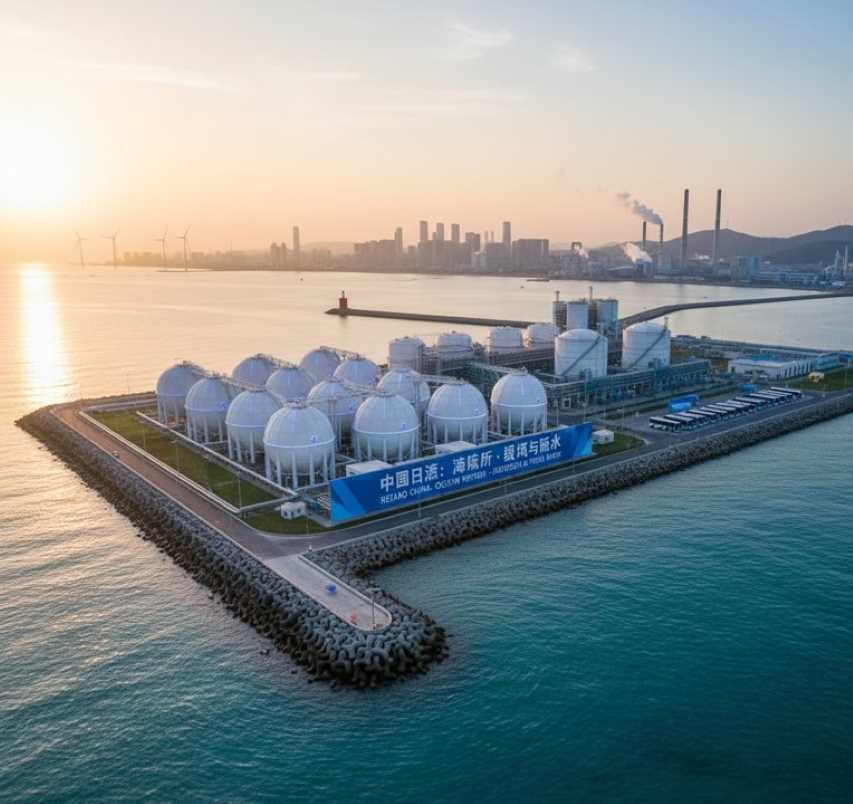
China has achieved a significant breakthrough in sustainable energy with the launch of a pioneering coastal facility in Rizhao, Shandong Province. This "ocean refinery" transforms seawater into three high-value outputs: ultra-pure drinking water, clean green hydrogen fuel, and mineral-rich brine. By utilizing industrial waste heat, the project offers a low-cost, circular-economy solution to global water and energy shortages.
The Technology: A "One-In, Three-Out" Model
The Rizhao facility is a 110-kilowatt demonstration plant developed through a collaboration between China General Nuclear Power Group, the Laoshan Laboratory, Shandong Normal University, and local government entities.
The system integrates desalination and electrolysis into a seamless process:
Thermal Desalination: The plant captures "free" waste heat from nearby steel and petrochemical plants. It uses a membrane-free thermodiffusive method to separate salt from water, producing ultra-pure water without the need for energy-intensive pretreatment.
Direct Electrolysis: The purified water is split into hydrogen and oxygen using specialized, corrosion-resistant catalysts. These catalysts prevent the salt-related scaling and chloride corrosion that typically plague seawater electrolysis.
Resource Recovery: Instead of discharging brine as waste, the concentrated minerals are harvested and sold for marine chemical production, creating an additional revenue stream.
Production Capacity and Efficiency
The facility demonstrates superior efficiency compared to traditional freshwater-based systems. Key performance metrics include:
Energy Consumption: Only 4.2 kWh of DC power per cubic meter of hydrogen produced (approximately 46.7 kWh/kg).
Power Utilization: Achieves a 20% higher utilization rate than conventional hydrogen production.
Annual Output (per 800 metric tons of seawater):
118,877 gallons (450 cubic meters) of fresh water.
192,000 standard cubic meters of green hydrogen.
Impact: This is enough hydrogen to power 50 city buses for approximately 4,600 miles each.
Cost Comparison: A Global Game-Changer
The Rizhao project significantly undercuts current global benchmarks for water production costs.
| Location | Facility Type | Cost per Cubic Meter (USD) |
|---|---|---|
| Rizhao, China | Ocean Refinery (Waste Heat) | $0.28 |
| Saudi Arabia | Traditional Desalination | $0.56 (approx.) |
| Carlsbad, USA | California Desalination | $2.20 |
While specific costs per kilogram of hydrogen were not disclosed, the use of industrial waste heat and high power efficiency makes the output economically competitive with "grey" hydrogen (derived from fossil fuels) without the associated carbon emissions.
Environmental and Economic Impact
The facility addresses several ecological concerns simultaneously:
Pollution Reduction: It converts industrial waste heat—which often causes thermal pollution in local waterways—into a primary energy source.
Water Security: It produces fresh water without depleting municipal supplies or groundwater.
Zero Emissions: The green hydrogen produced supports the decarbonization of heavy industries like shipping and manufacturing.
Future Outlook
The success of the Rizhao pilot project, which has already completed over 500 hours of stable operation, signals a "watershed moment" for the global hydrogen economy. As China continues to lead in marine-based clean energy, this technology offers a scalable blueprint for other industrial coastal regions in Japan, South Korea, India, and the Gulf States.
 |  |  |
 |  |  |