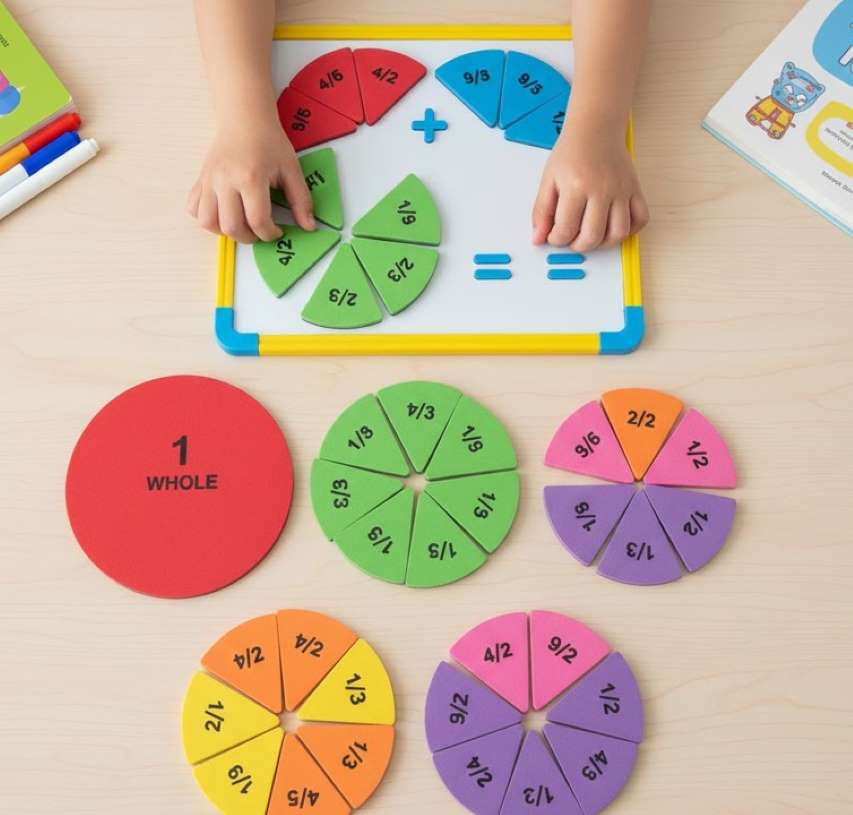
Making Fractions Tangible
A Magnetic Fraction Learning Set is a hands-on, manipulative-based educational tool designed to visually and physically teach the fundamental concepts of fractions, decimals, and percentages. By transforming abstract numerical ideas into colorful, magnetic pieces that students can hold, combine, and compare, it builds a concrete foundational understanding that is critical for future success in mathematics.
Core Components & Materials
Component | Description & Purpose |
|---|---|
Whole Circles or Bars | Represent the integer "1." Typically, the largest piece, used as a reference for all fractions. |
Fraction Pieces | Magnetic segments representing common fractions (½, ⅓, ¼, ⅕, ⅙, ⅛, 1/10, 1/12). Each fraction is a different color for easy identification. |
Material | Usually food-grade EVA foam with a flexible magnetic backing or solid plastic. Durable, safe, and easy for small hands to manipulate. |
Magnetic Board/Backing | A whiteboard or metal tray on which pieces are placed. Allows for vertical display during instruction and prevents pieces from slipping. |
Supporting Materials | Often includes decimal & percentage labels, activity cards, lesson guides, and symbols (+, –, =, >, <). |
Storage | A sturdy box or organizer with compartments to keep pieces sorted and complete. |
Key Learning Concepts & Educational Benefits
Foundational Fraction Understanding:
Part-Whole Relationships: Visually demonstrates how fractions are parts of a whole.
Equivalence: Shows that ½ = 2/4 = 3/6, a concept often difficult to grasp abstractly.
Comparison & Ordering: Allows students to physically place ⅓ next to ½ to see which is larger.
Common Denominators: Pieces can be lined up to visually find the least common denominator.
Advanced Operations:
Addition & Subtraction: Students combine or remove pieces to solve problems.
Multiplication of Fractions: Using a fraction of a fraction piece (e.g., ½ of ⅓).
Introduction to Decimals & Percentages: Many sets include labels to show that ½ = 0.5 = 50%.
Cognitive & Developmental Benefits:
Visual-Spatial Learning: Appeals to visual learners and strengthens spatial reasoning.
Tactile/Kinesthetic Learning: Engages the sense of touch, improving memory and understanding through physical action.
Promotes Problem-Solving: Encourages exploratory, student-led learning.
Builds Confidence: Provides a non-verbal, mistake-friendly way to grasp challenging concepts.
Supports Diverse Learners: Essential tool for differentiated instruction and intervention.
Ideal Age Range & Curriculum Alignment
Primary Grade Levels: 1st through 5th Grade (Ages 6-11).
Core Alignment: Directly supports Common Core State Standards (CCSS) and other international curricula in:
Grade 3: Developing understanding of fractions as numbers.
Grade 4: Extending fraction equivalence and ordering; building fractions from unit fractions.
Grade 5: Using equivalent fractions to add and subtract.
Intervention & Special Education: Highly effective for older students who need to reinforce foundational concepts.
Step-by-Step: How to Use the Set in Instruction
Sample Activity: Introducing Equivalence
Present a Problem: Ask, "How can we show one-half?"
Student Exploration: Have a student place the ½ piece on the board.
Challenge: Ask, "Can you make the same shape and size using only quarter pieces?"
Hands-On Discovery: Student uses two ¼ pieces to build a whole half.
Verbalize & Record: Guide them to state, "One-half is equal to two-fourths," and write the equation: ½ = 2/4.
Repeat & Expand: Continue with other equivalents (e.g., ⅓ = 2/6).
Types of Fraction Manipulatives & Comparison
Type | Pros | Cons |
|---|---|---|
| Magnetic Fraction Set | Stays in place on board, ideal for teacher demonstration, easy group viewing, organized storage. | Usually more expensive than non-magnetic versions. |
| Plastic/Popped Fraction Pieces | Inexpensive, great for individual student use in small groups. | Easily lost, can create clutter, does not stick for demonstrations. |
| Fraction Towers/Cuisenaire Rods | Excellent for comparing and measuring, teaches additive relationships. | Doesn't clearly show "part of a whole" as intuitively as circles/bars. |
| Paper/Cut-Out Fractions | Very low cost, customizable. | Not durable, easily torn, lacks the manipulative strength of solid pieces. |
Features of a High-Quality Set
Accurate Proportional Sizing: A ½ piece must be exactly half the size of the whole. Precision is non-negotiable.
Clear Color Coding: Consistent, distinct colors for each fraction type (e.g., all halves are red, all thirds are blue).
Labeled Pieces: Fractions printed on each piece reinforce number recognition.
Durable & Safe Materials: Thick, washable foam without sharp edges.
Comprehensive Scope: Includes a wide range of denominators (through twelfths) and decimals/percentages.
Aligned Teaching Resources: Well-designed activity guides that progress from simple to complex.
Practical Classroom & Homeschool Applications
Whole Group Instruction: Teacher models concepts on a magnetic board for all to see.
Small Group Stations: Students work collaboratively on guided activity cards.
Individual Practice & Assessment: Teacher can pose problems for a student to solve on their own tray.
Math Centers: A staple material in a rotational math center.
Games: Create fraction matching games, "Fraction War," or build-the-whole races.
Care and Maintenance
Cleaning: Wipe pieces with a damp cloth. Avoid submerging to preserve magnet strength.
Storage: Always return pieces to their designated compartments to prevent loss. A missing piece can hinder lessons.
Board Care: Use only dry-erase markers on coated boards and erase promptly.
Magnet Check: Over time, ensure pieces still have strong magnetic adhesion.
Buyer's Guide for Educators & Parents
Identify Need: Is this for teacher demonstration (prioritize magnetic board sets) or individual student kits (consider smaller, non-magnetic sets)?
Check Curriculum Relevance: Ensure the set covers the fractions your student/child will encounter (e.g., early learners need only ½, ¼, ⅓; older need more).
Assess Quality: Read reviews about accuracy and durability. Cheap sets often have sizing inaccuracies.
Look for Extras: Value-added resources like lesson plans, task cards, and digital printables enhance utility.
Consider Storage: A well-organized box is a major long-term convenience.
An Investment in Mathematical Literacy
The Magnetic Fraction Learning Set is more than a classroom accessory; it is a critical bridge between concrete and abstract thinking in one of mathematics' most pivotal domains. By allowing students to physically construct and deconstruct fractional relationships, it demystifies a topic that is historically challenging. For educators, it is a powerful visual aid. For parents, it is a tool to make homework support effective and engaging. For the student, it is the key to unlocking a genuine, lasting comprehension of fractions—a comprehension that forms the essential foundation for algebra, probability, and all higher-level math. Its value lies not in the magnets or colors, but in the "aha!" moments it creates.
 |  |  |
 |  |  |