Tea Brewing as a Performance
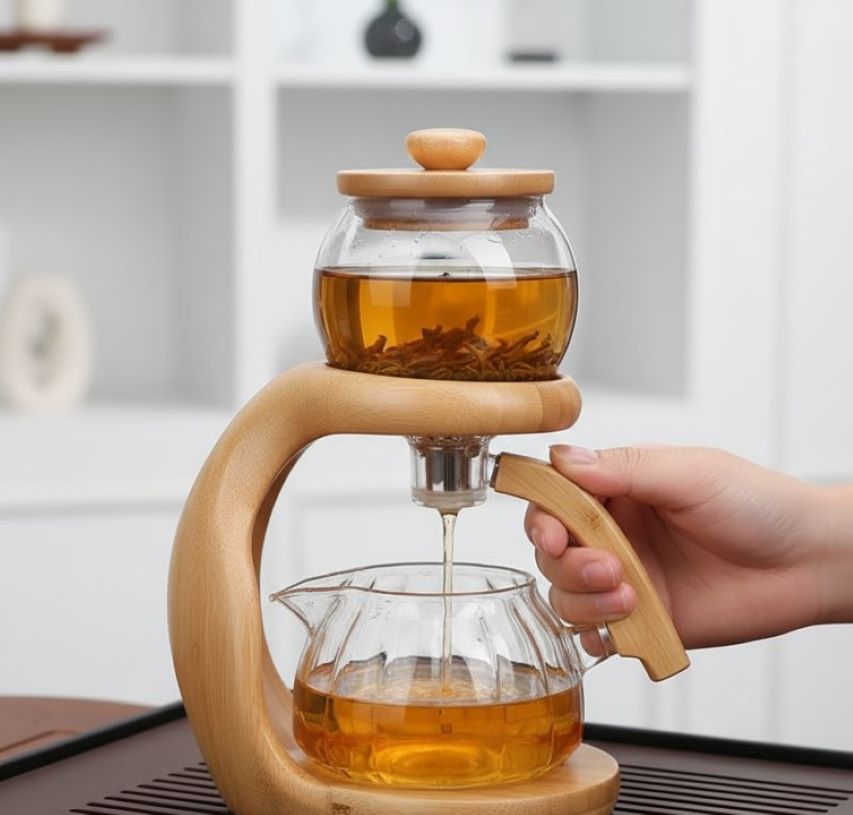
A Drip Floating Teapot, also known as a "hovering teapot" or "dripping tea set," is a specialized and visually captivating piece of teaware that elevates tea preparation into a meditative performance. Originating from modern interpretations of Chinese and Taiwanese Gongfu tea ceremony, its defining feature is a detachable brewing vessel that appears to float or hover above a matching pitcher or catching bowl. The brewed tea drips slowly and elegantly from the bottom of the upper vessel into the lower one, creating a serene, waterfall-like effect.
Core Design & Components
| Component | Description & Function |
|---|---|
| Upper Brewing Vessel | A small pot or cup-like container with a removable lid and an open bottom covered by a built-in mesh filter or perforated plate. This is where tea leaves are steeped. |
| Lower Pitcher (Gong Dao Bei / Fairness Cup) | A wider, deeper vessel that catches the infused tea dripping from above. It serves to mix the liquor evenly and cool it slightly before serving. |
| Hovering/Locking Mechanism | A clever design—often a ridge-and-groove system, magnetic rim, or balanced lip—that allows the upper vessel to sit securely on the lower one without sealing it, creating a small air gap for dripping. |
| Tray or Base | Often included to catch any accidental spills or condensation, completing the set. |
| Material | Most commonly heat-resistant glass (borosilicate) to showcase the color of the tea and the dripping process. Also found in ceramic, porcelain, or clay. |
How It Works: The Dripping Principle
The process exploits gravity and controlled airflow:
Water is poured into the upper vessel, saturating the tea leaves inside.
The lid is placed on top, creating a semi-sealed environment.
Steeping occurs. As the tea infuses, surface tension and air pressure initially prevent it from flowing through the filter at the bottom.
The "Drip" is initiated by one of two methods:
Passive Drip: Once enough liquid weight and infusion pressure build, tea begins to drip slowly through the filter on its own.
Active Lift: The user slightly lifts the upper vessel to break the seal, allowing air to enter and tea to flow freely, then re-seats it to stop the flow. This offers precise control over steeping time.
Collection & Serving: Tea collects in the lower pitcher. When dripping stops, the upper vessel (with spent leaves) is removed, and tea is served from the pitcher into tasting cups.
The Step-by-Step Brewing Ceremony
Warm & Prepare: Rinse both vessels with hot water to warm them. Place tea leaves in the upper brewing vessel.
First Rinse: Quickly pour hot water over the leaves and immediately let it drip through into the lower pitcher (this rinse is usually discarded to "awaken" the leaves).
The First Brew: Pour fresh hot water into the upper vessel, cover with the lid, and let steep for the desired time (20-60 seconds for many oolongs or black teas).
Initiate the Drip: Either wait for the passive drip or gently lift and re-seat the upper pot to start the flow. Watch as the amber stream flows down.
Separate & Serve: Once dripping ceases, remove the upper vessel and set it aside (this stops the steeping completely). Pour the tea from the lower pitcher into cups.
Repeat: The same leaves can be re-steeped multiple times (5-10+ infusions for high-quality teas), with slightly increased steeping time for each subsequent brew.
Key Features & Characteristics
Visual Transparency: Glass construction allows observation of tea leaf expansion, liquor color, and the mesmerizing drip.
Precision & Control: The lift-to-drip mechanism gives the brewer direct command over steeping time, preventing over-extraction.
Complete Separation: Instantly separates leaves from liquor at the perfect moment, ensuring consistent flavor without bitterness.
Aeration: The dripping process gently aerates the tea, which can enhance its aroma and smooth its texture.
Elegant Minimalism: The set is often a single, cohesive art piece emphasizing clean lines and the beauty of the tea itself.
Types of Drip Floating Teapots
Type | Mechanism | Best For |
|---|---|---|
| Classic Ridge-and-Groove | The most common. The upper vessel has a ridged base that sits in a groove on the pitcher's rim. | Stability, ease of use, and a reliable seal. |
| Magnetic | Uses small magnets embedded in the rims to hold the vessels together. | A secure connection with a modern, high-tech feel. |
| Balanced/Lip-Rest | The upper vessel simply rests on a flared lip of the lower one via gravity. | The simplest design, emphasizing the "floating" illusion. |
| Multi-Level/Cascading | Features multiple stacking drippers for different teas or sequential brewing. | Advanced users and theatrical presentations. |
Primary Benefits & Advantages
Enhanced Flavor Clarity: Prevents over-steeping, producing clean, nuanced infusions that highlight the tea's true character.
Mindful Ritual: The slow drip encourages patience and presence, transforming brewing into a calming, focused practice.
Optimal for Multiple Infusions: Excels at Gongfu-style brewing, where small amounts of leaves are steeped many times.
Conversation Piece: Its unique operation is a natural centerpiece for social tea gatherings.
Easy to Clean: Simple design with few nooks; spent leaves are easily discarded from the upper basket.
Thermal Efficiency: The lower pitcher acts as a decanter, allowing the tea to cool to an ideal drinking temperature (55-65°C / 130-150°F).
Limitations & Considerations
Learning Curve: Requires practice to master timing and the drip-initiation technique.
Fragility: Glass models, while beautiful, are prone to breaking if mishandled.
Brew Volume: Typically designed for smaller servings (100-300ml total yield), ideal for 1-4 people.
Not for All Teas: Less ideal for teas requiring very long steeps (like some herbal blends) or finely powdered teas (like matcha) that can clog the filter.
Heat Retention: Glass does not retain heat as well as clay or thick ceramic, so water may cool slightly faster during the steeping process.
Care and Maintenance
Cleaning: Hand wash with warm water and a soft brush. Avoid abrasive scrubbers on glass. Rinse immediately after use to prevent tannin stains.
Descaling: For hard water areas, soak in a citric acid or vinegar solution periodically to remove mineral deposits from the filter.
Drying: Air dry completely before storing, especially where the pieces connect, to prevent mold or mineral buildup.
Storage: Store the nested set or separate pieces with padding to prevent chips and cracks.
How to Choose the Right Drip Floating Teapot
Material Preference: Glass for visual beauty; ceramic/clay for better heat retention and a more traditional feel.
Size & Capacity: Match to your typical number of guests. A 150-200ml lower pitcher is a versatile starting point.
Filter Quality: Ensure the mesh or perforations are fine enough for your preferred teas (oolong needs a finer filter than whole-leaf herbal).
Stability & Fit: The upper vessel should sit securely without wobbling. The groove or connection should feel smooth.
Aesthetic: Choose a design that resonates with your personal style and brings you joy to use.
Quality: Look for even glass thickness, smooth finishes, and no sharp edges. Reputable teaware brands offer better durability.
More Than a Teapot, a Theatre for Tea
The Drip Floating Teapot is not merely a tool for hydration; it is an instrument for mindfulness and an amplifier of sensory pleasure. It demands engagement and rewards the user with unparalleled control over extraction and a deeply satisfying ritual. For the tea enthusiast seeking to deepen their practice, the curious novice drawn to elegant design, or anyone wishing to slow down and savor the moment, this teapot offers a unique pathway. It turns the simple act of making tea into a graceful performance where water, leaf, time, and gravity conspire to create something truly beautiful in both form and flavor. In a world of haste, it is a gentle invitation to pause, pour, and watch the world drip by.
 |  |  |
 |  |  |