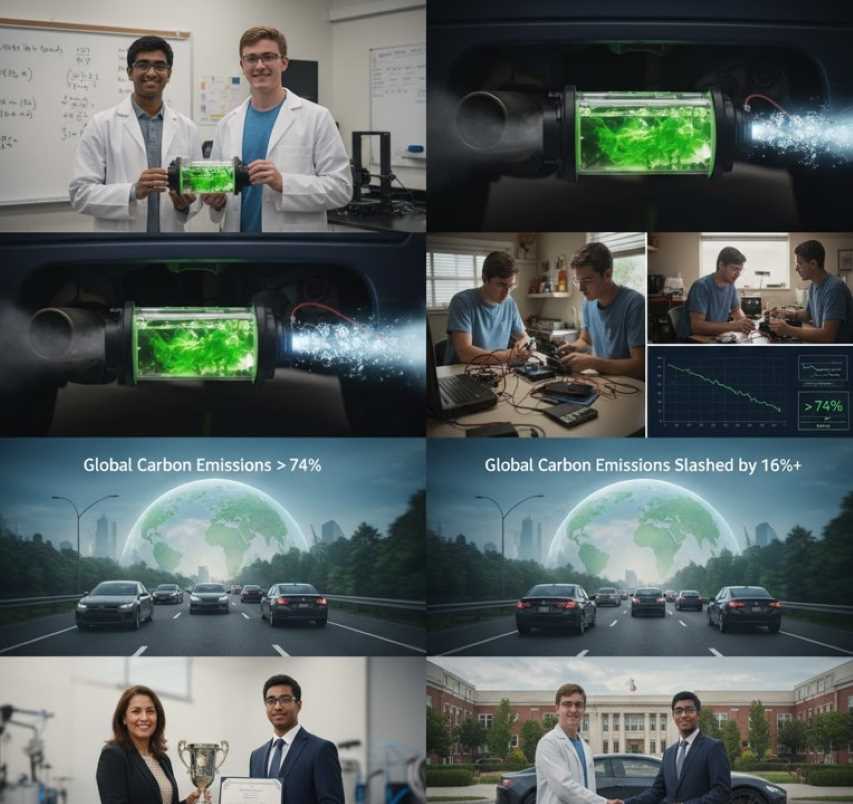
In a remarkable display of youthful innovation and environmental stewardship, two 18-year-old high school seniors from Chester County, Pennsylvania, have developed a groundbreaking exhaust filter that could significantly curb global carbon emissions.
Rohan Kapoor and Jack Reichert, both students at Unionville High School in Unionville, have created the "Go Green Filter," a low-cost device that harnesses the power of microalgae to convert harmful vehicle exhaust into breathable oxygen.
The invention comes at a critical time when transportation accounts for nearly 17 percent of global greenhouse gas emissions, primarily from cars and small trucks. Kapoor and Reichert's filter offers an affordable alternative to electric vehicles, priced at just $50, making it accessible for widespread adoption, especially in developing countries where electric vehicle infrastructure remains limited.
The Spark of Inspiration and Development Journey
The duo's journey began with inspiration from a Massachusetts Institute of Technology professor's research on using algae for carbon capture. Motivated by the urgent need to combat climate change, Kapoor and Reichert sourced microalgae from a local botanist and set out to engineer a practical solution. They utilized three-dimensional printing technology to design a compact filter that clamps directly onto a vehicle's exhaust pipe.
The development process was no small feat. Over nearly a year, the teenagers iterated through multiple prototypes, overcoming challenges such as ensuring the algae's survival in high-heat environments and optimizing the filter's efficiency. The final design incorporates water, algae, and a light source to facilitate photosynthesis within the device. As exhaust gases pass through, the microalgae absorb carbon dioxide and release oxygen, effectively transforming pollution into an environmental benefit.
Rigorous testing has shown the Go Green Filter reduces carbon dioxide emissions by more than 74 percent. The inventors estimate that if adopted universally across all vehicles, it could slash global carbon emissions by over 16 percent.
This potential impact underscores the filter's revolutionary nature, positioning it as a bridge technology in the transition to sustainable transportation.
Background of the Young Inventors
Kapoor and Reichert are not just inventors; they are entrepreneurs who founded the Go Green Filter company while still navigating high school coursework. Residents of Chadds Ford in Chester County, the pair combined their passions for science, engineering, and environmental activism to tackle real-world problems. Their collaboration highlights how young minds can drive meaningful change, even from a suburban high school setting.
🏆 Accolades and Future Prospects
The innovation has already garnered significant recognition.
In 2024, Kapoor and Reichert were named finalists for the Gloria Barron Prize for Young Heroes, an award that honors young leaders demonstrating courage, compassion, and perseverance in community service or environmental protection.
Selected from nearly 500 applicants across the United States and Canada, they join a prestigious group of 25 honorees celebrated annually by the prize, founded in 2001 by author T. A. Barron in memory of his mother.
Additionally, the duo secured the grand prize in a major wireless provider's Changemaker Challenge and were included in the 2024 Inno Under 25 list, which spotlights young innovators making positive impacts.
Looking ahead, the latest version of the filter has received approvals from several car manufacturers, paving the way for broader implementation. The teenagers have started distributing the devices in developing countries and are engaged in discussions with the United States Environmental Protection Agency for potential regulatory support. Their ultimate vision? Mandating the inclusion of such filters in every new vehicle produced worldwide, accelerating the fight against climate change.
Kapoor and Reichert's story is a testament to the power of ingenuity and determination. As they prepare to graduate and pursue higher education—likely in fields like environmental engineering or entrepreneurship—their invention serves as an inspiration for aspiring young scientists everywhere. In an era defined by environmental crises, these two teenagers remind us that solutions can emerge from the most unexpected places.
 |  |  |
 |  |  |