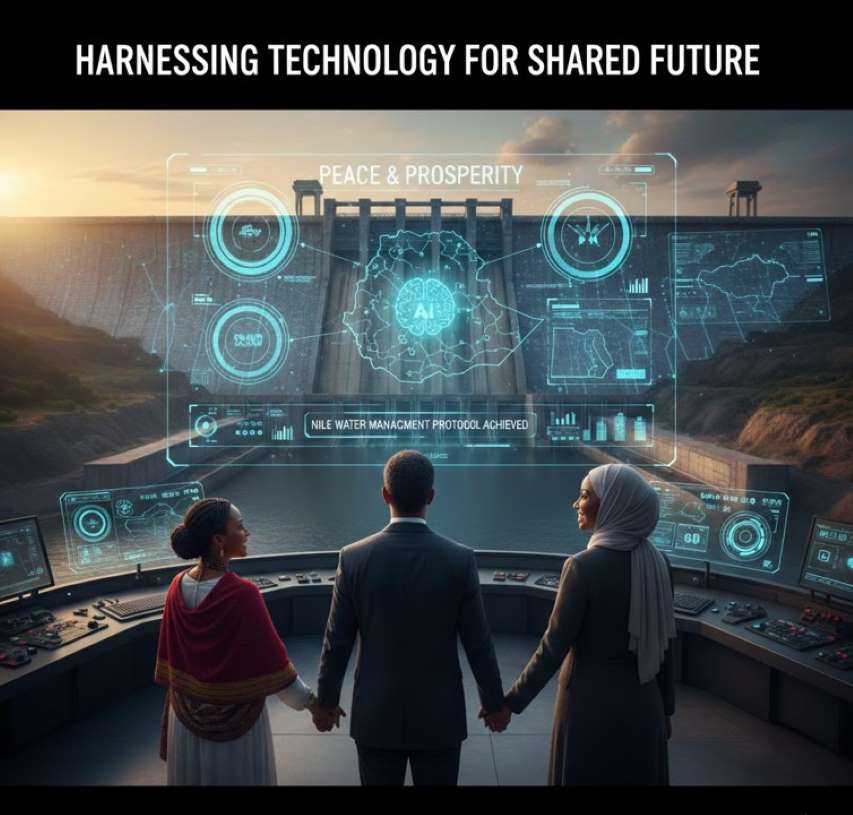
The Grand Ethiopian Renaissance Dam (GERD), Africa's largest hydroelectric project, has been a flashpoint of regional tension for over a decade. Located on the Blue Nile in Ethiopia, the dam promises to generate substantial electricity for Ethiopia's development while raising concerns in downstream nations—Egypt and Sudan—about water security.
As of September 2025, the Grand Ethiopian Renaissance Dam is fully operational, producing power from its turbines, yet diplomatic stalemates persist. Recent developments, including United States President Donald Trump's January 16, 2026, offer to mediate negotiations, have renewed hopes for a resolution. Egypt has shifted its stance, demanding compensation for alleged damages, while Ethiopia views the dam as a symbol of self-reliance. Amid these geopolitical maneuvers, experts argue that technology could bridge the divide, offering data-driven, equitable solutions to manage water resources without conflict.
The Core of the Conflict: Water vs. Power
The reservoir of the Grand Ethiopian Renaissance Dam, capable of holding billions of cubic meters of water, affects the flow of the Nile, which Egypt relies on for over 90% of its freshwater.
Ethiopia's Stance: Ethiopia insists the dam is non-consumptive and primarily designed for hydropower generation.
Egypt's Concern: There is fear that filling and operation during droughts could exacerbate shortages downstream.
Sudan's Position: Caught in the middle, Sudan benefits from flood control but fears sedimentation and irregular flows.
With climate change intensifying prolonged droughts, the need for innovative solutions is urgent.
Open Data and Real-Time Monitoring: Building Trust Through Transparency
One of the most promising technological avenues is the adoption of open science and data-sharing platforms. Researchers propose a framework where Ethiopia shares real-time data on the reservoir levels, inflows, outflows, precipitation forecasts, and turbine operations of the Grand Ethiopian Renaissance Dam.
Satellite imagery, Internet of Things (IoT) sensors, and blockchain-secured databases could ensure tamper-proof transparency, allowing Egypt and Sudan to predict and mitigate impacts.
Example: NASA’s GRACE satellites already track water storage changes in the Nile Basin. Integrating this with ground-based sensors could create a unified monitoring system.
This approach could enable coordinated releases between the Grand Ethiopian Renaissance Dam and Egypt's Aswan High Dam, optimizing water during dry spells without compromising Ethiopia's energy output—potentially achieving 87% of the hydropower capacity without creating downstream deficits.
AI and Simulation Models: Predicting the Future
Artificial Intelligence (AI) is emerging as a game-changer in water diplomacy. Scientists have used AI modeling to demonstrate how all three countries can benefit from the Grand Ethiopian Renaissance Dam. Machine learning algorithms, fed with historical climate data, hydrological models, and economic projections, can simulate drought scenarios and recommend optimal dam operations.
Tools like those developed by the University of Southern California (USC) Viterbi School of Engineering use AI to reframe drought management, ensuring sustainable hydropower while minimizing water shortages.
Ethiopia could integrate AI into the control systems for adaptive filling policies, adjusting based on real-time weather forecasts from services like IBM's Watson or Google's DeepMind climate models. Such technology could de-securitize the dispute by providing objective, science-backed agreements rather than zero-sum negotiations.
Water Efficiency Technologies: Reducing Downstream Dependency
Technology can also alleviate the concerns of Egypt and Sudan by enhancing their water use efficiency.
Advanced Irrigation: Systems such as drip and precision agriculture, powered by drones and soil sensors, could cut water loss by up to 50% compared to traditional flood methods.
Wastewater Recycling: Egypt is already investing in wastewater recycling and crop diversification to less thirsty varieties, aided by Geographic Information System (GIS) mapping and remote sensing.
Desalination: Plants using reverse osmosis and solar-powered technology offer an alternative source; Egypt's expanding facilities could offset reductions from the Nile.
Collaborative projects, like joint AI-optimized farming initiatives, could foster economic ties, with Ethiopia exporting electricity generated by the dam to power these systems.
Challenges and the Path Forward
Despite these innovations, implementation hinges on political will. China's involvement in the construction highlights the role of international technology financing, but it also complicates neutrality. President Trump's mediation push, emphasizing electricity sales or sharing, could incorporate technology clauses in agreements.
Experts warn that without binding technology-enabled protocols, risks of escalation remain. Yet, as climate pressures mount, technology offers a neutral ground for cooperation, potentially transforming the Grand Ethiopian Renaissance Dam from a source of strife into a model of regional sustainability.
In an era where data is power, leveraging technology could finally quench the thirst for resolution in the Nile Basin.
 |  |  |
 |  |  |