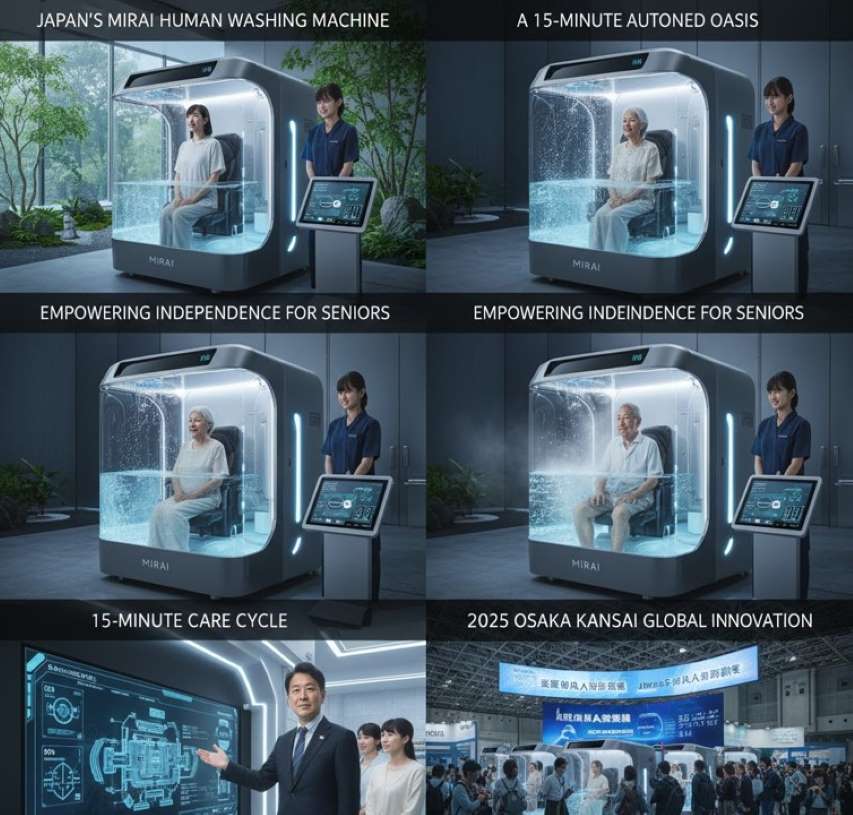
In a fascinating blend of historical inspiration and state-of-the-art technology, Japan has launched the Mirai Human Washing Machine. This luxurious pod promises to deliver a full-body washing, massaging, and drying experience in a mere fifteen minutes.
Developed by the Osaka-based company Science Co., this high-tech device is now available for sale, targeting high-end hotels, spas, and wellness centers across the nation. Priced at a substantial sixty million Japanese yen (approximately three hundred eighty-five thousand United States dollars), the machine represents a significant advancement in automated personal hygiene, reviving a concept first introduced over fifty years ago.
The Future Human Washing Machine
The device, known in Japanese as the Mirai Ningen Sentakki (which translates to "Future Human Washing Machine"), was unveiled at the 2025 Osaka Kansai Expo, where it quickly became a major attraction. Visitors enthusiastically queued up to try the pod, which has the sleek, transparent appearance of an escape capsule from a science fiction movie.
Specifications:
Length: 8.2 feet (2.5 meters)
Width: 3.28 feet (1 meter)
Height: 8.53 feet (2.6 meters)
It is designed to comfortably accommodate most adults. The user simply reclines inside, and the pod seals shut, initiating a fully automated cycle that integrates cleaning, relaxation, and health monitoring.
How the Technology Works
The automated process begins with the pod filling halfway with warm water to create a soothing, immersive environment.
Safety and Comfort: Powered by artificial intelligence, the machine utilizes advanced sensors to monitor the user's vital signs, including heart rate and pulse, ensuring safety throughout the session. If the system detects anxiety—for instance, through an elevated heart rate—it intervenes by displaying calming images at eye level or playing relaxing music and videos.
Advanced Cleaning: Cleaning is achieved through a combination of water jets for the lower body, thin mists for the upper body, and microscopic air bubbles that penetrate deep into the pores. This microbubble technology, already popular in Japanese baths and salons, effectively removes oil, dirt, and dead skin cells without the need for abrasive scrubbing.
Completion: Following the wash, the pod rinses away the residue and transitions smoothly into a drying phase, leaving the user refreshed in under fifteen minutes. This efficiency not only conserves time but also aligns with Japan's cultural emphasis on bathing as a holistic ritual for cleansing both the body and the spirit.
Vision and Historical Context
Yasuaki Aoyama, Chairman of Science Co., is the visionary behind this revival. As a fourth-grade student in 1970, Aoyama was captivated by a similar invention, the Ultrasonic Bath, demonstrated by Sanyo Electric Co. (now part of Panasonic Holdings Corporation) at the original Osaka Expo. Although that prototype never achieved commercial success, it planted the seed for Aoyama’s idea. Decades later, he updated the design with modern technology to address contemporary needs, particularly within a nation facing the challenges of an aging population.
Market Strategy and Target Audience
Science Co. is positioning the Mirai as a premium product for the commercial sector, rather than for typical household use. The company plans to hand-build an initial batch of forty to fifty units and has already secured several commitments:
Target Venue | Benefit |
|---|---|
| High-End Hotels and Spas | Offers a novel, time-saving, luxurious amenity. |
| Elderly Care Facilities | Reduces physical strain on caregivers and promotes independence for those with mobility issues. |
| Theme Parks and Resorts | Provides a unique, efficient, and relaxing experience for guests. |
Reports confirm that these pods are set to appear in select Japanese hotels to enhance the guest experience. The automation of the device is particularly relevant in Japan's rapidly aging society—where over twenty-nine percent of the population is sixty-five or older—where it could significantly address hygiene challenges.
While the current price limits accessibility, Science Co. suggests that future mass production could eventually lead to more affordable home versions, making this technology available to a wider consumer base. For the present, the Mirai serves as a testament to Japan’s leadership in robotics and automation.
Broader Implications
Public feedback from Expo attendees has been overwhelmingly positive, with many describing the experience as "absurdly relaxing" and comparable to being pampered in a spaceship. Social media has amplified interest, with videos on platforms like YouTube and Reddit showing users emerging from the pod looking rejuvenated.
As Japan continues to innovate in response to demographic shifts, the Mirai Human Washing Machine demonstrates how historical ideas can be successfully reimagined for the future.
 |  |  |
 |  |  |