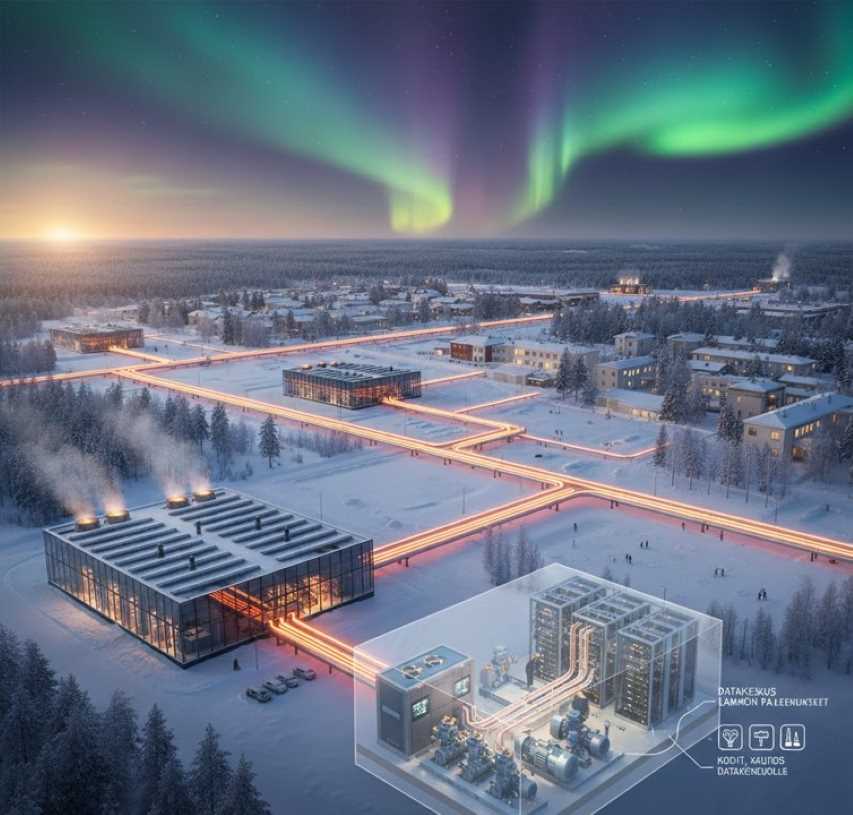
In the face of frigid Nordic winters, Finland has quietly pioneered an ingenious and cutting-edge solution to a growing energy challenge. Without much fanfare, the country has developed a system that captures waste heat from power-hungry data centers and repurposes it to warm homes, schools, and public buildings via its extensive district heating networks.
This innovative approach slashes carbon emissions and transforms what was once considered an environmental liability into a sustainable asset, positioning Finland as a global leader in green energy integration. By leveraging the inevitable byproduct of our digital age—server-generated heat—Finland is addressing the dual demands of booming data consumption and climate goals, all while helping to keep energy costs down for residents.
Understanding the Mechanism: Data Centers and District Heating
District heating is a centralized system common in Nordic countries. It involves producing hot water or steam at a central plant and distributing it through insulated pipes to heat buildings across entire neighborhoods or cities. This infrastructure already serves about half of Finland’s population.
The Role of Data Centers
Data centers, packed with servers running 24/7 for cloud computing, AI, and online services, generate enormous amounts of heat as a byproduct of electricity consumption.
Globally, up to 99% of this heat is often wasted, vented into the atmosphere, or cooled with energy-intensive systems.
Finland’s breakthrough lies in capturing this heat at the source and integrating it into district heating grids, effectively turning data centers into urban heaters.
The Process
Heat Transfer: Heat exchangers transfer the warm air or water from server cooling systems into the district heating network.
Circulation: Pumps circulate this recovered energy to end-users.
End Use: The recovered energy is used for space heating and hot water in homes and buildings.
This closed-loop system is highly efficient, particularly because data centers in cold climates benefit from natural air cooling, which reduces their additional energy needs, and their heat output is consistent year-round.
🗺️ Landmark Projects Driving the Innovation
Finland's waste heat recovery initiatives have gained momentum over the past decade, demonstrating the technology's scalability:
Mäntsälä: In this small southern town, a 75-megawatt data center, operational for a decade, supplies heat to the equivalent of 2,500 homes, covering roughly two-thirds of the town's heating needs.
Google's Hamina Facility: Starting in 2025, this project is expected to provide 80% of Hamina's annual heat demand, serving households, schools, and public buildings free of charge (barring a nominal administrative fee). The heat is captured from servers already running on 97% carbon-free energy.
Fortum and Microsoft (Kolabacken & Hepokorpi): Touted as the world's largest such project, two data centers near Espoo and Kirkkonummi will have a combined thermal capacity of up to 350 megawatts. Once operational in the 2025–2026 heating season, it will supply heat to about 40% of Fortum's customers in the surrounding areas, accelerating the phase-out of coal.
Nokia Labs (Espoo): Even smaller-scale operations are contributing, with Nokia using waste heat from its labs to warm nearby residences starting in 2024.
💰 Environmental and Economic Benefits
The integration of data center waste heat into district heating yields significant advantages:
Environmental: A study found that a 21-megawatt data center could reduce $\text{CO}_2$ emissions by 36% by displacing high-emission fuels like biomass and peat. Nationally, these projects support Finland's shift to a low-carbon economy and help meet emission reduction targets.
Economic:
Production costs can drop significantly, with greater savings realized during periods of rising fuel prices.
Residents often enjoy lower heating bills; for example, in Hamina, the heat is provided essentially for free.
This model attracts tech investments to the Nordics, where renewable-heavy grids (hydro, wind, and nuclear) and cold weather make data centers more efficient.
🚧 Challenges and the Road Ahead
Despite its great promise, the system faces hurdles:
Supply Volatility: Data centers' heat output can fluctuate with market demands, potentially leading to supply volatility. Diversifying heat sources is key to avoiding over-reliance on a single facility.
Upfront Investment: Initial infrastructure investments, such as pipes and pumps, require significant capital, though long-term savings are expected to justify the costs.
Looking forward, experts predict this "heat harvesting" could become a standard in cold climates, inspiring similar initiatives worldwide and turning data centers from energy guzzlers into community benefactors. Finland's quiet revolution in heating exemplifies how innovation can effectively bridge technology and sustainability.
 |  |  |
 |  |  |