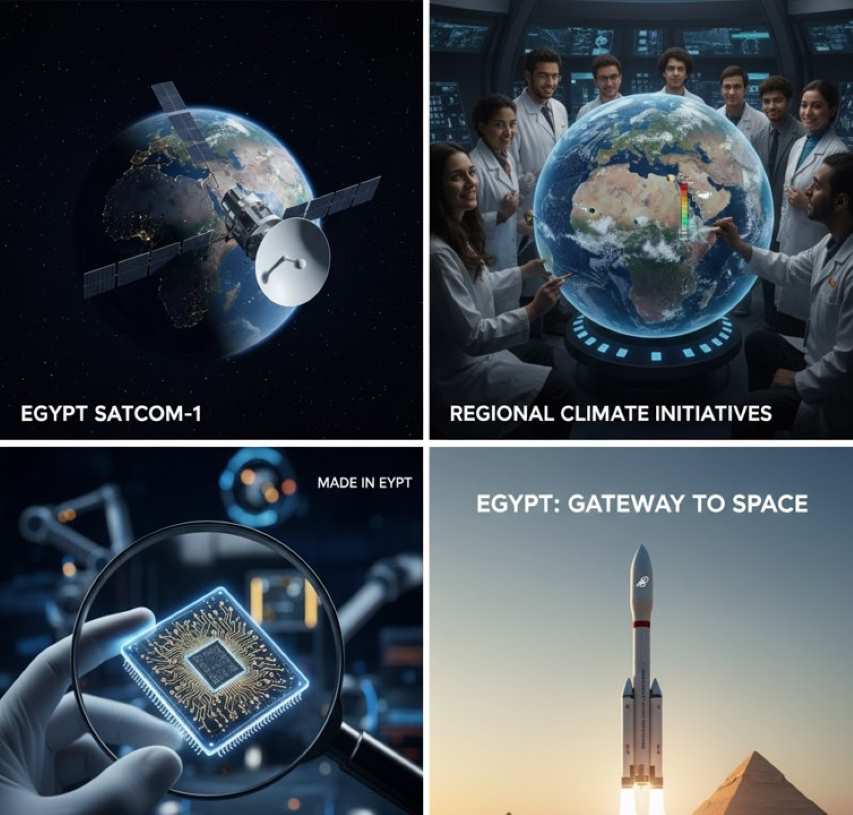
On December 10, 2025, Egypt reached a pivotal milestone in its aerospace journey with the successful launch of the SPNEX satellite. Deployed aboard China’s Lijian-1 Y11 carrier rocket, this mission marks Egypt's 15th satellite deployment and serves as a powerful testament to the nation’s growing autonomy in space manufacturing and research.
Core Mission and Objectives
Developed through a partnership between the Egyptian Space Agency (EgSA) and the Academy of Scientific Research and Technology (ASRT), SPNEX is designed to address two primary scientific goals during its two-year operational lifespan:
Climate Monitoring: Tracking the tangible impacts of climate change to provide localized environmental data.
Ionospheric Research: Studying variations in Earth's ionosphere and plasma behavior to improve communication and atmospheric understanding.
By generating its own high-resolution data, Egypt is significantly reducing its historical reliance on foreign information sources.
Technical Specifications & Domestic Development
The SPNEX project highlights Egypt’s transition from a satellite operator to a satellite manufacturer. Key technical details include:
Feature | Description |
|---|---|
Payload 1 | Plasma diagnostics system for ionospheric study. |
Payload 2 | Earth observation system with 10-meter panchromatic resolution. |
Applications | Disaster management, resource assessment, and environmental tracking. |
Manufacturing | Assembled and tested at Egypt’s domestic Assembly, Integration, and Testing (AIT) facility. |
This project follows the success of the NEXSAT-1 launched in 2024, representing a strategic effort to localize the entire design and assembly process.
Launch Execution
The launch took place at the Dongfeng Commercial Space Innovation Pilot Zone in China. The Lijian-1 Y11 rocket, manufactured by CAS Space, successfully delivered all nine of its payloads into orbit. Following the separation, the Egyptian Space Agency confirmed that SPNEX had begun transmitting signals, verifying the health of its onboard systems.
Strategic Impact for Egypt and Africa
The deployment of SPNEX carries weight beyond its scientific instruments:
Technological Sovereignty: By handling core functions in-house, Egypt is successfully minimizing its dependence on international contractors.
Regional Leadership: Egypt remains a dominant force in the African space sector. Of the 66 satellites launched by African nations to date, the vast majority have been led by Egypt, South Africa, Algeria, and Nigeria.
Regional Benefits: Data from SPNEX is expected to assist in tracking climate effects across the Nile Basin and monitoring disturbances that affect regional communication networks.
This mission sets a solid foundation for future Egyptian endeavors in telecommunications, navigation, and deep-space scientific exploration.
 |  |  |
 |  |  |